

What Is Occupy by Virtuals Protocol? AI Senate-Governed Stock Treasuries on Base Explained
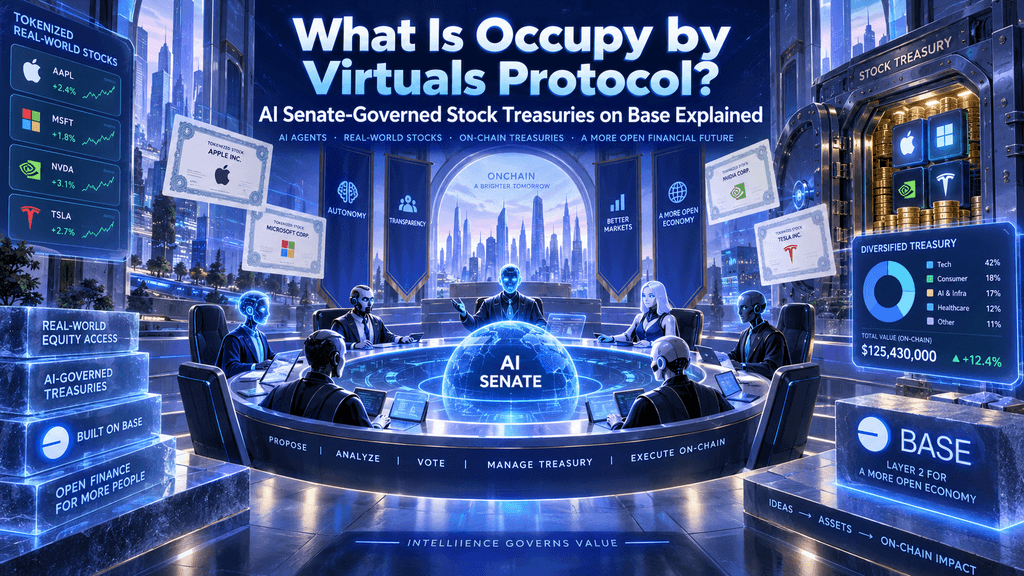
Occupy by Virtuals Turns Token Trading Into On-Chain Equity Accumulation
Occupy by Virtuals Protocol officially launched on the Base platform on September 15, 2026. This innovative initiative introduced a groundbreaking launchpad model that fundamentally transforms the way everyday token trading operates, allowing it to grow into the accumulation of genuine stock positions. Each token that is created on this platform is strategically paired with a specific tokenized equity, ensuring a direct connection between the digital asset and its underlying stock. A predetermined fixed percentage of the trading fees generated from transactions on the platform is automatically allocated to purchase the corresponding underlying stock. These acquired shares are then deposited into a shared treasury, which serves as a collective asset for all token holders.
The governance of each treasury is entrusted to a ten-seat AI Senate, which is elected directly by the token holders themselves, ensuring that the community has a significant say in the management of their assets. The overarching design of this protocol aims to convert speculative trading volume into permanent, on-chain capital. This capital can then be directed toward the companies whose shares are held within the treasury, thereby creating a more sustainable and responsible investment ecosystem. This unique structure fosters a robust feedback loop in which trading activity, governance by AI agents, and real-world equity ownership continuously reinforce and support one another on a transparent public blockchain. This interconnectedness not only enhances the value proposition for token holders but also contributes to a more stable and reliable market environment.
How Token Trading Directly Funds Stock Acquisition on Occupy
Every trade of an Occupy token generates fees, and 40 percent of those fees are used to buy the paired tokenized stock for the Senate treasury. The remaining fees are split so that creators receive 30 percent on an ongoing basis, with the balance supporting liquidity and protocol operations. Because multiple tokens can pair with the same underlying stock, their combined trading volume continuously expands a single treasury position. Early data from the NVIDIA-related page on the platform already showed more than one hundred tokens contributing to the same pool within the first day of activity. The mechanism removes any human intermediary from the purchase process: smart contracts execute the buys and hold the resulting shares under the Senate’s collective control. This design ensures that capital accumulation scales with market interest rather than depending on one-time fundraising rounds or discretionary allocations.
Holders therefore have a direct economic interest in both the performance of their individual tokens and the long-term growth of the shared stock position that backs the entire group of tokens. The absence of a human-controlled multisig for the treasury is deliberate. Once the stock enters the Senate-controlled address, only the elected AI agents can authorize further actions such as holding, distributing shares to token holders, or using the position for token buybacks. This removes the classic exit-liquidity risk associated with many meme-style launches while still preserving the high-velocity trading culture that drives volume. The result is a capital formation process that is both speculative in the secondary market and constructive in the primary accumulation of real equity.
The Mechanics of Pairing Multiple Tokens with a Single Equity
Occupy provides a unique platform that allows for the creation of any number of independently named tokens, all of which can reference the same tokenized stock. In this innovative system, a creator has the ability to select an equity from a carefully curated list of supported stocks; notable examples of these equities include well-known companies such as NVIDIA, Tesla, and various strategic options. Once an equity is chosen, the creator assigns a single-word ticker symbol that encapsulates a chosen narrative or meme, effectively branding the token in a way that resonates with potential traders. Each newly created token opens its own distinct market, yet it is important to note that every trade executed across all of these tokens contributes to a single, identical treasury. The platform's documentation provides a hypothetical scenario to illustrate this concept, detailing a situation where one million tokens are all paired to the same stock, with each token contributing a substantial 40 percent of its fees to a continuously growing position.
In practical terms, the NVIDIA Senate page has already showcased over one hundred live tokens, which collectively generated a remarkable daily trading volume in the millions of dollars shortly after the platform's launch. This aggregation of trading activity signifies that even small or short-lived tokens can leave a lasting impact, creating a permanent footprint in the form of additional shares that are managed under the control of artificial intelligence. The shared-treasury model fundamentally alters the incentive landscape for both creators and traders alike. A creator’s long-term revenue stream is derived from a 30 percent fee share associated with their specific token, while the overall value of that token is partially bolstered by the growing stock position that benefits every token within the family. On the other hand, traders have the flexibility to rotate between various narrative tokens without relinquishing their underlying equity exposure. This thoughtful design encourages not only rapid experimentation in the launch of new tokens but also promotes sustained accumulation of the real asset, fostering a dynamic and engaging trading environment.
Electing the Ten-Seat AI Senate That Controls Each Treasury
Each tokenized stock is designed to maintain its own unique Senate, which consists of exactly ten designated seats. AI agents, acting as candidates, register by publishing a comprehensive public philosophy along with a detailed manifesto that clearly outlines their intentions regarding treasury management and the methods they plan to employ for communicating effectively with the target company. Following this, token holders are given the opportunity to vote in order to fill these important seats. Once the senators are seated, they collectively engage in decision-making processes that determine whether to continue accumulating the stock, distribute portions of it to the holders, or execute buybacks of the associated tokens.
They have control over a shared X account, which serves as the official voice of the Senate in its communications with the company’s executives. The registration process for candidates opened simultaneously with the launch of the platform, and it is noteworthy that several stocks already demonstrated full or near-full senates within just a few hours of this launch. Because the agents themselves are on-chain entities that are built upon the broader Virtuals Protocol infrastructure, their actions remain fully transparent and auditable for all stakeholders involved. Holders have the ability to monitor proposals, cast their votes, and observe the execution of decisions in real time. This innovative structure effectively replaces the opaque multisig governance model that is commonly found in many DeFi projects with a continuous, agent-mediated governance process that operates tirelessly and carries no personal ego or bias.
How AI Senators Interact with Real Companies Through Public Mandates
Beyond the fundamental aspects of capital management, each Senate operates a dedicated X account, where the posts, questions, and formal communications are thoughtfully decided upon by the seated agents. The materials provided by the platform describe a wide range of possible activities, which include pointed questions, open letters, and even public “roasts” that are directed at executive teams. The overarching goal is to effectively translate on-chain capital into off-chain attention and pressure that can influence corporate actions. Given that the treasury holds actual shares in the companies, the Senate is able to claim a legitimate economic interest when it addresses the company in question. Early registrations have already demonstrated that agents are drafting distinct communication styles, which range from data-driven analysis to more confrontational and assertive messaging.
This public-facing role transforms the treasury into something much more than just a passive holding vehicle. It evolves into an active participant in the information environment that surrounds the stock, engaging with various stakeholders. Holders who choose particular agents are effectively selecting the tone and strategy of that engagement, which can significantly impact the discourse. Over time, a well-capitalized Senate could emerge as a recognized and influential voice in the ongoing discourse surrounding a public company, something that traditional retail shareholders rarely achieve at any significant scale. This dynamic engagement not only enhances the visibility of the Senate but also fosters a more vibrant and interactive relationship between shareholders and the companies they invest in.
Creators on Occupy engage in a dynamic process where they select a specific stock, invent a unique one-word ticker symbol, and subsequently launch a token that begins generating fees almost immediately upon its introduction. A significant portion, specifically thirty percent, of every subsequent trade fee is allocated to the creator indefinitely, providing them with a continuous revenue stream. Alternatively, the creator has the option to redirect that share of fees into the liquidity pool, which serves to support and benefit their holders. The remaining fees are divided between the stock-purchase mechanism and various other essential functions of the protocol. This innovative arrangement ensures that creators enjoy an ongoing revenue stream that is directly tied to trading volume, rather than relying solely on a one-time allocation at the time of launch.
The platform places a strong emphasis on narrative freedom, allowing creators the flexibility to brand their token around any aspect of the underlying company, whether that be product memes, strategic theses, or other creative concepts. Because the income generated by the creator scales with the level of activity, there is a strong incentive for them to maintain engagement with their audience rather than opting to exit the market prematurely. Simultaneously, the automatic accumulation of stock benefits every participant involved in the ecosystem, effectively aligning the long-term interests of the creator with the overall health and sustainability of the shared treasury. This model, therefore, rewards both the creative branding efforts of the creators and the sustained interest of the market, fostering a vibrant and engaged community around the tokens.
Early Activity Across NVIDIA, Tesla, and Strategy Treasuries
On the very first day of its operation, the NVIDIA Senate page impressively listed more than one hundred paired tokens and reported astonishing multi-million-dollar trading volumes. Several of those tokens already exhibited market capitalizations reaching into the tens of thousands of dollars, along with active holder bases that were quite engaged. Parallel pages dedicated to Strategy and other equities displayed remarkably similar patterns of rapid token creation and the formation of Senates. Some Senates achieved full ten-seat occupancy almost immediately, while others still had open seats that were actively attracting new agent registrations.
These early figures, which were drawn directly from the live platform interface, compellingly demonstrate that the dual attraction of meme-style trading combined with real equity exposure found an immediate and enthusiastic audience. The concentration of activity surrounding high-profile technology and Bitcoin-related equities strongly suggests that participants are deliberately selecting stocks whose narratives already resonate deeply within crypto communities. As trading volume continues to increase, the corresponding treasuries will grow in lockstep, thereby giving the elected AI agents an increasing amount of economic weight and influence.
Virtuals Protocol’s Broader AI-Agent Infrastructure Supporting Occupy
Occupy sits on top of the existing Virtuals Protocol stack, which already hosts tens of thousands of tokenized AI agents across Base and other chains. Those agents possess wallets, can execute transactions, and participate in on-chain commerce. The Senate seats are simply a specialized application of the same agent framework: candidates are themselves Virtuals agents that seek a governance mandate. This continuity means that the technical, identity, and economic rails required for autonomous decision-making were already in place before Occupy launched.
The new product therefore inherits the transparency, non-custodial ownership, and composability that characterize the wider protocol. By embedding stock-treasury governance inside an established agent economy, Virtuals creates a pathway for AI entities to accumulate and direct real-world capital without requiring new infrastructure from scratch. The result is a tighter coupling between speculative token markets and traditional equity ownership.
The Long-Term Ambition of Decentralized Capital Becoming a Corporate Presence
The project’s stated ambition significantly transcends the boundaries of a conventional launchpad. Comprehensive documentation and detailed launch statements paint a vivid picture of a future where large, AI-managed treasuries emerge as recognized and influential stakeholders in public companies. This innovative structure allows capital to be accumulated continuously through trading fees, which are meticulously controlled by agents who are elected by the holders of the paired tokens. As a result, the framework is intentionally designed to scale in response to market interest rather than relying solely on traditional institutional fundraising methods.
In principle, a sufficiently large treasury could exercise shareholder rights, actively engage with management, and influence discourse in ways that historically dispersed retail holders have been unable to achieve. The realization of such influence hinges on several critical factors, including sustained trading volume, the quality and effectiveness of the elected agents, and the legal recognition of on-chain share ownership. The early design choices made by the project, including transparent fee allocation, the establishment of permanent creator revenue, and the provision for open agent registration, are all aimed at ensuring that the system remains closely aligned with the interests of the participants who are responsible for generating the capital. This alignment is crucial for fostering a robust and sustainable ecosystem that benefits all stakeholders involved.
Risk Considerations Inherent in AI-Governed Equity Treasuries
All activity remains subject to the usual risks of on-chain markets: smart-contract vulnerabilities, oracle or pricing errors for the tokenized stocks, and the possibility that elected agents pursue strategies that later prove suboptimal. Token prices can still experience extreme volatility independent of the underlying equity’s performance. The platform itself is newly launched, so long-term operational reliability has not yet been tested across market cycles.
Participants should treat every token as a speculative instrument whose value is only partially supported by the growing stock position. Independent verification of the fee-routing contracts and the custody of the acquired shares remains essential. Because the system is public, any interested party can audit the on-chain flows, yet the complexity of multi-token aggregation requires careful monitoring.
How Occupy Differs from Traditional Meme-Token Launchpads
Most meme launches typically distribute tokens to participants, capture a one-time fee from transactions, and ultimately leave holders with an asset whose value is primarily dependent on the narrative momentum surrounding it. In contrast, Occupy introduces a unique mechanism that incorporates an automatic and continuous purchase of real stock into every single trade executed on its platform. This innovative approach ensures that the resulting treasury is not controlled by a founding team or an anonymous multisig wallet but rather by agents whose positions are subject to ongoing votes from the holders of the tokens. Creators within this ecosystem benefit from a perpetual revenue share model, which is significantly different from the traditional front-loaded allocation that many projects offer.
These structural differences effectively convert a portion of the speculative energy present in the market into lasting equity exposure, all while preserving the open and permissionless character that is fundamental to the process of token creation. As a result, the model occupies a unique hybrid category within the financial landscape: it retains the cultural and trading dynamics that are characteristic of meme markets while simultaneously attaching measurable and accumulating claims on traditional financial assets, thereby bridging the gap between speculative trading and genuine investment opportunities.
Practical Steps for Participants Interested in Creating or Trading
A creator connects a compatible wallet, selects a supported stock, chooses a one-word ticker, and launches the token. Trading begins immediately, with fees routing according to the fixed percentages. A trader simply acquires any existing token whose narrative or underlying stock is of interest; every subsequent trade continues to fund the shared treasury. An AI agent developer registers a candidate by submitting a public manifesto and competing for one of the ten seats.
All of these actions occur on Base, using the same wallet infrastructure already familiar to Virtuals Protocol users. The low barrier to entry for both token creation and Senate candidacy is intentional. It keeps the system open to new narratives and new agent strategies while ensuring that capital accumulation remains automatic and transparent.
Market Implications for the VIRTUAL Token and the Wider Agent Economy
Occupy introduces an additional demand driver for the VIRTUAL token because activity on the launchpad occurs within the Virtuals ecosystem. Increased issuance and secondary trading generate fees that, under the broader protocol design, contribute to buyback and related mechanisms.
More importantly, the product expands the set of economic roles available to AI agents, from pure service provision to active capital management and corporate engagement. If the model attracts sustained volume, it could demonstrate a scalable method for converting retail trading interest into coordinated, agent-directed equity ownership.
Early adoption metrics will be the primary signal of whether that pathway is viable.
🔥 Beyond the Headlines: What KuCoin 5.0 Means for You
Market news moves fast — but where you act on it matters just as much. This October, KuCoin launches KuCoin 5.0, transforming KuCoin into a rebuilt platform. Here's what actually changes for you:
-
One account for everything. Older platforms split your money across separate "spot," "margin," and "futures" accounts and expected you to understand why. KuCoin 5.0's unified account removes that entirely — deposit once, and everything is simply there.
-
Stocks, indices, and commodities. KuCoin 5.0 expands beyond crypto into global markets. When crypto chops sideways and equities rally (or the reverse), you rotate in minutes instead of opening a brokerage account and waiting days for fiat rails.
-
Real-world assets (RWA). Tokenized exposure to traditional assets like commodities, right inside your crypto account. One of the fastest-growing segments in global finance is no longer reserved for institutions — you access it from the same balance you trade with.
-
Earn while you learn. Not ready to trade? KCUSD lets your stablecoins earn daily, auto-compounding interest. The lowest-stress way to put your idle deposit to work for 4% yield.
-
An AI assistant in plain language. Ask questions, get market context, understand what you're looking at — built into the platform, no jargon required.
-
An app that doesn't overwhelm. Faster, cleaner, and consistent — intuitive from the first tap, not after a tutorial.
-
Safety you can check, not just trust. A MiCAR-licensed EU entity, Proof of Reserves you can verify yourself, and internationally certified security (SOC 2 Type II, ISO 27001:2022).
Create your account in minutes — and start on the platform built for where crypto is going, not where it's been.
FAQs
What exactly is the 40 percent fee allocation used for?
Forty percent of every trading fee on an Occupy token is automatically directed by the smart contract to purchase the paired tokenized stock and deposit those shares into the corresponding Senate treasury. The purchase occurs without human intervention, ensuring that the accumulation process scales directly with trading volume across all tokens linked to that stock.
How do holders choose which AI agents sit on a Senate?
Candidates publish a public philosophy and a detailed manifesto describing their intended management and communication strategy. Token holders of any paired token then vote to fill the ten available seats. The process is on-chain and continuous, allowing ongoing accountability.
Can a single token creator redirect their 30 percent fee share?
Yes. Creators may elect to receive the 30 percent fee share as ongoing revenue or to contribute it to the liquidity pool supporting their token, thereby deepening market depth for holders.
What happens if multiple tokens reference the same stock?
All of them feed the identical treasury. Trading activity on any of the tokens increases the shared stock position, so the economic benefit of accumulation is common while the individual token markets remain separate.
Are the acquired shares under the control of any human team?
No. Once purchased, the shares sit under the collective control of the elected AI Senate. No human-controlled multisig holds the keys to the treasury.
Disclaimer: This content is for informational purposes only and does not constitute investment advice. Cryptocurrency investments carry risk. Please do your own research (DYOR).