

NVNM Chain Tokenomics Explained: 19% Initial Circulating Supply and Token Allocation
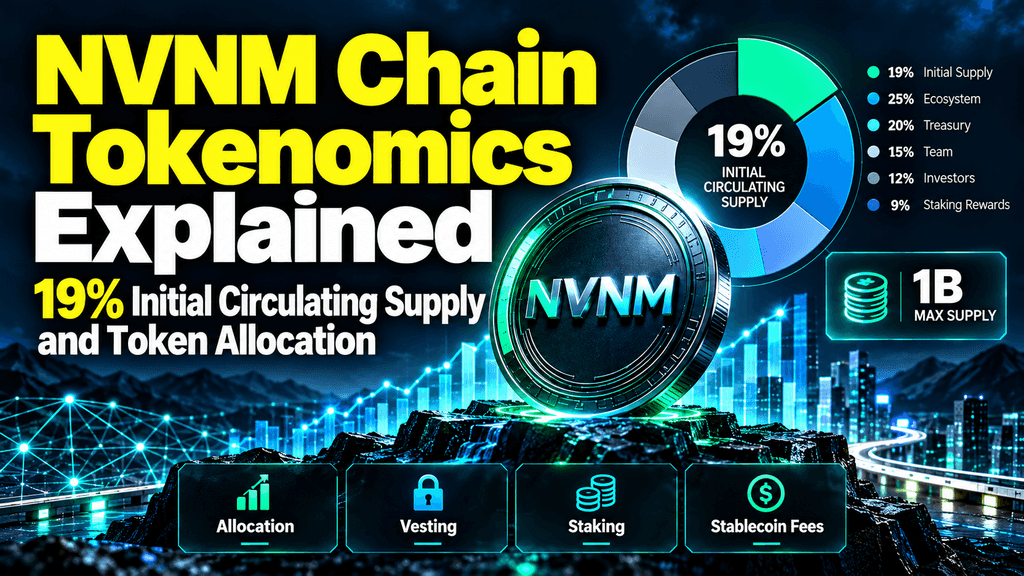
NVNM Chain has outlined its tokenomics model, setting a maximum supply of 1 billion NVNM tokens, with approximately 19%, or 190 million tokens, expected to circulate at launch. The distribution reserves the largest share for ecosystem partnerships and adoption, while team and investor allocations will remain locked during the initial launch period. Highlighted in news coverage on October 13, 2026, the model includes multi-year vesting schedules, stablecoin-based network fees, validator staking, and a proposed token repurchase mechanism. These arrangements are intended to support network development while controlling how additional tokens become available. However, actual liquidity, future unlocks, and network adoption remain important considerations for investors evaluating NVNM's token economics.
NVNM Chain Tokenomics Explained and How the 19% Initial Circulating Supply Works
NVNM Chain's tokenomics establish how its total supply will be distributed among network participants, developers, investors, and ecosystem programs. According to the project's official tokenomics announcement, published on September 16, 2026, the distribution model combines a planned fixed supply with gradual token releases and participation-based incentives. Team and investor allocations are scheduled to remain locked at launch, while separate reserves support early liquidity and ecosystem activity. The network's economic design also distinguishes NVNM's staking and governance functions from everyday transaction payments, which are denominated in stablecoins.
The proposed supply framework does not include ongoing token issuance to fund validator compensation. Instead, the project intends to support network operations through transaction revenue and existing token allocations. Although the whitepaper describes a maximum supply that cannot increase, the documented ERC-20 implementation includes authorized upgrade functionality that could change contract behavior in the future. The published supply restrictions should therefore be understood alongside those technical controls.
How Is NVNM's 19% Initial Circulating Supply Calculated?
The projected initial circulating supply consists of three allocations. The public sale accounts for 10%, or 100 million NVNM tokens, while liquidity provisioning represents another 5%, equivalent to 50 million tokens. An additional 4%, or 40 million tokens, is designated for ecosystem partners and will be delivered in staked form. Together, these allocations represent 190 million NVNM tokens, leaving approximately 810 million tokens outside the reported initial circulation. Each percentage is calculated against the project's maximum supply rather than the number of tokens immediately available for trading.
The distribution is intended to provide liquidity and support early network participation without releasing all reserved tokens at once. The public sale and liquidity allocations are scheduled to be fully unlocked at launch, while other categories remain subject to their respective restrictions. The model also includes a 1.5% Foundation operating tranche, equivalent to 15 million tokens, that is unlocked for operational purposes but excluded from reported circulating supply until deployed. Its eventual deployment could increase reported circulation without changing the number of tokens issued.
What Does the 19% Circulating Supply Mean for NVNM Liquidity?
Although 190 million NVNM tokens are expected to count toward initial circulation, circulating supply does not necessarily equal freely tradable supply. The 40 million tokens allocated to initial ecosystem partners will be delivered staked, while the 50 million reserved for liquidity provisioning may be used in exchange liquidity and market-making arrangements. Consequently, the actual tradable supply could differ from the reported circulation figure, depending on how these tokens are distributed and used. Exchange liquidity will also depend on available order-book depth, trading venues, and participation from market makers.
The limited initial circulation may restrict the amount of supply entering the market at launch, but it does not guarantee price stability or strong demand. Market conditions will depend on trading activity, token-holder behavior, staking participation, and the availability of buyers and sellers. Future releases from reserved allocations could increase circulating supply, potentially changing the balance between available tokens and market demand. However, scheduled unlocks do not automatically lead to selling, as recipients may choose to retain or stake their holdings. The 19% figure should therefore be viewed as a planned starting point rather than a prediction of NVNM's market performance.
How Is NVNM's 1 Billion Token Supply Allocated?
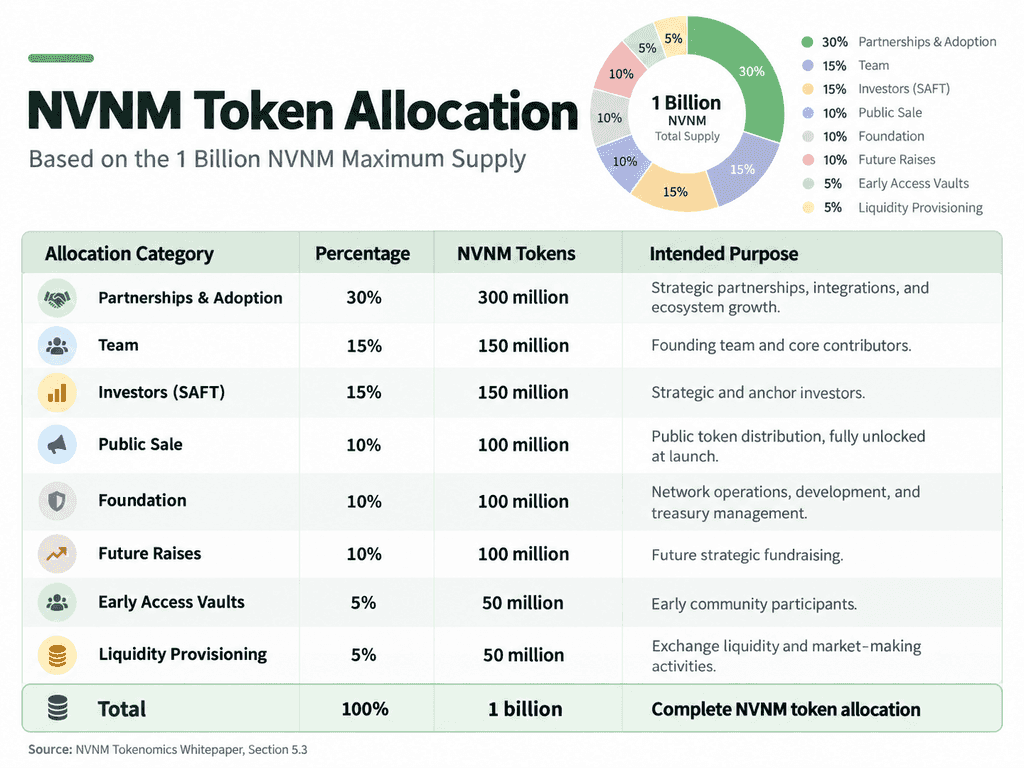
NVNM Chain divides its 1 billion-token supply into eight allocation categories covering ecosystem expansion, project development, investors, community participation, and market liquidity. The largest share is reserved for partnerships and adoption, reflecting the project's emphasis on attracting institutional users, integrating applications, and supporting network activity. Other allocations provide resources for the development team, strategic investors, Foundation operations, and future fundraising. Dedicated reserves also support public participation and early community contributors. Each category has a distinct purpose under the project's published economic framework.
NVNM Token Allocation Breakdown
The following table shows how the complete NVNM supply is distributed across its eight categories.
Source: NVNM Tokenomics Whitepaper
Which NVNM Allocations Support Ecosystem Growth?
Partnerships and Adoption receives 30% of the total supply, making it the largest individual allocation. These 300 million tokens are intended to fund strategic partnerships, technical integrations, and ecosystem programs that encourage network adoption. The NVNM Foundation oversees their deployment under a published policy tied to demonstrated network usage. This means distribution is intended to support specific participation and development activities rather than provide unrestricted tokens to partners.
The Foundation and Future Raises categories each receive another 10% of the supply, serving different financial and operational purposes. The Foundation reserve supports network stewardship, ongoing operations, and ecosystem programs, while Future Raises provides capacity for additional strategic financing under a published mandate. Meanwhile, the 5% Early Access Vaults allocation is designated for participants who committed assets through the project's pre-launch community initiative. These reserves establish separate funding channels for operations, community engagement, and future development without requiring additional token issuance under the proposed economic model.
How Much NVNM Is Allocated to the Team and Investors?
The founding team and strategic investors each receive 15% of the total NVNM supply, representing a combined allocation of 300 million tokens. The team reserve is intended to compensate founding members and core contributors responsible for building and maintaining the ecosystem. The investor allocation covers strategic and anchor participants involved in the project's Simple Agreement for Future Tokens (SAFT) arrangements. Together, these categories account for nearly one-third of the total supply, making their distribution an important consideration when assessing long-term token ownership.
The allocation percentages also show how NVNM's supply is divided between operational reserves, project stakeholders, and broader ecosystem participation. However, a token allocation does not establish how many tokens each individual recipient ultimately owns or controls. The published breakdown does not provide a complete holder-level distribution, making it difficult to independently assess future ownership concentration. The allocation structure identifies where tokens are reserved, but actual distribution and ownership will depend on implementation. This distinction matters when evaluating how the project's governance and economic participation may develop.
NVNM Token Unlock Schedule and Team and Investor Vesting
NVNM Chain's token unlock schedule outlines how reserved tokens are planned to become available over a 48-month period following the token generation event (TGE). The project uses different lockup periods and linear vesting arrangements to manage the timing of token releases. Rather than making large allocations available at once, the published model spreads distributions across several years, with certain categories subject to additional conditions. Scheduled releases follow a monthly calendar, avoiding a single large distribution when a cliff period expires. However, the actual effect of these releases will depend on market demand, available liquidity, and how recipients manage their holdings.
When Will the NVNM Team and Investor Tokens Unlock?
Under the September 2026 tokenomics whitepaper, team and investor allocations are subject to an initial 12-month lockup period. After this period, team tokens are scheduled to vest linearly over 36 months, while investor tokens will vest over 24 months. Linear vesting means tokens become available gradually throughout the specified period rather than being released in a single distribution. The different schedules are intended to align project contributors and financial backers with longer-term network development.
Foundation tokens have a three-month cliff followed by 24 months of vesting, subject to the separate initial operating tranche. Future Raises tokens remain locked for 24 months before vesting over another 24 months. Early Access Vault tokens follow a 12-month lockup and 12-month vesting period. Partnerships and Adoption tokens have no fixed cliff and follow a 36-month, usage-dependent distribution schedule, meaning actual releases are conditional on qualifying network activity. All periods are measured from the token generation event rather than fixed calendar dates, and the published schedule remains subject to the project's final distribution conditions.
When Will NVNM Token Unlocks Reach Their Peak?
According to the project's published release model, months 13 through 24 are expected to experience the highest concentration of scheduled token unlocks. During this period, the average release rate is projected to reach approximately 2.5% of maximum supply per month, equivalent to around 25 million NVNM tokens. This increase coincides with the beginning of team and investor vesting, alongside continuing releases from other eligible categories. Token availability is expected to expand more gradually afterward as individual vesting programs approach their scheduled completion.
The timing of these releases could influence NVNM's future market liquidity, particularly if newly unlocked tokens become available faster than trading demand grows. However, token unlocking does not automatically mean token selling, since recipients may retain their holdings or use them for network participation. The market impact will also depend on trading depth, staking activity, and overall investor sentiment when releases occur. Because a confirmed token generation date was not established in the documentation reviewed as of October 15, 2026, these milestones should be interpreted as relative periods rather than fixed calendar dates. Monitoring the finalized release schedule and actual circulating supply will be important for assessing potential changes in token availability.
NVNM Staking, Stablecoin Fees, Token Buybacks, and Key Risks
NVNM Chain's economic model connects token utility with network participation, transaction fees, and a proposed revenue-funded repurchase mechanism. Unlike blockchains that require their native tokens for transaction fees, NVNM Chain is designed to charge fees in stablecoins while using NVNM for staking, access benefits, and governance. The project also plans to compensate validators through network revenue rather than newly issued tokens. These arrangements aim to support network operations without relying on continuous token inflation, although their effectiveness will depend on adoption and actual fee generation.
How Does NVNM Staking Support Network Participation?
NVNM staking is designed to provide several benefits, including potential transaction fee discounts, higher usage limits, priority processing, and verified network participation status. Participants may also stake NVNM to support identity reputation, demonstrate confidence in datasets, or provide performance bonds for certain activities. Under the proposed initial proof-of-authority model, validator operators must acquire and bond at least 1 million NVNM tokens to qualify for validator positions. The validator share of network fees will initially accumulate in an on-chain Lockbox rather than being paid immediately. Distribution can begin only after non-affiliated operators control more than half the validator set and the validators approve the release through a vote. Broader delegated staking is planned for a later development phase, but general staking reward rates and participation parameters have not been finalized.
Why Does NVNM Chain Charge Transaction Fees in Stablecoins?
NVNM Chain separates transaction payments from its participation token to reduce the need for users to hold NVNM for routine network activity. Gas, attestation, provenance, and marketplace fees are designed to be paid in stablecoins, giving institutions and applications costs denominated in relatively stable assets rather than a potentially volatile cryptocurrency. The current Layer 1 documentation identifies nUSD as the default transaction fee token, with support for other eligible stablecoins under specified conditions. Network fees are intended to support validator compensation, protocol development, and token repurchases. This structure may improve cost predictability, although transaction expenses can still vary with network demand, fee settings, and the ability of supported stablecoins to maintain their intended pegs.
How Does the NVNM Token Buyback Mechanism Work?
The proposed NVNM token buyback mechanism allocates at least 20% of network fee revenue to programmatic repurchases, linking part of the token's economic model to network activity. According to the project's published tokenomics, the mechanism is intended to operate from the first block that generates network revenue, independently of the conditions governing validator payments. Repurchased tokens would be transferred to a publicly declared address and permanently withdrawn from available circulation. This arrangement differs from conventional token burning because the documented ERC-20 implementation does not currently include a burn function. The scale of future repurchases will depend on actual network revenue, and removing tokens from available circulation does not guarantee an increase in NVNM's market price.
What Are the Main Risks of NVNM's Tokenomics Model?
Despite its proposed economic safeguards, NVNM faces risks related to network adoption, revenue generation, token liquidity, and implementation. Limited transaction activity could reduce the funds available for repurchases and validator compensation, while weak demand may affect the token's market performance. Governance and contract controls also deserve attention because the project's official ERC-20 documentation describes an upgradeable implementation with a global transfer-pause function. Although the current implementation has no additional minting, burning, or token-seizure functions, authorized upgrades could introduce different capabilities in the future. The documentation also lists Ethereum and Base mainnet token deployments as pending as of October 15, 2026. Investors should therefore distinguish the published economic design from mechanisms already operating in a live token market.
Conclusion
NVNM Chain's tokenomics model outlines a structured approach to distributing its 1 billion NVNM tokens, beginning with a projected 19% circulating supply at launch. The allocation plan prioritizes ecosystem partnerships, while multi-year vesting schedules determine when team, investor, and other reserved tokens become available. Stablecoin transaction fees, staking utility, and revenue-funded repurchases form the basis of the project's proposed economic structure. However, the long-term effectiveness of these mechanisms will depend on network adoption, actual trading liquidity, and implementation of the published tokenomics. Future token unlocks, validator participation, and fee revenue will be important factors to monitor as NVNM Chain progresses toward its planned token launch. The announced figures provide a framework for assessing token distribution, but they should not be treated as guarantees of future market performance.
FAQs
Is NVNM Chain a Layer 1 or Layer 2 blockchain?
NVNM Chain's updated September 2026 whitepaper describes it as a sovereign Layer 1 blockchain designed for AI-agent accountability and verifiable institutional data. Earlier versions operated as Layer 2 infrastructure connected to MANTRA Chain. The newer architecture uses its own validator network and consensus system, allowing it to operate independently.
Is NVNM replacing the MANTRA token?
No. NVNM and MANTRA are separate cryptocurrency tokens with different intended purposes. MANTRA holders were offered an optional early-access program allowing eligible participants to contribute to MANTRA in exchange for future NVNM allocations. Participation does not represent a mandatory token migration, and the program does not mean MANTRA is being discontinued.
Who can participate in the NVNM Early Access program?
The NVNM Early Access initiative targets eligible MANTRA token holders, with its contribution portal specifying participation through MANTRA EVM. Eligible participants can contribute assets under the applicable campaign terms in exchange for future NVNM allocations. Participation is optional and subject to eligibility requirements, contribution limits, and lockup conditions. Applicants should confirm the latest terms and campaign status through official channels.
Where can investors verify the official NVNM token contract?
Investors should verify contract addresses through NVNM Chain's official technical documentation and recognized blockchain explorers. As of October 15, 2026, the documentation lists a live Ethereum Sepolia testnet deployment, while Ethereum and Base mainnet deployments remain pending. The Sepolia tokens have no monetary value, and unrelated assets using the NVNM ticker should not be assumed to represent the official project.
Can NVNM's fixed token supply be changed?
The published ERC-20 implementation creates an initial supply of 1 billion tokens without providing additional minting functionality. However, NVNM uses an upgradeable smart contract, meaning authorized administrators could introduce different functionality through a future upgrade. Investors should distinguish the project's stated fixed-supply policy from the technical powers available to contract administrators.
Disclaimer: This article is for informational purposes only and does not constitute investment advice. Crypto assets can be highly volatile, and market conditions, token liquidity and project developments may change rapidly. Readers should conduct their own research and assess their risk tolerance before making financial decisions.