

How Will Middle East Conflict Impact Global Markets and Crypto in 2026?
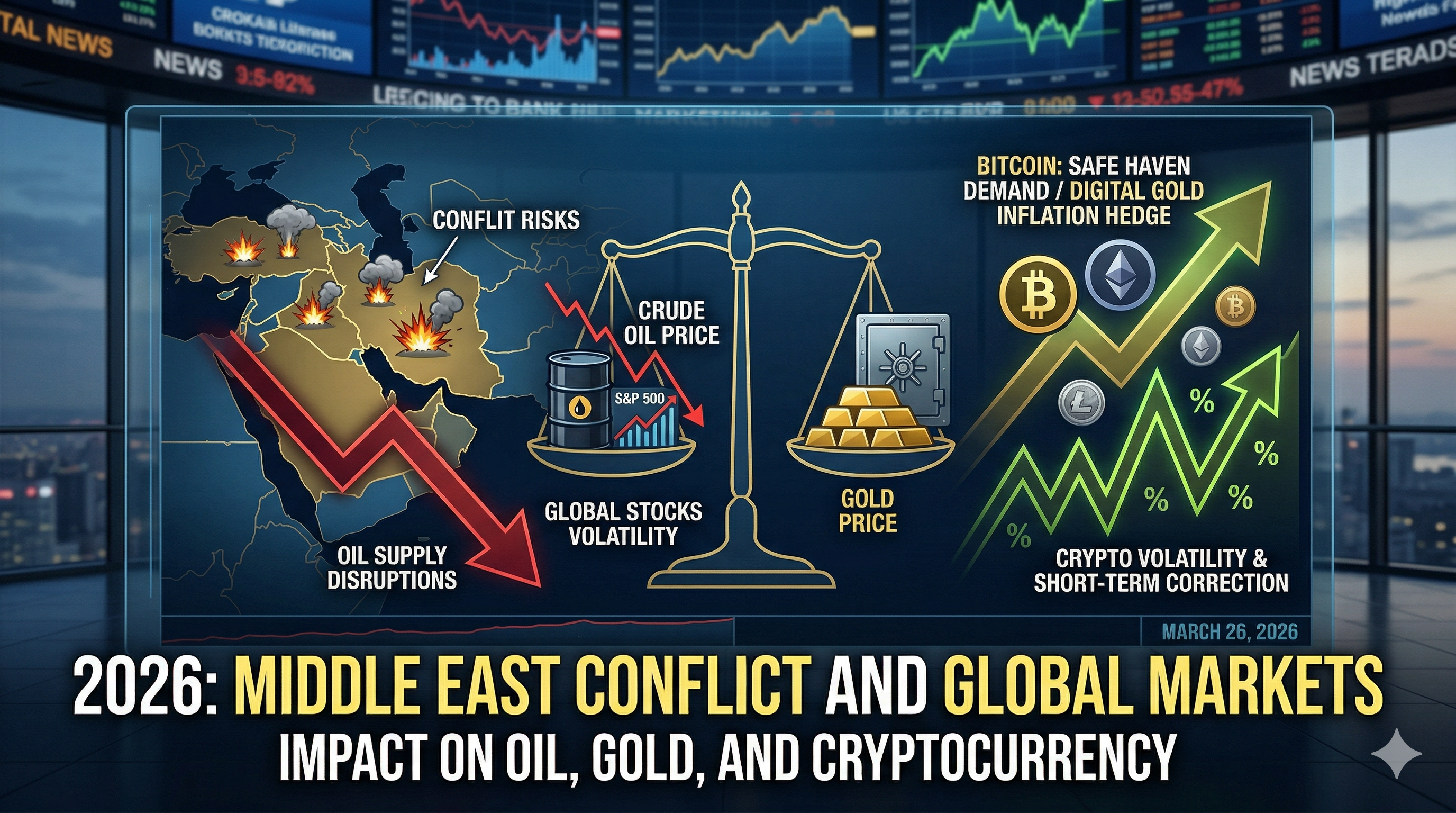
Geopolitical tensions have always shaped global financial markets, but in 2026, renewed conflict in the Middle East is once again testing the resilience of both traditional and digital assets. Escalating friction involving Iran, regional powers, and Western allies has heightened uncertainty across energy markets, disrupted trade flows, and intensified inflationary pressures. These developments are not occurring in isolation, they are feeding directly into macroeconomic conditions that influence equities, commodities, currencies, and increasingly, cryptocurrencies.
As of March 2026, Bitcoin continues to trade in the $69,000–$70,000 range, with total crypto market capitalization near $2.5 trillion and Bitcoin dominance hovering around 58–59% per Coinmarketcap. Despite global uncertainty, crypto markets have demonstrated relative resilience compared to equities, supported by institutional participation, strong network fundamentals, and growing recognition of Bitcoin as a macro-relevant asset.
This raises a fundamental question: how exactly does Middle East conflict impact global markets and crypto in 2026? The answer lies in understanding the transmission mechanisms between geopolitical risk, energy prices, inflation, monetary policy, and investor behavior. This article provides a comprehensive, data-driven analysis of these dynamics, offering insights for both beginners and experienced market participants navigating volatile conditions.
Understanding Geopolitical Risk and Energy Dependence
The Middle East remains central to the global energy system, making it a focal point for geopolitical risk. A critical component of this system is the Strait of Hormuz, a narrow shipping lane through which approximately 20% of global petroleum liquids consumption passes daily. Any disruption to this chokepoint can have immediate and far-reaching consequences for global markets.
In 2026, tensions have escalated to a level where supply disruptions are no longer hypothetical. Reports indicate that oil prices surged above $100 per barrel amid fears of export interruptions and infrastructure attacks. Additional coverage confirms that prices have risen significantly following strikes on production facilities, reinforcing concerns about sustained supply constraints.
These developments highlight the sensitivity of energy markets to geopolitical events. Even the perception of risk can drive speculative trading, amplifying price movements and volatility. For the global economy, rising energy prices translate into higher costs for transportation, manufacturing, and production, feeding directly into inflation.
Geopolitical risk also influences investor psychology. During periods of uncertainty, capital typically flows into safe-haven assets such as gold, government bonds, and the U.S. dollar. However, Bitcoin is increasingly being included in this category, particularly among institutional investors seeking alternatives to traditional stores of value.
Energy Shock, Inflation, and Monetary Policy
Rising oil prices contribute directly to inflation. Higher fuel costs increase transportation expenses, which in turn raise the price of goods and services. According to macroeconomic analysis, prolonged energy disruptions could add up to 0.5%–0.8% to global inflation rates, complicating central bank policy decisions.
Central banks face a difficult balancing act in this environment. On one hand, they must control inflation to maintain economic stability. On the other, aggressive rate hikes can slow economic growth. In 2026, this tension is particularly pronounced, as policymakers weigh the risks of persistent inflation against the need to support fragile economies.
For financial markets, monetary policy decisions have a direct impact on liquidity. Higher interest rates reduce the availability of capital, which tends to pressure risk assets such as equities and cryptocurrencies. Conversely, expectations of future rate cuts or monetary easing can support asset prices by increasing liquidity.
Impact on Global Financial Markets
Equities and Risk Sentiment
Equity markets are highly sensitive to geopolitical developments, particularly when they affect energy prices and economic growth. In 2026, rising oil prices and inflation concerns have contributed to increased volatility in global stock markets. Sectors such as technology and consumer discretionary, which are sensitive to interest rates and economic conditions, have faced downward pressure.
At the same time, energy and defense sectors have outperformed, benefiting from higher commodity prices and increased government spending. This divergence highlights the importance of sector-specific analysis during periods of geopolitical stress.
Bond Markets and Safe-Haven Demand
Bond markets typically experience increased demand during geopolitical crises, as investors seek stability. This demand can drive yields lower in the short term. However, inflation concerns complicate this dynamic. Rising inflation expectations can push yields higher, creating conflicting forces within bond markets.
Currency Markets
Currency markets also reflect geopolitical dynamics. The U.S. dollar often strengthens during periods of uncertainty due to its status as the world’s primary reserve currency. Emerging market currencies, particularly those dependent on energy imports, may weaken significantly.
For crypto markets, currency instability can act as a catalyst for adoption. In regions experiencing currency devaluation or capital controls, cryptocurrencies offer an alternative means of storing and transferring value.
Cryptocurrency Markets: Evolution Under Pressure
Bitcoin as a Macro Asset
Bitcoin’s performance during the 2026 conflict reflects its dynamic role in global finance. Initially, Bitcoin tends to move in tandem with equities during risk-off events, declining as investors reduce exposure to volatile assets. However, it often recovers more quickly as macro narratives shift toward inflation and monetary instability.
Recent analysis shows that Bitcoin rebounded faster than traditional markets following geopolitical shocks, supported by institutional demand and long-term positioning. This suggests that Bitcoin is increasingly viewed as a hybrid asset, combining characteristics of both a risk asset and a store of value.
Stablecoins and Liquidity Flows
Stablecoins play a critical role during periods of volatility, providing a bridge between fiat and crypto markets. They enable rapid capital movement, allowing investors to exit volatile positions without leaving the crypto ecosystem.
Stablecoin usage tends to increase during periods of financial instability, particularly in regions facing currency restrictions or capital controls. This trend highlights the practical utility of crypto beyond speculation.
Altcoins and Market Rotation
Altcoins typically experience higher volatility during geopolitical events. Risk-off sentiment often leads to capital rotation into Bitcoin and stablecoins, reducing liquidity in smaller assets. This dynamic reinforces Bitcoin dominance during periods of uncertainty.
Stablecoins, Sanctions, and Financial Access
Geopolitical conflicts often lead to sanctions, trade restrictions, and limitations on traditional financial systems, making access to global markets more difficult for individuals, corporations, and even entire nations. In such environments, stablecoins, digital assets pegged to fiat currencies like the U.S. dollar or the euro, emerge as a practical alternative. Their value stability, compared to highly volatile cryptocurrencies, allows users to preserve purchasing power while still participating in global financial activity. During crises, this functionality becomes particularly crucial, enabling businesses to continue cross-border trade, individuals to remit funds, and investors to hedge against local currency devaluation.
One of the most significant advantages of stablecoins in times of geopolitical tension is their ability to facilitate cross-border transactions without relying on traditional banking intermediaries. Conventional financial channels often face delays, high fees, or outright blockage due to sanctions or political restrictions. Stablecoins, operating on decentralized blockchain networks, bypass these limitations, offering near-instantaneous transfers that can occur around the clock. This accessibility is especially important for regions experiencing restricted banking operations or for populations facing limited access to foreign currencies. In addition, smart contract technology enables programmable payments, escrow services, and automated settlements, further enhancing their utility for both commercial and personal financial needs.
Moreover, stablecoins provide an avenue for liquidity in otherwise constrained markets. Traders and investors can quickly move assets into stablecoins to avoid exposure to volatile local currencies or to mitigate risks during market shocks. They also act as a bridge between traditional financial markets and the rapidly growing crypto ecosystem, enabling smoother interactions between fiat assets and decentralized financial protocols. This dual functionality increases their appeal not only to individual users but also to institutional investors, who seek secure, efficient, and scalable solutions for capital mobility across borders.
However, as their adoption grows, stablecoins are increasingly drawing regulatory attention. Governments and financial authorities are closely monitoring stablecoin activity, particularly in relation to anti-money laundering (AML) compliance and sanctions enforcement. The anonymity and borderless nature of digital transactions make them potentially attractive for illicit activities if left unchecked. As a result, regulators are actively exploring frameworks to ensure that stablecoins operate within legal boundaries while still preserving their benefits for legitimate users. In 2026, the evolution of these regulatory frameworks will play a decisive role in determining how stablecoins integrate into the broader financial system. Future legislation may impose stricter issuance requirements, transparency standards, or compliance protocols, which could influence user adoption and the operational models of stablecoin platforms.
Stablecoins have emerged as an indispensable tool during geopolitical crises, offering speed, accessibility, and liquidity that traditional financial systems may struggle to provide. Their continued adoption hinges not only on technological innovation but also on regulatory developments that balance security with usability. For users and investors alike, understanding both the advantages and regulatory implications of stablecoins will be essential for navigating the increasingly complex landscape of global finance.
Bitcoin Mining and Energy Economics
Rising energy prices have implications for Bitcoin mining, which is an energy-intensive process. According to reports, energy costs are expected to remain elevated due to geopolitical uncertainty.
Higher energy costs can reduce mining profitability, particularly for smaller operators. However, the global distribution of mining operations and the use of diverse energy sources help mitigate these effects. Additionally, higher Bitcoin prices can offset increased costs, maintaining network stability.
DeFi and Decentralized Alternatives
Decentralized finance (DeFi) offers an alternative to traditional financial systems, particularly during periods of geopolitical instability. In regions where banking infrastructure becomes unreliable or access to capital is restricted, DeFi protocols can continue operating without interruption because they are built on decentralized blockchain networks. This resilience makes DeFi especially attractive in times of currency devaluation, capital controls, or political uncertainty, where individuals and businesses seek ways to preserve value and maintain financial autonomy.
DeFi platforms enable lending, borrowing, and trading without reliance on centralized institutions such as banks or brokers. Instead, these functions are executed through smart contracts, self-executing code that operates transparently on the blockchain. Users can earn yield by providing liquidity to decentralized exchanges, stake assets for rewards, or use their crypto holdings as collateral to access loans instantly. This removes many of the barriers associated with traditional finance, such as credit checks, paperwork, and geographic limitations, opening up financial services to a global audience.
Major advantage of DeFi is its permissionless nature. Anyone with an internet connection and a crypto wallet can participate, regardless of location or socioeconomic status. This has significant implications for financial inclusion, particularly in underbanked regions where access to traditional banking services is limited. Additionally, DeFi platforms often offer higher yields compared to conventional savings accounts, driven by market demand for liquidity and the efficiency of automated systems.
However, while DeFi provides increased accessibility and censorship resistance, it also carries substantial risks that cannot be overlooked. Smart contract vulnerabilities remain one of the biggest concerns. Since these contracts are immutable once deployed, any bugs or exploits can lead to significant financial losses. High-profile hacks and protocol failures have demonstrated that even well-audited platforms are not immune to security breaches. As a result, users must carefully evaluate the credibility, audit history, and track record of any protocol before committing funds.
Liquidity constraints also present challenges, particularly during periods of market stress. In highly volatile conditions, liquidity can dry up quickly, leading to slippage, failed transactions, or forced liquidations for borrowers. This is especially relevant in leveraged positions, where sudden price movements can trigger automatic sell-offs, amplifying losses. Additionally, the interconnected nature of DeFi protocols means that failures in one platform can cascade across the ecosystem, creating systemic risks.
Regulatory uncertainty is another factor shaping the DeFi landscape. Governments and financial authorities are increasingly scrutinizing decentralized platforms, and future regulations could impact accessibility, compliance requirements, and overall market dynamics. While DeFi was designed to operate without centralized oversight, evolving legal frameworks may influence how these platforms are used and who can access them.
Ultimately, users should approach DeFi with caution and conduct thorough due diligence. This includes understanding how a protocol works, assessing risk exposure, diversifying across platforms, and avoiding over-leveraging. While DeFi presents powerful opportunities for financial independence and innovation, it requires a level of responsibility and awareness that goes beyond traditional financial systems.
Investor Behavior and Market Psychology
Investor psychology plays a significant role during geopolitical crises, often amplifying market volatility beyond what fundamental economic factors alone might suggest. When news of conflict, sanctions, or political instability emerges, fear and uncertainty can drive rapid, sometimes irrational, decision-making. Panic selling is a common reaction as investors rush to liquidate positions, seeking safety in cash or perceived low-risk assets. This behavior can exacerbate market declines, creating self-reinforcing downward spirals that affect both traditional equities and digital assets like cryptocurrencies. Similarly, when markets recover or show signs of stabilization, a wave of optimism or FOMO (fear of missing out) can prompt investors to jump back in hastily, often at inflated prices. These emotional swings underscore the importance of understanding the psychological factors that influence investment behavior during turbulent times.
Behavioral finance studies reveal that humans are predisposed to cognitive biases that can cloud judgment, especially under stress. For instance, loss aversion, the tendency to feel losses more intensely than equivalent gains, often causes investors to sell too quickly during crises. Confirmation bias may lead individuals to focus on information that supports their fears, ignoring signals that indicate recovery or stability. Herd mentality can further compound market movements, as people follow the actions of others without fully analyzing underlying fundamentals. Recognizing these tendencies can empower investors to approach decisions more strategically, mitigating the impact of short-term emotional impulses.
Maintaining a long-term perspective is one of the most effective strategies for navigating these challenges. Investors who focus on fundamental value, such as the financial health of a company or the underlying utility of a cryptocurrency, are better equipped to withstand market turbulence. Diversification across asset classes and geographies also reduces exposure to localized geopolitical risks, providing a buffer against sudden market shocks. Additionally, employing risk management techniques, such as setting stop-loss orders, using position sizing, and regularly reassessing portfolios, helps preserve capital while maintaining flexibility to capitalize on recovery opportunities.
Emotional discipline is equally critical. Developing a structured investment plan and sticking to it, even amid market panic or euphoria, can prevent impulsive decisions that may lead to significant losses. Some investors also find it helpful to separate the decision-making process from the constant flow of news, which often exaggerates risks and fuels anxiety. Professional guidance or algorithmic trading tools can assist in maintaining objectivity, ensuring that actions are based on data and strategy rather than fear or greed.
Understanding investor psychology is as important as analyzing market fundamentals during geopolitical crises. Awareness of behavioral tendencies, combined with a disciplined, long-term investment approach, enables individuals to navigate volatility with greater confidence and resilience. By controlling emotional reactions and focusing on sustainable value, investors can turn periods of uncertainty into opportunities for strategic positioning, ultimately strengthening their financial outcomes over time.
Risk Management Strategies
Effective risk management is critical in uncertain markets. Key strategies include diversification, position sizing, and maintaining liquidity. Advanced tools such as derivatives can be used for hedging, but they require a thorough understanding of associated risks.
Security is equally important. Investors should use secure platforms, enable two-factor authentication, and store assets in hardware wallets when possible.
Educational resources such as KuCoin Learn can provide valuable insights into trading strategies and risk management practices.
Long-Term Outlook for Crypto in a Fragmented World
The 2026 Middle East conflict is part of a broader trend toward geopolitical fragmentation. In this environment, cryptocurrencies have the potential to play an increasingly important role due to their borderless nature and independence from traditional financial systems.
Institutional adoption is expected to continue growing, contributing to market stability and integration with global finance. At the same time, regulatory developments will shape the future of the industry, balancing innovation with oversight.
Conclusion
The Middle East conflict in 2026 highlights the interconnected nature of global markets and the growing relevance of cryptocurrencies. Energy price shocks, inflation, and shifting investor sentiment are influencing both traditional and digital assets in complex ways.
Bitcoin’s resilience suggests that it is evolving into a macro-relevant asset, though it remains influenced by liquidity and market conditions. For investors, understanding these dynamics and applying disciplined risk management strategies is essential.
FAQ
How does Middle East conflict affect crypto markets?
It influences inflation, liquidity, and investor sentiment, leading to volatility and shifts in capital flows.
Is Bitcoin a safe-haven asset?
It is increasingly viewed as one, but still behaves like a risk asset in certain conditions.
Why do oil prices matter for crypto?
They impact inflation and monetary policy, which affect liquidity and investment behavior.
Are stablecoins useful during crises?
Yes, they provide liquidity and enable cross-border transactions.
How can investors manage risk?
Through diversification, proper position sizing, and security practices.
Does conflict increase crypto adoption?
In some cases, yes, especially in regions facing financial restrictions.
What is the long-term outlook for crypto?
Growing adoption, increased regulation, and deeper integration into global finance.