

Japan’s Blockchain Settlement Plan Explained: Could Stocks and Government Bonds Trade 24/7?
2026/08/27 14:31:00
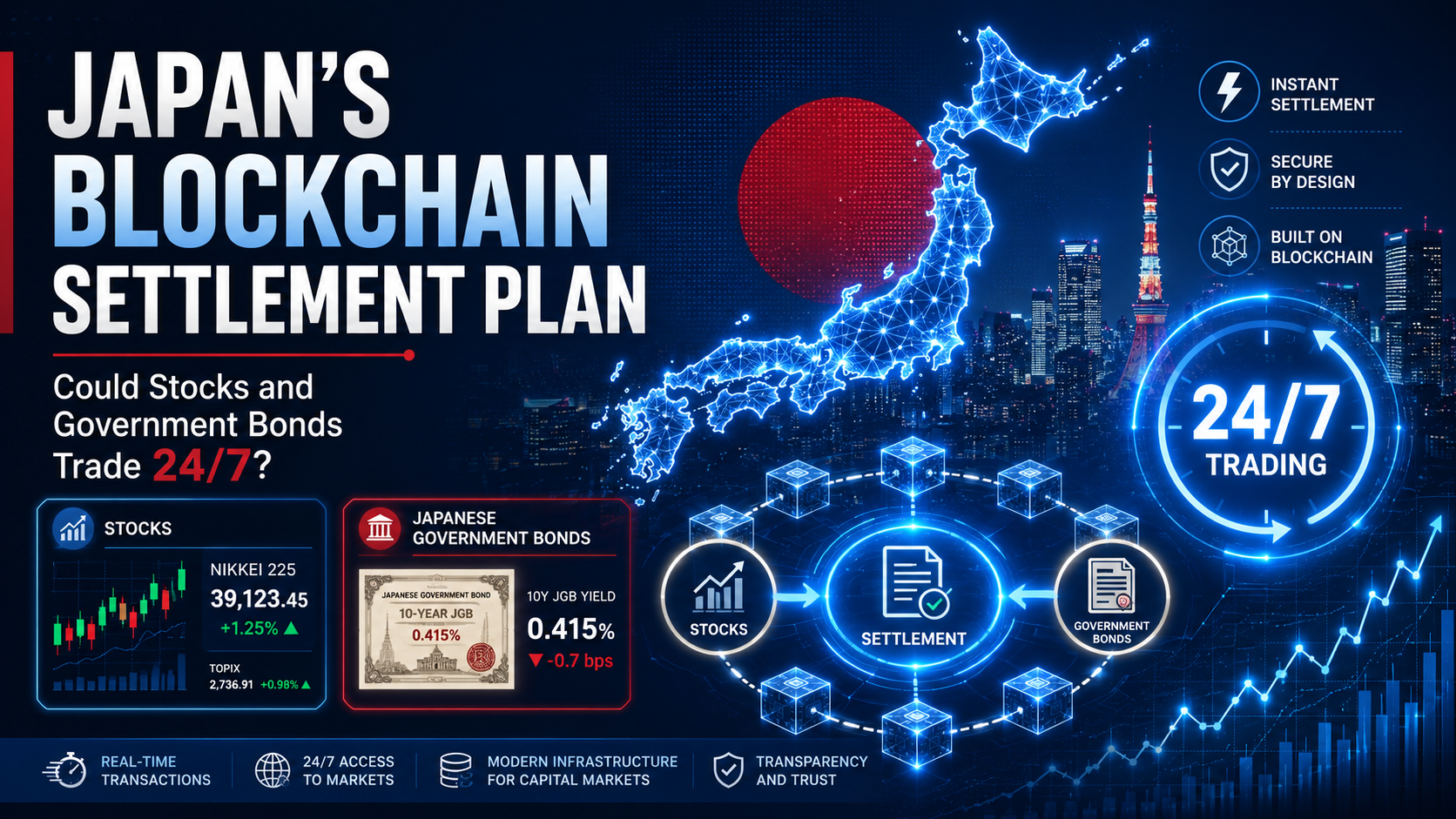
Japan’s financial authorities are advancing plans for a next-generation payment infrastructure that would allow stocks and Japanese government bonds to settle instantaneously at any hour. According to reporting by Nikkei Asia on August 26, 2026, the Financial Services Agency, the Ministry of Finance, the Bank of Japan, and major financial institutions will form a study group this summer. The group aims to produce a development plan by early 2027 covering blockchain design, division of responsibilities, and a roadmap. If approved, the system could begin operations within a few years and reach fuller functionality in the early 2030s. Current settlement for equities takes two business days after execution, while Japanese government bonds settle the following day.
The proposed infrastructure would synchronize the transfer of securities with the corresponding cash payment, potentially enabling investors to reinvest proceeds almost immediately and supporting continuous market activity. The core thesis is that Japan is moving deliberately toward real-time, around-the-clock settlement of its largest traditional securities markets by tokenizing a portion of banks’ current accounts held at the Bank of Japan and linking them to blockchain records, building on existing private-sector pilots while preserving the legal status of book-entry securities. This approach addresses settlement risk, capital efficiency, and competitive positioning without requiring an immediate wholesale replacement of existing systems.
How Current T+2 Equity and T+1 Bond Cycles Create Operational Friction in Tokyo Markets
Japanese equity trades settle on a T+2 basis, meaning the exchange of securities and cash occurs two business days after the trade is executed. Japanese government bond transactions generally settle on T+1. These cycles leave a window during which counterparty risk remains on the books of clearing houses, brokers, and investors. During that interval, participants must manage collateral, funding, and potential fails, which ties up capital and limits the speed at which sale proceeds can be redeployed. Market participants have long accepted these delays as the cost of operating within established book-entry and payment systems that run primarily during standard business hours. The gap between trade execution and final settlement also complicates cross-border activity and overnight risk management for institutions that operate across time zones.
A real-time system would close that gap by linking the securities transfer leg with the cash payment leg so that both occur atomically or near-atomically. Investors selling securities could receive funds and reinvest them almost at once rather than waiting one or two business days. The study group now forming is expected to examine how blockchain records can update the existing transfer registers while a tokenized form of central-bank money moves simultaneously. This dual structure aims to retain the legal character of Japanese government bonds and listed shares as book-entry instruments while adding continuous settlement capability. The resulting reduction in settlement risk and improvement in capital velocity form the practical foundation for the authorities’ interest in 24-hour operation.
Why Tokenizing Portions of Bank of Japan Current Accounts Form the Settlement Backbone
The infrastructure under discussion would convert a portion of the current-account balances that commercial banks hold at the Bank of Japan into digital tokens that circulate on a blockchain network. These tokens would function as wholesale digital central-bank money used for settling securities transactions. Because the tokens represent claims on the central bank rather than commercial-bank liabilities, they carry the lowest credit risk available in the domestic system. Synchronization between the blockchain ledger and the official book-entry transfer registers would allow the securities leg and the cash leg to move together. This design avoids the need to create an entirely new legal category of security while still enabling continuous, atomic delivery-versus-payment.
Officials have indicated that the same infrastructure could later support international remittances. By keeping the underlying securities within the existing legal framework and using tokenized central-bank money for payment, the project seeks to modernize settlement without disrupting the established ownership and transfer rules that govern Japan’s capital markets. The Bank of Japan has already been running sandbox experiments that test settlement using commercial banks’ current-account deposits on blockchain infrastructure, providing a technical foundation for the larger initiative.
What the Summer 2026 Study Group Will Define Before the Early-2027 Development Plan
The study group comprising the Financial Services Agency, the Ministry of Finance, the Bank of Japan, and participating financial institutions is scheduled to begin work during summer 2026. Its mandate includes determining the specific blockchain architecture, clarifying the division of operational and oversight responsibilities among public agencies and private institutions, and producing a concrete roadmap. The resulting development plan is targeted for early 2027 at the earliest. That plan will serve as the formal basis for subsequent technical design, pilot expansion, and, if approved, system rollout.
Because the project may be incorporated into a multi-year strategic investment framework beginning in fiscal 2027, the study group’s conclusions will also influence funding and prioritization decisions. The group must balance the desire for near-instant settlement against the need for resilience, cybersecurity, legal certainty, and interoperability with existing clearing and custody systems. Participants will therefore examine both the technical performance of candidate blockchain platforms and the institutional arrangements required to operate them on a continuous basis.
How MUFG’s Canton Network Proof-of-Concept for JGB Repos Previews Continuous Settlement
On August 13, 2026, Mitsubishi UFJ Financial Group announced a proof-of-concept for on-chain Japanese government bond repo transactions using the Canton Network. Four MUFG entities are collaborating with Digital Asset and Progmat. The test focuses on simultaneous delivery-versus-payment settlement of JGBs and digital money while preserving the legal status of the bonds as book-entry transfer instruments. The book-entry transfer account register is updated in conjunction with the blockchain record rather than replacing the underlying securities with fully native tokens. Tokenized deposits or stablecoins are under consideration for the cash leg.
The proof-of-concept also aims to implement the full repo lifecycle on-chain, including trade agreement, collateral management, valuation, and closing-leg settlement. It runs under the Financial Services Agency’s Payment Innovation Project and is expected to conclude by the end of 2026, with a possible commercial version targeted for fiscal years 2027 to 2029. By demonstrating real-time, potentially 24-hour atomic settlement of a high-volume collateral market while leaving the legal character of JGBs unchanged, the MUFG initiative supplies practical data that the broader study group can incorporate into its development plan.
The Scale of Japan’s Government Bond Market That Continuous Settlement Would Affect
Japan’s outstanding government bonds and bills form one of the world’s largest fixed-income markets. Ministry of Finance data show central government debt, including government bonds, exceeding 1,300 trillion yen in recent reporting periods. General bonds alone account for the bulk of that total. Because Japanese government bonds serve as the primary high-quality collateral for repo and other funding transactions, any improvement in settlement speed and continuous availability has direct implications for liquidity management across the banking system and the broader capital markets.
Faster settlement reduces the capital that institutions must hold against unsettled positions and shortens the period during which collateral is locked. Continuous availability would allow market participants to adjust positions and funding arrangements outside conventional business hours, potentially increasing the effective liquidity of the JGB market. The same infrastructure, once established for government bonds, could later extend to equities and other instruments, amplifying the scale of the efficiency gains.
Parallel Stablecoin and Tokenized Deposit Experiments Supporting Atomic Settlement
Japan’s three largest banking groups are preparing to issue a joint stablecoin for use in securities trading during the current fiscal year. Separate pilots involving tokenized deposits for interbank transfers are also underway among regional and online banks. These initiatives supply the digital cash instruments that can pair with blockchain-recorded securities transfers to achieve atomic delivery-versus-payment. When the securities leg and the cash leg settle in a single, indivisible step, the risk that one party delivers while the other fails is eliminated.
The Financial Services Agency’s Payment Innovation Project provides a controlled environment in which these experiments can address legal and operational questions. By testing the linkage between blockchain-managed rights transfers and stablecoin or tokenized-deposit payments, participants are generating the technical and regulatory experience required for a national real-time settlement system. The convergence of these private-sector efforts with the official study group’s work increases the likelihood that practical solutions will be available when the development plan is finalized.
Existing Book-Entry Transfer Rules and How Blockchain Synchronization Preserves Them
Japanese securities law treats listed stocks and government bonds as book-entry transfer instruments. Ownership and transfer are recorded in account management institutions rather than through physical certificates. The proposed blockchain layer is designed to update those official registers in tandem with on-chain records rather than to replace the legal form of the securities. This approach maintains continuity with the Book-Entry Transfer Act and the Financial Instruments and Exchange Act while adding the speed and continuous availability of distributed-ledger technology.
Preserving the existing legal character reduces the need for wholesale legislative overhaul and limits disruption for custodians, clearinghouses, and investors. The technical challenge lies in ensuring that the synchronized updates remain consistent, auditable, and resilient under high-volume, continuous operation. The study group will need to define the precise interface between the blockchain and the legacy registers so that legal finality is achieved at the same moment the on-chain settlement occurs.
Potential Extension of the Infrastructure to Cross-Border Remittances and Collateral
Nikkei reporting notes that the same real-time payment infrastructure could eventually support international remittances. Continuous, atomic settlement of domestic securities creates a foundation that can be extended to cross-border use cases once interoperability and regulatory alignment are established. In parallel, trials already underway examine the use of Japanese government bonds as blockchain-managed collateral for both domestic and cross-border purposes.
These extensions would allow Japanese institutions to move high-quality collateral and funds more efficiently across time zones. The combination of tokenized central-bank money, synchronized securities records, and continuous availability positions the eventual system as a potential hub for regional settlement activity. Realization of that potential depends on successful domestic implementation first, followed by careful expansion of the technical and legal frameworks.
Timeline from 2027 Development Plan to Possible Early-2030s Operations
The study group’s development plan is expected in early 2027. Subject to formal approval, operations could begin within a few years thereafter, with the system potentially reaching fuller operational status in the early 2030s. That multi-year horizon reflects the complexity of replacing or augmenting core market infrastructure while maintaining uninterrupted service. The project may be folded into a broader multi-year strategic investment framework starting in fiscal 2027, which would provide a structured funding and prioritization path.
During the intervening period, private-sector pilots such as the MUFG Canton Network test and various stablecoin experiments will continue to supply operational data. Success in those limited environments will inform the design choices and risk controls that appear in the national plan. The measured timeline also allows regulators and market participants to address cybersecurity, operational resilience and contingency arrangements before continuous settlement becomes the default mode.
Positioning of Tokyo Relative to Other Global Capital Markets
Other major markets have already shortened settlement cycles or launched tokenization pilots. Japan’s approach of combining tokenized central-bank money with synchronized book-entry records for both equities and government bonds aims to move beyond incremental cycle compression toward continuous operation. By targeting both the cash and securities legs in a single infrastructure, the initiative seeks to improve capital efficiency and reduce settlement risk more comprehensively than cycle reductions alone.
If successfully implemented, the system would allow Tokyo to offer real-time settlement availability that is currently rare in traditional securities markets. That capability could attract greater international participation and reinforce the competitiveness of Japanese capital markets as other jurisdictions pursue their own modernization programs. The advantage, however, will depend on the reliability, cost, and accessibility of the finished infrastructure rather than on the announcement of plans alone.
Operational and Capital Efficiency Gains Expected from Continuous Atomic Settlement
Atomic delivery-versus-payment eliminates the window during which one party has delivered securities while the other has not yet paid, or vice versa. Continuous availability further reduces the need to pre-fund positions or hold excess collateral overnight. Institutions can recycle capital more rapidly, lower the opportunity cost of unsettled trades and manage liquidity with greater precision. For a market the size of Japan’s government bond and equity markets, even modest improvements in velocity can free substantial amounts of capital.
These gains accrue to brokers, custodians, asset managers, and banks that intermediate the markets. They also benefit end investors through potentially tighter spreads and more responsive portfolio adjustments. Realization of the full benefit requires that the technical systems remain available and secure around the clock and that market practices adapt to the new settlement speed without introducing new forms of operational risk.
Remaining Technical and Institutional Questions the Study Group Must Resolve
Key open questions include the precise choice of blockchain platform or platforms, the governance model for continuous operation, the standards for interoperability with existing clearing and custody systems, and the arrangements for cybersecurity and operational resilience. The group must also define how failures or disputes will be resolved when settlement occurs outside traditional business hours. Legal finality must be unambiguous even when updates to the official registers and the blockchain occur simultaneously.
These issues are not merely technical. They involve the allocation of responsibilities among the Financial Services Agency, the Bank of Japan, the Ministry of Finance, central counterparties, account management institutions and private technology providers. Clear answers in the 2027 development plan will determine whether the subsequent implementation proceeds smoothly or encounters delays. The existence of ongoing pilots provides empirical evidence that can inform those answers, yet the transition from limited tests to national infrastructure remains a substantial institutional undertaking.
How Private Tokenization Platforms Already Demonstrate Market Readiness
Platforms such as Progmat have already migrated substantial volumes of tokenized securities onto dedicated blockchain networks. Other initiatives are testing secondary-market delivery-versus-payment using tokenized deposits. These private efforts demonstrate that regulated Japanese institutions can issue, transfer, and settle tokenized instruments under existing legal frameworks. The official settlement infrastructure under study would provide the common cash and finality layer that allows such private platforms to scale more safely and efficiently.
By building on demonstrated private-sector capability rather than starting from a blank slate, the public authorities reduce implementation risk. The combination of proven issuance and transfer platforms with a planned real-time central settlement layer creates a more complete ecosystem than either element alone. Continued progress in the private pilots will therefore remain an important indicator of overall readiness as the study group advances its work.
FAQs
What exactly is Japan proposing for stock and bond settlement?
Japan’s Financial Services Agency, Ministry of Finance, and Bank of Japan are preparing to design blockchain infrastructure that would allow stocks and Japanese government bonds to settle in real time, potentially around the clock. A study group is expected to begin work in summer 2026 and produce a development plan by early 2027. The system would tokenize a portion of banks’ current accounts at the Bank of Japan and synchronize those tokens with updates to the existing book-entry transfer registers, enabling atomic or near-atomic delivery-versus-payment while preserving the legal character of the securities.
How does the current settlement cycle in Japan compare with the proposed system?
Equities currently settle two business days after trade execution and government bonds settle the following day. The proposed blockchain infrastructure aims to compress both cycles to near real time by linking the securities transfer and the cash payment so that investors can access and reinvest proceeds almost immediately. Continuous availability would further remove the constraint of standard business hours.
What role do tokenized Bank of Japan accounts play?
A portion of the current-account balances that banks hold at the central bank would be converted into digital tokens circulating on a blockchain. These tokens serve as low-risk wholesale settlement money. When a securities transfer is recorded, the corresponding tokenized funds move at the same time, achieving delivery-versus-payment without relying solely on commercial-bank liabilities.
Are private banks already testing similar technology?
Yes. Mitsubishi UFJ Financial Group launched a proof-of-concept in August 2026 for on-chain Japanese government bond repo transactions using the Canton Network. The test synchronizes the official book-entry register with blockchain records and explores tokenized deposits or stablecoins for the cash leg. Other megabanks and securities firms are running parallel experiments with tokenized securities and stablecoins under the Financial Services Agency’s Payment Innovation Project.
When could the new system become operational?
A development plan is targeted for early 2027. If approved, operations could begin within a few years, with the infrastructure potentially reaching fuller functionality in the early 2030s. The timeline reflects the need for careful design, testing, and institutional preparation before continuous settlement becomes standard.
🔥 KuCoin Offers A More Stable Option in A Volatile Market
If you worry about the frequent ups and downs in the market, and pursue a more stable option to earn money passively, KuCoin is the right place to come:

Simple Earn: Deposit and withdraw tokens anytime, earning stable returns.
Kucoin Earn: Earn stable profits with professional asset management.
Hold to Earn: Earn rewards by holding assets in Funding, Trading, Margin, Futures, Mining, and Unified Accounts.
Staking: Unlock the earning potential of on-chain assets.
Advanced Investments: Advanced Investments offer a variety of structured products to help your money grow in any market.
Shark Fin: Principal Protection and Guaranteed Gains
Dual Investment: Buy low and sell high with transparent return calculations.
Snowball: High yields, with price protection.
Discount Buy: Buy crypto at discount prices.
KCS Loyalty: Level up to enjoy exclusive perks by staking ≥ 1 KCS.
KuCoin Wealth: Discover future value and begin your smart investing journey.
KCS Benefits: Hold and stake KCS to access benefits across the platform.
KCS Staking 2.0: Participate in KCS on-chain governance to earn yield.
Disclaimer: This content is for informational purposes only and does not constitute investment advice. Cryptocurrency investments carry risk. Please do your own research (DYOR).