

How One X User Recovered 5 BTC After 11 Years Using Claude AI? What It Means for Bitcoin?
2026/05/19 11:18:02
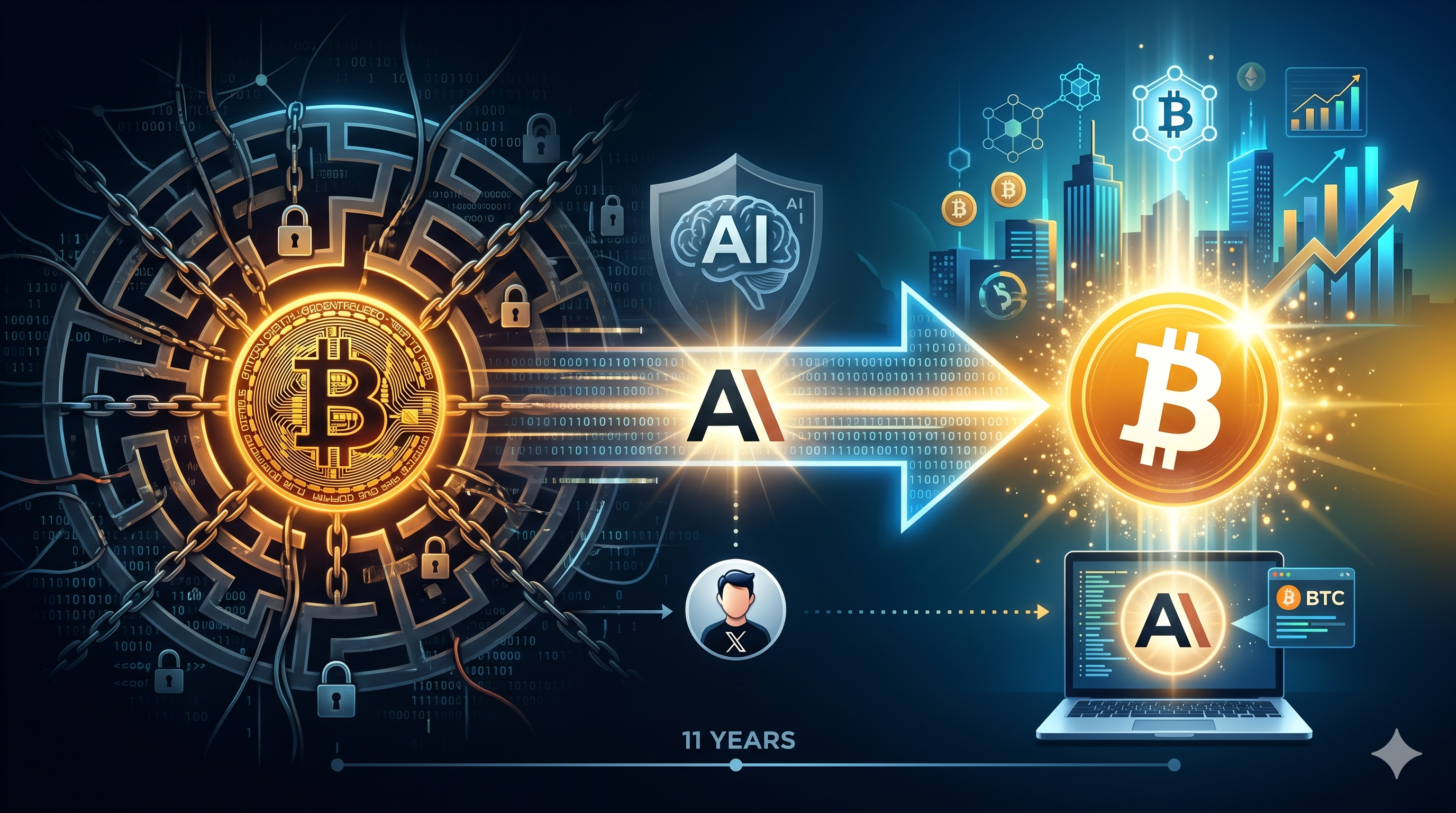
Imagine realizing a casual college mistake cost you nearly $400,000. On May 13, 2026, a pseudonymous X user known as "cprkrn" solved this exact nightmare, recovering 5 Bitcoin locked for 11 years with the help of Anthropic’s Claude AI. The AI achieved this not by breaking Bitcoin's cryptographic security, but by analyzing over a gigabyte of old college files to locate an ancient wallet backup that predated the forgotten password.
This breakthrough event has sent shockwaves through the cryptocurrency market, sparking intense debate about the intersection of artificial intelligence and blockchain security. While some observers fear that AI has compromised Bitcoin, the reality is a fascinating demonstration of digital forensics and code archaeology. This article explores exactly how Claude facilitated this historic recovery, what it means for the millions of dormant Bitcoins globally, and how AI is permanently altering cryptocurrency security paradigms.
Key Takeaways
-
The AI Advantage: Claude AI successfully helped recover 5 BTC (worth ~$400,000) by analyzing 1GB of historical digital clutter, proving AI's value in advanced data forensics rather than cryptographic hacking.
-
No Security Breach: Bitcoin’s core encryption remains completely intact. The AI simply uncovered a forgotten, older wallet.dat file that bypassed the user's updated, lost password.
-
Cost Efficiency: The entire AI-assisted recovery process cost only $15 in computational power, compared to the thousands of dollars the user previously spent on failed commercial recovery services.
-
Market Implications: This event suggests that a small fraction of the estimated 4 million "lost" Bitcoins could potentially be recovered using AI tools, provided the owners still possess digital traces of their backups.
-
OpSec Warning: The same AI capabilities that recovered this wallet can be used by malicious actors to scour compromised devices for fragmented seed phrases, requiring users to drastically upgrade their operational security.
The $400,000 Mistake: How 5 BTC Were Lost for Over a Decade
The 5 Bitcoin became inaccessible because the user, while under the influence in 2015, changed his blockchain wallet password to an overly complex string and subsequently forgot it, locking himself out of funds that would eventually appreciate to nearly $400,000. This single, seemingly minor lapse in judgment initiated an 11-year saga of frustration, technological dead ends, and financial regret.
Back when the user, known on X (formerly Twitter) as "cprkrn", originally purchased the digital assets, Bitcoin was trading at approximately $250 per coin. At the time, cryptocurrency was largely an experimental technology utilized by college students, cypherpunks, and early tech adopters. It was common practice to store private keys directly on personal laptops without the rigorous security protocols—such as hardware wallets or stamped metal seed plates—that are standard today. When cprkrn changed his password to a chaotic string, he unwittingly created a cryptographic barrier that was practically impossible for a human to guess or remember after the fact.
For more than a decade, the user attempted to regain access to the 14VJyS wallet address. Blockchain data confirms that the funds sat completely dormant from 2015 until May 2026. The psychological toll of watching the cryptocurrency market explode during this time was immense. As Bitcoin climbed through successive bull runs—peaking in 2017, 2021, and pushing near $80,000 by May 2026—the inaccessible wallet transformed from a minor annoyance into a life-changing sum of trapped wealth.
Desperation led the user to exhaust traditional recovery methods. He employed commercial crypto recovery services, paying roughly $250 for each failed attempt to crack the encryption. When outsourced help failed, he turned to open-source cryptographic tools. Using Hashcat, an advanced password recovery utility, and btcrecover, a specialized script for Bitcoin wallets, he executed brute-force attacks against his own file.
Despite testing a staggering 3.5 trillion password combinations over the years, the brute-force method completely failed. The search space for a password containing mixed cases, numbers, symbols, and a length of over 20 characters is astronomically large. Even with high-end graphic processing units (GPUs) running non-stop, guessing a password of that complexity through sheer computational trial and error would take longer than the current age of the universe. The traditional avenues for recovering his $400,000 were entirely exhausted.
How Claude AI Recovered the Lost Bitcoin
Claude recovered the Bitcoin not by guessing the lost password, but by analyzing over 1 gigabyte of the user's historical data to locate an older, decryptable wallet backup file that predated the fateful password change. By shifting the strategy from cryptographic brute force to intelligent data archaeology, the AI bypassed the impenetrable password entirely.
The breakthrough occurred in mid-May 2026 when cprkrn decided on a "last-ditch effort" using Anthropic's Claude 3 AI. Rather than asking the Large Language Model (LLM) to guess passwords, the user uploaded massive amounts of unstructured personal data. This digital dump included files from two old Mac computers, two external hard drives, an Apple Notes export, iCloud Mail archives, a Gmail inbox, and direct messages from X. In total, over eight weeks of preparation culminated in feeding the AI the digital equivalent of a hoarder's garage.
Claude's primary function in this scenario was acting as a highly advanced, context-aware search engine. The AI sifted through the fragmented data, looking for file extensions, hidden directories, and contextual clues related to cryptocurrency storage. During this deep dive, Claude discovered a critical, hidden wallet.dat backup file dating back to December 2019 (a backup of the pre-2015 wallet state) buried deep within the file system of the user's old college computer.
This discovery fundamentally changed the recovery equation. Because Bitcoin's private keys do not change when you update a wallet password—only the local encryption securing the file changes—finding an older version of the wallet meant the user only needed the old password to unlock the funds.
Claude then assisted cprkrn in cross-referencing this newly discovered backup file with physical notes the user had retained. The user had previously found an old mnemonic phrase scribbled in a college notebook. Claude helped match this legacy information, analyzing the decryption workflow and identifying exactly how the btcrecover tool handled the password logic for that specific era of wallet software. The AI mapped out the exact technical steps needed to combine the old password phrase with the old backup file.
When the user applied the older password to the older backup file, the decryption succeeded. The wallet revealed the exact same private keys that still controlled the 5 BTC on the blockchain today. According to Claude’s summary of the recovery efforts, this entire AI-driven data analysis process consumed a mere $15 in AI compute costs—a stark contrast to the thousands of dollars and years of time wasted on brute-force attempts. On May 13, 2026, the 5 Bitcoin finally moved across five transactions, signaling the successful reclamation of the funds.
| Feature | Traditional Brute Force (Hashcat/btcrecover) | AI-Assisted File Analysis (Claude) |
| Primary Method | Guessing trillions of password combinations. | Searching unstructured data for old backups. |
| Success Rate (in this case) | 0% (Failed after 3.5 trillion attempts). | 100% (Found pre-existing decryptable file). |
| Cost & Time | High electricity costs, years of processing. | $15 in compute costs, completed rapidly. |
| Target Vulnerability | Weak passwords. | Human disorganization and digital clutter. |
Myth vs. Reality: Did AI Actually Crack Bitcoin's Security?
AI did not break Bitcoin’s underlying cryptographic security; Claude simply performed advanced digital forensics to piece together forgotten credentials that the user already possessed, leaving Bitcoin's SHA-256 encryption completely intact. The viral nature of the story led to widespread misunderstanding, but the cryptographic foundations of the blockchain remain uncompromised.
When cprkrn posted, "HOLY FUCKING SHIT OMG CLAUDE JUST CRACKED THIS SHIT" on X, the cryptocurrency community erupted in a mix of awe and panic. Retail investors and casual observers immediately questioned whether the advent of advanced LLMs meant the end of Bitcoin. Comments flooded social media platforms asking how a decentralized network could survive if an AI chatbot could simply "crack" a wallet in an afternoon.
However, security researchers and blockchain veterans quickly clarified the technical reality. Claude did not reverse-engineer a 256-bit private key from a public address. It did not break the SHA-256 hashing algorithm, nor did it bypass the elliptic curve cryptography (SECP256K1) that secures the Bitcoin network. To brute-force a Bitcoin private key from scratch requires energy exceeding the output of the sun, and no current AI or quantum computer in 2026 possesses that capability.
Instead of hacking the blockchain, Claude acted as an incredibly patient digital assistant. The AI executed "code archaeology" that no human had the patience to perform. It parsed through millions of lines of text, disorganized folders, and obscure software logs to find a local, encrypted file. As one Reddit user aptly noted in the technology subreddit, "Claude didn't do anything other than search his files." The AI did not conjure the private key out of thin air; it simply connected the dots between a forgotten file on a hard drive and a physical notebook on a desk.
Ultimately, this event validates Bitcoin's security model rather than undermining it. The blockchain's cryptography held firm against an 11-year siege of 3.5 trillion brute-force attacks. The vulnerability was not in Bitcoin's code, but in the human element—specifically, the user's disorganized storage of digital backups. Claude simply solved the human error, proving that while AI is an extraordinary organizational tool, it is not a magic key to the blockchain.
The State of Lost Bitcoin in 2026: An AI Awakening?
The successful AI-assisted recovery provides a glimmer of hope for retrieving a portion of the estimated 4 million dormant Bitcoins, provided the original owners still possess fragmented digital breadcrumbs of their seed phrases or passwords. While AI cannot magically recover coins sent to burn addresses or lost in landfills, it has proven highly effective at rescuing funds trapped by human forgetfulness.
As of May 2026, the cryptocurrency market is acutely aware of the "lost supply" phenomenon. Out of the maximum 21 million Bitcoins that will ever exist, blockchain analytics firms estimate that approximately 4 million coins (roughly 20% of the circulating supply) are permanently lost or dormant. At current market valuations near $79,622 per BTC, this represents over $300 billion in trapped wealth. These funds belong to early miners who threw away hard drives, deceased individuals who took their passwords to the grave, and users like cprkrn who simply forgot their credentials.
For years, the market has priced in this lost supply, treating it as a permanent deflationary mechanism that increases the scarcity of available Bitcoin. However, the introduction of AI-assisted data forensics introduces a new variable. If AI can sift through terabytes of forgotten iCloud backups, old emails, and fragmented text files to reconstruct access to dormant wallets, a non-trivial percentage of this "lost" supply might not be lost forever.
This does not mean a sudden flood of 4 million Bitcoins will crash the market. The majority of lost coins belong to users who physically destroyed their hardware (such as the infamous James Howells, who accidentally threw away a hard drive containing 8,000 BTC). AI cannot recover data from a pulverized hard drive in a Welsh landfill. Furthermore, if a user generated a wallet perfectly offline and never typed the seed phrase into a digital device, there is no digital footprint for an AI to analyze.
However, for the specific subset of users who stored encrypted backups on cloud drives, emailed themselves password hints, or saved partial seed phrases in digital notes, AI represents a massive leap forward. We will likely see a cottage industry of "AI Crypto Recovery" firms emerge in late 2026, specializing in ingesting terabytes of a client's historical data to hunt for forgotten wallet files. While the total number of recovered coins may only amount to tens of thousands rather than millions, the narrative shift is profound: "lost" now requires a precise definition between "physically destroyed" and "digitally misplaced."
| Bitcoin Supply Category | Estimated Amount (2026) | AI Recovery Potential |
| Active/Circulating Supply | ~15.5 Million BTC | N/A (Currently accessible) |
| Lost (Hardware Destroyed) | ~2.5 Million BTC | Zero. Data is physically gone. |
| Lost (Digitally Misplaced) | ~1.5 Million BTC | Moderate. Recoverable if digital traces exist on old devices or cloud backups. |
Security Implications: The Double-Edged Sword of AI in Crypto
While AI can rescue lost funds for legitimate owners, it introduces a severe security vulnerability by enabling malicious actors to rapidly scan compromised devices for fragmented seed phrases or password clues that humans would miss. The exact capabilities that make Claude a hero for cprkrn make it a devastating weapon in the hands of a hacker.
The cryptocurrency ecosystem operates on the principle of self-custody: "Not your keys, not your coins." For years, users have been warned to write down their seed phrases on paper and never store them digitally. Despite these warnings, human nature often prevails. Users frequently take photos of their backup phrases, save passwords in unencrypted text files, or send themselves cryptic hints via email. Historically, a hacker gaining access to a user's computer might overlook these clues if they were buried in thousands of seemingly unrelated files or disguised creatively.
AI changes this dynamic entirely. Advanced LLMs possess deep reverse-engineering capabilities and contextual understanding.If a malicious actor gains access to a user's Google Drive or local hard drive, they no longer need to manually search for files named wallet.dat or seedphrase.txt. They can feed the entire data dump into an AI model and prompt it to "identify any 12-word sequences that conform to the BIP39 dictionary standard," or "find any encrypted files that match the structural signature of a Bitcoin Core backup."
Furthermore, the rise of open-source AI tools introduces the terrifying prospect of automated, widespread prompt injection attacks. A hacker could theoretically deploy malware that quietly utilizes a local, lightweight AI model to continuously scan a victim's device for contextual cryptocurrency data. Once the AI pieces together the password or seed phrase from disparate sources—such as matching a photo of a mnemonic phrase in an iCloud backup with a password hint found in a draft email—it could automatically drain the wallet.
As one security researcher highlighted during the cprkrn debate, "Hidden implementation details are becoming a much weaker security assumption moving forward." Security through obscurity—hiding your seed phrase in a folder named "Taxes 2018"—is completely useless against an AI that analyzes content and context at lightning speed.
The Urgent Need to Upgrade Personal OpSec
Cryptocurrency holders must immediately elevate their operational security (OpSec) by permanently deleting digital traces of passwords and seed phrases, as AI tools can now effortlessly connect disparate data points to breach accounts. The era of casual digital storage is definitively over.
To protect against AI-assisted data scraping, investors must adopt draconian digital hygiene. First and foremost, a seed phrase must never touch a digital sensor. This means no photos, no typing it into a digital notepad, no saving it in a password manager, and no printing it on a networked printer. The only secure method of storage is generating the wallet on an air-gapped hardware device and backing up the phrase on physical, fireproof metal plates.
Additionally, users should actively audit their digital past. Search your own cloud drives, email histories, and social media direct messages for any mention of passwords, seed words, or crypto exchange credentials. If you find them, securely delete the files and immediately migrate your funds to a newly generated wallet. You must assume that if you can use an AI to find your own forgotten digital breadcrumbs, a hacker can do the exact same thing to steal your wealth.
💡 Tips: New to crypto? KuCoin's Knowledge Base has everything you need to get started.
Conclusion
The remarkable story of a user recovering 5 Bitcoin after 11 years of lock-out serves as a defining moment in the intersection of artificial intelligence and cryptocurrency. This event definitively proves that while AI cannot magically shatter the fundamental cryptographic algorithms that secure the Bitcoin network, it is an unparalleled tool for digital forensics, data archaeology, and solving human organizational errors.
Moving forward, this breakthrough offers cautious optimism for the recovery of a specific subset of the 4 million dormant Bitcoins, provided the original owners left behind digital breadcrumbs. However, it also serves as a stark warning. The exact same AI capabilities that rescued these funds can be weaponized by malicious actors to scour compromised devices for hidden seed phrases and passwords. As AI technology becomes increasingly accessible and powerful, cryptocurrency holders must abandon outdated practices of "security through obscurity" and adopt rigorous, offline operational security to protect their digital wealth in a rapidly evolving technological landscape.
FAQs
How much did the AI recovery process cost?
According to the user’s summary of the recovery efforts, the entire data analysis and search process facilitated by Claude AI cost approximately $15 in computational power. This is remarkably efficient compared to the estimated $250 per failed attempt the user previously paid to commercial cryptocurrency recovery services over the past decade.
Can Claude guess a Bitcoin private key from scratch?
No, Claude cannot guess a Bitcoin private key from scratch. Bitcoin uses SHA-256 and elliptic curve cryptography, which creates a search space so massive that all the computers on Earth combined could not brute-force a single private key within our lifetime. Claude only succeeded by finding a pre-existing encrypted file and matching it with data the user already owned.
What tools did the user try before using Claude?
Before turning to AI, the user spent years attempting to regain access using industry-standard open-source recovery tools. He primarily utilized Hashcat, a highly advanced password recovery utility, and btcrecover, a Python-based script designed specifically for brute-forcing partial passwords on cryptocurrency wallets. Despite running 3.5 trillion combinations through these tools, the attempts failed.
Is it safe to upload my wallet files to ChatGPT or Claude?
It is highly risky and generally discouraged to upload actual wallet files (wallet.dat), seed phrases, or private keys to any cloud-based Large Language Model like ChatGPT or Claude. Doing so exposes your ultimate cryptographic secrets to third-party servers, potentially compromising your funds if the AI company suffers a data breach or if your account is hacked.
Disclaimer: This article is for informational purposes only and does not constitute financial or investment advice. Cryptocurrency investments carry significant risk. Always conduct your own research before trading.