

Puffer Partners with Google Cloud to Power Sub-50ms Preconfirmations on UniFi
Google Cloud Brings Enterprise-Grade Infrastructure to Puffer UniFi’s Preconfirmation System
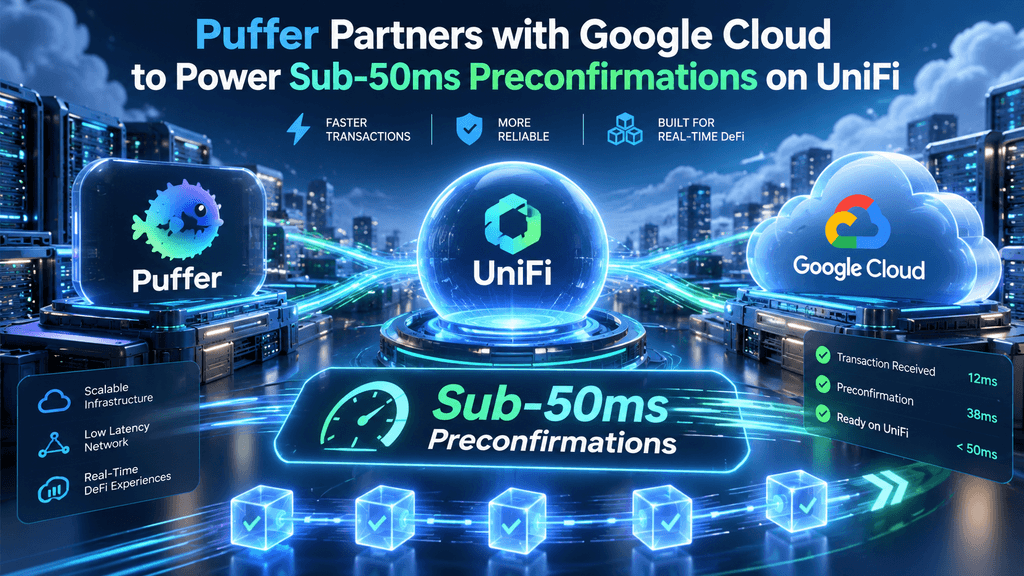
Puffer Finance has announced a strategic infrastructure partnership with Google Cloud that positions the technology giant as a registered gateway operator within the Puffer Preconf system powering Puffer UniFi. Announced on September 22, 2026, the collaboration integrates Google Cloud’s enterprise-grade infrastructure directly into the execution path of UniFi, Puffer’s high-performance Ethereum-based rollup. Google Cloud will process transactions and issue execution preconfirmations ahead of final settlement on Ethereum, targeting latencies as low as 50 milliseconds while preserving the security and settlement guarantees of the base layer.
This marks the first time a major cloud provider has operated as a gateway in a base rollup’s preconfirmation architecture, combining Web2 reliability with cryptoeconomic enforcement. The move addresses a longstanding tension in Ethereum scaling: the need for near-instant user feedback without sacrificing decentralization or introducing centralized sequencer risk. By onboarding Google Cloud as a Puffer Preconf gateway, Puffer UniFi achieves production-grade, sub-50ms execution preconfirmations secured by restaked ETH, establishing a practical blueprint for real-time Ethereum applications across DeFi, institutional finance, and autonomous AI agent systems.
Google Cloud Joins as Registered Gateway in Puffer Preconf Architecture
Google Cloud has been onboarded as a registered gateway on the Puffer Preconf gateway registry, enabling it to receive transactions, apply ordering policies, and issue execution preconfirmations for Puffer UniFi before batches settle on Ethereum. Gateways function as specialized sequencing entities that act on behalf of L1 proposers, handling continuous transaction validation and fragment-based block construction without waiting for the full 12-second Ethereum slot. This design, detailed in UniFi architecture documentation, allows users to receive confirmation receipts within milliseconds while the underlying-based rollup maintains L1 sequencing neutrality. Puffer UniFi becomes the first rollup to route traffic through Google Cloud’s gateway, putting the multi-provider model into live operation rather than leaving it theoretical.
The partnership explicitly combines Google Cloud’s globally distributed infrastructure with Puffer’s cryptoeconomic layer, where preconfirmation commitments carry slashable economic security derived from restaked ETH. Official statements emphasize that this creates a configurable execution path supporting single-gateway or parallel multi-gateway configurations for redundancy and geographic optimization. The integration lowers practical barriers for production deployment by injecting enterprise-grade uptime, latency consistency, and operational maturity into a previously more experimental preconfirmation stack.
Rollups integrating Puffer Preconf can now select Google Cloud alongside other approved operators, reducing reliance on any single infrastructure provider. This multi-gateway flexibility supports institutional requirements around compliance, regional data handling, and failover. Economic security remains anchored in the EigenLayer-based registry, where validators delegate sequencing rights and gateways post collateral. Failures to honor preconfirmations trigger designed slashing pathways that protect users and applications. The result is an execution environment that delivers sub-second feedback while retaining Ethereum as the settlement and liquidity foundation, a combination previously difficult to achieve at institutional scale.
How Sub-50ms Preconfirmations Overcome Based Rollup Latency Constraints
Based rollups inherit Ethereum’s security and decentralization by using L1 validators for sequencing, yet they traditionally inherit the 12-second block interval that feels slow for high-frequency use cases. Puffer Preconf solves this by inserting a gateway layer that processes transactions continuously and streams ordered fragments, allowing nodes to execute pieces as they arrive and issue receipts before the full block seals. Users experience confirmation in tens of milliseconds rather than waiting for L1 finality. Google Cloud’s participation supplies the high-performance compute and network reliability needed to sustain these latencies under real load.
Documentation from Puffer confirms that execution preconfirmations, not merely inclusion guarantees, form the core offering: the promised state transition is the one that will execute, reducing slippage risk in swaps or liquidations. This architecture preserves the based property because sequencing rights ultimately derive from L1 proposers who opt in via the registry. Gateways hold temporary exclusive write access during assigned slots, enabling confident preconfirmation issuance. Fragment broadcasting and inter-gateway state synchronization minimize gaps during slot transitions.
The addition of Google Cloud expands capacity and geographic distribution, making sustained sub-50ms performance more achievable in production. For applications such as perpetual exchanges or automated market makers, the difference between 12-second feedback and sub-50ms feedback is decisive for capital efficiency and user retention. The system remains open: any rollup integrating the Preconf registry can select Google Cloud or combine it with other gateways, creating a competitive infrastructure market rather than a single-operator dependency.
Puffer Preconf Registry Delivers Economically Secured Execution Guarantees
Puffer Preconf operates as an EigenLayer-based, actively validated service that maintains an on-chain registry of approved gateways. Validators opt in by delegating proposal rights, while restaked ETH provides the slashable collateral that backs preconfirmation commitments. Gateways themselves post additional collateral, creating layered economic accountability. When a gateway issues an execution preconfirmation, the commitment is enforceable; failure triggers slashing designed to compensate affected parties.
This moves preconfirmations beyond soft promises into cryptoeconomically meaningful guarantees. Google Cloud’s registration means its infrastructure now participates under these same rules, subjecting even enterprise operators to the same accountability framework. The registry model supports progressive decentralization. Initial deployments may feature a limited set of high-performance gateways; later phases expand independent operators and refine lookahead scheduling so that L1 proposers more directly control assignments.
Revenue sharing distributes preconfirmation fees across L2 operators, gateways, L1 validators, and the protocol, addressing the economic concern that based rollups otherwise cede all priority fees to L1. By keeping a share of fees at the L2 and gateway layers, the design makes based architectures commercially viable for application-specific chains and general-purpose rollups alike. Google Cloud’s entry demonstrates that large infrastructure providers can participate without requiring special exemptions from the economic security model.
Enterprise Infrastructure Meets Cryptoeconomic Security in UniFi Stack
Integrating Google Cloud directly into the UniFi execution path delivers several concrete advantages: globally distributed low-latency networking, proven operational reliability, and infrastructure already trusted by institutions. At the same time, settlement and security remain native to Ethereum. Preconfirmations carry slashable ETH backing rather than relying solely on the reputation of a cloud provider. This hybrid model reduces the trust surface compared with fully centralized sequencers while exceeding the speed of pure L1-sequenced-based rollups. Official commentary shows that the combination supports institutional workflows that demand both performance and enforceable finality guarantees.
For developers, the stack presents a more responsive environment without forcing a choice between speed and Ethereum alignment. Applications can offer users near-instant feedback while batches continue to settle on L1 with full composability. The multi-gateway option further allows operators to optimize for latency, cost, or regulatory geography by routing through Google Cloud, other registered operators, or parallel combinations. This configurability is especially relevant for teams building cross-border financial products or AI agent systems that require predictable execution under varying network conditions. The partnership therefore functions as both a performance upgrade and a credibility signal for institutions evaluating based rollup infrastructure.
Real-Time Execution Unlocks New DeFi Market Structures
DeFi protocols that rely on frequent state updates, perpetual futures, liquidations, automated market making, and high-frequency arbitrage have historically faced friction on pure-based designs because of the 12-second feedback loop. Sub-50ms preconfirmations compress that loop dramatically, enabling tighter spreads, faster liquidations, and more capital-efficient strategies. Because the preconfirmations are execution guarantees rather than mere inclusion promises, traders and protocols can act on the confirmed state with higher confidence. Google Cloud’s infrastructure contribution helps sustain these latencies under the transaction volumes typical of active DeFi markets.
Puffer UniFi’s synchronous composability features further amplify the impact. Same-slot L1-to-L2 messaging and instant withdrawals via TEE proofs allow liquidity and state to move fluidly between layers. A user can deposit on L1 and immediately deploy capital on UniFi within the same slot or execute complex multi-layer strategies atomically. The addition of enterprise-grade preconfirmation infrastructure makes these capabilities practical at scale rather than experimental. Market makers and protocols can design products that assume sub-second feedback without introducing new trusted intermediaries, preserving the permissionless character of DeFi while matching the responsiveness users expect from centralized venues.
Institutional Adoption Path Strengthened by Familiar Infrastructure Provider
Institutions evaluating onchain infrastructure often cite operational maturity, uptime guarantees, and recognizable counterparties as decision factors. Google Cloud’s presence as a registered gateway directly addresses these preferences. Institutions already running workloads on Google Cloud can extend those relationships into Ethereum execution environments without adopting entirely unfamiliar operators. The multi-gateway architecture additionally permits configuration according to internal compliance, data residency, or risk policies. Preconfirmation commitments remain backed by restaked ETH and subject to slashing, providing economic recourse independent of any single provider’s reputation.
Over $350 billion in real-world assets have already been minted on Ethereum mainnet, yet efficient secondary trading and structured-product venues remain underdeveloped. UniFi’s combination of high throughput, sub-50ms feedback, and Ethereum settlement creates a natural environment for those assets. Institutions can explore tokenized fund shares, credit products, or collateralized instruments with execution speeds closer to traditional finance systems while retaining the transparency and composability of public blockchain settlement. The partnership therefore functions as both a technical and a signaling upgrade that lowers the perceived operational risk of migrating institutional workflows on-chain.
AI Agents Require Machine-Speed Execution Rails with Enforceable Guarantees
Autonomous AI agents that rebalance portfolios, pay for services, execute trades, or settle obligations on-chain cannot tolerate multi-second confirmation delays. Sub-50ms preconfirmations supply the low-latency feedback loop necessary for agents to operate at machine speed. Because the preconfirmations carry economic enforcement through slashing, agents and the protocols they interact with gain stronger assurances that the confirmed state will match final settlement. Google Cloud’s infrastructure contribution expands the capacity and geographic reach of the gateway layer available to such agents.
Puffer positions UniFi explicitly as infrastructure for agentic commerce. Agents executing high-frequency or time-sensitive operations benefit from the same combination of speed, economic security, and Ethereum settlement that institutions require. The multi-gateway model further allows agent operators or the protocols serving them to select infrastructure profiles optimized for latency or reliability. As more economic activity migrates to autonomous agents, the demand for production-grade, low-latency, cryptoeconomically secured execution will intensify. The Google Cloud partnership places UniFi among the first-based rollups to offer a concrete, enterprise-supported pathway for that demand.
Multi-Gateway Design Eliminates Single Points of Failure
A core design principle of Puffer Preconf is configurability across multiple gateways. Rollups can select Google Cloud alone, combine it with other registered operators, or run parallel paths for redundancy. This approach reduces the infrastructure risk associated with dependence on any single provider. Geographic distribution becomes feasible: traffic can be routed according to latency or regulatory requirements. Failover between gateways can be engineered at the application or rollup level. Official materials stress that the registry model is intended to evolve toward greater operator diversity over time.
Google Cloud’s entry accelerates that evolution by demonstrating that large, established infrastructure companies can participate under the same economic and technical rules as specialized crypto operators. The resulting market for gateway services introduces competitive pressure on latency, reliability, and pricing. Users and applications benefit from choice and resilience. Because economic security remains rooted in restaked ETH and on-chain commitments, the addition of enterprise operators does not dilute the cryptoeconomic guarantees; it expands the set of entities capable of delivering them at scale.
Synchronous Composability Complements Fast Preconfirmations
UniFi implements L1↔L2 synchronous composability through a Signal Service that enables same-slot message passing. Users can register signals on L1 that are imported and consumable within the same L2 batch, supporting atomic cross-layer operations. Instant withdrawals, powered by TEE proofs, further compress the L2-to-L1 path to tens of seconds rather than the traditional seven-day challenge window. When these features operate alongside sub-50ms preconfirmations, the overall user experience approaches that of a single high-performance environment while retaining Ethereum settlement.
Google Cloud’s gateway role strengthens the preconfirmation component of this stack without altering the composability mechanisms. Developers can design applications that assume both rapid local feedback and reliable cross-layer atomicity. Use cases such as same-slot deposits followed by immediate L2 deployment, or complex strategies spanning L1 oracles and L2 execution, become more practical. The partnership therefore advances UniFi’s broader objective of unifying Ethereum liquidity and state rather than fragmenting it across isolated high-speed environments.
Economic Security Model Aligns Incentives Across Stakeholders
Puffer Preconf’s revenue-sharing design distributes preconfirmation fees among L2 operators, gateways, L1 validators, and the protocol. This addresses a structural concern of pure-based rollups, in which all priority fees would otherwise flow exclusively to L1 proposers. By retaining value at the L2 and gateway layers, the model makes based architectures economically sustainable for application teams. Validators earn additional yield from restaked ETH participation, while gateways are compensated for the infrastructure and performance they deliver. Slashing conditions protect users when commitments are broken.
Google Cloud participates under these same incentive and accountability structures. Its operational scale can help absorb volume spikes that smaller operators might struggle to handle, improving overall system reliability. The presence of a major cloud provider does not create special privileges; it expands the pool of capable participants subject to the same registry rules and economic security. Over time, this alignment encourages broader validator opt-in and additional gateway registrations, strengthening the security and capacity of the preconfirmation layer for the entire ecosystem of integrating rollups.
Production Deployment Path for High-Throughput Applications
Puffer UniFi is designed from the outset as a production execution environment rather than a pure research vehicle. The Google Cloud partnership supplies the operational maturity required for applications that cannot tolerate experimental infrastructure. Continuous transaction acceptance, fragment streaming, and exclusive write access during assigned slots enable sustained high throughput. Enterprise networking and compute resources help maintain consistent latencies even as concurrent users and agents increase. Official materials note that the combination targets DeFi protocols, institutional-grade applications, and AI agents specifically.
Developers evaluating the stack gain a clearer path from test environments to mainnet deployment. The multi-gateway option allows gradual traffic migration or A/B testing of different infrastructure providers. Economic security provides a quantifiable risk framework for applications handling significant value. As more real-world assets and autonomous agents come online, the demand for environments that combine sub-50ms feedback with Ethereum settlement will grow. UniFi’s first-mover status with Google Cloud’s gateway positions it to capture early production workloads seeking that exact profile.
Looking Ahead: Real-Time Ethereum Execution at Institutional Scale
The partnership signals a maturation point for based rollup technology. What began as an elegant security and decentralization thesis now incorporates enterprise-grade infrastructure capable of supporting institutional and agentic workloads. Puffer continues to develop the broader UniFi stack, preconfirmations, instant withdrawals, and synchronous composability, while expanding the set of registered gateways. Google Cloud’s participation validates that large technology providers can integrate into cryptoeconomic systems without requiring privileged status.
Future phases of Puffer Preconf are expected to refine lookahead scheduling, expand operator diversity, and strengthen slashing enforcement. Additional rollups beyond UniFi can adopt the same registry, creating a shared infrastructure layer for fast, secure preconfirmations across the Ethereum ecosystem. The combination of sub-50ms execution, economic guarantees, and Ethereum settlement forms a practical foundation for the next wave of onchain activity. DeFi markets, institutional products, and autonomous agents all stand to benefit from execution rails that no longer force a trade-off between speed and credible neutrality.
🔥 Beyond the Headlines: What KuCoin 5.0 Means for You
Market news moves fast — but where you act on it matters just as much. This October, KuCoin launches KuCoin 5.0, transforming KuCoin into a rebuilt platform. Here's what actually changes for you:
-
One account for everything. Older platforms split your money across separate "spot," "margin," and "futures" accounts and expected you to understand why. KuCoin 5.0's unified account removes that entirely — deposit once, and everything is simply there (only available to VIPs for now).
-
Stocks, indices, and commodities. KuCoin 5.0 expands beyond crypto into global markets. When crypto chops sideways and equities rally (or the reverse), you rotate in minutes instead of opening a brokerage account and waiting days for fiat rails.
-
Real-world assets (RWA). Tokenized exposure to traditional assets like commodities, right inside your crypto account. One of the fastest-growing segments in global finance is no longer reserved for institutions — you access it from the same balance you trade with.
-
Earn while you learn. Not ready to trade? KCUSD lets your stablecoins earn daily, auto-compounding interest. The lowest-stress way to put your idle deposit to work for 4% yield.
-
An AI assistant in plain language. Ask questions, get market context, understand what you're looking at — built into the platform, no jargon required.
-
An app that doesn't overwhelm. Faster, cleaner, and consistent — intuitive from the first tap, not after a tutorial.
-
Safety you can check, not just trust. A MiCAR-licensed EU entity, Proof of Reserves you can verify yourself, and internationally certified security (SOC 2 Type II, ISO 27001:2022).
Create your account in minutes — and start on the platform built for where crypto is going, not where it's been.
FAQs
What exactly does Google Cloud do as a Puffer Preconf gateway?
Google Cloud operates infrastructure that receives user transactions, processes them according to the rollup’s ordering policies, constructs blocks as ordered fragments, and issues execution preconfirmations to users. These preconfirmations arrive before the corresponding batch settles on Ethereum. The gateway participates under the same registry rules and economic security requirements as other approved operators, meaning its commitments are backed by slashable collateral. Puffer UniFi is the first rollup routing traffic through this Google Cloud gateway, providing a live production reference for the model.
How do sub-50ms preconfirmations differ from ordinary inclusion guarantees?
Ordinary inclusion preconfirmations promise only that a transaction will appear in a future block; the final executed state may differ due to competing transactions or price movement. Execution preconfirmations, the type delivered by Puffer Preconf, guarantee that the transaction will execute against the specific state promised at the moment of confirmation. This stronger guarantee is particularly valuable for trading, liquidations, and any application where the exact outcome matters. Economic security through restaked ETH and gateway collateral enforces the commitment.
Does the partnership centralize sequencing on Google Cloud?
No. Sequencing rights remain rooted in Ethereum L1 proposers who opt into the Puffer Preconf registry. Gateways, including Google Cloud, receive temporary delegated rights for specific slots. The multi-gateway architecture allows rollups to run parallel providers or switch between them, preventing any single operator from becoming a permanent bottleneck. Economic accountability via slashing further disciplines all participants, including large infrastructure providers.
What economic security backs the preconfirmations?
Preconfirmations are secured by restaked ETH contributed by participating validators and additional collateral posted by gateways. The system is built on EigenLayer. If a gateway fails to honor a commitment, designed slashing mechanisms redistribute value to affected parties. This cryptoeconomic layer operates independently of any individual provider’s corporate reputation, giving users and applications a quantifiable form of recourse.
Which applications benefit most from the new infrastructure?
High-frequency DeFi protocols, institutional trading and settlement systems, and autonomous AI agents stand to gain the most. These use cases require low-latency feedback loops and enforceable execution guarantees. Sub-50ms preconfirmations combined with UniFi’s synchronous composability and instant withdrawals create an environment closer to traditional finance systems while retaining public blockchain settlement and transparency.
Can other rollups use Google Cloud’s gateway through Puffer Preconf?
Yes. Puffer Preconf is designed as a neutral, open registry. Any rollup that integrates the Preconf service can select Google Cloud or other registered gateways. UniFi simply serves as the first production deployment. The registry model encourages a competitive market of gateway operators rather than locking the infrastructure to a single rollup.
Disclaimer: This content is for informational purposes only and does not constitute investment advice. Cryptocurrency investments carry risk. Please do your own research (DYOR).