

Is Dogecoin Mining Still Profitable? A 2026 Essential Guide
2026/04/20 14:54:02
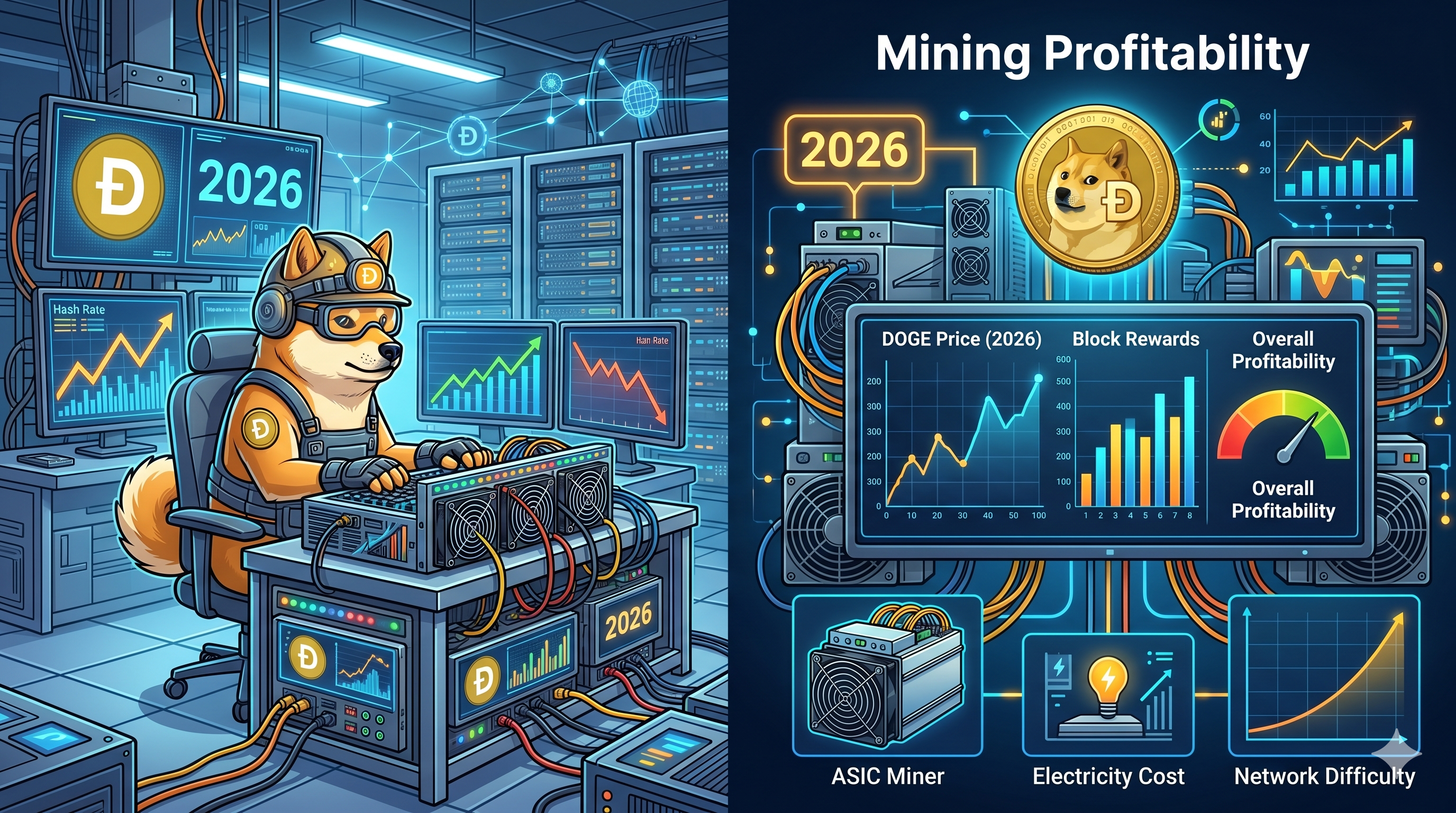
Key Takeaways
-
Profitability is narrow. Miners paying under $0.07/kWh with modern Scrypt ASICs can stay in the green. Above $0.10/kWh, most setups operate at a net loss at current DOGE prices.
-
Merged mining is essential. Mining DOGE and Litecoin simultaneously via the Scrypt algorithm doubles your reward stream at zero extra electricity cost — skipping it in 2026 is a costly oversight.
-
Competition is fierce. The Dogecoin network hashrate stands at ~4.18 PH/s with a difficulty of 61.2 million, up 6.39% in the past 24 hours alone.
-
The Antminer L9 leads hardware. At 16 GH/s and $0.07/kWh, it nets ~$12.55/day — but it's an industrial machine with a steep upfront cost.
-
DOGE price is the wildcard. Trading around $0.09–$0.10 in April 2026, analysts see $0.18–$0.20 as a mid-year target if Bitcoin's macro support holds. A rally would dramatically improve mining economics.
-
Trading may beat mining for many. KuCoin offers instant DOGE exposure, leverage, and copy-trading — no hardware or electricity bills required.
Dogecoin launched in 2013 as an internet joke. By April 2026, it's listed on the Nasdaq via a dedicated ETF (ticker: TDOG), woven into Elon Musk's X Money payment network, and held by institutional funds. The meme grew up.
Yet the question miners have asked for a decade hasn't changed: Is Dogecoin mining actually worth it?
The honest answer is nuanced. Mining DOGE is not a path to overnight riches — it demands the right hardware, cheap electricity, and a clear-eyed understanding of the merged-mining ecosystem it shares with Litecoin. For those who check every box, it still generates consistent cash flow. For those who don't, it's an expensive lesson.
This guide delivers the real numbers: current network stats, top hardware, a straight profitability breakdown, and whether there's a smarter route to DOGE exposure without ever plugging in a miner.
How Dogecoin Mining Works in 2026
Dogecoin runs on the Scrypt hashing algorithm — the same as Litecoin. Early adopters could mine it on consumer GPUs, but those days are long gone. Today, Scrypt ASIC miners dominate the network. GPU mining DOGE in 2026 means spending more on electricity than you'll ever earn in rewards.
Every 60 seconds, the network produces a new block carrying a fixed reward of 10,000 DOGE. Unlike Bitcoin, there's no halving — the reward has been locked at 10,000 DOGE since 2015. This gives miners a predictable, stable incentive to keep the network secure indefinitely, with roughly 14.4 million DOGE entering circulation each day.
The biggest profitability lever in the entire ecosystem is Merged Mining, adopted in 2014. Because DOGE and LTC share the Scrypt algorithm, a single ASIC can validate transactions on both blockchains simultaneously — earning rewards from both chains with zero extra energy. In 2026, running a Scrypt miner without merged mining is simply leaving money on the table.
The competitive landscape is intensifying. The global Dogecoin hashrate currently sits at approximately 4.18 PH/s with a difficulty of 61,259,407 — a 6.39% spike in just the last 24 hours. More miners competing for the same fixed block reward means individual earnings per unit of hashrate keep shrinking, making equipment efficiency the decisive variable for profitability.
The 2026 Hardware Landscape: What Miners Are Actually Using
When comparing mining machines, the metric that matters most is Joules per Megahash (J/MH) — efficiency. Lower is better. It determines how much revenue each watt of power produces, which is ultimately what separates profitable miners from money-losers.
Bitmain Antminer L9 — The Industrial Champion The performance king in 2026: 16 GH/s at 3,360W. At $0.07/kWh, it generates roughly $18.20/day in gross merged mining revenue, translating to ~$12.55/day net profit. Over a year, that's $4,500+ per unit before price shifts. The catch: it's loud (75 dB), power-hungry, and built for industrial farms — not spare bedrooms. ROI window: approximately 8–12 months under current conditions.
Bitmain Antminer L11 Pro — The Balanced Workhorse The L11 Pro delivers near-L9 performance with improved efficiency and lower noise — the preferred choice for operators who want serious throughput without the extreme demands of the flagship. The L11 Hydro 2U variant adds liquid cooling for dense rack environments.
Goldshell DG Max — The Efficiency Leader Released in late 2025/early 2026, the DG Max pushes efficiency to a class-leading 0.13 J/MH at 6.5 GH/s. It generates roughly $7.23/day in income and $1.52/day net profit at $0.07/kWh — modest, but the top pick for miners in high-electricity-cost regions.
Fluminer L1 Pro — The Home-Friendly Option For miners who can't run industrial hardware, the Fluminer L1 Pro offers manageable noise, modest power draw, and residential compatibility. Output is lower — approximately 30–60 DOGE per day — but it's the most accessible on-ramp into the ecosystem.
The golden rule: Before purchasing any hardware, plug your actual local electricity rate into a live calculator like CoinWarz or WhatToMine. Two people buying identical machines can get completely opposite results depending on whether they pay $0.05/kWh or $0.14/kWh.
The Profitability Equation: What the Numbers Say Right Now
Here's the current snapshot as of April 20, 2026:
-
Network Hashrate: ~4.18 PH/s
-
Mining Difficulty: ~61.26 million
-
Block Reward: 10,000 DOGE (fixed)
-
Block Time: ~60 seconds
-
DOGE Price: ~$0.09–$0.10
Profitability by electricity rate (Antminer L9, 16 GH/s, merged mining):
At $0.05/kWh — strong margins. This is the zone where serious operations thrive, typically accessible through industrial contracts, renewable energy, or geographic advantages (Iceland, Paraguay, parts of Central Asia).
At $0.07/kWh — viable business case. Net daily profit of ~$12.55 supports professional operations with a sub-12-month hardware ROI.
At $0.10/kWh — unprofitable. Mining calculators currently show a net daily loss of ~$3.00 at this rate, even with the best available hardware and full LTC merged mining rewards included.
This is why profitable mining in 2026 is increasingly concentrated in regions with industrial power subsidies or renewable infrastructure. The residential miner in Singapore, Germany, or Australia — where electricity routinely exceeds $0.20/kWh — is almost certainly losing money every day.
The "Mine and HODL" Thesis
A significant share of 2026 miners are not chasing day-to-day fiat profit. Their play: accumulate DOGE now at thin margins, then benefit disproportionately from future price appreciation. With the Nasdaq-listed TDOG ETF providing institutional price support, X Money integration giving DOGE genuine payment utility, and the broader market cycling toward its next bull phase — the long-term accumulation case has rarely been stronger. If DOGE doubles to $0.20, a miner running at a modest loss today becomes highly profitable in hindsight without changing a single setting.
Pool Selection
Join a pool supporting merged DOGE and LTC mining — F2Pool, AntPool, and ViaBTC are the top picks in 2026. Most charge 1%–3% in fees. FPPS (Full Pay-Per-Share) payout models, which include a proportional share of transaction fees on top of block rewards, are generally superior to basic PPS for merged mining operations.
Beyond Mining: Why Smart DOGE Investors Are Turning to KuCoin
Here's the question most guides skip: if you're paying above $0.10/kWh, live in a region with grid restrictions, or simply don't want to sink $5,000–$15,000 into ASIC hardware — is there a genuinely better way to gain DOGE exposure?
For a growing number of market participants in 2026, the answer is trading on KuCoin — and the math is hard to argue with.
KuCoin is one of the world's most established crypto exchanges, supporting 700+ trading pairs and a full toolkit for DOGE participants. Consider what mining can't offer: immediate liquidity, zero hardware depreciation risk, no electricity bills, and the ability to go short as well as long. KuCoin delivers all of it.
Spot Trading: Instant DOGE Exposure On KuCoin's DOGE/USDT spot market, you can build a position in seconds. Every dollar goes directly into price exposure — not into a depreciating ASIC sitting in a noisy room. For investors whose thesis is simply "DOGE will be higher in 12 months," this is a cleaner, more capital-efficient entry.
Futures and Hedging for Advanced Participants: KuCoin offers DOGE perpetual contracts with leverage for traders who want amplified directional exposure. Notably, many experienced miners already use KuCoin's DOGE pairs to hedge their mining book — locking in profits when DOGE spikes and reducing downside risk during drawdowns. Mining and trading aren't mutually exclusive; the smartest operators use both.
Copy Trading: The 2026 Elite Trader Premier Program- KuCoin's copy trading ecosystem lets you automatically replicate the positions of verified lead traders — with a minimum entry of just 100 USDT. The platform's 2026 Elite Trader Premier Program, running through May 4, 2026, lets top-tier lead traders earn up to 30% profit sharing and 600 USDT in monthly bonuses, creating genuine alignment between platform, lead trader, and follower. For newcomers who want DOGE market exposure without managing positions independently, it's one of the most accessible entry points available.
A Capital Allocation Reality Check: Consider this: $8,000 invested in an Antminer L9 at $0.10/kWh faces a 3+ year ROI at current prices — and that assumes stable difficulty, no hardware failure, and flat DOGE pricing. The same $8,000 deployed on KuCoin with disciplined risk management offers immediate liquidity, no operational overhead, and direct participation in any DOGE price upside. For most retail participants, the trading route is simply more efficient. Mining is a business for those with structural power cost advantages. For everyone else, KuCoin is where the smarter edge lives.
DOGE Price Outlook and Mining Economics
Mining profitability is permanently tethered to DOGE's market price. With the block reward fixed at 10,000 DOGE, your fiat earnings move in lockstep with the coin's value — which makes the 2026 price trajectory essential reading for any prospective miner.
DOGE currently trades around $0.09–$0.10, having pulled back from earlier highs. KuCoin analysts cite key resistance at $0.135–$0.145, with a potential breakout toward $0.18–$0.20 by mid-2026 if Bitcoin holds above $70,000 and altcoin rotation resumes. A more bullish scenario — accelerated X Money rollout or a broad market rally — could push DOGE toward $0.35–$0.50 by year-end.
The mining implications are direct:
-
At $0.10: most residential setups are at or below break-even
-
At $0.18–$0.20: mid-tier ASICs become profitable even at $0.10/kWh electricity
-
At $0.35+: nearly every modern Scrypt ASIC turns green regardless of moderate power costs
The structural backdrop has shifted meaningfully. The Nasdaq-listed TDOG ETF brings institutional capital with a genuine price floor. X Money positions DOGE as a real transactional currency. And the coin's fixed annual issuance of ~5 billion DOGE is increasingly viewed by analysts as a feature — ensuring miner incentives and coin liquidity remain healthy for the long term, unlike Bitcoin's aggressive tapering.
Conclusion: Is Dogecoin Mining Worth It in 2026?
The straight verdict: Dogecoin mining in 2026 is viable for the right operator, and a poor bet for everyone else.
If you have electricity below $0.07/kWh, the capital for modern Scrypt ASICs, and proper industrial or semi-industrial infrastructure — merged DOGE/LTC mining can generate real, consistent revenue. The fixed 10,000 DOGE block reward and dual-chain income from Litecoin make it a uniquely attractive Proof-of-Work setup that no other major coin replicates.
For the majority paying residential electricity rates, the day-to-day numbers don't work at current DOGE prices. But the long-term accumulation thesis — mining and holding through the lean period in anticipation of the next price leg — has legitimately strong fundamental support in 2026 that it simply didn't have in earlier cycles.
And for those without the infrastructure for mining? KuCoin's DOGE/USDT spot market, perpetual contracts, and copy-trading ecosystem offer a faster, more flexible, and potentially more capital-efficient route to the same upside.
Whatever path you choose: run the numbers first, understand your risks, and never commit capital you can't afford to lose.
FAQs
What is the best Dogecoin mining hardware in 2026?
The Bitmain Antminer L9 leads on raw performance (16 GH/s). The Goldshell DG Max leads on efficiency (0.13 J/MH). For home miners, the Fluminer L1 Pro is the most practical option.
Can you still mine DOGE with a GPU?
Technically, but it's economically unviable. Scrypt ASICs are orders of magnitude more efficient. GPU mining in 2026 guarantees you spend more on electricity than you earn.
What is merged mining and why does it matter?
Merged mining lets a single Scrypt ASIC earn both DOGE and LTC rewards simultaneously using the same computational work. It effectively doubles revenue with no extra electricity cost — skipping it is one of the costliest mistakes a DOGE miner can make.
What electricity rate do I need to be profitable?
Below $0.07/kWh for reliable profitability with current DOGE prices. Above $0.10/kWh, most setups run at a loss. Always verify with a live calculator before purchasing equipment.
Should I mine DOGE or trade it on an exchange?
Mining makes sense as a business for operators with structural electricity cost advantages and the scale to amortize hardware over multiple years. For most individuals, trading DOGE on a platform like KuCoin is simpler, more liquid, and potentially more capital-efficient.
Disclaimer: This article is for informational purposes only and does not constitute financial or investment advice. Cryptocurrency mining and trading involve significant risk. Always conduct your own research before making investment decisions.