

Citrini’s Treasury-Fed Accord Thesis Explained: Why 30-Year Treasuries Could Outperform 5-Year Notes
2026/08/31 11:22:00
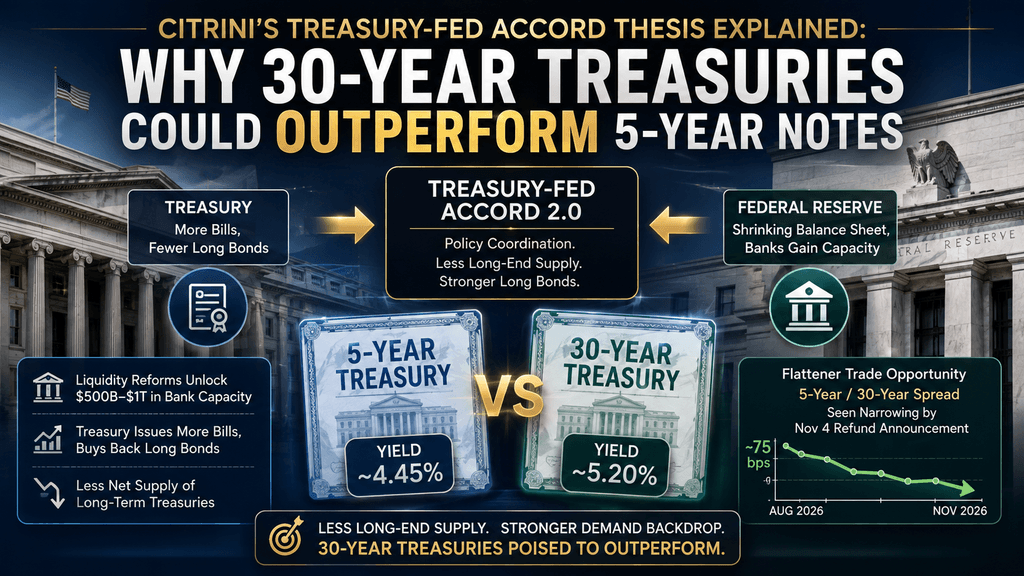
Treasury-Fed Coordination Could Drive a Steeper Demand for Long-Term Bonds
In late August 2026, independent research firm Citrini Research published a detailed macro memo arguing that coordinated policy shifts between the U.S. Treasury and Federal Reserve could reshape the Treasury yield curve over the next three months. The firm, founded by James Van Geelen, frames these developments as a modern “Treasury-Fed Accord 2.0.” Under this framework, the Fed continues shrinking its balance sheet while commercial banks expand capacity through regulatory changes to liquidity rules. Simultaneously, the Treasury tilts issuance toward shorter-maturity bills and expands buybacks of longer-dated debt. The result, according to the analysis, is a reduced net supply of long-duration Treasuries.
Citrini recommends a five-year/30-year flattener trade, expecting the yield gap between the two maturities to narrow meaningfully by the November 4 quarterly refunding announcement. Recent market data shows the 30-year yield near 5.20 percent and the 5-year near 4.45 percent, producing a spread of roughly 75 basis points after the long bond reached multi-year highs above 5.30 percent earlier in the month. The core thesis holds that bank liquidity reforms act as the enabling mechanism for a coordinated reduction in long-end supply, allowing the Fed to shrink its footprint without tightening financial conditions and enabling the Treasury to manage duration risk more effectively, thereby supporting relative outperformance of 30-year Treasuries versus intermediate notes through early November.
How Bank Liquidity Reforms Unlock Hundreds of Billions in Balance Sheet Capacity
Citrini Research identifies proposed changes to the Liquidity Coverage Ratio framework as the foundational element of the new coordination. Treasury Secretary Scott Bessent and Federal Reserve officials, including Vice Chair for Supervision Michelle Bowman, have publicly called for recognizing prepositioned borrowing capacity at the discount window and Federal Home Loan Banks as countable liquidity. Former Fed Governor Stephen Miran quantified the potential impact in a policy paper outlining options for balance-sheet reduction, estimating that capping such recognition at 20 percent of high-quality liquid assets could free between 500 billion and 1 trillion dollars of capacity across the banking system, equivalent to 1.5 to 3 percent of nominal GDP.
This capacity would previously have been tied up in cash or short-term securities held solely to meet regulatory ratios. Banks could then redeploy those resources into lending or securities purchases while maintaining the same coverage ratio. JPMorgan Chase has already operated with a cash-to-assets ratio near 6 percent, the lowest of the post-global financial crisis period, and CEO Jamie Dimon has advocated precisely this recognition of discount-window capacity, estimating nearly 500 billion dollars of additional lendable liquidity for his own institution alone. The reform therefore expands private-sector balance sheets at the same time the central bank contracts its own.
The practical effect is a substitution of holders rather than a net reduction in demand for government paper. Banks historically prefer shorter-duration assets because long-term bonds expose them to mark-to-market losses when rates rise, a lesson reinforced by the 2023 regional bank stresses. Consequently, incremental capacity is more likely to flow into Treasury bills than into 30-year bonds. This preference reinforces the Treasury’s incentive to adjust its issuance mix. Evidence of front-running already appears in large-bank balance-sheet composition, where cash holdings have declined relative to securities even before formal rule changes. The reform therefore serves dual purposes: it supports credit growth and AI-related investment priorities while simultaneously creating natural demand for the very short-term paper the Treasury intends to issue in greater volume.
Treasury’s Expanded Long-Bond Buybacks Signal a Duration Shift
Treasury Secretary Scott Bessent announced in mid-August 2026 that the department would at least double the size of its long-end buyback operations to a minimum of 4 billion dollars per operation, covering the 10-to-20-year and 20-to-30-year sectors through early November. Bessent has described the program as a “Treasury twist.” Unlike the Federal Reserve’s historical Operation Twist, this initiative is executed by the borrower itself: proceeds from additional bill issuance fund the repurchase of longer-maturity debt. The scale remains modest relative to the roughly 10 trillion dollars of outstanding Treasuries with ten or more years to maturity, yet the signaling value is substantial. A subtle linguistic change in the August 5 quarterly refunding statement, from language about potential future “increases” in bond auction sizes to potential future "changes," is interpreted by Citrini as preparation for a structural shift toward more bills and fewer coupons.
The combination of larger buybacks and altered issuance language reduces the net supply of long-duration paper entering the market. Market reaction to the initial announcement was mixed. The 30-year yield briefly retreated from its post-2007 high near 5.33 percent but remained elevated near 5.20 percent by late August. Critics, including investor Stanley Druckenmiller, characterized the buybacks as price management rather than genuine liquidity support and warned of credibility costs. Citrini acknowledges the longer-term risks yet focuses on the near-term supply effect. By retiring longer paper and replacing it with bills that banks are better positioned to absorb, the Treasury can lower the duration of outstanding marketable debt without requiring the Federal Reserve to expand its holdings. The November 4 refunding announcement is identified as the moment when the market is most likely to recognize the full extent of the shift.
Fed Chair Kevin Warsh’s Balance-Sheet Priorities Align with the Framework
Newly installed Federal Reserve Chair Kevin Warsh has repeatedly criticized large-scale asset purchases outside periods of genuine market dysfunction and has established a task force to examine both the size of the central bank’s balance sheet and the maturity composition of its holdings. Warsh’s public emphasis on shrinking the Fed’s footprint coincides with Bessent’s duration-management efforts. Citrini argues that the two officials are pursuing complementary rather than conflicting objectives: the Fed reduces its holdings of longer-duration securities through ongoing quantitative tightening or maturity management, while banks and the Treasury together fill the resulting demand gap with shorter-maturity instruments. This division of labor constitutes the practical content of the “Accord 2.0.” Historical precedent exists in the 1951 Treasury-Fed Accord, which clarified roles after wartime rate pegs, though the current arrangement is framed as voluntary coordination rather than a formal renunciation of independence.
The policy mix is designed to achieve fiscal sustainability improvements without immediately raising the government’s average borrowing cost. By shifting issuance toward bills, the Treasury reduces the term premium embedded in longer yields. Banks, newly empowered by liquidity-rule changes, become the primary absorbers of that short-term paper. The Federal Reserve can therefore continue shrinking its balance sheet without creating a sudden scarcity of safe assets that would otherwise force yields higher across the curve. Market participants who focus solely on the Fed’s quantitative-tightening path or solely on Treasury issuance volumes miss the interactive effect. Citrini’s thesis rests on the joint trajectory of the three actors, Fed, Treasury, and regulated banks, rather than any single lever.
Why Banks Prefer Bills Over Long-Duration Bonds After 2023 Stresses
Commercial banks learned a costly lesson during the 2023 regional banking episode: long-duration securities held in available-for-sale portfolios can generate large unrealized losses when rates rise rapidly, eroding tangible capital and triggering deposit runs. The iShares 20+ Year Treasury Bond ETF, a widely used proxy for long-end exposure, traded near multi-decade lows in mid-August 2026 after a cumulative decline of more than 50 percent from its 2020 peak. Regulatory and internal risk-management frameworks therefore continue to discourage aggressive extension of duration. When liquidity-rule reforms free capacity, banks are expected to deploy it primarily into high-quality liquid assets that carry minimal interest-rate risk, chiefly Treasury bills and short notes. This behavioral constraint is central to the supply-demand imbalance Citrini anticipates at the long end.
The preference is reinforced by the regulatory treatment of different maturities under the Liquidity Coverage Ratio and net stable funding ratio. Short-term government paper receives favorable weighting, while longer bonds consume more balance-sheet capacity relative to their liquidity contribution. As a result, incremental bank demand will concentrate at the front end of the curve even as the Treasury reduces net long-end supply. The combination produces relative scarcity in 30-year paper. Positioning data cited by Citrini indicates that speculative accounts are already heavily short the long bond, amplifying the potential price response once the supply shift becomes visible. A squeeze would not require absolute bullishness on rates; it would require only that the relative scarcity of 30-year securities exceed current market expectations.
Positioning Data Points to Elevated Short Interest in the Long Bond
Citrini shows concentrated short positioning in 30-year Treasuries as a tactical accelerant. Speculative accounts have maintained large short exposure after the long bond’s climb to the highest yields since 2007. When net supply contracts through a combination of larger buybacks and reduced new issuance, the need to cover those shorts can produce outsized price gains independent of broader rate direction. The firm cautions that realizing the squeeze “is going to take some doing,” yet identifies the period leading to the November 4 quarterly refunding announcement as the window in which the Treasury’s intentions become clearest. A five-year/30-year flattener profits from a narrowing of the yield differential rather than from an absolute decline in either yield.
Even if intermediate yields remain stable or rise modestly on growth or inflation data, a larger decline or smaller rise in 30-year yields generates positive returns for the relative-value trade. Historical episodes of supply-driven curve flattening illustrate the mechanism. When the Treasury has previously adjusted auction sizes or maturity composition, the affected sector has often outperformed neighboring maturities for several months. Current positioning magnifies the potential magnitude. The trade is therefore framed as a three-month tactical opportunity rather than a multi-year structural view. Beyond the November refunding, Citrini reverts to a more cautious stance on long-duration bonds, citing the risk that lower yields could stimulate additional borrowing and reintroduce inflationary pressure.
The November 4 Quarterly Refunding Announcement as the Key Catalyst
Treasury’s next quarterly refunding announcement, scheduled for November 4, 2026, is the focal point of Citrini’s timeline. By that date, the firm expects the market to observe concrete evidence of the “Treasury twist” in the form of higher bill auction sizes, maintained or reduced coupon auction sizes, and continued elevated long-end buybacks. The August 5 statement’s shift in language already provided an early signal; the November announcement will either confirm or disappoint the emerging narrative. Between the two dates, ongoing buyback operations and any incremental regulatory progress on liquidity rules can reinforce the thesis.
Market participants who wait for formal confirmation risk missing the bulk of the relative-value move, according to the research. The three-month horizon also coincides with the period in which bank balance-sheet adjustments can begin to materialize. Even partial implementation of discount-window recognition would free measurable capacity. The interaction of these three calendars, Treasury refunding, regulatory rule-making, and Fed balance-sheet runoff, creates a concentrated window for curve dynamics. Outside that window, the longer-term fiscal and inflation outlook reasserts itself, limiting the durability of any long-end rally.
Fiscal Sustainability Goals Underpin the Coordinated Approach
Both Warsh and Bessent have emphasized the need to improve the direction of federal debt service costs. With total public debt having crossed 40 trillion dollars, the average maturity and coupon structure of outstanding debt directly influence interest expense. Shifting new issuance toward bills lowers the weighted-average maturity and, under a positively sloped curve, reduces near-term interest costs. Expanded long-end buybacks further trim the stock of high-coupon longer paper. The strategy does not eliminate the need for primary deficit reduction, yet it buys time and lowers the path of debt service relative to a pure long-bond issuance strategy.
Citrini presents the Accord as a framework that simultaneously shrinks the Fed’s footprint, expands private credit capacity, and moderates the term premium. Critics argue that any artificial suppression of long yields merely postpones necessary fiscal adjustment and risks currency depreciation. Citrini acknowledges the longer-term inflation and credibility risks yet maintains that the near-term supply effect remains tradeable. The distinction between tactical relative-value opportunities and structural bullishness on duration is central to the firm’s recommendation: the five-year/30-year flattener is a three-month position, not a multi-year allocation.
Relative Scarcity of Long-Duration Paper Creates Asymmetric Price Pressure
When the marginal buyer of government debt shifts from the Federal Reserve to commercial banks that prefer short maturities, the long end of the curve experiences a relative scarcity of natural demand. Existing holders of 30-year bonds face less incremental supply competing for their capital, while short-sellers confront a thinner market in which to cover. The resulting price dynamics favor the long end relative to the intermediate sector even if absolute yields remain elevated by historical standards.
Current 30-year yields near 5.20 percent still offer positive real yields under most inflation assumptions, yet the supply reduction can compress the term premium without requiring a broad decline in the neutral rate. This asymmetry is the economic heart of the recommended trade. A parallel decline in both five-year and 30-year yields would leave the spread unchanged; only a differential move, larger price gains, or smaller price losses in the 30-year generates profit. The combination of bank demand concentrated at the front end and Treasury supply concentrated away from the long end produces precisely that differential.
Market Skepticism and Counterarguments from Prominent Investors
Not all market participants accept the premise of effective coordination. Stanley Druckenmiller publicly described Bessent’s buyback program as price management that subsidizes fiscal procrastination. Other strategists have noted that long-end yields continued to climb after the initial announcement, suggesting limited immediate impact. Concerns about residual inflation pressures, tariff effects, and elevated AI-related corporate bond issuance also weigh on the long end.
Citrini’s response is temporal: the firm does not claim the strategy solves structural fiscal challenges, only that the near-term supply and positioning dynamics favor a relative rally in the 30-year paper through early November. The divergence of views underscores the importance of monitoring actual auction sizes and buyback volumes rather than relying solely on rhetorical signals. If the November refunding statement reaffirms or expands the shift toward bills, the thesis gains empirical support. If coupon sizes rise instead, the relative-value trade would face headwinds.
Results for Curve Trades and Portfolio Construction
Investors who accept the core logic can express the view through a cash or futures flattener between the five-year and 30-year points or through options structures that benefit from a compression of the spread. Because the trade is relative, it carries lower directional exposure to the overall level of rates than an outright long-bond position. Portfolio managers with existing intermediate-duration holdings may consider modest extensions into the long end financed by reductions in five-year exposure.
The limited three-month horizon also allows the position to be reassessed after the refunding announcement without requiring a multi-year commitment to long duration. Risk management remains essential. An unexpected acceleration of inflation data, a hawkish shift in Fed communication, or a reversal of the buyback program could widen rather than narrow the spread. Position sizing and stop-loss discipline therefore form part of any practical implementation.
Market Reaction to Elevated Term Premiums and Debt Levels
The current environment features a term premium that has risen alongside the stock of public debt and the volume of long-duration corporate issuance linked to artificial-intelligence infrastructure. Thirty-year yields have spent much of 2026 near or above 5 percent, levels last sustained before the global financial crisis. In this setting, any policy action that reduces net long-end supply carries amplified price impact.
Citrini’s thesis exploits precisely that sensitivity: a modest reduction in supply can produce a meaningful relative move when the marginal buyer is already scarce, and speculative positioning is skewed short. The same elevated yields also provide a cushion. Even after a partial rally, 30-year paper would still offer yields well above the multi-decade average, limiting the downside for holders who enter at current levels. The combination of tactical supply dynamics and still-attractive absolute yields forms the practical case for the recommended relative-value position.
Monitoring Indicators for Validation or Invalidation of the Thesis
Key data points over the coming weeks include the size and composition of Treasury auctions, the volume and tenor of buyback operations, any formal regulatory proposals on discount-window recognition, and changes in bank cash and securities holdings reported in weekly H.8 data. Yield-curve spreads, particularly the five-year/30-year differential, and measures of speculative positioning in Treasury futures will provide real-time feedback.
A sustained narrowing of the spread accompanied by rising bank holdings of bills would corroborate the framework. Widening of the spread or a return to larger coupon auction sizes would challenge it. Continuous observation of these indicators allows market participants to update probabilities as new information arrives.
FAQs
What is the historical Treasury-Fed Accord, and how does the current thesis differ from it?
The 1951 Accord ended the wartime practice of the Federal Reserve pegging Treasury yields to support government financing and restored the central bank’s ability to set rates according to macroeconomic conditions. Citrini’s “Accord 2.0” is an informal, prospective coordination rather than a formal agreement. It envisions the Fed continuing to shrink its balance sheet while the Treasury and banks jointly manage duration, without requiring the Fed to subordinate monetary policy to fiscal needs. The parallel lies in clarifying roles so that each institution can pursue its primary objectives without creating market dysfunction.
How large is the potential capacity unlocked by liquidity-rule changes?
Estimates cited by Citrini from former Fed Governor Stephen Miran range from 500 billion to 1 trillion dollars system-wide if prepositioned discount-window capacity is recognized up to 20 percent of high-quality liquid assets. Individual large banks have indicated that the same change could free hundreds of billions for their own balance sheets. The figures represent potential rather than guaranteed capacity and depend on the final form of any regulatory amendment.
Why does Citrini focus on a three-month horizon ending in early November?
The November 4 quarterly refunding announcement is the next major opportunity for the Treasury to formalize any shift in issuance mix. By that date, ongoing buybacks and any progress on bank liquidity rules should also be more visible. The firm treats the period as a discrete tactical window rather than a multi-year structural call, after which longer-term fiscal and inflation considerations regain prominence.
What risks could cause the five-year/30-year spread to widen instead of narrow?
Faster-than-expected inflation, a hawkish turn in Federal Reserve communication, a reversal or scaling back of long-end buybacks, or an increase in coupon auction sizes relative to bills would all pressure the long end more than the intermediate sector. Elevated short positioning also means that any disappointment could trigger short-covering in reverse if the supply narrative fails to materialize.
How does bank preference for short-term paper affect the overall demand for Treasuries?
Banks are expected to absorb a larger share of the bill market once liquidity capacity is freed. This demand supports the front end of the curve and simultaneously reduces the pool of natural buyers for longer-duration bonds. The net effect is relative scarcity at the long end even if total government borrowing remains unchanged.
Is the recommended trade an outright bullish bet on falling long-term yields?
No. The position is a relative-value flattener that profits when 30-year yields fall more, or rise less, than five-year yields. Absolute yields can remain elevated or even increase modestly provided the differential compresses. This construction reduces exposure to parallel shifts in the entire curve.
Disclaimer: This content is for informational purposes only and does not constitute investment advice. Cryptocurrency investments carry risk. Please do your own research (DYOR).
🔥 KuCoin Offers A More Stable Option in A Volatile Market
If you worry about the frequent ups and downs in the market, and pursue a more stable option to earn money passively, KuCoin is the right place to come:

Simple Earn: Deposit and withdraw tokens anytime, earning stable returns.
Kucoin Earn: Earn stable profits with professional asset management.
Hold to Earn: Earn rewards by holding assets in Funding, Trading, Margin, Futures, Mining, and Unified Accounts.
Staking: Unlock the earning potential of on-chain assets.
Advanced Investments: Advanced Investments offer a variety of structured products to help your money grow in any market.
Shark Fin: Principal Protection and Guaranteed Gains
Dual Investment: Buy low and sell high with transparent return calculations.
Snowball: High yields, with price protection.
Discount Buy: Buy crypto at discount prices.
KCS Loyalty: Level up to enjoy exclusive perks by staking ≥ 1 KCS.
KuCoin Wealth: Discover future value and begin your smart investing journey.
KCS Benefits: Hold and stake KCS to access benefits across the platform.
KCS Staking 2.0: Participate in KCS on-chain governance to earn yield.
Disclaimer: This content is for informational purposes only and does not constitute investment advice. Cryptocurrency investments carry risk. Please do your own research (DYOR).