

Bitcoin Price Falls as US Inflation Hits 3.7%: Will October Fed Rate Hike Bets Pressure BTC?
Introduction
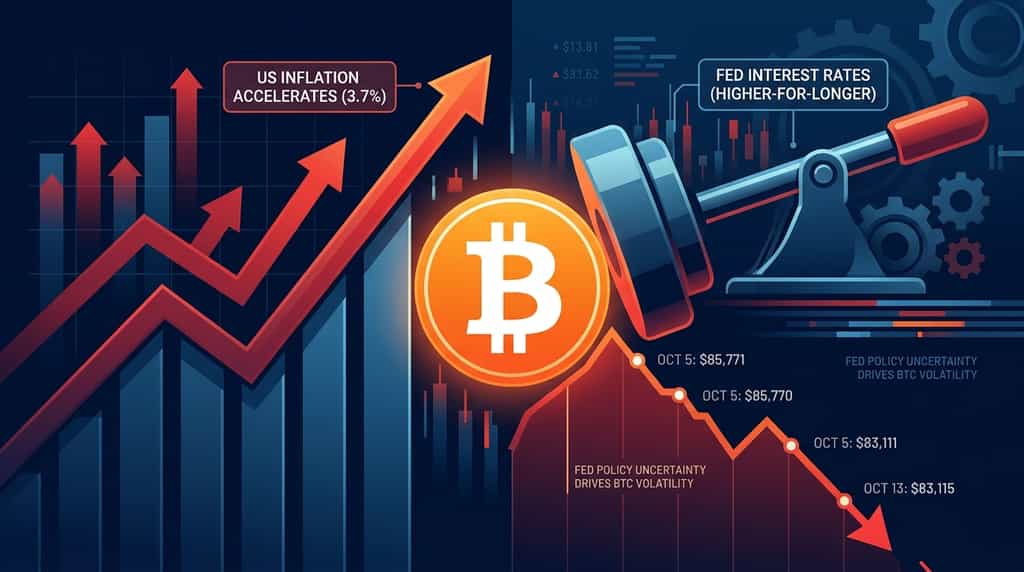
Bitcoin price came under renewed pressure as hotter-than-expected US inflation strengthened concerns that the Federal Reserve could keep monetary policy restrictive for longer. According to the US Bureau of Labor Statistics (BLS), the Consumer Price Index (CPI) rose 3.7% year over year in September 2026, accelerating from 3.4% in August, while monthly inflation increased from 0.4% to 0.6%. The data has revived market discussion about a possible Fed rate hike, although an increase at the October meeting is not guaranteed. Bitcoin's price fell from around $85,771 on October 5 to $83,115 on October 13, based on historical data from CoinGecko.
The key question for crypto investors is whether persistent inflation and higher-for-longer interest rates will extend BTC's pullback or whether the market has already priced in much of the risk.
Why Did Bitcoin's Price Fall After the Latest US Inflation Report?
Bitcoin's recent weakness reflects concerns that persistent inflation could delay monetary easing and reduce demand for risk-sensitive assets. The September CPI report added to uncertainty around the Fed's next policy decision, putting interest rates and the US dollar back at the center of the crypto market outlook.
According to the BLS September 2026 CPI release, the headline CPI increased 0.6% month over month, following a 0.4% rise in August. Annual inflation reached 3.7%, up from 3.4% the previous month. The energy index increased 5.2% in September, while gasoline prices rose 9.1%, accounting for more than half of the monthly increase in the overall index. These figures indicate that higher energy costs were a major contributor to the latest inflation acceleration.
Bitcoin's price action shows that the market was already under pressure before the September inflation figures were released. BTC closed at approximately $85,771 on October 5 and $83,115 on October 13, a decline of about 3.1%. This comparison captures the market's recent pullback, but it does not establish that inflation alone caused the move. Crypto prices can also respond to leveraged positioning, profit-taking, liquidity changes, and broader investor sentiment.
The distinction matters because markets react to the difference between reported data and prior expectations. When inflation runs hotter than anticipated, investors may revise their outlook for interest rates, bond yields, and the dollar. Bitcoin can then face selling pressure as traders reassess the opportunity cost and risk of holding a volatile asset. However, a price decline around an economic release is not proof of a single cause, and subsequent market movements may reverse if new data changes expectations.
How Could Higher US Inflation Affect the Federal Reserve's October Rate Decision?
Higher inflation makes an immediate shift toward easier monetary policy more difficult, but it does not automatically mean the Fed will raise rates in October. Policymakers must assess whether price pressures are persistent, whether inflation is spreading beyond volatile categories, and how monetary policy is affecting employment and economic activity.
The Fed's inflation target is 2% over the longer run, measured using the Personal Consumption Expenditures (PCE) price index rather than CPI. The September CPI report is therefore an important signal, but it is not the Fed's sole decision-making input. Officials also examine labor-market conditions, inflation expectations, consumer spending, financial conditions, and the PCE data.
Market expectations can change quickly as new information arrives. The CME FedWatch tool uses 30-day federal funds futures prices to estimate the probabilities of different Fed policy outcomes at upcoming meetings. These probabilities reflect market pricing, not a promise from policymakers or a definitive forecast. Traders should distinguish between the market assigning a higher probability to a rate hike and the Fed actually deciding to increase rates.
The October decision also depends on how officials interpret the sources of inflation. If energy costs are responsible for much of the increase and other price pressures remain contained, policymakers may prefer to wait for more evidence before tightening further. If inflation broadens, expectations rise, or price growth remains persistently above target, the case for restrictive policy becomes stronger. For Bitcoin, uncertainty about that decision can be enough to increase volatility even before the Fed announces its next move.
Does the September CPI Report Mean Bitcoin Will Keep Falling?
No. The latest inflation report increases the risk of restrictive monetary policy, but it does not establish that Bitcoin will continue declining. The next move will depend on how investors interpret incoming economic data, how Fed expectations evolve, and whether BTC demand can absorb selling pressure.
Three scenarios help frame the possible outcomes.
Scenario 1: Inflation Remains Elevated and the Fed Turns More Hawkish
If upcoming inflation indicators remain firm and Fed officials signal that further tightening may be necessary, Bitcoin could face continued pressure. Higher expected rates may support the dollar and bond yields while encouraging investors to reduce exposure to volatile assets. A break below recent trading levels could also trigger stop-loss orders and leveraged liquidations, potentially intensifying a decline.
In this scenario, traders may monitor price support, spot-market demand, futures funding rates, and open interest for signs of whether selling pressure is broadening. None of these indicators predicts the market with certainty, but together they can help distinguish a controlled pullback from a more disorderly move.
Scenario 2: Inflation Pressure Proves Temporary
If the rise in headline inflation is concentrated in energy and subsequent data shows that broader price pressures are easing, markets may reduce expectations for additional tightening. A less hawkish outlook could improve risk sentiment and support a Bitcoin recovery, particularly if buyers return to spot markets.
That outcome would not guarantee a rally. Bitcoin could still face resistance from investors who bought at higher prices or from traders reducing risk after recent volatility. A sustained recovery would be more convincing if price strength were accompanied by healthy spot demand rather than driven primarily by leveraged positions.
Scenario 3: The Fed Holds Rates but Keeps a Hawkish Stance
A third possibility is that the Fed leaves rates unchanged while signaling that inflation remains a concern. This could produce a mixed response: avoiding an immediate hike may initially support risk assets, but a warning that rates could rise later may limit the recovery.
The market's reaction would depend on whether the decision is more restrictive or less restrictive than investors had anticipated. For this reason, the Fed's statement, projections, and subsequent communication may matter as much as the rate decision itself. Investors should avoid assuming that a rate hold automatically translates into a bullish outcome for Bitcoin.
How Can You Trade Bitcoin on KuCoin During Macroeconomic Volatility?
You can access Bitcoin markets through KuCoin's BTC trading page, but a trading decision should follow your risk plan rather than a prediction about the Fed's next move. Visit the KuCoin BTC/USDT market to review the available market interface and check current trading availability in your region.
Before placing an order, decide whether your objective is to build a long-term spot position or trade short-term price movements. Spot trading avoids the liquidation mechanics associated with leveraged derivatives, although the value of the Bitcoin you purchase can still fall significantly. If you use derivatives where available, review contract specifications, margin requirements, funding costs, and liquidation rules before trading.
Compare the current BTC price with your planned entry, exit, and maximum acceptable loss. Consider whether the trade remains reasonable if the Fed holds rates, raises them, or signals that a future hike is possible. Avoid using money needed for near-term expenses, and do not assume that a lower price automatically represents a bargain. Market conditions can remain unfavorable longer than expected, particularly when inflation and monetary policy are uncertain.
KuCoin provides access to crypto markets, not a guarantee of returns or a prediction of Federal Reserve policy. Confirm the products available to you and understand the risks before proceeding.
Conclusion
The September 2026 US inflation report has increased uncertainty around the Federal Reserve's next policy decision and renewed concerns about the potential for higher interest rates. According to the BLS, headline CPI rose 3.7% year over year and 0.6% month over month, with higher gasoline prices contributing substantially to the monthly increase. Bitcoin's recent decline shows that the market has been under pressure, but price movements alone cannot prove that inflation was the only cause.
The central issue for BTC is whether inflation remains persistent enough to keep monetary policy restrictive. Higher expected rates, rising Treasury yields, and a stronger US dollar can weigh on risk appetite, while easing inflation or a less hawkish Fed outlook may help stabilize sentiment. Neither outcome guarantees a particular Bitcoin price direction.
Investors should monitor new inflation data, CME FedWatch expectations, bond yields, the dollar, and crypto-market positioning rather than relying on a single headline. A disciplined approach to position sizing and leverage is especially important around major economic releases. Bitcoin remains volatile, and the October rate decision is only one of several factors that can shape its short-term performance.
FAQs
1. What is the difference between CPI and PCE inflation?
CPI measures changes in prices paid by urban consumers for a basket of goods and services. PCE inflation measures prices of goods and services consumed by households using a different methodology and expenditure weighting. The Federal Reserve uses the PCE price index as its primary inflation measure for its 2% longer-run target.
2. Can Bitcoin act as a hedge against inflation?
Bitcoin is sometimes described as an inflation hedge because its protocol limits its maximum supply to 21 million BTC. However, its market price can be highly volatile and may fall during periods of rising inflation or tighter monetary policy. Its historical behavior does not establish that it will reliably preserve purchasing power over any particular period.
3. What is dollar-cost averaging in Bitcoin investing?
Dollar-cost averaging involves investing a fixed amount at regular intervals instead of investing the entire amount at once. It can reduce dependence on a single entry price, but it does not prevent losses or guarantee better returns than investing a lump sum. The strategy should match the investor's budget, time horizon, and risk tolerance.
Disclaimer
This article is for informational purposes only and does not constitute financial, legal, or investment advice. Always conduct your own research before interacting with digital assets.