

Anthropic Q3 2026 Revenue Reaches $16.8 Billion: Growth, Profitability, and IPO Outlook
Introduction
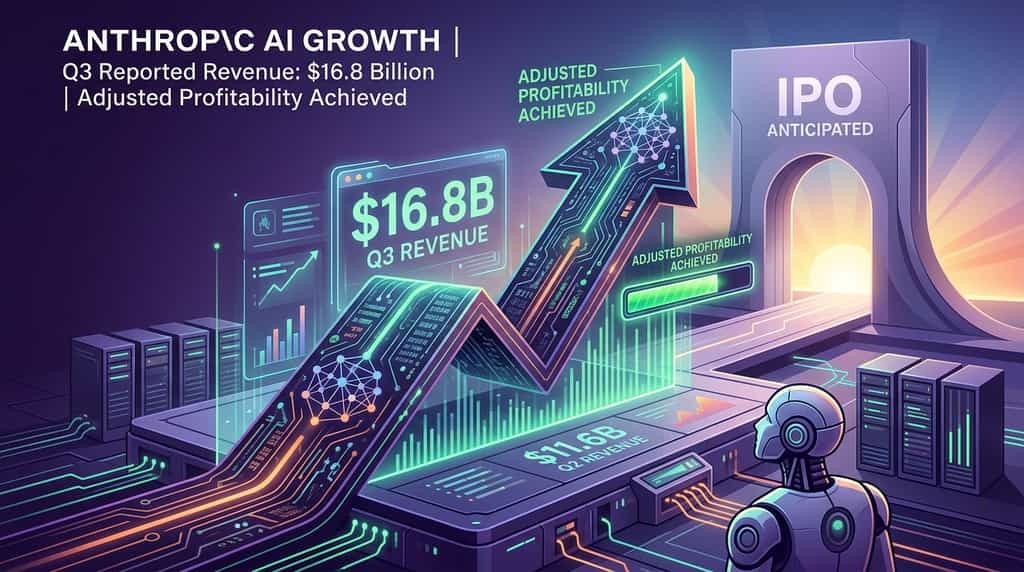
Anthropic's reported third-quarter 2026 revenue of $16.8 billion puts the Claude developer at the center of the artificial intelligence (AI) investment debate ahead of its anticipated initial public offering (IPO). The company reportedly told prospective investors that Q3 revenue rose approximately 45% from $11.6 billion in Q2, while it achieved adjusted profitability for the quarter. These figures suggest that enterprise demand for AI models and coding tools is translating into substantial commercial revenue, although investors must also consider slowing growth, infrastructure costs, and intensifying competition.
The key distinction is that the $16.8 billion figure comes from reports of a private investor briefing, rather than a publicly released quarterly filing. Anthropic has previously confirmed that it confidentially submitted a draft registration statement to the US Securities and Exchange Commission (SEC), but the timing, valuation, and terms of a potential IPO remain subject to change. Investors evaluating Anthropic's IPO prospects should therefore separate reported financial performance from confirmed company disclosures and assumptions about its future public-market valuation.
What Does Anthropic's $16.8 Billion Q3 Revenue Figure Mean?
Anthropic's reported $16.8 billion in Q3 2026 revenue indicates that demand for its AI products has grown rapidly, but the pace of growth matters as much as the headline number. According to reporting on the company's October 14 investor briefing, quarterly revenue increased from $11.6 billion in Q2 to $16.8 billion in Q3, an increase of approximately 45%. The same reports said Anthropic achieved adjusted profitability in the quarter. These figures have not yet been presented in a public quarterly financial filing, so they should be treated as reported results rather than audited public-company disclosures.
How Fast Is Anthropic's Revenue Growing?
The reported quarterly figures show strong sequential growth, alongside a potential moderation in momentum. Revenue reportedly rose from approximately $4.7 billion in Q1 2026 to $11.6 billion in Q2 and $16.8 billion in Q3. The increase from Q1 to Q2 was much larger in percentage terms than the rise from Q2 to Q3, suggesting that the extraordinary acceleration earlier in the year may be easing.
That change does not necessarily mean demand is weakening. As a company's revenue base expands, maintaining the same percentage growth rate becomes more difficult. However, the distinction is important for IPO investors because valuation depends partly on how quickly revenue can grow from an already substantial base. A company can continue adding billions of dollars in revenue while its growth rate declines, and public-market investors may still lower their valuation expectations if growth falls short of forecasts.
Does Adjusted Profitability Mean Anthropic Is Profitable?
Reported adjusted profitability is an encouraging signal, but it does not establish that Anthropic is profitable under every accounting measure. Adjusted results can exclude expenses that remain economically meaningful, such as stock-based compensation or other costs specified by the company. Investors will need to review the precise definition of adjusted earnings, operating income, net income, and cash flow when formal IPO disclosures become available.
For a capital-intensive AI developer, cash generation is especially important. Training and operating advanced models require computing capacity, data centers, networking, specialized chips, and research staff. Revenue growth can improve the economics of those investments, but high infrastructure commitments can also consume substantial cash. Until Anthropic publishes fuller financial statements, investors should avoid treating a reported adjusted profit as proof of durable, generally accepted accounting principles (GAAP) profitability or positive free cash flow.
Why Is Anthropic Advancing Toward an IPO?
Anthropic's IPO preparations could give the company access to a broader pool of capital while allowing public-market investors to evaluate its growth and financial risks. The company confirmed in an official announcement on June 1, 2026 that it had confidentially submitted a draft Form S-1 registration statement to the SEC for a proposed offering of common stock. Anthropic said the submission gave it the option to go public after the SEC completed its review, depending on market conditions and other factors.
A confidential filing is an important procedural step, but it is not a guarantee that an IPO will occur on a particular date. It also does not establish the final share count, offering price, valuation, or amount of capital to be raised. Those details depend on the registration process, market demand, and decisions made closer to a potential listing.
What Could Anthropic Gain From Going Public?
An IPO could provide funding for AI research, product development, computing infrastructure, and international expansion. Public shares may also give Anthropic a more liquid form of equity compensation for employees and a publicly traded currency that could support future strategic transactions. A listing would also bring more structured disclosure requirements, allowing investors to examine revenue composition, expenses, customer concentration, and risk factors in greater detail.
The trade-off is that public-market scrutiny can intensify pressure to deliver predictable results. Investors may expect Anthropic to demonstrate not only rapid adoption but also improving margins, responsible capital allocation, and a credible route to sustained cash generation. If revenue growth slows faster than anticipated, a newly listed company could face valuation pressure even if its business continues to expand.
How Should Investors Interpret IPO Valuation Expectations?
Investors should distinguish between a reported or proposed valuation and the final valuation implied by the IPO price. A private funding valuation, a target discussed during IPO preparations, and a public-market valuation are different measures established under different circumstances. Any valuation figure circulating before the final prospectus should therefore be treated as provisional unless confirmed in official offering documents.
A useful starting point is to compare the company's potential market capitalization with its revenue, expected growth, margins, and future capital requirements. Revenue multiples can help investors compare fast-growing software and AI businesses, but they are not sufficient on their own. Two companies with similar revenue may deserve very different valuations if one has stronger margins, lower customer-acquisition costs, more recurring revenue, or less dependence on outside computing providers.
What Are the Biggest Risks Facing Anthropic Before Its IPO?
Anthropic's key risks include slower revenue growth, fierce competition, high computing costs, and uncertainty about how quickly AI products can generate sustainable profits. These factors can affect both its operating performance and the valuation investors are willing to pay for its shares. Strong revenue alone cannot remove these risks.
Could Competition Slow Anthropic's Growth?
Competition could pressure Anthropic through lower prices, faster model improvements, or the emergence of capable alternatives. Anthropic competes in a market where other AI developers, cloud platforms, and open-source projects are also investing heavily in model development. Large customers may negotiate discounts or distribute workloads among multiple providers, limiting any single vendor's pricing power.
Model performance is only one factor in this competition. Buyers also evaluate reliability, data protection, compliance requirements, integration options, latency, and the total cost of operating an AI system. Anthropic will need to keep improving its products while making them practical and economical for enterprise customers. If competing systems deliver comparable results at a lower cost, Anthropic may have to reduce prices or spend more on research and infrastructure to maintain its position.
How Could Computing Costs Affect Profitability?
AI models require substantial computing resources for both training and inference, which is the process of generating outputs in response to user requests. As customer usage increases, Anthropic may need to secure more chips, data-center capacity, and energy. Higher demand can increase revenue, but it can also increase the cost of serving each customer.
The relationship between revenue and computing expenditure will be a critical measure of business quality. If model efficiency improves and customers pay more for valuable applications, revenue may grow faster than operating costs. If usage rises but prices fall sharply or computing requirements increase, margins could remain under pressure. IPO investors should therefore assess gross margin, operating expenses, capital commitments, and cash flow alongside reported revenue growth.
Beyond the Headlines: What KuCoin 5.0 Means for You
Market news moves fast — but where you act on it matters just as much. This October, KuCoin launches KuCoin 5.0, transforming KuCoin into a rebuilt platform. Here's what actually changes for you:
-
One account for everything. Older platforms split your money across separate "spot," "margin," and "futures" accounts and expected you to understand why. KuCoin 5.0's unified account removes that entirely — deposit once, and everything is simply there (only available to VIPs for now).
-
Stocks, indices, and commodities. KuCoin 5.0 expands beyond crypto into global markets. When crypto chops sideways and equities rally (or the reverse), you rotate in minutes instead of opening a brokerage account and waiting days for fiat rails.
-
Real-world assets (RWA). Tokenized exposure to traditional assets like commodities, right inside your crypto account. One of the fastest-growing segments in global finance is no longer reserved for institutions — you access it from the same balance you trade with.
-
Earn while you learn. Not ready to trade? KCUSD lets your stablecoins earn daily, auto-compounding interest. The lowest-stress way to put your idle deposit to work for 4% yield.
-
An AI assistant in plain language. Ask questions, get market context, understand what you're looking at — built into the platform, no jargon required.
-
An app that doesn't overwhelm. Faster, cleaner, and consistent — intuitive from the first tap, not after a tutorial.
-
Safety you can check, not just trust. A MiCAR-licensed EU entity, Proof of Reserves you can verify yourself, and internationally certified security (SOC 2 Type II, ISO 27001:2022).
Create your account in minutes — and start on the platform built for where crypto is going, not where it's been.
Conclusion
Anthropic's reported Q3 2026 revenue of $16.8 billion highlights the commercial momentum behind Claude and the broader enterprise AI market. The reported increase from $11.6 billion in Q2, alongside adjusted profitability, suggests that Anthropic is scaling its business rapidly as it prepares for a possible public listing. Its confirmed confidential S-1 submission also indicates that IPO preparations have progressed beyond speculation, although the final timing, offering terms, and valuation remain uncertain.
For prospective investors, the central question is whether Anthropic can turn rapid revenue growth into sustainable profits and cash flow. Enterprise adoption and AI coding tools may support continued demand, but slowing growth, competitive pressure, infrastructure spending, and regulatory exposure could affect future results. Adjusted profitability should also be assessed against the company's formal accounting disclosures once they become available.
A potential IPO could offer investors an opportunity to evaluate Anthropic through public-market disclosures, but the quality of the business and the price of its shares are separate considerations. Investors should review the prospectus, assess valuation assumptions, and compare multiple financial scenarios before deciding whether an offering fits their objectives and risk tolerance.
FAQs
1. Is Anthropic a publicly traded company?
No public listing has been confirmed in the information cited here. Anthropic announced that it confidentially submitted a draft S-1 registration statement to the SEC in June 2026, but a confidential filing does not mean its shares are already publicly tradable.
2. What is Anthropic's main product?
Anthropic develops Claude, a family of AI models and related products used for tasks such as writing, analysis, coding, and enterprise workflows. Its offerings include products for individual users, businesses, and developers integrating AI through APIs.
3. What does a confidential S-1 filing mean?
A confidential S-1 submission allows a company to begin the SEC registration review process without immediately making the draft registration statement public. The company must still meet applicable requirements before an IPO can proceed, and the filing does not guarantee that a listing will occur.
Disclaimer
This article is for informational purposes only and does not constitute financial, legal, or investment advice. Always conduct your own research before interacting with digital assets.