

Aerodrome and Velodrome Merge Into Aero: AERO and VELO Token Migration Guide
Introduction
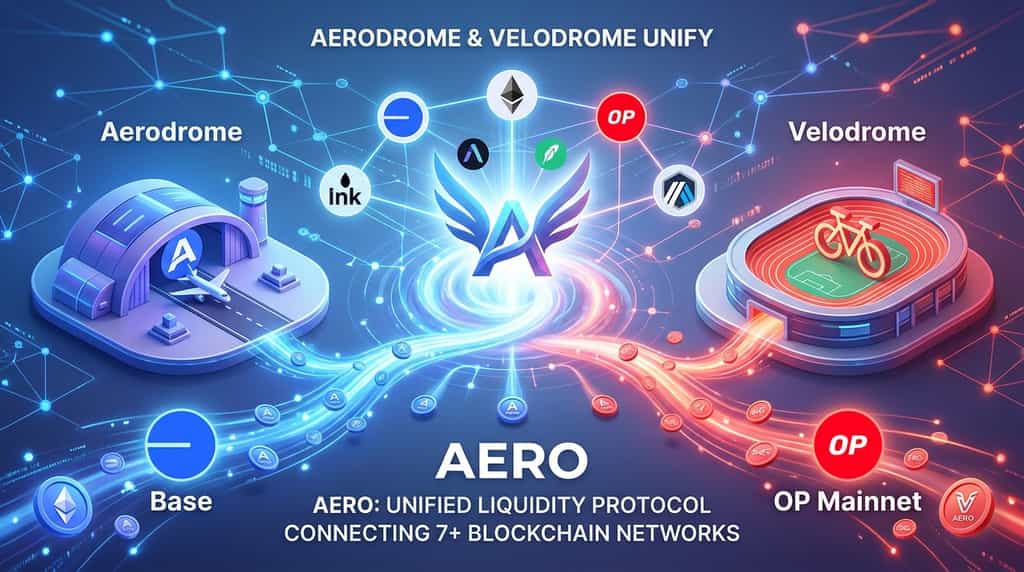
Aerodrome and Velodrome have combined their decentralized exchange ecosystems to launch Aero, a unified liquidity protocol designed to connect trading and liquidity incentives across multiple blockchain networks. The transition, which went live on October 22, 2026, introduces a new AERO token, replaces the previous veAERO and veVELO locking systems with sAERO, and changes how participants direct liquidity rewards and earn protocol revenue.
For existing token holders, the most important detail is the conversion ratio: 1 legacy AERO converts to 1 new AERO, while 1 VELO converts to 0.044 new AERO. The upgrade is not automatic for self-custody wallets. Holders need to follow the official migration process, and users who keep assets on centralized exchanges should check each platform's instructions.
According to the official Aero Upgrade and Launch Hub, the new protocol launched across seven networks: Base, Ethereum Mainnet, OP Mainnet, Arbitrum, Ink, Arc, and Robinhood Chain. The merger also changes token supply, staking, and liquidity incentives, making it important for AERO and VELO holders to understand the transition before managing their assets.
What Is the Aero Merger, and Why Did Aerodrome and Velodrome Combine?
The Aero merger brings Aerodrome and Velodrome under one protocol, combining their liquidity networks and token economics into a shared system. Aerodrome previously focused on Base, while Velodrome served as a major decentralized exchange and liquidity coordination layer on OP Mainnet. Aero aims to extend their combined model across a broader network of blockchain ecosystems.
Both predecessor protocols used automated market makers, which allow users to swap digital assets through liquidity pools rather than relying on a traditional order book. Liquidity providers deposit assets into pools, while token holders participate in directing incentives toward selected markets. This structure connects trading activity, liquidity provision, and token-based governance.
The unified protocol is intended to make liquidity and reward allocation work across several supported chains. According to Aero's official launch hub, the new system allows sAERO holders to allocate AERO rewards to eligible pools across Aero's supported networks. Participants can also earn a share of exchange revenue from the pools to which they allocate rewards, subject to the protocol's rules and the revenue those pools generate.
The merger is therefore more than a change in branding. It consolidates two token systems, changes how liquidity incentives are allocated, and creates a shared economic framework. However, combining protocols does not automatically guarantee higher trading volume, deeper liquidity, or stronger token demand. Those outcomes depend on user activity, liquidity-provider participation, market conditions, and how effectively Aero attracts trading across its supported networks.
What Are the AERO and VELO Token Conversion Ratios?
The conversion ratio determines how many new AERO tokens eligible holders receive for their existing AERO or VELO balances. According to the official Aero migration documentation, the conversion terms are:
| Existing asset | Conversion ratio | New asset received |
| 1 legacy AERO | 1:01 | 1 new AERO |
| 1 legacy VELO | 1:0.044 | 0.044 new AERO |
| veAERO | Based on the underlying AERO position | sAERO |
| veVELO | Based on the underlying VELO position and applicable conversion terms | sAERO |
The 1:1 conversion means that a holder of 1,000 legacy AERO is eligible to receive 1,000 new AERO through the upgrade process. A holder of 10,000 VELO, by comparison, would receive 440 new AERO at the announced ratio, before any applicable network fees or other costs.
The difference between the two ratios reflects the allocation of the new token supply, not a direct statement about the relative market value of the old tokens. Aero's published terms allocate 94.5% of the new AERO supply to the Aerodrome side and 5.5% to the Velodrome side. The 0.044 conversion rate translates the allocation for Velodrome holders into a per-token amount based on the expected token supplies at launch.
Holders should also distinguish token quantity from market value. Receiving a specific number of new tokens does not guarantee that their combined market value will match the value of their former holdings. Market prices can change during a migration, and liquidity conditions may differ between the legacy assets and the new token.
How Does the AERO Token Supply Change After the Merger?
The merger expands AERO's combined token supply because VELO holders receive a share of the unified token. According to Aero's published launch parameters, the new token has an expected maximum supply of approximately 2.127 billion AERO, compared with approximately 2.01 billion legacy AERO before the merger. Expected circulating supply rises from about 1.01 billion to a maximum of approximately 1.07 billion at launch, based on the protocol's published estimates.
The new supply allocation reflects the conversion terms: Aerodrome holders receive 94.5% of the new supply, while Velodrome holders receive 5.5%. The migration therefore incorporates VELO holders into the unified token economy without using a 1:1 token conversion for both legacy assets.
Aero's launch hub also states that the realized annual inflation rate is expected to be approximately 12%, with an annual rate ceiling of 20% at launch. These are protocol estimates and parameters, not guaranteed future outcomes. Actual token issuance and circulating supply will depend on how the protocol's emission rules and economic mechanisms operate.
Token emissions matter because new supply can affect the balance between token issuance and demand. The effect depends on how rewards are distributed, whether recipients retain or sell their tokens, and whether protocol activity generates sufficient demand. A higher supply does not automatically mean a lower price, just as a lower supply does not automatically imply a higher price. Holders should evaluate token economics alongside trading activity, liquidity, and the protocol's ability to generate revenue.
What Risks Should AERO and VELO Holders Consider After the Merger?
The merger creates a unified token economy, but it also introduces migration, market, smart-contract, and tokenomics risks. Holders should understand these risks before deciding whether to upgrade, stake tokens, or provide liquidity.
Migration and operational risk: The conversion process involves interacting with smart contracts and, for some holders, moving between networks. Incorrect addresses, incompatible wallets, insufficient gas tokens, or mistakes during the migration process can result in delays or asset loss. Users should follow official documentation and verify transaction details before confirming any action.
Smart-contract and security risk: Aero relies on smart contracts to manage token conversions, liquidity pools, reward allocations, and revenue distribution. Smart-contract vulnerabilities, integration issues, or unexpected behavior could affect user assets or protocol operations. Using an established protocol does not eliminate these risks.
Market and liquidity risk: The new AERO token may experience price volatility as holders migrate, trading venues adjust support, and market participants reassess the combined token economy. Liquidity can vary across exchanges and trading pairs. A published conversion ratio determines the number of tokens received, not the market price at which those tokens can be sold.
Token supply and reward risk: The protocol's emission parameters and revenue-sharing design affect the economics of holding and staking AERO. New token issuance can create selling pressure, while exchange revenue depends on actual trading activity and applicable protocol rules. Neither rewards nor future token demand are guaranteed.
Governance and execution risk: A successful merger requires the new system to attract users, maintain liquidity, and deliver a workable experience across its supported networks. Technical integration and a larger network footprint do not by themselves guarantee that Aero will gain market share or generate sufficient revenue to support its token economy.
The most important distinction is between the mechanics of the migration and the investment outcome. A holder may complete the token conversion successfully and still experience a decline in market value. Migration completion is an operational event, not evidence of future price performance.
Join KuCoin's Futures Trading Competition
Looking to put your market analysis and trading skills to the test? Join the KuCoin Futures Trading Competition and explore an opportunity to compete with other traders.
Whether you are tracking AI-related stocks like Micron or following broader market trends, disciplined risk management remains essential when trading volatile assets. Before participating, review the competition rules, eligibility requirements, reward details, and trading conditions on the official event page. Futures trading involves substantial risk and may not be suitable for every trader.
Conclusion
The Aerodrome and Velodrome merger brings two established decentralized exchange ecosystems into Aero, a unified liquidity protocol launched on October 22, 2026. The transition introduces a new AERO token, a multi-chain operating model across seven networks, and a revised system for allocating liquidity rewards and sharing exchange revenue with sAERO holders.
For existing holders, the most important migration terms are straightforward: legacy AERO converts at 1:1, while VELO converts at 0.044 AERO per token. However, the process is not automatically completed for self-custody holders. Locked positions, liquidity deposits, network locations, and centralized exchange arrangements can require different steps.
The merger also changes token supply and reward mechanics. Aero's published launch parameters estimate a maximum new supply of approximately 2.127 billion AERO, while sAERO replaces the previous veAERO and veVELO positions. These changes create a unified framework, but they do not guarantee stronger liquidity, higher revenue, or favorable token-price performance.
Holders should verify migration instructions through official channels, understand the applicable network fees and contract interactions, and review the new token economics before taking action. Long-term outcomes will depend on adoption, trading activity, protocol execution, and broader market conditions.
FAQs
1. Has the Aerodrome and Velodrome merger already taken place?
Yes. According to Aero's official launch hub, the unified protocol went live on October 22, 2026, at 00:00 UTC. The upgrade process for legacy tokens began with the launch.
2. What is the conversion ratio for AERO and VELO?
One legacy AERO converts to one new AERO, while one VELO converts to 0.044 new AERO. These are the published migration ratios, not guarantees about the market value of the resulting tokens.
3. Do AERO and VELO holders need to migrate their tokens manually?
Self-custody holders need to initiate the upgrade through the official migration process; the conversion does not happen automatically in their wallets. Centralized exchanges manage their own processes, so customers should follow the relevant platform's official instructions.
4. What happens to veAERO and veVELO after the merger?
The legacy locked positions migrate into sAERO under the new system. The remaining lock duration carries over according to Aero's published rules, and the old position identifiers are retired during the upgrade.
Disclaimer
This general market information, possibly from third-party, commercial, or sponsored sources, is provided for reference and educational purposes only and does not constitute financial or investment advice, an offer, solicitation, or guarantee. We disclaim liability for its accuracy, completeness, reliability, and any resulting losses. Investments/trading are risky; past performance doesn’t guarantee future results. Users should research, judge prudently, and take full responsibility. For further details, please consult KuCoin’s Terms of Use and Risk Disclosure.