

Orbio and Mosh Partner to Launch an AI Agent Launchpad: What ORBIO's Rally Means
Introduction
Can an AI agent launchpad turn token trading activity into a sustainable source of funding for autonomous software? Orbio's partnership with Mosh aims to connect AI agent creation with token issuance, market liquidity, and computing resources. The announcement drew market attention, with ORBIO reportedly gaining more than 70% in 24 hours, but the longer-term significance depends on whether the new model attracts developers and generates lasting demand.
Orbio says its launchpad provides infrastructure for AI agents, while Mosh focuses on tokenization and market structure. Under the planned integration, developers will be able to launch supply-managed AI agent tokens associated with ORBIO, with community funding and AI market-making tools intended to support early trading. The teams have described the functionality as forthcoming, so the partnership should not be mistaken for proof that every planned feature is already live.
The central question for ORBIO is whether this collaboration can convert speculative attention into sustained product usage, token utility, and measurable protocol activity.
What Is the Orbio and Mosh AI Agent Launchpad Partnership?
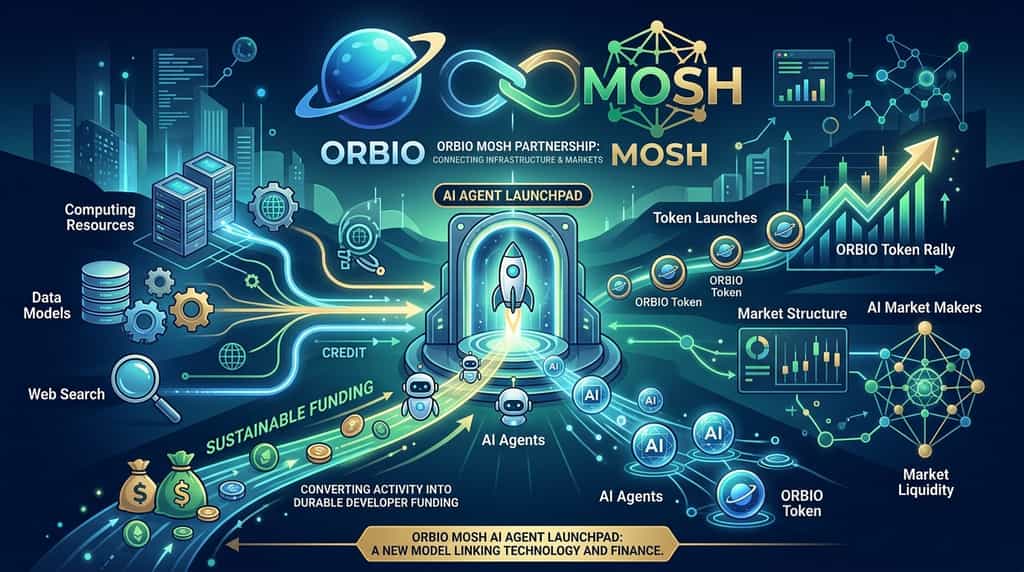
The partnership brings together Orbio's AI agent infrastructure and Mosh's token-launch and market-making framework, with the goal of making it easier to launch and fund AI agent projects. According to the Orbio launchpad and Mosh's official website, the two products focus on different parts of the same process: creating agent-linked tokens and providing market infrastructure for them.
Under the announced model, developers will be able to create AI agent tokens associated with ORBIO and use community funding to support their development. Mosh is expected to contribute tokenization and market-structure tools, while Orbio provides computing resources, distribution, and developer tooling. AI market makers are intended to help establish initial liquidity and support trading activity around new launches.
The integration is notable because AI agents need more than a token to become useful products. They may require access to language models, web search, social data, onchain information, code execution, and persistent hosting. Orbio's broader infrastructure aims to let agents access such services through a shared system for paying for computing and tools. Linking that infrastructure to a token launchpad could give developers a way to connect project financing with ongoing agent operations.
However, the partnership is still an execution story. The announcement describes planned functionality, not independently verified adoption or guaranteed market liquidity. Investors should distinguish between the launch of a product concept, the availability of its features, and evidence that developers are using it repeatedly.
How Does the Orbio AI Agent Launchpad Work?
The proposed launchpad connects an agent's token economy with the resources required to operate the agent, potentially giving developers a way to fund AI usage through activity around their projects. The concept builds on Orbio's existing model, in which trading fees can be converted into CREDIT, a tokenized form of AI-service credits used to pay for models and tools.
According to Orbio's official launch announcement, the broader system is designed to let a token help fund its associated agent's intelligence. An agent may need repeated model inference, data retrieval, web research, and other computational services. Rather than requiring a developer to manage each expense separately, the infrastructure aims to connect funding and service consumption through a shared credit mechanism.
The planned Mosh integration adds a token-launch and market-making layer. A project could issue an agent-linked token, attract community funding, and use the associated infrastructure to support its development and trading market. AI market makers are intended to help provide initial liquidity, although their presence does not guarantee tight spreads, deep order books, or stable prices.
This model could appeal to developers who want to build agents without first assembling every component of the economic and technical stack. It may also give token communities a more concrete role in funding software operations. The critical test, however, is whether the mechanism creates useful agents that people continue to use, rather than tokens whose main attraction is short-term trading.
Why Did ORBIO Rally After the Partnership Announcement?
The reported rally reflects how traders may price a new product narrative before its commercial results are established. A partnership that links AI agents, token launches, and automated market-making can attract attention because it offers a clear story about potential token utility. However, a sharp price increase is evidence of market activity, not proof that the project's long-term value has increased by the same amount.
The announcement creates several possible sources of speculative demand. Traders may anticipate more projects launching through Orbio, increased demand for ORBIO-related infrastructure, or more activity from users interested in AI agent tokens. Some may also buy because they expect other traders to react to the news. This last effect can amplify short-term price movements even when there is little new information about revenue or adoption.
Low or uneven liquidity can make these moves more pronounced. If available buy-side orders are limited, a relatively small amount of aggressive buying may push the quoted price higher. A rapid rise can then attract momentum traders, while a reversal may leave late buyers facing large losses. Without verified data on trading depth, turnover quality, and the distribution of holders, the size of a price move cannot be used on its own to estimate sustainable demand.
The headline figure of a more-than-70% daily gain should therefore be treated as a reported market snapshot tied to the announcement, not a forecast. Prices can change quickly, and different venues may show different returns depending on the trading pair, observation window, and liquidity. For a more complete assessment, investors should compare price performance with trading volume, order-book depth, token distribution, and subsequent product activity.
What Risks Should Investors Consider Before Buying ORBIO?
The main risks are speculative volatility, uncertain product adoption, token economics, and the possibility that AI agent activity fails to generate meaningful recurring demand. The partnership provides a potential growth path, but investors should not assume that a new launchpad automatically creates sustainable value for its associated token.
-
Execution risk: The planned integration needs to move from an announcement to reliable product functionality. Developers must be able to launch agents, access the required services, and manage their projects without excessive complexity. Delays or weak adoption could reduce the market's initial enthusiasm.
-
Liquidity risk: AI market-making tools may help support token markets, but they cannot guarantee buyers, stable prices, or protection against losses. Thin liquidity can amplify both rallies and sell-offs. Investors should check the actual trading venue, available liquidity, spreads, and trading activity before entering a position.
-
Token-economics risk: A project's success and its token's performance are not necessarily aligned. Investors need to understand the token's utility, circulating supply, unlocks, staking arrangements, and any mechanism connecting protocol revenue with token demand. A rise in platform usage is less compelling if it does not create meaningful demand for the token or if new supply puts pressure on its price.
-
Adoption and competition risk: The AI agent sector is developing quickly, and developers can choose among multiple model providers, agent frameworks, and infrastructure platforms. Orbio must demonstrate that its tools offer enough value to retain developers and users. An early lead in a new category does not guarantee long-term market share.
-
Market risk: ORBIO may remain highly sensitive to broader crypto sentiment and short-term speculation. A rapid rally can reverse if traders take profits, expected features arrive later than anticipated, or actual usage fails to match market expectations. Investors should assess their risk tolerance and avoid making decisions based solely on a large daily percentage gain.
Join KuCoin's Futures Trading Competition
Looking to put your market analysis and trading skills to the test? Join the KuCoin Futures Trading Competition and explore an opportunity to compete with other traders.
Whether you are tracking AI-related stocks like Micron or following broader market trends, disciplined risk management remains essential when trading volatile assets. Before participating, review the competition rules, eligibility requirements, reward details, and trading conditions on the official event page. Futures trading involves substantial risk and may not be suitable for every trader.
Conclusion
Orbio's partnership with Mosh brings together AI agent infrastructure, token launches, and automated market-making in an effort to make agent projects easier to fund and develop. The planned launchpad could give developers access to computing resources and distribution while connecting token activity with the ongoing cost of operating AI agents. This combination offers a clear product thesis, but its commercial impact will depend on adoption and execution.
ORBIO's reported rally of more than 70% highlights the market's interest in the announcement. It does not, by itself, demonstrate that the token has gained equivalent fundamental value. The more important signals will be whether the integration becomes fully available, whether developers launch useful agents, whether users return, and whether platform activity translates into sustained demand for Orbio's services and token utility.
Investors should also examine liquidity, token supply, project competition, and the relationship between protocol activity and ORBIO's economic value. The partnership may create opportunities if the launchpad develops into a productive ecosystem, but it also carries substantial uncertainty. Tracking verifiable usage and token-economic developments is more informative than relying on short-term price momentum.
FAQs
1. What is Orbio?
Orbio is a project developing infrastructure for AI agents, including access to models, tools, and computing services. Its token-related system uses CREDIT to pay for supported AI services, and its launchpad aims to connect agent creation with token-based funding.
2. What is Mosh?
Mosh is a platform focused on token launches and market infrastructure, including AI market-making agents. Its partnership with Orbio is intended to combine these capabilities with Orbio's agent development and computing tools.
3. Is an AI agent token the same as an AI company's equity?
No. An AI agent token is a digital asset whose rights and utility depend on its specific design and governing documentation. It does not automatically represent company ownership, shareholder rights, a claim on revenue, or a right to receive profits.
Disclaimer: This article is for informational purposes only and does not constitute financial, legal, or investment advice. Always conduct your own research before interacting with digital assets.