

OpenAI Announces 3 Scientific Breakthroughs in 2026: Math, Computer Science and Physics
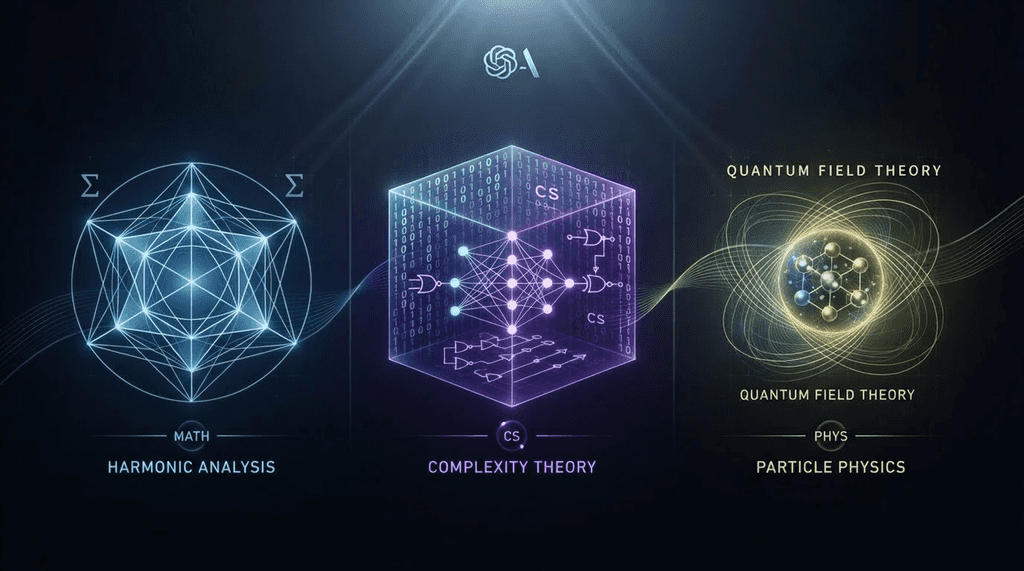
On October 26, 2026, in a research publication titled Working with academic communities to build scientific understanding, OpenAI disclosed that its internal reasoning models generated three major theoretical proofs spanning fundamental mathematics, theoretical computer science, and mathematical physics. If validated by the broader scientific community, the findings represent a notable evolution in artificial intelligence: moving beyond empirical pattern recognition and code generation toward multi-step deductive reasoning and theoretical discovery.
Rather than treating these machine-generated manuscripts as settled scientific consensus, OpenAI introduced an experimental verification framework supported by a $5 million contribution to the Simons Foundation. Through what it describes as an "academic shepherd" approach, OpenAI is testing three distinct disclosure pathways—ranging from direct public GitHub releases with Lean formalizations to independent working groups led by domain pioneers.
Across the three announcements, OpenAI claims its models produced a proof of Sogge’s local smoothing conjecture in harmonic analysis, a deterministic refutation of the Exponential Time Hypothesis (ETH) in computational complexity, and a rigorous mathematical existence proof for four-dimensional interacting quantum field theories (QFT), including Quantum Chromodynamics (QCD).
This analysis examines the core concepts behind each claim in plain terms, explores why Lean formal verification and complexity theory matter for the cryptocurrency and Web3 security landscape, and evaluates the governance principles guiding independent academic review.
Breakthrough 1: Harmonic Analysis and Sogge’s Local Smoothing Conjecture
The first result addresses a central open problem in Euclidean harmonic analysis: the local smoothing conjecture for the wave equation, proposed by mathematician Christopher Sogge in 1991.
In plain terms, the wave equation models how ripples, such as sound waves, light waves, or ocean swells, propagate across space and time. When multiple waves overlap, they can interfere constructively to create sharp, concentrated energy spikes. Mathematicians have spent over three decades trying to prove strict mathematical rules governing how intensely waves can concentrate and how averaging their behavior over a brief window of time "smooths out" those irregularities across two or more spatial dimensions. While partial proofs existed in two dimensions, proving the full conjecture across all spatial dimensions remained an open challenge.
Plain-Text Mechanism: Auxiliary Partial Differential Equations
According to OpenAI’s technical release in its openai/math GitHub repository, the model generated a natural-language proof on October 18, 2026, resolving the conjecture across every spatial dimension of at least two.
Rather than relying solely on traditional geometric slicing techniques, the model constructed a new auxiliary partial differential equation that tracks how wave energy dissipates over time. By bounding how quickly energy spreads out, the argument prevents wave packets from concentrating excessively along light cones, resolving technical barriers that previously limited higher-dimension proofs.
Downstream Impact: Unlocking the Kakeya Conjecture
In pure mathematics, Sogge's local smoothing conjecture acts like a master key sitting at the top of a hierarchy of famous problems. Proving it automatically resolves several long-standing conjectures in geometric measure theory:
-
The Kakeya Maximal and Dimension Conjectures: Originating from a 1917 puzzle asking for the smallest possible area required to rotate a unit needle a full 360 degrees, the high-dimensional Kakeya conjecture states that any set containing a unit line segment in every direction must have the full dimension of the space it occupies. OpenAI claims its local smoothing proof settles both the Kakeya and Nikodym maximal conjectures.
-
Stein’s Spherical Restriction Estimates: The result also establishes the interior range of Fourier restriction bounds initiated by Elias Stein in the 1970s, which govern how waves behave when restricted to curved spherical surfaces.
To support independent inspection, OpenAI translated the October 18 manuscript into the Lean theorem-proving language on October 19, 2026, releasing both the PDF write-up and the machine-checkable Lean proof directly to the public.
Breakthrough 2: Computer Science and the Refutation of the Exponential Time Hypothesis
The second, and arguably most surprising, claim targets the foundations of computational complexity theory. OpenAI announced that its model generated a formal refutation of the Exponential Time Hypothesis (ETH), claiming to prove that this widely held assumption is false.
Proposed by Russell Impagliazzo, Ramamohan Paturi, and Francis Zane between 1999 and 2001, the Exponential Time Hypothesis concerns the 3-SAT problem—a classic logical puzzle where an algorithm must determine whether a complex set of Boolean (true/false) switches can satisfy thousands of overlapping rules. As the number of variables (n) grows, the number of possible combinations explodes exponentially.
In plain terms, the ETH states that there is no computational shortcut for 3-SAT in the worst case: any deterministic algorithm must take strictly exponential time (growing at a rate proportional to 2 raised to a constant fraction of n). For 25 years, hundreds of computer science papers used ETH as a foundational baseline to prove that other difficult problems in graph theory, network routing, and databases cannot be solved faster than exponential time.
How the Claimed Algorithm Works
On October 16, 2026, OpenAI’s internal model produced a disproof of ETH, which the team formalized in Lean the following day (October 17). The manuscript presents a deterministic algorithm that counts the exact number of valid solutions for fixed-width Boolean formulas in subexponential time while using only polynomial memory space.
Here, "subexponential time" means the algorithm's runtime grows strictly slower than a standard exponential curve as the problem size increases (specifically scaling proportionally to 2 raised to n divided by the double logarithm of n). While still requiring massive computation for large inputs, crossing the mathematical boundary from strictly exponential to subexponential is sufficient to refute the ETH on paper.
What Does This Mean for Cryptocurrency and Blockchain Security?
Whenever a breakthrough in computational complexity is announced, digital asset investors naturally ask whether cryptographic networks like Bitcoin or Ethereum are at risk. Even if OpenAI’s ETH refutation is fully validated, it does not threaten blockchain cryptography, for three fundamental reasons:
-
The P vs. NP Barrier Remains Intact: Disproving the ETH does not mean P = NP. Subexponential time is still vastly slower than polynomial time. Furthermore, a divisor like "log log $$$$" grows so slowly that for real-world problem sizes, the theoretical speedup does not translate into practical runtime gains. OpenAI explicitly noted that turning this theoretical bound into practical algorithmic speedups would require significant further research.
-
Worst-Case vs. Average-Case Hardness: The ETH only measures the worst-case difficulty of logical satisfiability puzzles. Modern cryptography, such as Bitcoin's SHA-256 hashing or elliptic curve digital signatures (ECDSA), relies on average-case cryptographic hardness and one-way mathematical traps that remain secure even against minor asymptotic shifts in SAT solving.
-
Potential Upside for Web3 Verification: Rather than breaking encryption, theoretical advances in Boolean satisfiability (SAT) and counting algorithms are primarily useful for formal verification tools—which developers use to check smart contracts and zero-knowledge (ZK) circuit constraints for hidden bugs.
Independent Review by ETH’s Original Creators
To examine the computer science claim, OpenAI reached out to Russell Impagliazzo and Ramamohan Paturi (UC San Diego), two of the original proposers of the Exponential Time Hypothesis, alongside MIT computer scientist Ryan Williams.
In a joint open letter to the computer science community on October 26, the three scholars agreed to help organize an open, independent examination of the claim, while stressing a clear caveat: "Our involvement should not be taken as certification of the claim." Operating with no non-disclosure agreements and zero payment from OpenAI, the group requested, and OpenAI agreed, to release all raw model data publicly and fund an academic conference to examine the findings.
Breakthrough 3: Mathematical Physics and the Existence of 4D Quantum Chromodynamics
The third claim addresses constructive quantum field theory, led by Tadeusz Balaban's renormalization framework, aiming to place particle physics on rigorous mathematical footing.
In modern physics, the Standard Model, and specifically Quantum Chromodynamics (QCD), which describes the strong nuclear force binding quarks inside protons and neutrons, predicts particle collider experiments with remarkable accuracy. Yet a famous paradox has persisted for over half a century: while physicists use four-dimensional quantum field theories every day, mathematicians have never been able to prove that these equations remain mathematically well-defined when calculated across continuous, infinitely fine four-dimensional spacetime.
Previously, mathematicians only succeeded in proving rigorous existence for simplified field theories in two or three dimensions. In four dimensions, taking the "continuum limit" (shrinking a discrete calculation grid down to zero spacing) caused equations to blow up with mathematical infinities.
Addressing the Yang-Mills Existence Problem
According to OpenAI’s release timeline:
-
September 9, 2026: The internal model generated a natural-language proof establishing the rigorous mathematical existence of pure four-dimensional Yang-Mills theory, addressing the existence half of the famous Clay Mathematics Institute Millennium Prize Problem (though proving existence alone does not automatically resolve the full "mass gap" requirement of the prize).
-
September 18, 2026: The model extended the construction to include gauge fields interacting with fermions (matter particles like quarks), claiming to establish the mathematical existence of four-dimensional QCD and grand unified completions of the Standard Model.
Review Led by Nobel Laureate David Gross
The five-member physics panel is led by David Gross—who shared the 2004 Nobel Prize in Physics for discovering asymptotic freedom in QCD—alongside renowned mathematical physicists Arthur Jaffe (co-author of the official Clay Millennium Prize problem statement for Yang-Mills), Michael Douglas, Igor Klebanov, and Nikita Nekrasov (2023 Dannie Heineman Prize winner). The group chose to withhold the raw AI manuscripts for now while they independently inspect and write up the work.
The Academic Shepherd Model and Lean 4 Verification
The release of three major claims simultaneously highlights a growing bottleneck in modern science: generating complex AI manuscripts now takes far less time than human experts need to verify them. Earlier in October 2026, OpenAI released over 700 experimental AI-generated math notes, sparking pushback from mathematicians concerned about overwhelming traditional peer review.
To avoid flooding journals with unvetted claims, OpenAI outlined four governance principles for its academic collaborations:
| Governance Principle | Core Commitment | Practical Meaning for Researchers |
| 1. Transparency | Zero Non-Disclosure Agreements (NDAs) | External scholars can freely discuss the work, share intermediate findings, and publish critiques or refutations without restriction. |
| 2. No Academic Credit | No AI or Corporate Authorship Claims | OpenAI seeks no academic authorship or priority for its models (consistent with its September 2026 pledge not to claim Millennium Prizes). |
| 3. Recognition | Credit for Human Expositors | Academic working groups receive full recognition for the explanations they write and ensure prior human research is properly cited. |
| 4. Independence | Voluntary and Unpaid Review | Reviewers receive no personal compensation from OpenAI, ensuring their conclusions remain independent of corporate influence. |
Why Lean Verification Matters
For both the mathematics (local smoothing) and computer science (ETH) results, OpenAI paired its natural-language papers with formal proofs in Lean, an open-source interactive theorem prover backed early on by the Simons Foundation.
In Lean, mathematical statements are written as strict computer code. If a step contains a logical leap or hidden hallucination, the code simply fails to compile. However, academic commentators emphasize a vital distinction: while Lean guarantees that a formal proof follows logically from its definitions, human experts must still verify that the formal code faithfully captures the original mathematical question. For example, on October 7, 2026, OpenAI withdrew three earlier manuscripts from its openai/math repository after discovering a sign error in the problem formulation.
This same formal verification technology is increasingly foundational to the Web3 and cryptocurrency industry. High-assurance blockchain ecosystems, zero-knowledge virtual machines (zkVMs), and institutional DeFi protocols rely on interactive theorem provers like Lean 4 to mathematically verify that smart contracts and cryptographic circuits cannot be exploited. If AI models can reliably translate complex logic into verified Lean code, the downstream impact on automated smart contract auditing and formal protocol verification could be substantial.
Conclusion
OpenAI’s October 2026 announcement marks a pivotal test for AI-assisted scientific discovery. By pairing internal reasoning models with Lean formal verification and handing oversight of major claims in mathematics, complexity theory, and quantum physics to independent experts like Impagliazzo, Paturi, Williams, and Gross, the initiative moves frontier AI beyond simple benchmarks. While months of rigorous academic scrutiny remain before these proofs can be considered settled science, the convergence of automated theorem proving and open verification sets a powerful precedent for both theoretical research and high-assurance cryptographic systems.
FAQs
What are the 3 OpenAI scientific breakthroughs announced in October 2026?
On October 26, 2026, OpenAI announced that its internal models produced three major theoretical results: (1) a proof of Sogge’s local smoothing conjecture in every dimension, which also resolves the Kakeya conjecture. (2) a deterministic subexponential algorithm that refutes the Exponential Time Hypothesis (ETH) in computer science. (3) a mathematical existence proof for four-dimensional interacting quantum field theories, including Quantum Chromodynamics (QCD).
Does refuting the Exponential Time Hypothesis break Bitcoin or crypto encryption?
No. Even if the ETH refutation is confirmed by independent computer scientists, it does not prove P = NP and does not create a fast practical solver capable of breaking cryptographic keys. Blockchain hashing (SHA-256) and digital signatures rely on average-case cryptographic hardness rather than worst-case 3-SAT bounds, and OpenAI noted that its theoretical result does not yield immediate real-world runtime speedups.
Have these AI-generated proofs been confirmed by the scientific community?
Not yet. While OpenAI released machine-checked Lean proofs for the mathematics and computer science claims on GitHub, external scholars must still verify that the formal code accurately represents the original conjectures. The computer science review group explicitly stated that their involvement is an independent examination, not an endorsement, and the physics group led by Nobel laureate David Gross is still evaluating the QCD manuscripts.
How is OpenAI funding independent academic verification?
Alongside its unpaid, NDA-free "academic shepherd" working groups, OpenAI committed $5 million to the Simons Foundation as part of a $15 million joint initiative (with Anthropic) announced in October 2026 to fund academic workshops, conferences, and tools that help scientists evaluate AI-generated proofs.
Disclaimer
This general market information, possibly from third-party, commercial, or sponsored sources, is provided for reference and educational purposes only and does not constitute financial or investment advice, an offer, solicitation, or guarantee. We disclaim liability for its accuracy, completeness, reliability, and any resulting losses. Investments/trading are risky; past performance doesn’t guarantee future results. Users should research, judge prudently, and take full responsibility. For further details, please consult KuCoin’s Terms of Use and Risk Disclosure.