

OpenAI Revenue in 2026: Why the $50 Billion Figure Is Below Earlier Estimates
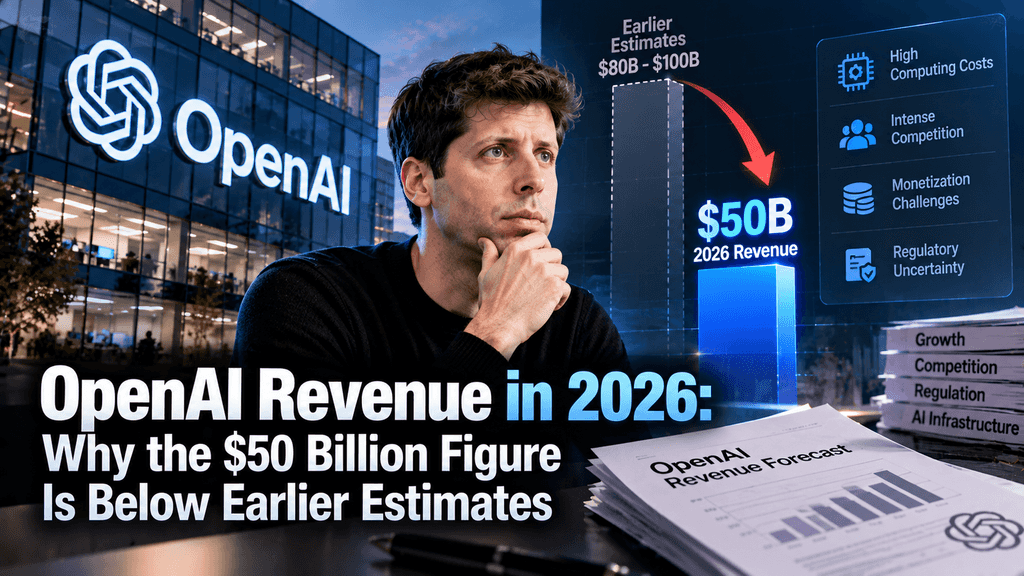
OpenAI revenue in 2026 has attracted renewed scrutiny after reports revealed that the ChatGPT maker's annualized revenue was approaching $50 billion at the end of September, approximately $20 billion below earlier estimates of nearly $70 billion. The discrepancy unsettled technology investors and contributed to selling pressure across AI-related stocks, raising questions about the financial sustainability of the artificial intelligence boom.
However, the lower figure does not necessarily signal declining demand or a sudden loss of revenue. According to Reuters, the gap largely reflects differences in how OpenAI and rival Anthropic recognize revenue generated through cloud partners. Meanwhile, subsequent Bloomberg reporting indicated that OpenAI still expects its annualized revenue to reach at least $70 billion by the end of 2026. The controversy highlights a broader challenge for AI investors: understanding the difference between revenue growth, accounting methods, and long-term profitability.
What Happened to OpenAI's $70 Billion Revenue Estimate?
On October 8, 2026, the Financial Times reported that OpenAI had informed investors its annualized revenue was approaching $50 billion at the end of September. That figure was substantially below the nearly $70 billion estimate reported by several financial news organizations in late September. The difference immediately raised concerns because investors had been using the higher number to assess OpenAI's commercial expansion and compare its performance with Anthropic.
The discrepancy was primarily linked to an attempt by investors to calculate OpenAI's revenue using a methodology more comparable with Anthropic's. While the two companies both generate substantial income from enterprise AI services, they recognize certain cloud-partner transactions differently. Consequently, the $20 billion gap did not represent confirmed lost revenue or canceled customer contracts.
The following figures provide a clearer picture of OpenAI's reported financial performance.
| Revenue metric | Reported figure |
| Annualized revenue at the start of 2026 | $20 billion |
| Earlier September estimate | Nearly $70 billion |
| Annualized revenue at September 30 | Nearly $50 billion |
| Projected full-year 2026 revenue | Approximately $35 billion |
| Expected year-end annualized revenue | $70 billion or more |
Sources: Reuters, Financial Times, and Bloomberg reporting through October 10, 2026. The figures represent different accounting periods and measurement methods.
The timing was particularly sensitive because OpenAI was reportedly discussing a fundraising round of at least $30 billion at a pre-money valuation of approximately $1.4 trillion. With such significant financial expectations attached to its future growth, even uncertainty surrounding revenue calculations can influence investor confidence.
Why Is OpenAI's Revenue Below Earlier Estimates?
The main explanation involves gross versus net revenue recognition. Although both methods are widely used in financial accounting, they can produce different headline revenue figures for businesses operating through distribution partners.
Gross vs. Net Revenue Explained
Under gross revenue recognition, a company records the total amount customers pay for a service and separately recognizes payments to distributors as expenses. Under net revenue recognition, the company records only the amount attributable to its own role in the transaction.
Consider a hypothetical example in which a customer pays $100 for an AI service through a cloud platform. If the AI developer is responsible for delivering the service and pays the platform $20, it may recognize $100 in revenue and record the $20 payment as an expense. Alternatively, if the developer's accounting position requires net recognition, it may record only its $80 share as revenue. Although the reported revenue differs, the underlying customer payment remains unchanged.
According to Axios, Anthropic records gross sales from certain cloud distribution arrangements, while OpenAI recognizes only its share of certain partner transactions. Both approaches can comply with Generally Accepted Accounting Principles, depending on contractual responsibilities and control over the service.
Why Investors Used the $70 Billion Estimate
The earlier estimate emerged as some investors attempted to adjust OpenAI's revenue upward to make it more directly comparable with Anthropic's reported figures. This adjustment included a broader calculation of sales associated with distribution partners, producing an estimate approaching $70 billion.
However, an adjusted revenue figure should not be confused with a company's own reported revenue. Gross sales can illustrate the scale of customer transactions, but they do not necessarily indicate how much revenue a company recognizes or ultimately retains. The OpenAI controversy therefore demonstrates how inconsistent financial comparisons can create misleading impressions of business performance.
What Does OpenAI's Annualized Revenue Actually Mean?
Annualized revenue run rate estimates the revenue a business could generate over twelve months if its recent sales performance continued. It is commonly calculated by multiplying one month's revenue by twelve, although companies may use different reporting periods.
For example, a monthly revenue level of approximately $4.17 billion would produce an annualized run rate of $50 billion. This does not mean the company has already earned $50 billion during the calendar year. It simply projects recent revenue over a full year, without guaranteeing that customer demand or sales conditions will remain unchanged.
This distinction is especially important for rapidly expanding AI businesses. OpenAI's projected actual revenue for 2026 was reportedly revised upward to approximately $35 billion, while its September annualized revenue approached $50 billion. The figures are not contradictory: the full-year forecast reflects revenue accumulated across months when sales were growing at different speeds.
Annualized revenue can help investors evaluate business momentum, but it provides limited information about profitability, operating expenses, and cash flow. A company may report impressive revenue growth while continuing to spend heavily on computing infrastructure, model development, and customer acquisition.
How Fast Is OpenAI Revenue Growing in 2026?
Despite the accounting controversy, OpenAI's reported financial trajectory indicates substantial growth. Reuters reported that its annualized revenue increased from approximately $6 billion in 2024 to $20 billion at the beginning of 2026, before approaching $50 billion by September. These figures suggest that demand for generative AI applications continues to expand across consumer and enterprise markets.
Enterprise customers have become an especially important growth driver. According to figures cited by CNBC and subsequent reporting, OpenAI's investor presentation indicated that its total revenue run rate increased approximately 77% during the third quarter of 2026, while enterprise revenue run rate grew about 107%. These measurements indicate accelerating commercial activity, although they should not be confused with audited quarterly revenue growth.
Enterprise AI Is Becoming a Major Revenue Driver
OpenAI generates revenue through ChatGPT subscriptions, business products, enterprise agreements, API services, and commercial partnerships. While individual subscriptions provide an important recurring revenue base, enterprise adoption creates opportunities for larger contracts and sustained consumption of AI services.
Organizations increasingly deploy AI for software development, customer support, research, document analysis, and internal workflow automation. These applications can generate recurring demand as companies integrate AI into everyday operations. However, enterprise customers may also become more selective about their spending, particularly when evaluating whether AI investments deliver measurable productivity improvements.
The challenge for OpenAI is to convert growing usage into sustainable financial performance. Expanding enterprise adoption can support higher revenue, but model inference, infrastructure maintenance, and continued research require substantial spending. Long-term success will depend not only on attracting more customers but also on improving the economics of serving them.
OpenAI vs. Anthropic: Who Is Growing Faster?
The revenue discrepancy has intensified comparisons between OpenAI and Anthropic, two leading developers of advanced AI models. According to Reuters, Anthropic's annualized revenue surpassed $65 billion in July 2026, while projections suggested it could approach $100 billion by year-end. At first glance, these figures appear to indicate stronger revenue growth than OpenAI's September run rate of approximately $50 billion.
However, the comparison is complicated by differences in revenue recognition. Anthropic includes gross sales associated with certain cloud partnerships, including Amazon Web Services and Google Cloud. OpenAI recognizes only its share of certain comparable transactions, making direct comparisons between the companies' headline figures unreliable.
Distribution partnerships are nevertheless important competitive advantages. Cloud platforms provide access to established enterprise customers, allowing AI developers to expand their reach without building every customer relationship independently. In return, cloud providers receive compensation for distribution and infrastructure services. These arrangements can accelerate adoption while influencing both recognized revenue and operating margins.
A more meaningful comparison would examine customer retention, actual recognized revenue, gross profit, operating costs, and cash flow. Model performance, enterprise integration, and pricing competitiveness also matter. Ultimately, the company reporting the highest annualized revenue may not necessarily have the strongest profitability or most sustainable business model.
Why Did OpenAI's Revenue Report Push AI Stocks Lower?
The October 8 revenue report contributed to a broad decline in AI-related stocks as investors reassessed the relationship between AI monetization and infrastructure spending. Nvidia fell approximately 2.9%, AMD declined 3.9%, and Broadcom dropped around 4.3%, according to MarketWatch. Oracle and several other companies exposed to AI infrastructure also experienced selling pressure.
The market reaction reflected concerns extending beyond OpenAI itself. The company is an important customer and demand indicator for the broader AI computing industry, where semiconductor manufacturers, cloud providers, and data center operators are investing heavily to support increasingly sophisticated models.
Why AI Infrastructure Companies Are Vulnerable
Companies such as Nvidia, Broadcom, and Oracle benefit from the demand for computing power required to train and operate AI systems. Investors expect sustained commercial adoption to justify expanding data center capacity, specialized chips, and related infrastructure.
When OpenAI's reported revenue appeared lower than expected, some investors questioned whether AI developers could generate enough income to support the industry's enormous capital expenditures. This concern was amplified by the high valuations of technology companies associated with AI development.
The broader market environment also contributed to the selloff. Elevated Treasury yields, energy prices, and financing costs increased pressure on capital-intensive businesses. Higher borrowing costs can make long-term infrastructure projects less attractive, particularly when expected returns depend on future revenue growth.
Why AI Stocks Recovered After the Clarification
Investor sentiment improved on October 9 as additional reporting clarified that the discrepancy largely reflected accounting differences. Bloomberg also reported that OpenAI continued to expect annualized revenue of at least $70 billion by year-end, supported by enterprise growth.
Several AI-related stocks subsequently rebounded, with Oracle gaining approximately 4.7%, according to Barron's. The recovery suggested that the initial selloff had partly reflected uncertainty about financial reporting rather than evidence of collapsing AI demand.
Nevertheless, the episode demonstrated how sensitive AI valuations have become to the financial outlook of major private AI developers. Even without detailed public financial statements, developments involving OpenAI can influence expectations across the technology sector.
Can OpenAI Reach $70 Billion by the End of 2026?
Despite the September discrepancy, OpenAI has reportedly maintained an ambitious revenue outlook. Bloomberg reported on October 9 that the company expects its annualized revenue to reach or exceed $70 billion by December 2026, driven largely by growth in enterprise AI services.
Moving from a $50 billion annualized revenue run rate at the end of September to $70 billion at year-end would require an increase of approximately 40% over three months. Expressed in monthly terms, the underlying revenue run rate would need to rise from roughly $4.17 billion to $5.83 billion.
Such an increase would require continued expansion in enterprise contracts, subscriptions, API usage, and other commercial activities. Larger organizational deployments could provide meaningful growth as AI becomes more deeply integrated into business operations.
However, achieving the target is not guaranteed. Competition from Anthropic, Google, and other AI developers may pressure pricing, while higher computing requirements could constrain operating efficiency. Enterprise customers may also delay spending if AI projects fail to demonstrate sufficient returns.
Even if OpenAI reaches the $70 billion annualized target, profitability would remain a separate question. Strong revenue growth can support future earnings, but investors still need evidence that the company can manage infrastructure costs and generate sustainable cash flow.
What Does the Revenue Gap Mean for the AI Industry?
The controversy highlights a broader shift in how investors evaluate artificial intelligence companies. During the early stages of the AI boom, market enthusiasm focused heavily on model capabilities, user adoption, and infrastructure expansion. In 2026, attention is increasingly moving toward revenue quality, operating efficiency, and investment returns.
AI Spending Needs Sustainable Revenue
Building advanced AI systems requires substantial spending on specialized processors, electricity, networking equipment, and data centers. These investments often occur before the resulting applications generate sufficient revenue to cover their costs.
According to Reuters, Morgan Stanley estimates that AI infrastructure could require approximately $1.5 trillion in external financing by 2028. This illustrates the financial scale of the industry's expansion and the importance of sustained customer demand.
If AI adoption produces strong enterprise revenue and improving margins, infrastructure investment could support lasting economic growth. However, if commercial returns fall short of expectations, companies may face pressure from debt obligations, depreciation expenses, and underutilized computing capacity.
Financial Transparency Is Becoming Essential
The revenue discrepancy also highlights the limitations of comparing privately held technology companies through selective financial disclosures. OpenAI and Anthropic frequently attract attention through annualized revenue estimates, but these metrics provide only a partial picture of their financial health.
More consistent disclosures of actual revenue, gross margins, operating expenses, and cash flow would make comparisons easier. Potential future public listings could improve transparency, although neither company has guaranteed a specific IPO timetable.
For investors, the lesson is that accounting definitions matter as much as headline growth rates. Understanding how revenue is calculated can prevent misleading comparisons and help distinguish temporary market uncertainty from genuine changes in business fundamentals.
What Should Investors Watch Next?
The most important indicator will be whether OpenAI achieves its reported year-end revenue target while maintaining strong enterprise demand. Future disclosures about customer growth, actual quarterly revenue, API spending, and operating expenses could provide a clearer picture of its commercial performance.
Investors should also follow the earnings reports of AI infrastructure companies, including Nvidia, Oracle, and Broadcom. Their order growth, capital spending, and cloud demand can offer indirect evidence of investment activity throughout the AI supply chain, although supplier sales do not necessarily demonstrate profitable AI adoption by end users.
Finally, financing conditions remain important. Elevated interest rates and rising infrastructure costs can pressure businesses that depend on substantial future cash flows. Sustainable AI growth will require the expansion of commercial revenue to remain aligned with the cost of developing and operating increasingly advanced models.
🔥 Beyond the Headlines: What KuCoin 5.0 Means for You
Market news moves fast — but where you act on it matters just as much. This October, KuCoin launches KuCoin 5.0, transforming KuCoin into a rebuilt platform. Here's what actually changes for you:
-
One account for everything. Older platforms split your money across separate "spot," "margin," and "futures" accounts and expected you to understand why. KuCoin 5.0's unified account removes that entirely — deposit once, and everything is simply there (only available to VIPs for now).
-
Stocks, indices, and commodities. KuCoin 5.0 expands beyond crypto into global markets. When crypto chops sideways and equities rally (or the reverse), you rotate in minutes instead of opening a brokerage account and waiting days for fiat rails.
-
Real-world assets (RWA). Tokenized exposure to traditional assets like commodities, right inside your crypto account. One of the fastest-growing segments in global finance is no longer reserved for institutions — you access it from the same balance you trade with.
-
Earn while you learn. Not ready to trade? KCUSD lets your stablecoins earn daily, auto-compounding interest. The lowest-stress way to put your idle deposit to work for 4% yield.
-
An AI assistant in plain language. Ask questions, get market context, understand what you're looking at — built into the platform, no jargon required.
-
An app that doesn't overwhelm. Faster, cleaner, and consistent — intuitive from the first tap, not after a tutorial.
-
Safety you can check, not just trust. A MiCAR-licensed EU entity, Proof of Reserves you can verify yourself, and internationally certified security (SOC 2 Type II, ISO 27001:2022).
Create your account in minutes — and start on the platform built for where crypto is going, not where it's been.
Conclusion
OpenAI revenue in 2026 remains a critical indicator of the AI industry's commercial momentum. The approximately $50 billion annualized figure reported for September was below earlier estimates of nearly $70 billion, but the difference largely reflected inconsistent revenue accounting rather than a confirmed decline in customer demand.
With OpenAI still reportedly targeting at least $70 billion in annualized revenue by year-end, the company continues to pursue rapid expansion. More broadly, the controversy underscores why financial transparency, sustainable margins, and infrastructure investment returns will become increasingly important as the AI industry matures.
FAQs
Is OpenAI publicly traded in 2026?
No. As of October 10, 2026, OpenAI remains privately held, with no publicly traded shares available on major stock exchanges.
Does $50 billion in revenue mean OpenAI is profitable?
No. Revenue measures sales, while profitability depends on expenses, including computing infrastructure, research, and operating costs.
What is the difference between AI revenue and bookings?
Revenue reflects recognized sales, while bookings generally represent contracted business that may generate revenue over future periods.
Can lower AI model prices reduce OpenAI's revenue?
Yes, although lower prices may also encourage wider adoption. The overall impact depends on usage growth and operating efficiency.
Disclaimer: This content is for informational purposes only and does not constitute investment advice. Investments carry risk. Please do your own research (DYOR).