

Nvidia CFO Says Memory Prices Will Rise Further as SK Hynix Sees HBM Balance Only by 2030
Nvidia Warns of Prolonged Memory Shortage as AI Demand Outpaces Supply
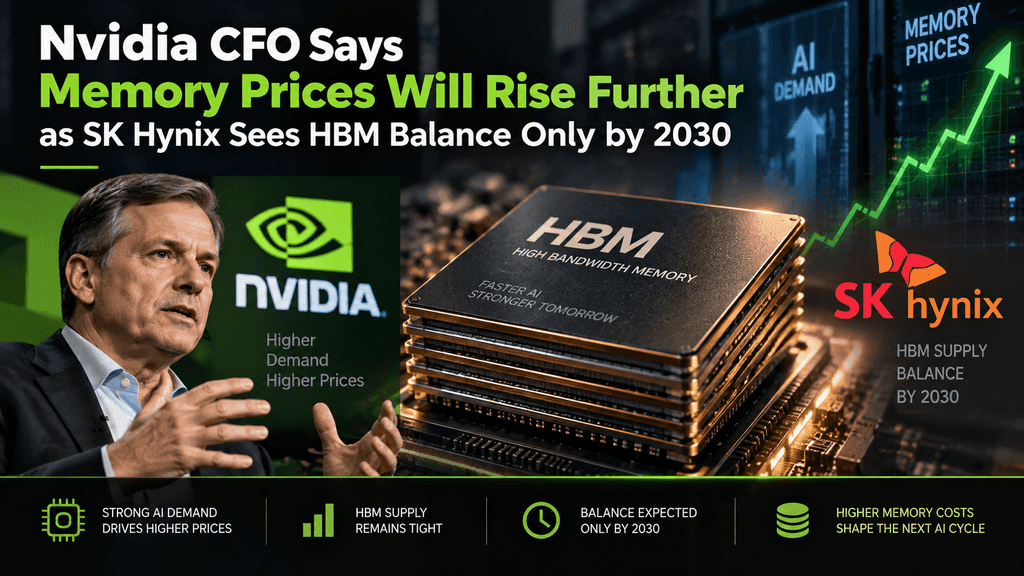
Nvidia’s chief financial officer has delivered a clear signal that the memory shortage powering the artificial intelligence boom shows no signs of easing soon. During the company’s fiscal second-quarter earnings call on August 26, 2026, Colette Kress described “extreme pricing conditions in memory,” noting that price increases had already surpassed prior expectations and would continue rising into the following year. The remarks come as SK Hynix, the leading supplier of high-bandwidth memory, forecasts that the broader memory market will not reach supply-demand balance until 2030 at the earliest.
These developments underscore a structural shift in which AI infrastructure build-outs are both driving demand and constraining the very components needed to meet it. Nvidia has responded by more than doubling its supply commitments to $279 billion, while guiding that gross margins will bottom in the 71-72 percent range in the fourth quarter before recovering modestly in fiscal 2028. The combination of sustained price pressure and multi-year capacity constraints is reshaping cost structures across the semiconductor industry and forcing hyperscalers, chip designers, and memory producers to recalibrate long-term plans around a prolonged period of scarcity.
The reality is that AI-driven demand for high-bandwidth memory and related DRAM products has outstripped industry capacity expansion timelines, locking in elevated prices and tight supply through the remainder of the decade. This imbalance is not a temporary cyclical spike but a structural feature of the current technology cycle, with direct implications for Nvidia’s profitability, SK Hynix’s investment strategy, and the broader economics of AI data center construction.
Extreme Pricing Conditions Force Nvidia to Reset Margin Expectations
Colette Kress was explicit during the August 26 earnings discussion that memory costs had moved beyond what the company had previously modeled. “We are experiencing extreme pricing conditions in memory. The magnitude of the price increase has exceeded our prior expectations and are headed even higher into next year,” she stated, according to the call transcript. The impact is already visible in Nvidia’s guidance: non-GAAP gross margins are expected to reach approximately 74 percent in the third quarter before bottoming at 71 to 72 percent in the fourth quarter. Management projects a subsequent recovery to the 72-73 percent range in fiscal 2028 once previously announced product price increases begin to flow through results. This direction represents a deliberate reset rather than an unexpected shock.
Nvidia’s own aggressive advance purchasing has contributed to the tightness, with disclosed supplier purchase commitments rising from $119 billion in the prior quarter to $279 billion. Of that total, roughly $92 billion is scheduled for the remainder of fiscal 2027, followed by substantial outlays in the subsequent two years. The company has framed the margin compression as a temporary cost of securing the memory volumes required to support its growth targets, noting that the scarcity itself is a symptom of the same AI demand surge that is expanding its addressable market. The decision to absorb higher component costs in the near term while planning to pass a portion of the inflation through to customers later reflects Nvidia’s prioritization of volume and market position over short-term profitability metrics. Kress emphasized that tighter memory supply is not an external drag without offsetting benefits; rather, it is tightly linked to the AI factory build-out that continues to generate record data-center revenue.
In the second quarter, data-center revenue reached new highs, and the company guided for approximately 70 percent year-over-year revenue growth in fiscal 2028, constrained primarily by available supply rather than underlying demand. That demand, according to Jensen Huang, remains close to 100 percent growth potential, with the 70 percent figure reflecting what Nvidia expects to be able to ship given current component availability. The memory bottleneck is therefore both a headwind to margins and a confirmation of the durability of the AI infrastructure cycle. Industry observers note that Nvidia’s long-standing relationships with the three primary memory suppliers, SK Hynix, Samsung, and Micron, position it to secure preferential allocations, yet even those relationships cannot eliminate the fundamental capacity constraints that are pushing prices higher across the board.
AI Infrastructure Expansion Continues to Absorb Available HBM Output
The primary driver of the current memory shortage is the quick scaling of AI accelerators that require substantially more high-bandwidth memory per unit than previous generations. Nvidia’s Vera Rubin platform, for example, incorporates significantly higher HBM content than earlier architectures, with each GPU package demanding multiple advanced stacks. This shift has redirected a growing share of DRAM wafer capacity toward HBM production, reducing the volume of conventional server and consumer DRAM available to the rest of the market. TrendForce data indicate that DRAM contract prices rose 90 to 95 percent quarter-over-quarter in the first quarter of 2026 and a further 58 to 63 percent in the second quarter, reflecting both the reallocation of capacity and the intensity of hyperscaler procurement.
HBM capacity for 2026 is widely reported as sold out, with long-term agreements locking in volumes for key customers well into subsequent years. The result is a feedback loop in which AI demand raises memory prices, which in turn increase the bill of materials for AI servers, prompting further price adjustments downstream. SK Hynix has dedicated approximately 30 percent of its DRAM capacity to HBM in 2026, with analysts expecting that share to approach 40 percent by 2027. The transition from 12-die HBM3E stacks to 16-die HBM4 configurations intensifies the capacity displacement effect, as each advanced module consumes more silicon relative to the conventional DRAM it displaces.
Cloud providers and enterprise buyers are responding by securing multi-year supply agreements, further tightening the spot market and reinforcing the upward pressure on prices. Nvidia itself has described the shortage as largely driven by the AI build-out, a characterization that aligns with comments from SK Hynix leadership that customer demand continues to exceed production capacity even on a multi-year horizon. The practical consequence is that memory has become the binding constraint on AI system deployment rates, limiting the speed at which new data center capacity can be brought online and elevating the overall cost of AI infrastructure.
SK Hynix Projects Market Balance No Earlier Than 2030
SK Hynix has consistently signaled that the current supply-demand imbalance will persist for years. Chief Executive Kwak Noh-jung has stated that 2027 is expected to be the most difficult year for supply in the industry’s history and that customer demand is projected to remain higher than available capacity beyond 2030. Chairman Chey Tae-won has reinforced this view, noting at industry events that the memory shortage, including HBM, is likely to continue through the end of the decade. These forecasts are grounded in the long lead times required to add meaningful new wafer capacity.
Constructing a new fabrication facility from an existing site typically requires at least three years, while a greenfield project can take more than five years from groundbreaking to volume production. Even with accelerated investment schedules, the bulk of incremental output from current expansion plans will not reach the market until the late 2020s. The company’s public statements emphasize that the nature of demand has changed. AI memory is increasingly customized and developed jointly with customers, improving demand visibility but also concentrating orders among a smaller group of large buyers.
This move reduces the likelihood of the sharp boom-and-bust cycles that characterized previous memory industry downturns, yet it also means that capacity additions must be carefully timed to avoid either prolonged shortages or eventual oversupply. SK Hynix’s leadership has indicated that any future downturn is more likely to involve moderating growth rather than a steep collapse in demand, reflecting the structural nature of AI-related consumption. In the interim, the company is prioritizing long-term agreements that provide greater earnings stability and support more efficient capital allocation. The net effect is a multi-year period in which pricing power remains firmly with suppliers and buyers must plan around constrained availability.
Major Capacity Investments Aim to Narrow the Gap by the Early 2030s
In response to the sustained shortage, SK Hynix’s board has approved approximately $38.3 billion in investments through 2031 to expand two domestic production bases in South Korea. Of that total, 35.2 trillion won is allocated to the second phase of the Yongin fabrication complex, focused on advanced DRAM including HBM, while 19.1 trillion won is directed to the M17 facility in Cheongju for NAND production. Construction timelines indicate that the first cleanrooms at these sites will open in 2028 and 2029, with full investment phasing extending into 2031. These projects form part of a broader strategy that includes accelerating the overall Yongin Semiconductor Cluster timeline, with four fabs now targeted for completion by 2033 rather than the original 2045 horizon.
The scale of the commitment reflects management’s assessment that AI-driven memory demand will remain elevated for the foreseeable future. SK Hynix has also broken ground on its first U.S. production facility in Indiana, with volume production of next-generation HBM4E chips planned for the third quarter of 2029. That site is intended to bring capacity closer to major North American customers and to diversify geographic risk. Even with these expansions, company executives continue to caution that new output will take years to materialize and that demand growth is expected to keep pace with or exceed the added supply through the end of the decade. The investment program therefore represents a necessary but not immediately sufficient response to the current imbalance, leaving prices and availability under pressure in the near and medium term.
SK Hynix currently holds approximately 50 percent of the high-bandwidth memory market, ahead of Samsung at roughly 33 percent and Micron at 18 percent, according to recent industry estimates. This concentration has allowed the leading supplier to capture a disproportionate share of the value created by the AI memory cycle. All three companies are now shipping HBM4 for Nvidia’s Vera Rubin platform, a milestone confirmed publicly in mid-2026. The competitive dynamic is evolving as each firm ramps advanced-node production and secures long-term supply agreements with hyperscalers and accelerator vendors. Nvidia’s $279 billion in purchase commitments is expected to flow primarily to SK Hynix and Micron, reinforcing their positions while still leaving Samsung as a significant alternative source.
The market-share structure has important implications for pricing discipline and capacity allocation. With the majority of advanced HBM output already contracted, the residual spot market remains thin and highly sensitive to incremental demand. Suppliers are reallocating wafer starts toward higher-margin HBM products, which has secondary effects on conventional DRAM and NAND pricing. Industry data show that this reallocation has contributed to multi-quarter price increases across the broader memory portfolio. For buyers outside the major long-term agreements, securing volume often requires accepting higher prices or accepting longer lead times. The concentration of supply among three firms also means that any production disruption or yield shortfall at a single supplier can quickly amplify tightness across the ecosystem.
Nvidia’s Supply Commitments Signal Strategic Prioritization of Memory Access
The jump in Nvidia’s disclosed supplier commitments from $119 billion to $279 billion in a single quarter represents one of the largest forward purchasing signals in the semiconductor industry. The increase is widely interpreted as an effort to lock in memory volumes ahead of further price escalation and to reduce exposure to the spot market. Roughly one-third of the total is scheduled for the remainder of fiscal 2027, with the balance spread across the following two years. This level of commitment effectively converts a portion of future demand into contractual obligations, providing suppliers with greater revenue visibility while giving Nvidia preferential access to scarce capacity.
The strategy carries clear trade-offs. Higher component costs are the primary reason Nvidia has guided for a temporary margin trough in the low-70-percent range. Management has indicated that it will absorb most of the inflation through the end of the current fiscal year and then implement price increases that begin to restore margins in fiscal 2028. The approach prioritizes shipment volume and customer relationships over near-term gross-margin expansion. It also places competitive pressure on other AI chip designers and system builders that may lack comparable purchasing scale. In effect, Nvidia is using its balance-sheet strength and market position to secure a larger share of available memory, which in turn supports its ability to deliver the 70 percent revenue growth it has projected for fiscal 2028 despite supply constraints.
Conventional DRAM and Consumer Markets Feel Secondary Effects of Capacity Reallocation
As memory manufacturers redirect wafer capacity toward HBM, conventional server DRAM and consumer DRAM products have experienced sharp price increases and tighter availability. TrendForce reported that overall DRAM contract prices rose 59.5 percent quarter-over-quarter in the second quarter of 2026, with server DRAM among the strongest performers. Spot prices for DDR5 and DDR4 modules have likewise climbed substantially over the past year, with some categories showing multi-hundred-percent year-over-year gains. The displacement effect is mechanical: each wafer converted to HBM production removes a larger volume of conventional bits from the market because advanced HBM stacks require more silicon per finished module.
Consumer electronics and PC OEMs have responded by raising retail prices, adjusting product configurations, and in some cases reducing DRAM content per system. Notebook and smartphone shipments have shown sensitivity to the higher component costs, leading to more cautious procurement in those segments. Enterprise solid-state drive pricing has also risen as NAND capacity faces parallel pressure from AI-related demand. The result is a broad-based inflationary environment across memory categories that extends well beyond the AI accelerator market. For system builders, the higher memory costs are translating into elevated server bill-of-materials and, in some cases, list-price increases of 15 percent or more on AI-optimized systems scheduled for early 2027 shipments.
Future Supply Agreements Are Becoming the Dominant Contracting Model
The prevalence of multi-year long-term agreements has risen sharply as both suppliers and buyers seek greater predictability. SK Hynix has noted that a significant portion of its HBM output is already covered by such contracts, and industry estimates suggest that 50 percent or more of total memory capacity is now under similar arrangements, with the share potentially rising toward 70 percent. These agreements typically prioritize volume certainty over pure price optimization, reflecting the reality that securing supply has become more important than minimizing unit cost for many large buyers. For suppliers, the contracts improve demand visibility and support more disciplined capital spending.
The shift toward long-term contracting reduces the volatility that historically characterized the memory industry but also concentrates available capacity among a smaller set of counterparties. Buyers without comparable scale or established relationships face higher prices and greater uncertainty. The model also embeds current high price levels into future periods, meaning that even as new capacity comes online, the contractual floor for pricing may remain elevated for several years. Analysts monitoring the sector expect this structure to persist at least through 2028, with the potential for further extension if demand growth continues to outpace supply additions.
Micron’s Upcoming Earnings Will Provide Additional Visibility into Pricing Trends
Micron Technology is scheduled to report its fiscal fourth-quarter results on September 30, 2026, offering a timely update on the memory pricing environment from the perspective of the third major supplier. Micron has been ramping HBM production and securing strategic customer agreements of its own, and its commentary on pricing, capacity utilization, and demand outlook will be closely watched for confirmation of the trends described by Nvidia and SK Hynix. Previous quarters have shown Micron capturing a meaningful share of the AI memory upside, with revenue and margins expanding as the HBM and server DRAM mix increased. The September report is expected to address the sustainability of recent price increases and the timeline for incremental capacity additions.
Investors and industry participants will focus particularly on any forward guidance regarding HBM pricing and conventional DRAM trends into 2027. Given the consistency of commentary from Nvidia, SK Hynix, and Samsung regarding multi-year tightness, Micron’s results are more likely to reinforce the existing narrative than to introduce a materially different outlook. The report will nonetheless provide granular data on bit shipments, average selling prices, and the contribution of advanced memory products to overall profitability, offering a useful cross-check on the broader market dynamics.
Power, Water, and Infrastructure Constraints Compound the Capacity Challenge
Beyond pure wafer capacity, memory producers face additional bottlenecks related to power availability, water resources, and advanced packaging infrastructure. SK Hynix leadership has previously cited these factors as reasons for prioritizing domestic expansion over rapid overseas fab construction. Building new facilities requires not only capital but also reliable access to the utilities and specialized equipment needed for high-volume HBM production. Advanced packaging capacity, particularly for the complex stacking processes used in HBM, remains tightly constrained as well, further limiting the rate at which finished modules can be delivered.
These secondary constraints mean that even large capital commitments do not translate linearly into near-term output. The three-to-five-year timeline for new fabs already incorporates construction and equipment installation; additional delays can arise from utility infrastructure or packaging yield issues. Industry forecasts that place meaningful supply relief only in the late 2020s already assume successful execution on current expansion plans. Any slippage would extend the period of elevated prices and limited availability, reinforcing the cautious stance adopted by both Nvidia and SK Hynix regarding the timeline to market balance.
Pricing Power Is Expected to Remain with Suppliers Through at Least 2028
Multiple independent forecasts converge on the view that memory prices will remain elevated and that supply will stay constrained through 2028. Jefferies has projected continued quarter-over-quarter increases in the second half of 2026 followed by further year-over-year gains in 2027, with meaningful relief unlikely before new capacity begins to contribute in volume. Counterpoint Research and other analysts have similarly indicated that prices are unlikely to soften substantially before the end of 2028. Nvidia’s own guidance that supply will remain a bottleneck at least through the end of fiscal 2028 aligns with these external assessments.
The combination of sold-out HBM capacity, rising long-term agreement coverage, and slow incremental supply growth supports the expectation of continued supplier pricing power. For Nvidia, this environment translates into higher input costs that must be managed through a combination of absorption and eventual pass-through. For memory producers, it supports elevated margins and justifies the large capital programs now under way. The practical implication for the broader technology sector is that AI infrastructure costs will incorporate a higher memory component for several years, influencing total cost of ownership calculations and the pace of data center deployments.
Looking Ahead: Capacity Additions Will Gradually Ease but Not Eliminate Constraints
Even with the $38.3 billion expansion program and parallel investments by Samsung and Micron, the consensus among industry participants is that supply will lag demand into the early 2030s. New cleanrooms opening in 2028 and 2029 will begin to add incremental volume, yet the concurrent growth in AI deployments is expected to absorb much of that capacity. Nvidia’s projection of supply remaining a bottleneck through fiscal 2028 and SK Hynix’s forecast of imbalance beyond 2030 together define a multi-year horizon of elevated prices and constrained availability.
Market participants are adjusting by locking in long-term contracts, redesigning systems for memory efficiency where possible, and accepting higher bill-of-materials costs as a cost of participating in the AI infrastructure cycle. The period ahead will test the industry’s ability to execute on complex capacity expansions while managing the pricing and allocation challenges inherent in a supplier-constrained market. For now, the signals from Nvidia’s CFO and SK Hynix’s leadership point to a prolonged phase in which memory remains both a critical enabler and a binding constraint on the pace of AI advancement.
🔥 Beyond the Headlines: What KuCoin 5.0 Means for You
Market news moves fast — but where you act on it matters just as much. This October, KuCoin launches KuCoin 5.0, transforming KuCoin into a rebuilt platform. Here's what actually changes for you:
-
One account for everything. Older platforms split your money across separate "spot," "margin," and "futures" accounts and expected you to understand why. KuCoin 5.0's unified account removes that entirely — deposit once, and everything is simply there.
-
Stocks, indices, and commodities. KuCoin 5.0 expands beyond crypto into global markets. When crypto chops sideways and equities rally (or the reverse), you rotate in minutes instead of opening a brokerage account and waiting days for fiat rails.
-
Real-world assets (RWA). Tokenized exposure to traditional assets like commodities, right inside your crypto account. One of the fastest-growing segments in global finance is no longer reserved for institutions — you access it from the same balance you trade with.
-
Earn while you learn. Not ready to trade? KCUSD lets your stablecoins earn daily, auto-compounding interest. The lowest-stress way to put your idle deposit to work for 4% yield.
-
An AI assistant in plain language. Ask questions, get market context, understand what you're looking at — built into the platform, no jargon required.
-
An app that doesn't overwhelm. Faster, cleaner, and consistent — intuitive from the first tap, not after a tutorial.
-
Safety you can check, not just trust. A MiCAR-licensed EU entity, Proof of Reserves you can verify yourself, and internationally certified security (SOC 2 Type II, ISO 27001:2022).
Create your account in minutes — and start on the platform built for where crypto is going, not where it's been.
FAQs
What specific comments did Nvidia CFO Colette Kress make about memory pricing during the August 2026 earnings call?
During the fiscal second-quarter call on August 26, 2026, Colette Kress stated that Nvidia was experiencing extreme pricing conditions in memory and that the magnitude of the price increases had exceeded the company’s prior expectations. She added that prices were headed even higher into the following year.
Why does SK Hynix expect the memory market to reach supply-demand balance only by 2030?
SK Hynix leadership has cited the combination of surging AI-related demand and the multi-year lead times required to construct and ramp new fabrication capacity. Chief Executive Kwak Noh-jung has indicated that 2027 will be the most constrained year from a supply perspective and that customer demand is projected to exceed production capacity even beyond 2030.
How large is SK Hynix’s planned investment in Korean production facilities through 2031?
The company’s board has approved approximately $38.3 billion in investments through 2031, with 35.2 trillion won allocated to the second phase of the Yongin complex for advanced DRAM and HBM production and 19.1 trillion won directed to the M17 facility in Cheongju for NAND. Construction timelines target first cleanrooms in 2028 and 2029, with investment phasing continuing into 2031. These projects form part of a broader acceleration of the Yongin Semiconductor Cluster, now scheduled for substantial completion by 2033.
What is Nvidia’s current guidance for gross margins in light of higher memory costs?
Nvidia expects non-GAAP gross margins of approximately 74 percent in the third quarter of fiscal 2027, followed by a trough of 71-72 percent in the fourth quarter. Margins are then projected to settle in the 72-73 percent range in fiscal 2028 once previously executed product price increases begin to appear in results. The company has attributed the temporary compression primarily to elevated memory pricing and has framed the trough as a managed outcome rather than an uncontrolled deterioration.
How have DRAM contract prices moved in 2026 according to industry data?
TrendForce and related reports indicate that DRAM contract prices rose 90-95 percent quarter-over-quarter in the first quarter of 2026 and an additional 58-63 percent in the second quarter. Overall DRAM contract prices were reported up 59.5 percent quarter-over-quarter in the second quarter, with server DRAM among the strongest categories.
Disclaimer: This content is for informational purposes only and does not constitute investment advice. Cryptocurrency investments carry risk. Please do your own research (DYOR).