

Nvidia Earnings Preview August 2026: The Watershed Moment Defining the Next AI Narrative
2026/08/26 11:12:00
Introduction
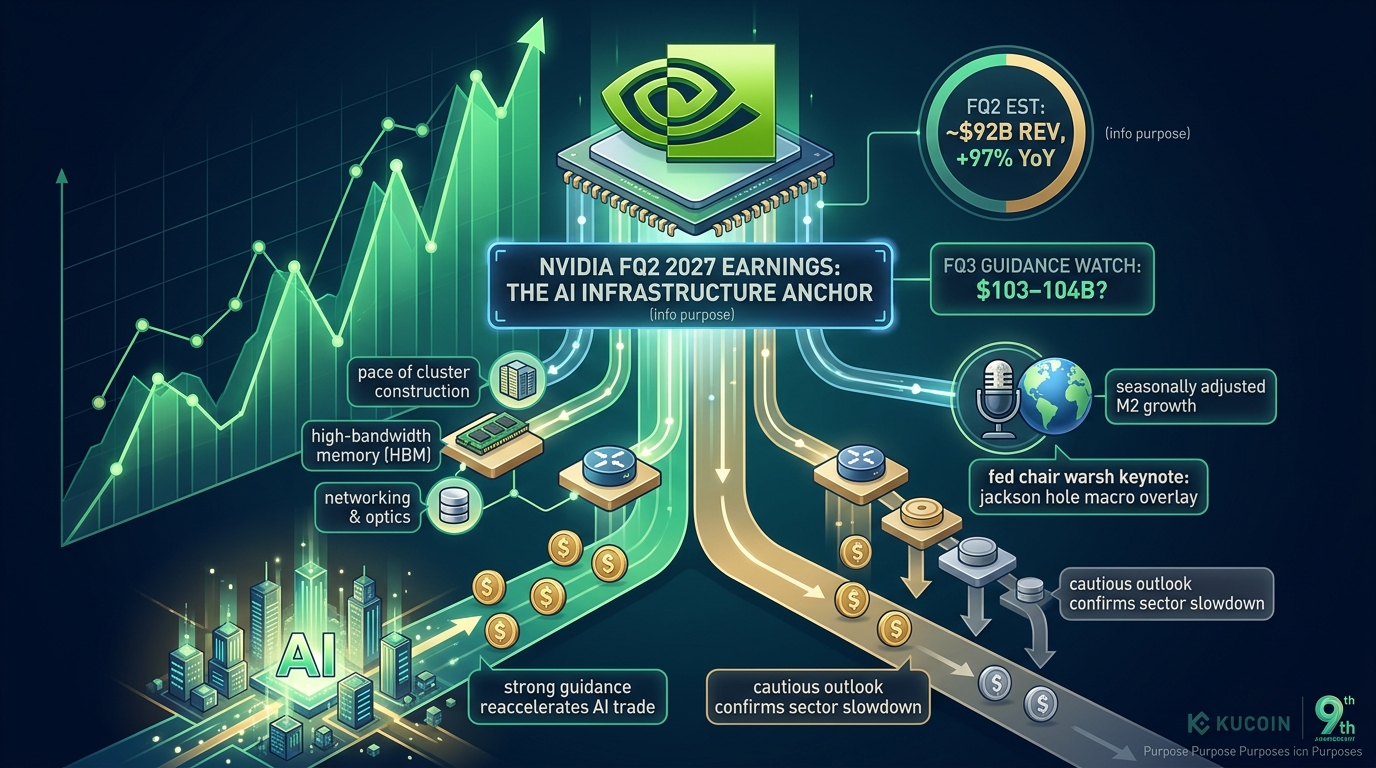
Nvidia is set to release its fiscal Q2 2027 results after the market close tomorrow, August 26, 2026, and this upcoming report stands as the single most important near-term test for the AI trade. After a recent pullback in AI chip stocks and softening sentiment toward the broader AI narrative, combined with ongoing pressure from U.S. Treasuries weighing on equities, the numbers and guidance from the dominant GPU supplier will either reaccelerate capital flows into AI infrastructure or confirm a slowdown already partially priced in.
Wall Street currently expects roughly $92 billion in revenue (up about 97% year-over-year) and adjusted EPS near $2.09. Investors will scrutinize next-quarter guidance, gross margins, Blackwell and Rubin delivery timelines, and confirmation that hyperscaler capital expenditures remain on track. The outcome will set the direction for the entire AI capital-expenditure chain and related market sentiment in the sessions ahead.
Why Does Nvidia’s Upcoming Earnings Report Matter So Much for the AI Narrative Right Now?
Nvidia’s results will serve as the primary pricing anchor for the full AI infrastructure buildout. GPU shipment volumes and forward guidance directly influence the pace of cluster construction, which then flows through to high-bandwidth memory (HBM), server DRAM, enterprise SSDs, and nearline HDDs. When Nvidia signals stronger demand, memory and optical-communication names typically amplify the move; when guidance disappoints, the same names absorb outsized downside.
Recent sessions already illustrated the linkage: Nvidia ended a seven-session losing streak with a gain of more than 2% on August 25, and storage plus optical names strengthened in tandem. Based on recent market data, the company currently trades at a forward price-to-earnings ratio of approximately 21 times next-twelve-month estimates. That multiple sits in clear contrast to the still-elevated revenue and earnings growth trajectory, indicating the market has already begun pricing a deceleration. Management must therefore demonstrate continued profit expansion and free-cash-flow generation that can support both ongoing investment and share repurchases.
Investors are watching several concrete items beyond a simple beat of consensus. Next-quarter revenue guidance—currently clustered around $103–104 billion—will determine whether growth is still accelerating at scale. Gross-margin commentary is equally critical; the company guided to roughly 75% adjusted, yet rising HBM costs create pressure that could compress profitability if not offset by pricing power or mix. Delivery updates on the Blackwell generation and the early ramp of Rubin (which entered mass production in July) will shape multi-quarter visibility. Finally, any color on whether major cloud providers continue to convert capital-expenditure plans into actual GPU orders will either reinforce or undermine the multi-year AI infrastructure thesis.
How Have Recent Market Conditions Set the Stage for Tomorrow’s Report?
AI-related chip stocks have experienced a noticeable pullback in recent weeks, and trading sentiment around the pure AI narrative has softened. At the same time, rising U.S. Treasury yields have exerted broader downward pressure on equity valuations.
In this environment, Nvidia’s report functions as an internal stress test for the AI sector itself. A strong beat accompanied by confident guidance can quickly restore risk appetite across related hardware, software, and infrastructure names. A merely in-line print or cautious outlook risks reinforcing the view that the easiest phase of the AI buildout is behind us. The seven-day decline that ended on August 25 already reflected this tension; the rebound showed traders positioning for the event rather than expressing renewed conviction.
The capital-expenditure chain remains tightly coupled. Hyperscalers continue to project elevated spending for 2026, with collective outlays expected to remain robust. Nvidia captures a large share of that spending through its GPU platforms. Any indication that those plans are being deferred, stretched, or redirected would ripple outward quickly. Conversely, confirmation that supply remains constrained and demand exceeds available capacity would support the higher end of analyst estimates and potentially extend the current cycle.
What Specific Metrics Will Investors Focus on in Tomorrow’s Earnings Release?
Revenue and adjusted EPS will be the headline figures, but the real market-moving information sits in the qualitative and forward-looking details. Consensus currently sits near $92 billion in revenue and $2.09 adjusted EPS for the quarter ended July 26. Management’s prior guidance midpoint was $91 billion (±2%). A modest beat is largely expected; the question is the size of the beat and the accompanying commentary. Data-center revenue, expected to exceed $85 billion, will receive particular scrutiny for the split between hyperscalers and the AI-cloud/industrial/enterprise segment.
Gross-margin trajectory matters because memory costs have risen sharply. Industry trackers have noted substantial sequential increases in server-memory contract prices. Sustaining the mid-70% range while absorbing those costs would demonstrate pricing power. Any material compression without clear offsetting factors could pressure the stock even if top-line numbers clear the bar.
Blackwell remains the volume driver, while Rubin is expected to begin contributing more meaningfully in subsequent quarters. Updates on production status, customer qualification, and shipment volumes for both platforms will shape multi-quarter models. Capital-deployment plans and free-cash-flow allocation—how much will fund further capacity, how much will return to shareholders via buybacks—will also be examined closely given the current valuation.
How Does the Upcoming Jackson Hole Speech by Fed Chair Kevin Warsh Fit into the Picture?
Nvidia’s report will address the internal health of the AI complex. Fed Chair Kevin Warsh’s keynote at the Jackson Hole Economic Policy Symposium later this week will address the broader macro backdrop that affects every risk asset, including AI-related equities and related digital-asset markets. Markets are looking for clarity on three fronts. First, which quantitative indicators the Federal Reserve currently prioritizes—five-year inflation expectations, federal-funds futures pricing, or other measures. Second, how those indicators translate into the policy reaction function. Third, whether Warsh has coordinated messaging with Treasury Secretary Scott Bessent regarding recent Treasury actions in the bond market.
Recent data add urgency to the inflation discussion. According to the latest Federal Reserve figures, seasonally adjusted U.S. M2 money supply reached $23.22 trillion in July 2026, a 5.41% year-over-year increase—the fastest pace since mid-2022. Faster money-supply growth can complicate efforts to return inflation sustainably to the 2% target and may influence the path of policy rates. A speech that reassures markets on the independence of monetary policy and the commitment to price stability could ease pressure on equity valuations. Ambiguous or hawkish language could reinforce the drag already visible from higher Treasury yields.
Together, the two events create a two-day window that will shape near-term risk appetite. Nvidia supplies the sector-specific signal; Warsh supplies the macro overlay.
KuCoin Offers A More Stable Option in A Volatile Market
If you worry about the frequent ups and downs in the market, and pursue a more stable option to earn money passively, KuCoin is the right place to come:
-
Simple Earn: Deposit and withdraw tokens anytime, earning stable returns.
-
Kucoin Earn: Earn stable profits with professional asset management.
-
Hold to Earn: Earn rewards by holding assets in Funding, Trading, Margin, Futures, Mining, and Unified Accounts.
-
Staking: Unlock the earning potential of on-chain assets.
-
Advanced Investments: Advanced Investments offer a variety of structured products to help your money grow in any market.
-
Shark Fin: Principal Protection and Guaranteed Gains
-
Dual Investment: Buy low and sell high with transparent return calculations.
-
Snowball: High yields, with price protection.
-
Discount Buy: Buy crypto at discount prices.
-
KCS Loyalty: Level up to enjoy exclusive perks by staking ≥ 1 KCS.
-
KuCoin Wealth: Discover future value and begin your smart investing journey.
-
KCS Benefits: Hold and stake KCS to access benefits across the platform.
-
KCS Staking 2.0: Participate in KCS on-chain governance to earn yield.

Conclusion
Nvidia’s fiscal Q2 2027 earnings release tomorrow, August 26, arrives at a pivotal moment. Recent weakness in AI chip shares, softer narrative sentiment, and macro pressure from U.S. Treasuries have raised the stakes. The report will clarify whether GPU demand, gross margins, and the Blackwell-to-Rubin transition remain on the strong trajectory that has defined the cycle so far.
Concurrently, Fed Chair Kevin Warsh’s Jackson Hole remarks will address the broader policy and inflation backdrop, including the implications of the latest M2 growth figures. Together these catalysts will determine whether the AI capital-expenditure narrative regains momentum or enters a more cautious phase. Investors will weigh the concrete metrics—revenue, guidance, margins, and product ramps—against a valuation that already reflects moderated growth expectations. The outcome will set the tone for the AI infrastructure complex and the risk assets that move with it in the days and weeks ahead.
FAQs
Will Nvidia’s earnings directly affect cryptocurrency prices?
Nvidia results influence overall risk appetite and AI-themed sentiment. Positive surprises often lift correlated digital assets and AI-related tokens; disappointments can weigh on the same group in the short term.
What is the most important number to watch beyond revenue?
Next-quarter guidance and gross-margin commentary carry the greatest weight. Guidance above the current $103–104 billion consensus range and stable mid-70% margins would be viewed most constructively.
How does rising memory pricing impact Nvidia?
Higher HBM and DRAM costs create potential margin pressure. Nvidia’s ability to maintain pricing power or improve mix will determine whether gross margins stay near the guided 75% level.
Why does the Jackson Hole speech matter alongside Nvidia’s report?
Nvidia addresses sector-specific demand; Warsh’s remarks address the macro environment that affects valuations across equities and digital assets. Clarity on inflation metrics and policy logic can either reinforce or offset the AI-specific signal.
Disclaimer: This article is for informational purposes only and does not constitute financial, legal, or investment advice. Always conduct your own research before interacting with digital assets.