

New Cryptocurrency Rules in Russia from September 1, 2026: What Will Change for Individuals and Businesses
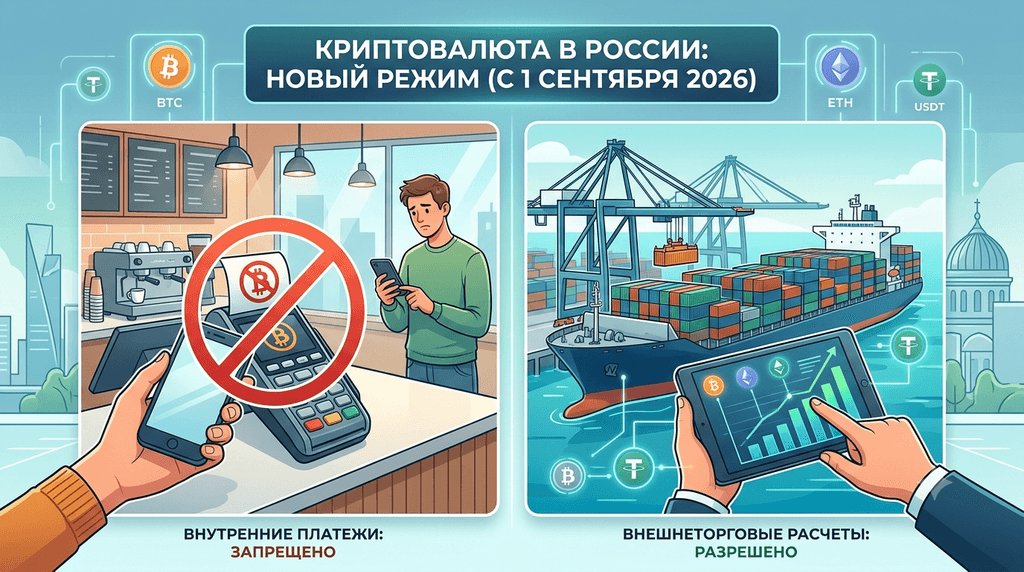
From September 1, 2026, cryptocurrency in Russia will no longer be an area of legal uncertainty, but it will not become ordinary money. The new regime recognizes digital currency as property, restricts its purchase by non-qualified investors, bans domestic payments, and gives companies a special channel for foreign-trade settlements. This was reported by Duma TV on August 31, 2026, on the eve of the entry into force of the main provisions.
The main practical conclusion is straightforward: individuals may own and hold BTC, ETH, or USDT, but purchasing assets through regulated Russian infrastructure will require KYC and risk testing. Businesses, meanwhile, will need to distinguish between domestic settlements, foreign economic activity, and mining. Below is an overview of what Russia's new cryptocurrency rules mean for individuals, companies, and miners.
What exactly is changing in Russia from September 1, 2026?
From September 1, 2026, a comprehensive regime for digital currency circulation will take effect, separating ownership rights, trading procedures, payments, and mining. The legislative reform does not give cryptocurrency the status of legal tender inside the country: the ruble remains the only mandatory means of payment in Russian settlements.
At the same time, digital currency will receive a more clearly defined property status. This matters in disputes, fraud cases, hacks, and bankruptcy proceedings because owners will have a clearer legal basis for protecting their claims. However, recognizing cryptocurrency as property does not remove the special restrictions governing its circulation or turn every crypto service into an authorized intermediary.
The new rules cover four areas. First, only participants provided for by law and included in the relevant registers of the Bank of Russia will be able to organize the circulation of digital currency. Second, retail investors will face knowledge testing, an approved-asset list, and an annual limit. Third, cryptocurrency will be prohibited for paying for goods, works, and services inside Russia, although it may be used in certain foreign-trade transactions. Fourth, legal entities and individual entrepreneurs will face formal requirements for mining.
Some provisions will apply later — on July 1 and September 1, 2027. Market participants should therefore review not only the reform's launch date but also the transitional provisions of the relevant law and subordinate regulations.
How can ordinary individuals buy and hold cryptocurrency?
An ordinary individual will be able to own cryptocurrency and keep it in a personal software or hardware wallet, but regulated purchases will require identification and the use of authorized infrastructure. Holding assets by itself is not the same as conducting business and does not create a separate obligation to register a personal wallet.
For transactions through a Russian intermediary, KYC and investment-risk assessment will become essential. A broker, crypto exchange service, or digital depository must identify the client, explain the risks, and ensure that a non-qualified investor has completed the mandatory test before making a first purchase. The purpose of this procedure is to distinguish a transparent transaction from an informal transfer of funds to an unknown counterparty.
In practice, this means that the space for private P2P transactions will narrow sharply. A transfer to an unfamiliar seller without a clear source of funds, contract, and verifiable transaction history may be stopped by a bank under anti-money-laundering controls. Even if the parties describe the transaction as an “ordinary exchange,” the bank may request documents under Federal Law No. 115-FZ and temporarily restrict account access if it detects suspicious activity.
Using a foreign exchange does not automatically prohibit ownership of the assets, but it does not release a resident from Russian tax, currency-control, or source-of-funds requirements. Before transferring funds to an external wallet, the user should verify the address, network, and counterparty because a blockchain transaction generally cannot be reversed after confirmation.
What limit applies to a non-qualified investor?
For a non-qualified investor, the main quantitative benchmark is up to 300,000 rubles in purchases per year through one official intermediary. This limit applies to assets approved by the regulator for public circulation through the relevant infrastructure; current explanations identify Bitcoin, Ethereum, and Tether USDT among those assets.
The limit restricts purchases, not ownership. Coins that have already been acquired do not need to be sold automatically, and a transfer between the user's own wallets is not a new purchase. However, the precise accounting treatment of transactions, including conversions, fees, and trades through different intermediaries, must be determined by the platform's rules and the regulations of the Bank of Russia.
|
Participant category
|
Asset access
|
Main requirement
|
Quantitative restriction
|
|
Non-qualified investor
|
Assets from the approved list
|
KYC and risk testing before the first purchase
|
Up to 300,000 rubles per year through one intermediary
|
|
Qualified investor
|
A broader range of instruments under market rules
|
Confirmed status and compliance with intermediary requirements
|
No special retail limit applies, but risks remain
|
|
Legal entity or individual entrepreneur
|
Transactions within permitted activities
|
Accounting, documentation, and infrastructure requirements
|
Depends on the purpose and regime of the transaction
|
Passing the test does not make an investment safe and does not guarantee returns. It only confirms that the client has been informed about volatility, the risk of losing funds, technological failures, and the specifics of key storage. Splitting purchases among different intermediaries also does not eliminate tax or other compliance obligations.
Can cryptocurrency be used for payments inside Russia?
No. Cryptocurrency cannot be used as an ordinary means of paying for Russian goods, works, or services. The new regulated market does not change this fundamental prohibition: domestic settlements must be conducted in rubles, including cash, non-cash, and digital forms of the national currency.
Accordingly, a store cannot lawfully replace a ruble price with a mandatory payment in BTC or USDT, and a Russian employer should not structure ordinary wages in cryptocurrency. It is also risky to disguise payment for goods as a “gift,” “reward,” or domestic P2P exchange if the transaction is economically still a settlement between a seller and a buyer.
The exceptions are specific. Digital currency may be used in foreign-trade settlements provided for by law, received as mining compensation, used in transactions involving other digital currencies and digital rights, and applied to certain fees expressly permitted by the regulatory regime. For each such transaction, the purpose of payment, the status of the participants, the documentation, and the selected financial infrastructure are important.
This distinction explains why cryptocurrency and the digital ruble are not interchangeable instruments. Cryptocurrency is a property and investment asset subject to a special circulation regime, whereas the digital ruble is a form of national currency for domestic payments. The existence of a digital wallet at a bank does not legalize paying for Russian services in USDT.
How can companies use cryptocurrency in foreign trade?
Russian businesses will be able to use digital currency for certain settlements under foreign economic contracts within an experimental legal regime. This creates an alternative channel for imports and exports when traditional international payments are difficult, but it does not turn cryptocurrency into a universal tool for bypassing sanctions or currency controls.
A company must confirm that the foreign-trade transaction is genuine and link each transaction to the contract, invoice, delivery, and counterparty. Internal controls should retain the TXID, wallet addresses, transfer date and amount, information about beneficial owners, documents relating to the goods or services, and the exchange rate used for accounting purposes.
USDT and BTC may be considered practical instruments within the permitted regime, but the choice of asset does not eliminate source-of-funds checks. For a large transaction, a financial institution or digital depository may request additional information about the payment route, counterparties, and economic substance of the transaction. Participants should not assume that a blockchain transaction replaces a contract or primary accounting documents.
Transactions exceeding 10 million rubles require heightened financial-monitoring attention under the published explanations of the new regime. A company should appoint compliance officers in advance, establish wallet-approval procedures and authority limits, and create a process for matching delivery with payment. Misclassifying a domestic payment as a foreign-trade settlement may lead to a block, a dispute with the bank, and liability.
Companies should treat cryptocurrency as property and document their transactions, while including proceeds from disposals in the applicable tax base under the relevant tax regime. The precise calculation depends on the legal form of the organization, tax system, nature of the transaction, and current explanations from the Federal Tax Service. An accounting policy should therefore be approved before regular transactions begin.
The minimum supporting package includes a contract or order, intermediary report, bank statement, TXID, public address, fee information, and the ruble valuation calculated on the transaction date. If the asset was received through mining, the company should separately record the accrual date, wallet, mining pool, amount, electricity cost, and subsequent disposal.
For individuals, the tax base generally arises when the asset is disposed of and an economic result is realized, rather than when it is merely held or transferred between the individual's own wallets. The working formula is: sale proceeds minus documented acquisition costs and related fees. Without supporting records, the tax base may be higher because the expenses may not be accepted.
An individual's income from transactions involving property and digital currency must be declared under personal income tax rules; published explanations identify 13% and 15% rates for the basic range. Materials on the subject also mention penalties and late-payment charges for concealing income. Depending on the nature of the violation, these may significantly increase the final amount, so the absence of a bank statement does not mean that there is no tax obligation.
What will change for miners?
For a Russian company or individual entrepreneur, mining requires inclusion in a special Federal Tax Service register. A citizen without individual-entrepreneur status may conduct home mining without such registration if the applicable electricity-consumption limit is not exceeded. Practical explanations use 6,000 kWh per month as a benchmark, but participants should verify the current regional procedure and its effective date.
A miner should distinguish three events: the creation of the asset, its receipt in the designated wallet, and its subsequent sale. The address of the mining wallet must be disclosed to the Federal Tax Service in the prescribed manner. Information about the pool, equipment, electricity, and income should be retained in a way that allows the entire path from the coins being credited to their eventual disposal to be reconstructed.
A legal entity or individual entrepreneur must account for equipment and electricity costs under the applicable rules, keep personal and corporate wallets separate, and avoid using a household tariff for activity that has effectively become commercial. Coins received through mining may be sold, including to a non-resident, but the transaction must take tax, currency-control, and AML requirements into account.
The household limit is not permission to operate an unlimited mining farm. If electricity consumption exceeds the threshold, the miner may need to move to an official regime. Violations may trigger claims from the electricity provider, tax authority, or financial-monitoring bodies. Before installing equipment, participants should check capacity, tariffs, regional restrictions, and registration procedures.
How can a large digital-currency transfer be protected?
For certain large transfers through a digital depository, a 48-hour delay will be introduced, giving the client time to cancel the instruction before execution. It applies when cryptocurrency worth more than 100,000 rubles is sent to an address not administered by the depository, or when assets worth more than 300,000 rubles are sent to a third party.
The delay is not a guarantee of recovery and does not replace address verification. Its practical purpose is to reduce losses caused by social engineering, account hacking, or an erroneous instruction. The user should immediately verify the network, address, memo or tag, amount, and recipient, and then contact the depository if there is any doubt.
Businesses should account for this period in their contract schedules. If the payment is connected with a delivery, the parties should agree in advance on the crediting time, exchange rate, fee, and backup settlement method. For individuals, the delay is especially important when transferring assets to an external wallet because an operation can be canceled only during the designated window and through the prescribed communication channel.
Should You Buy or Trade Cryptocurrency on KuCoin?
Trading on KuCoin should begin only after verifying that the selected access method and specific transaction comply with the laws of the user's country of residence, tax-accounting requirements, and the platform's own rules. An international exchange may provide access to a broad range of assets and tools, but its availability does not remove KYC, AML checks, tax reporting, Russia's ban on domestic crypto payments, or the user's responsibility to comply with local law.
For a Russian user, a reasonable process is as follows: first determine the purpose of the transaction — investment, exchange, holding, or a foreign-trade settlement. Then check the asset's status, the intermediary's restrictions, and the source of funds. After that, retain evidence of purchases, fees, deposits, and withdrawals. Users should not use P2P to bypass bank checks, send money to unknown individuals, or treat an intermediary's limit as a guarantee of profit.
KuCoin offers tools for spot trading, custody, and digital-asset management, but the crypto market remains volatile. Position size, the use of borrowed funds, and product selection should reflect the possibility of losing all invested capital. Registration on the platform makes sense only after independently checking regional availability, service terms, and tax consequences.
KuCoin Offers A More Stable Option in A Volatile Market
If you worry about the frequent ups and downs in the market, and pursue a more stable option to earn money passively, KuCoin is the right place to come:
Simple Earn: Deposit and withdraw tokens anytime, earning stable returns.
Kucoin Earn: Earn stable profits with professional asset management.
Hold to Earn: Earn rewards by holding assets in Funding, Trading, Margin, Futures, Mining, and Unified Accounts.
Staking: Unlock the earning potential of on-chain assets.
Advanced Investments: Advanced Investments offer a variety of structured products to help your money grow in any market.
Shark Fin: Principal Protection and Guaranteed Gains
Dual Investment: Buy low and sell high with transparent return calculations.
Snowball: High yields, with price protection.
Discount Buy: Buy crypto at discount prices.
KCS Loyalty: Level up to enjoy exclusive perks by staking ≥ 1 KCS.
KuCoin Wealth: Discover future value and begin your smart investing journey.
KCS Benefits: Hold and stake KCS to access benefits across the platform.
KCS Staking 2.0: Participate in KCS on-chain governance to earn yield.
Conclusion
Russia's new cryptocurrency rules, effective from September 1, 2026, create a more formal but also more layered system. Digital currency is recognized as property, individuals retain the ability to own and hold assets, and non-qualified investors gain access to approved coins after KYC and risk testing. Their primary benchmark is a limit of up to 300,000 rubles per year through one official intermediary.
At the same time, cryptocurrency does not become domestic money. Payment for goods, works, and services in Russia is generally prohibited, while foreign-trade settlements and certain other transactions are allowed under special regimes. Companies must document the economic substance of each transaction and retain TXIDs and contracts, while miners must comply with register, wallet, and electricity-consumption requirements.
For every participant, documentation, a transparent source of funds, and the separation of personal, corporate, and foreign-trade transactions are critical. Before buying or selling, users should check current acts of the Bank of Russia, the Federal Tax Service, and the terms of the relevant intermediary because some rules will be introduced in stages. An exchange may provide market access, but it does not replace a tax professional, lawyer, or the user's own risk assessment.
Frequently Asked Questions
1. Can BTC, ETH, or USDT be stored in a personal wallet?
Yes. Holding digital currency in a personal software or hardware wallet is not prohibited by itself. The user remains responsible for seed-phrase security, proof of the source of funds, and compliance with tax requirements when the assets are later sold.
2. Do I have to pay tax if I only hold cryptocurrency?
As a general rule, simple ownership, purchase, or a transfer between the user's own wallets does not create disposal income. The tax question arises when the asset is sold or another transaction realizes an economic result; acquisition costs should be supported by documents.
3. Can cryptocurrency be purchased through a foreign exchange?
The possibility depends on current Russian restrictions, the platform's rules, KYC requirements, and the specific transaction method. Using a foreign platform does not remove the obligation to declare income, prove the source of funds, or avoid using cryptocurrency for prohibited domestic payments.
4. What happens if a miner exceeds the electricity-consumption limit?
If the established limit is exceeded, home mining may no longer qualify for the unregistered regime. The participant will need to check whether they must enter the official register and account for regional rules, tariffs, and tax consequences.
5. Can cryptocurrency be used to pay for a Russian product if the seller agrees?
The seller's consent does not override the general prohibition on using digital currency as a means of payment inside Russia. It is safer to document a domestic transaction in rubles and treat the cryptocurrency separately as property or an asset in a permitted transaction.
Disclaimer : This material is provided for informational purposes only and does not constitute financial, investment, legal, or tax advice. Transactions involving cryptocurrencies and tokenized assets carry substantial risks — including price volatility, limited liquidity, counterparty exposure, and the potential for total loss of invested capital. Readers should conduct their own research and, where appropriate, consult a qualified professional before making any financial decisions.