

Why Whales Aren’t Selling: How HNWI Crypto Collateral Shifted in the 2026 Bear Market
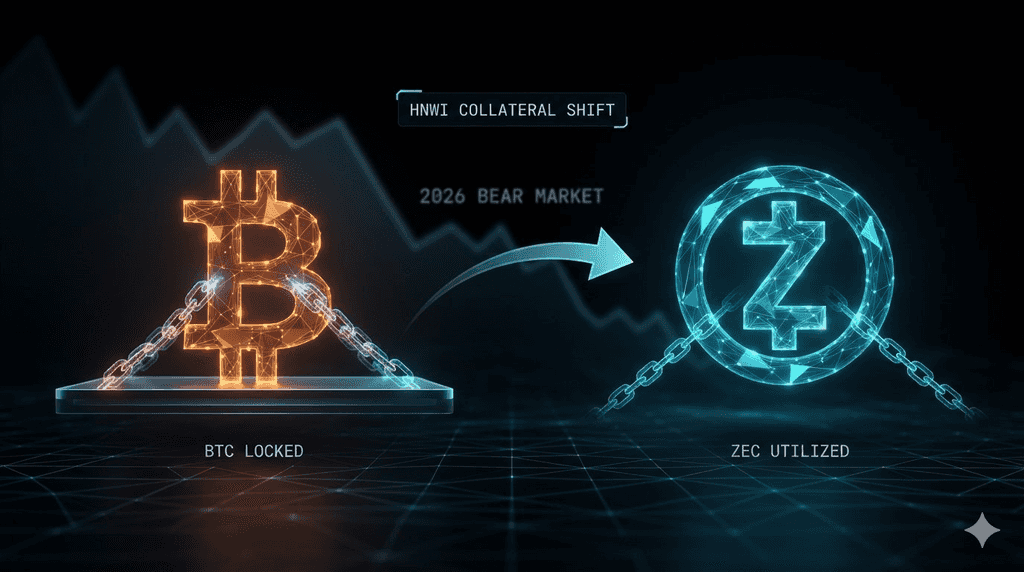
A joint analytical study conducted by crypto lending provider CoinRabbit and blockchain analytics firm CryptoQuant, titled Why Whales Don't Sell: Crypto Lending Across the Cycle, provides data on how borrowing behavior has shifted. Across both retail borrowers and high-net-worth individuals (HNWIs), loan origination frequencies increased during the 2026 downturn compared to the preceding 2025 expansion phase.
While Bitcoin long served as the default collateral asset, institutional-grade borrowers reduced their relative BTC allocations significantly during 2026. Concurrently, capital presence increased in privacy-preserving assets, notably Zcash (ZEC), alongside select decentralized infrastructure tokens.
Examining the operational data behind this collateral rotation reveals how market participants are managing counterparty risk, tax efficiency, and portfolio allocations during market corrections.
The Macro Lending Landscape: Rising Loan Activity Across Cycles
The 2026 market correction presented a different environment from historical crypto drawdowns. While speculative leverage on perpetual futures platforms compressed during 2026, credit demand across collateralized lending services expanded.
Rising Loan Frequency: Retail vs. Institutional Capital
Data published in the CoinRabbit and CryptoQuant report highlights a divergence in how different market cohorts utilize crypto-backed credit facilities. Among retail users, the average number of loans executed per user increased by 74%, rising from 30.8 operations during the 2025 bull cycle to 53.5 operations during the 2026 bear market.
For high-net-worth individuals, loan frequency grew at a more measured pace of 18%, moving from an average of 16.5 credit facilities per user in the expansion phase to 19.4 facilities in the contraction phase.
This differential reflects the standard economic functions debt serves for each demographic:
-
Retail Capital Utility: Retail market participants often utilize collateralized loans to address personal living expenses, service external fiat obligations, or avoid selling spot positions at realized losses during market troughs.
-
Institutional Liquidity Engineering: High-net-worth allocators approach lending desks to execute strategic basis trades, finance private equity deployments, or rebalance cross-market exposures without liquidating underlying core holdings.
-
Credit Facility Durability: The overall share of repeat borrowers climbed from 61.9% to 65.1% across the two market cycles, indicating steady reliance on credit lines for treasury management.
Lengthening Time Horizons and Cautious Liquidity Utilization
Alongside the increase in loan count, the duration of borrow cycles shifted between cycles. During the 2025 bull run, retail market participants averaged 11 days between consecutive loan actions. These shorter-duration loans typically financed speculative rotation into newly listed assets or yield strategies.
During the 2026 bear market, the average duration between retail borrowing operations widened to 21 days. This extension in loan lifecycles suggests a more conservative approach to debt management. Borrowers are drawing down larger, less frequent credit lines to maintain multi-week liquidity buffers rather than engaging in rapid capital turnover.
The Institutional Collateral Pivot: Bitcoin to ZEC
A notable shift in the 2026 lending data is the reconfiguration of collateral composition among high-net-worth borrowers. Traditionally, Bitcoin met institutional requirements for liquidity and order-book depth better than alternative assets. However, data from 2026 demonstrates a move toward multi-asset collateralization.
Bitcoin Decreases, Zcash Captures 24.2%
During the 2025 bull market, HNWIs allocated an average of 57.8% of their total collateral value to BTC. In the 2026 bear market, the share of Bitcoin within HNWI collateral portfolios fell to 30.5%.
Concurrently, Zcash (ZEC) emerged as the primary beneficiary of this rebalancing. Having failed to register among the top ten collateral assets during the 2025 expansion, ZEC accounted for 24.2% of all HNWI collateral balances in 2026, pacing behind Bitcoin as the second-largest institutional collateral asset on centralized lending desks.
Asset Appreciation and Risk Isolation
The migration toward ZEC reflects a combination of substantial market price appreciation and operational calculations among large capital holders. During this period, Zcash experienced a significant price rally (climbing from roughly $50 to approximately $800), which mechanically inflated its proportional weight in overall portfolio values. Alongside this price appreciation, whales utilized the asset for several strategic reasons:
-
Mitigating Public Wallet Profiling: As on-chain forensics tools become more standard, large addresses face routine tracking. By utilizing Zcash—particularly capital emerging from shielded address pools—large holders introduce a layer of privacy between their primary cold-storage reserves and third-party credit venues.
-
Custodial Risk Segmentation: Institutional allocators generally avoid maintaining their entire balance sheet within a single asset class. Depositing alternative assets like ZEC isolates the primary Bitcoin treasury from potential platform insolvencies or regulatory freezes.
-
Value Anchoring: Institutional holders who accumulated ZEC during lower consolidation ranges leveraged its appreciated value to unlock working capital, allowing their primary spot Bitcoin positions to remain in cold storage.
The Broader Defensive Spread: Monero, Chainlink, and Cardano
The shift away from concentrated Bitcoin collateral also extended to other assets. HNWI portfolios displayed broader diversification across alternative proof-of-work, privacy, and infrastructure networks. Monero (XMR) recorded an uptick in collateral utilization, while enterprise oracle network token Chainlink (LINK) and Layer 1 asset Cardano (ADA) established sustained presences within top-tier collateral reserves.
Retail Collateral Inelasticity: XRP and Long-Tail Altcoins
While institutional market participants restructured their balance sheets around privacy protocols and infrastructure tokens, retail borrowers exhibited a different operational pattern, showing high asset stickiness and a willingness to pledge depreciated altcoins.
XRP's Sustained Lead in Consumer Lending
Across both market phases, XRP retained its position as the preferred collateral asset for retail crypto borrowers. In the 2025 bull market, XRP accounted for 41.7% of all retail collateral volume. During the 2026 contraction, its share remained elevated at 35.2%. Retail holders consistently demonstrate a preference for borrowing against their XRP balances to satisfy cash-flow demands rather than liquidating spot positions. Additionally, retail borrowers maintained a consistent Bitcoin allocation across cycles, with BTC representing 32.1% of retail collateral in 2025 and 30.2% in 2026.
The Inclusion of Long-Tail Altcoins
A trend within the 2026 retail lending data is the dispersion of collateral across long-tail altcoins. Assets such as TRON (TRX), Stellar (XLM), BNB, Kaspa (KAS), and Velo (VELO) recorded rising utilization rates within consumer credit agreements. By locking lower-tier market-cap assets into collateral contracts, retail participants converted paper drawdowns into usable liquidity.
Capital Destination: The Shift Toward Cash Equivalents
The data regarding what borrowers pledged as collateral is matched by an analysis of what assets they withdrew. In a speculative bull market, borrowed funds are often directed into high-beta altcoins or decentralized finance yield farms. In the 2026 bear market, capital deployment shifted toward stable liquidity and yield-bearing instruments.
Liquidity Extraction Without Taxable Realization
A primary catalyst driving crypto borrowing is tax efficiency. In most jurisdictions, selling a digital asset triggers a capital gains tax assessment, whereas taking out a loan against that same asset is treated as a non-taxable liability. By depositing collateral and drawing down stablecoins, HNWIs obtain purchasing power while maintaining their token balance.
Where the Borrowed Capital Flows: USDC and RWA Momentum
An examination of withdrawal destinations reveals a move toward stable settlement mediums:
The Stablecoin Preference: Tether (USDT) remained the most requested loan asset across all categories. USD Coin (USDC) advanced to the third overall position, reflecting steady demand for US-domiciled banking reserves.
Real-World Assets (RWA): Among the top ten borrowed or swapped assets, tokens tied to real-world assets, such as Ondo Finance (ONDO) and Flare (FLR), experienced measurable gains as borrowers sought traditional fixed-income market yields.
The Decline of High-Beta Speculation: Highly volatile assets that featured prominently in 2025 lending volumes, including Solana (SOL) and Shiba Inu (SHIB), dropped out of the top ten destination assets in 2026.
Risk Management and Execution for Collateralized Borrowers
While collateralized borrowing eliminates the necessity of selling assets at cyclical lows, it introduces specific financial risks that market participants must manage.
Mitigating Loan-to-Value (LTV) Risks
If the value of a pledged asset falls sharply, the position's Loan-to-Value (LTV) ratio increases. If the LTV crosses the platform’s predetermined liquidation threshold, the custodian automatically liquidates a portion of the collateral. To manage this risk during bear markets, participants use:
-
Conservative Initial LTVs: While platforms permit LTVs of 70% or higher, institutional allocators routinely maintain baseline LTVs between 30% and 40%.
-
Active Margin Monitoring: Market participants track order-book liquidity across spot markets to assess whether broad liquidity conditions could trigger rapid price cascades.
-
Pre-Funded Collateral Buffers: Borrowers establish secondary reserves of liquid stablecoins that can be transferred into lending accounts at short notice to satisfy margin calls.
Conclusion
The 2026 market downturn highlights a structural shift where collateralized borrowing has increasingly replaced asset liquidation across crypto investor tiers. While retail participants rely on credit lines to cover cash-flow needs without realizing paper losses, high-net-worth allocators actively engineer multi-asset collateral strategies. By rebalancing into appreciated privacy protocols and yield-bearing stablecoins, sophisticated holders preserve their core Bitcoin reserves, mitigate tax liabilities, and protect long-term treasury liquidity across cycles.
FAQs
Why are crypto investors choosing to borrow against their assets instead of selling them?
Crypto investors utilize collateralized borrowing to unlock working capital without triggering taxable events. Selling a digital asset incurs capital gains tax, whereas taking out a loan against that asset is treated as a non-taxable liability. Borrowing also allows long-term holders to maintain upside exposure to the asset.
Why did Zcash (ZEC) experience a large increase in HNWI collateral allocation during 2026?
The rotation toward Zcash was driven largely by its massive price appreciation during this window, which mechanically expanded its weight in collateral portfolios. Alongside this price rally, whales utilized ZEC's privacy features and shielded address pools to interact with lending platforms without exposing their publicly tracked Bitcoin wallets to on-chain surveillance, effectively isolating their core reserves.
How does retail borrowing behavior differ from high-net-worth borrowing during a bear market?
Retail borrowers primarily use credit facilities for short-term expenses and to avoid selling underwater positions, resulting in a 74% surge in loan frequency during the 2026 bear market. HNWIs increased borrowing more conservatively (+18%) and focused on structural treasury management and tax mitigation. Retail users predominantly pledged XRP and long-tail altcoins, while institutional allocators weighted their baskets toward BTC, ZEC, and infrastructure tokens.
What are the primary risks associated with using crypto as loan collateral?
The main risk is liquidation resulting from downward price movements. If the market value of the pledged collateral declines significantly, the position's Loan-to-Value (LTV) ratio rises. If a borrower fails to deposit additional collateral when a threshold is breached, the platform will liquidate the pledged assets. Platform counterparty risk and fluctuating borrowing interest rates are also primary considerations.
KuCoin Offers A More Stable Option in A Volatile Market
If you worry about the frequent ups and downs in the market, and pursue a more stable option to earn money passively, KuCoin is the right place to come:
Simple Earn: Deposit and withdraw tokens anytime, earning stable returns.
Kucoin Earn: Earn stable profits with professional asset management.
Hold to Earn: Earn rewards by holding assets in Funding, Trading, Margin, Futures, Mining, and Unified Accounts.
Staking: Unlock the earning potential of on-chain assets.
Advanced Investments: Advanced Investments offer a variety of structured products to help your money grow in any market.
Shark Fin: Principal Protection and Guaranteed Gains
Dual Investment: Buy low and sell high with transparent return calculations.
Snowball: High yields, with price protection.
Discount Buy: Buy crypto at discount prices.
KCS Loyalty: Level up to enjoy exclusive perks by staking ≥ 1 KCS.
KuCoin Wealth: Discover future value and begin your smart investing journey.
KCS Benefits: Hold and stake KCS to access benefits across the platform.
KCS Staking 2.0: Participate in KCS on-chain governance to earn yield.
Disclaimer
The information provided on this page may originate from third-party sources and does not necessarily represent the views or opinions of KuCoin. This content is intended solely for general informational purposes and should not be considered financial, investment, or professional advice. KuCoin does not guarantee the accuracy, completeness, or reliability of the information, and is not responsible for any errors, omissions, or outcomes resulting from its use. Investing in digital assets carries inherent risks. Please carefully evaluate your risk tolerance and financial situation before making any investment decisions. For further details, please consult KuCoin’s Terms of Use and Risk Disclosure.