

What Is a Crypto Wallet? A Beginner’s Guide to Storing Cryptocurrency Securely in 2026
Introduction
As cryptocurrency adoption continues to expand in 2026, crypto wallets have become one of the most essential tools for anyone entering the digital asset market. Whether users are buying Bitcoin, trading meme coins, staking Ethereum, or exploring Web3 applications, a crypto wallet serves as the gateway to managing and securing digital assets.
A crypto wallet is a tool that allows users to store, access, send, and receive cryptocurrencies. Unlike a traditional wallet that physically holds cash, crypto wallets store the cryptographic credentials — known as private keys — that prove ownership of blockchain-based assets.
Modern crypto wallets have evolved significantly from the early days of Bitcoin wallet. Today’s wallets support multiple blockchains, NFT storage, DeFi access, staking, passkey authentication, and even social recovery features designed to improve user security and usability.
Understanding how crypto wallets work is critical because ownership in crypto ultimately comes down to control of private keys. If users lose access to their keys, they may permanently lose access to their funds. On the other hand, properly secured wallets give users complete control over their digital assets without relying entirely on banks or centralized institutions.
From hot wallets and cold wallets to custodial and non-custodial solutions, the crypto wallet ecosystem now offers a wide range of options tailored to different types of investors and traders. This guide explains the major wallet categories, how they work, and how to choose the right crypto wallet based on security, convenience, and investment goals.
Hardware Wallets vs. Software Wallets
One of the most important tasks in understanding crypto wallets is simply tackling the vocabulary. And one of the broadest categorizations is the difference between hardware and software wallets.
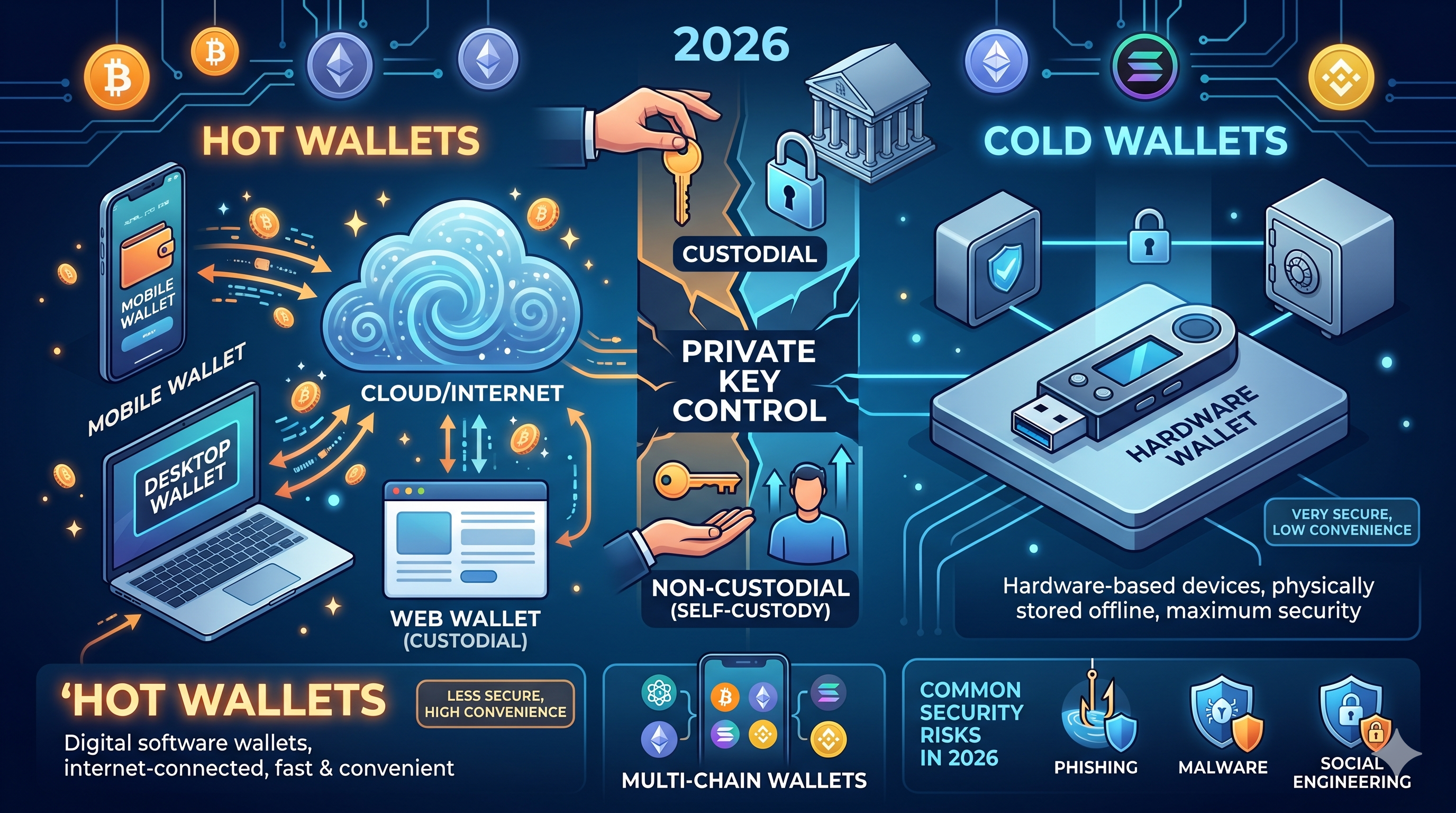
Software wallets are based on computer software. Because they are connected to the internet, software wallets are also known as ‘Hot Wallets’.
Hardware wallets are built onto hardware devices. They are considered a much safer alternative to the software wallets. However, they also offer far less functionalities. Hardware wallets are considered a ‘Cold Wallet’ because the information they store is not accessible via the internet.
The important thing to remember here is that hardware is ‘cold’ and software is ‘hot’. There are also paper wallets, which are ‘cold’. Those are discussed below but it’s important to understand the concept of control as it relates to crypto wallets.
Custodial vs. Non-Custodial Wallets
In the world of cryptocurrency, control is key. Rather, control of your keys is key. With a custodial wallet, another party controls the key codes securing the assets.
With non-custodial wallets, the opposite is true. In a non-custodial wallet the owner controls the key codes securing the assets.
Some people find that there is a greater sense of security associated with non-custodial wallets.
Almost all exchanges provide a custodial wallet. However, users with significant crypto holdings often lessen the risk by moving said assets to a non-custodial wallet.
Bearing that in mind let’s dive back into ‘cold’ hardware wallets and ‘hot’ software based wallets.
The Rise of Self-Custody and Multi-Chain Wallets
The crypto industry has evolved rapidly since the early generation of Bitcoin wallets. In recent years, self-custody has become one of the most discussed topics in digital asset security, especially following several high-profile exchange collapses and cybersecurity incidents across the crypto sector.
As a result, many investors now prefer to hold at least part of their assets in non-custodial wallets, where they maintain direct ownership of private keys rather than relying entirely on centralized platforms.
At the same time, modern wallets have become far more advanced than simple Bitcoin storage tools. Many leading wallets now support multiple blockchains simultaneously, allowing users to manage assets across networks such as Bitcoin, Ethereum, Solana, BNB Chain, TON, and Layer-2 ecosystems within a single application.
These “multi-chain wallets” have become increasingly popular because they simplify portfolio management while providing access to decentralized finance (DeFi), NFT marketplaces, GameFi ecosystems, and Web3 applications.
Some modern wallets also utilize MPC (Multi-Party Computation) technology and passkey authentication systems to improve both security and user experience. These technologies aim to reduce the risks associated with losing seed phrases while still preserving elements of self-custody.
As crypto adoption grows globally, wallet technology is expected to continue evolving toward greater security, interoperability, and ease of use for mainstream users.
Hot vs. Cold Wallets vs. Paper Wallets
A hot wallet is a wallet that is connected to the internet, whereas a cold wallet is one that is completely cut off from it. There are pros and cons to both types of wallets - which we’ll outline later - but first, let’s look at the sub-categories of hot wallets. After that, we’ll look at paper wallets.
Hot wallets come in three main types:
Mobile wallets: A mobile wallet is an app that runs on a smartphone and allows the user to store and control their cryptocurrency assets. Mobile wallets are convenient from the perspective that they allow the user to transfer crypto assets as payment for in-person transactions or via a QR code.
Desktop wallet: A desktop wallet is one which is installed on a desktop or laptop computer. A desktop wallet allows the user to store private keys and it also serves as an address at which the user can send and receive crypto currency. With a desktop wallet the user has increased control over their assets in comparison to the third type of hot wallet, a web wallet.
Web Wallet: Web wallets are hosted by exchanges and brokerages that offer cryptocurrency trading and related services. Web wallets can be accessed via mobile or desktop devices but offer less control than desktop wallets.
The three hot wallet types are generally free, which is an obvious point of attraction. Each of the three hot wallet types differ in slight ways. But whichever type of hot wallet a user considers the main point to remember is that hot wallets are internet connected and software-based.
Cold Wallets
Cold wallets are hardware-based devices that allow users to physically hold and carry the keys to their crypto currency assets. A cold wallet is essentially a USB flash drive with the capability of storing crypto currency asset data. Cold wallets can also be downloaded on a smartphone.
Cold wallets aren’t free since they are physical pieces of hardware. Most cold wallets cost around $100.
Paper Wallets
Lastly, there are paper wallets. Paper wallets are nearly a relic by this point in the evolution of cryptocurrency. That’s not to say that they no longer have utility, but paper wallets were more popular in the earlier years of crypto.
That explanation aside, a paper wallet is an actual printed piece of paper with a private key or QR codes printed onto it. As readers might imagine, there is inherent risk in relying on a paper wallet to secure one’s crypto assets. Damaged or torn paper wallets may be rendered useless. Likewise, a misplaced paper wallet makes the assets behind it impossible to retrieve.
Yet, the benefits make paper wallets an attractive option. Paper crypto wallets are generally very secure. Think of them not unlike a secret code you might have written on a paper as a child. As long as no one else has access to it, then it’s secure.
There is one caveat here. Because paper wallets are printed from an actual printer there can be security breaches. When printing a paper crypto wallet it is advisable to disconnect from the internet. Printers connected to larger networks may also store data. Thus, it is recommended to take caution against such potential breaches.
That was a lot of information. The overall thrust is that crypto wallets are broadly categorized: hot vs. cold, hardware vs. software, and custodial vs. non-custodial. After readers have absorbed all of that information, they’re left with a simple question: Which type of wallet is best?
Pros and Cons of Each
The answer to which type of wallet is best is of course, subjective. It depends upon what the user’s needs are. Generally speaking, there are two main needs to consider: Cost and security.
Hot wallets are digital software wallets, and as such they are almost always free. The cost to create a hot wallet is much lower than the cost to create a cold wallet. As previously mentioned, cold wallets are physical hardware and cost around $100 on average. So from the perspective of cost alone, hot wallets are the winner.
However, investors considering crypto wallets have to consider security. In this case the old maxim holds true: You get what you pay for. Hot wallets are less secure because they are hosted on the internet. Hackers can and do circumvent the security features of hot wallets.
Cold wallets on the other hand are much more secure. The small, portable pieces of hardware allow users to download their crypto assets and take them anywhere.
Cold wallets are built with security in mind. They have a reputation for being very safe and can provide a greater sense of security when compared to hot wallets. However, being that a cold wallet is a physical device, it can be misplaced or lost. Recovery is possible, but not easy.
Common Crypto Wallet Security Risks in 2026
Although crypto wallet technology has improved substantially, security risks remain one of the biggest challenges in the digital asset industry.
Phishing attacks continue to be among the most common threats. Scammers frequently create fake wallet applications, fraudulent browser extensions, and malicious websites designed to steal users’ seed phrases or private keys.
Malware attacks targeting clipboard addresses and browser wallet extensions have also become increasingly sophisticated. In many cases, attackers attempt to intercept wallet credentials during transactions.
Another growing risk involves social engineering attacks conducted through social media platforms, messaging apps, and fake customer support accounts impersonating exchanges or wallet providers.
To reduce these risks, users should follow several best practices:
- Never share a seed phrase or private key
- Enable two-factor authentication (2FA)
- Verify wallet URLs and application downloads carefully
- Store backup phrases offline
- Use hardware wallets for large holdings
- Avoid connecting wallets to suspicious decentralized applications (dApps)
As the crypto industry matures, wallet security education has become just as important as choosing the wallet itself.
Conclusion
Choosing the best crypto wallet ultimately depends on an individual user’s investment strategy, trading frequency, security preferences, and level of technical experience.
Hot wallets provide convenience, accessibility, and seamless integration with modern crypto applications, making them ideal for active traders and Web3 users. Cold wallets, on the other hand, offer a significantly higher level of protection for long-term investors seeking maximum asset security.
Meanwhile, custodial and non-custodial wallets each serve different purposes within the broader crypto ecosystem. Some users prioritize simplicity and integrated trading experiences, while others value complete ownership and self-custody of their assets.
As blockchain technology continues to evolve in 2026, crypto wallets are becoming more sophisticated, user-friendly, and interconnected with decentralized finance, NFTs, gaming ecosystems, and AI-powered applications.
Understanding how wallets function — and the trade-offs between convenience and security — is an essential step for anyone participating in the cryptocurrency market.
Whether you are a beginner buying your first Bitcoin or an experienced investor managing a diversified digital asset portfolio, selecting the right wallet is one of the most important decisions in your crypto journey.