

What Caused the Bitcoin Sell-Off in Late 2026? Weak Demand and Liquidations Explained
Introduction
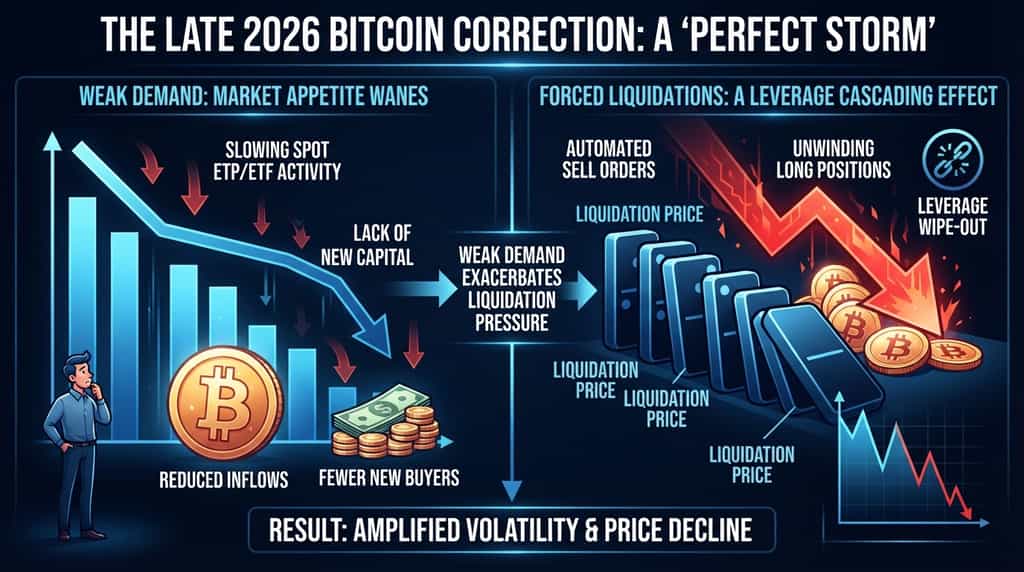
The Bitcoin sell-off observed in late November 2026 was primarily driven by a confluence of factors, most notably a significant contraction in market demand and a cascade of forced liquidations. According to market analysis from 21Shares, the confluence of these two forces created substantial downward pressure on the asset's price, resulting in a swift market correction. Understanding the mechanics behind this event requires a detailed look at both the behavior of market participants and the structure of the digital asset market itself during that period.
As of November 13, 2026, digital asset markets had experienced a period of heightened volatility, with the price of Bitcoin (BTC) retreating from its local highs. This retreat was not merely a random fluctuation but the result of specific, identifiable pressures within the market ecosystem. 21Shares, a prominent issuer of exchange-traded products (ETPs), identified a "perfect storm" of reduced buying interest and leveraged position unwinding as the main culprits. This article delves into the dynamics of weak demand and forced liquidations, offering an analytical perspective on the late 2026 Bitcoin market correction.
Key Takeaways
-
Primary Drivers: The Bitcoin sell-off in late 2026 was fueled by a sharp drop in buying pressure, coupled with a wave of forced liquidations of leveraged positions.
-
Weak Demand: Investor appetite for Bitcoin waned, evidenced by reduced inflows into spot products and a lack of new capital entering the market. This lack of bids allowed the price to cascade downward more easily.
-
Forced Liquidations: A significant portion of the sell-off was not voluntary but automated. Traders who had borrowed funds to buy Bitcoin (using leverage) were forced to sell as their collateral value fell, leading to a rapid succession of sell orders.
-
Leverage Wipeout: The liquidations disproportionately affected long positions, erasing a substantial amount of open interest from the derivatives market in a very short timeframe.
-
Market Structure: The sell-off highlighted the amplified volatility inherent in a market with significant leverage, particularly when combined with a sudden shift in market sentiment and liquidity.
How Weak Demand Contributed to the Bitcoin Price Decline
The first pillar of the late 2026 Bitcoin sell-off was a noticeable softening in demand. Market analysts, including those at 21Shares, pointed to a decrease in buying pressure as a critical factor that left the market vulnerable to a price correction. When demand is weak, even a moderate amount of sell pressure can have a magnified impact on an asset's price because there are fewer buyers willing to step in and absorb the supply at current levels.
Several indicators pointed to this lack of demand. In the weeks leading up to the sell-off, inflows into various Bitcoin investment vehicles, including spot ETFs and ETPs, had slowed down considerably. This suggested that institutional and retail investors were either holding off on making new purchases or had shifted to a more cautious stance. The reduced volume on major cryptocurrency exchanges also signaled that overall market participation was tapering off.
Furthermore, on-chain data indicated a decline in new address activity, suggesting that the number of new market entrants was falling. Without a steady influx of new capital and buyers, the market momentum began to stall, making it difficult for Bitcoin to sustain its previous price levels. This environment of declining interest and capital inflows created a vacuum, where the absence of buying support allowed the price to drift lower.
When negative sentiment began to emerge due to other macroeconomic or market-specific factors, the weak demand meant that there were few buyers to counteract the selling. This lack of "buy-the-dip" mentality, which has historically characterized bull market phases, was notably absent in late 2026, confirming the thesis of a broader contraction in investor appetite.
What Are Forced Liquidations and Why Did They Exacerbate the Sell-Off?
The second major driver of the Bitcoin sell-off was the rapid execution of forced liquidations, particularly in the derivatives market. Forced liquidations occur when a trader who has opened a leveraged position (using borrowed funds) can no longer meet the margin requirements for that position due to an adverse price movement.
In the context of the late 2026 event, many traders had taken "long" positions, betting that the price of Bitcoin would continue to rise. To maximize their potential gains, they borrowed capital, using their existing Bitcoin holdings or other assets as collateral. When the price of Bitcoin began to decline, the value of their collateral also fell.
At a certain price point, known as the liquidation price, the exchange or lending platform automatically steps in and sells the trader's position to recover the loan. This is a non-discretionary, automated process designed to prevent further losses for the lender. These liquidations trigger market sell orders, which add to the existing selling pressure.
The scale of the liquidations in late 2026 was significant. As Bitcoin's price breached key support levels, it triggered a cascading effect. The initial wave of liquidations pushed the price down further, which in turn hit the liquidation prices of even more leveraged traders, causing another, larger wave of sell orders. This positive feedback loop, often referred to as a "long squeeze," resulted in a sharp and accelerated drop in price.
Data from crypto derivatives analytics platforms revealed that hundreds of millions of dollars' worth of long positions were liquidated across various exchanges within a single day. The sheer volume of these forced sales overwhelmed the market's liquidity, exacerbating the price decline and leading to the pronounced volatility observed during this period.
The Interaction Between Weak Demand and Liquidations: A Case of Market Mechanics
It is important to understand that weak demand and forced liquidations did not operate in isolation but rather interacted to create a particularly severe sell-off. The combination of these two factors created a dynamic where the market's ability to absorb selling pressure was severely compromised.
On one hand, the lack of strong demand meant that there was a thin order book, with relatively few buy orders at lower price levels. This lack of depth meant that the market was ill-equipped to handle a sudden surge of sell orders.
On the other hand, the forced liquidations generated a large and immediate surge of sell orders. Because the liquidations were automated and had to be executed at market prices, they consumed the available buy orders on the order book very quickly. The absence of new demand meant that these large sell orders were not met with corresponding buy-side liquidity, causing the price to "gap" down and fall through multiple price levels in rapid succession.
If demand had been stronger, investors might have viewed the price dip as a buying opportunity and stepped in to purchase the Bitcoin being sold off by the liquidating traders. This influx of demand would have stabilized the price and mitigated the severity of the correction. However, because demand was weak, this stabilizing force was absent, allowing the liquidations to have an amplified, unhindered impact on the market price.
The event underscored the critical role of market liquidity and the inherent risks associated with high leverage. In a liquid market with strong demand, even significant liquidation events can be absorbed without causing a major market-wide crash. In a less liquid market with softer demand, however, the same level of liquidations can trigger a much more profound and damaging sell-off.
The Impact of the Late 2026 Sell-Off on the Broader Digital Asset Market
The late 2026 Bitcoin sell-off had a ripple effect across the entire digital asset market. Bitcoin, as the largest and most influential cryptocurrency, often dictates the sentiment and price action for the rest of the market. When BTC experiences a significant correction, it is common for altcoins (alternative cryptocurrencies) to see even larger percentage declines.
This phenomenon is often attributed to the fact that many altcoin pairs are traded against Bitcoin. As the price of Bitcoin falls, investors may sell their altcoins for BTC to rebalance their portfolios or to hedge against further losses, putting additional pressure on altcoin prices. Additionally, a loss of confidence in the crypto market leader can lead to a general flight from risk-on assets, including all digital currencies.
The sell-off also had implications for the broader crypto derivatives market. The massive wave of liquidations led to a significant reduction in open interest across exchanges, signaling that capital was exiting the market or being sidelined. This can lead to a period of lower trading volumes and increased market fragility in the immediate aftermath, as participants await a clearer signal on market direction.
From an analytical standpoint, the event provided a clear case study on how a combination of internal market factors—specifically, the interplay between leverage and demand—can drive significant price action. While macroeconomic factors can certainly influence market sentiment, the 21Shares report highlights that the mechanics of the crypto market itself can be a powerful driver of volatility.
How Analysts Interpret Events Like the Late 2026 Bitcoin Correction
Market analysts and institutional investors employ a variety of tools and frameworks to interpret events such as the late 2026 Bitcoin sell-off. The explanation provided by 21Shares, which focuses on on-chain data and derivatives market activity, represents a common and effective approach to dissecting market movements.
Key metrics monitored by analysts include:
-
Derivatives Data: Analysts closely track open interest, liquidation volumes, and funding rates. A high level of open interest combined with a sudden price drop is a strong indicator of a potential long squeeze and forced liquidations. High funding rates can also suggest excessive leverage on the long side of the market.
-
On-Chain Metrics: On-chain data, such as exchange inflows and outflows, address activity, and transaction volumes, provides insight into the behavior of market participants. Large inflows to exchanges can signal an intent to sell, while declining address activity can indicate a lack of new demand.
-
Net Flows into Investment Products: The inflows and outflows from spot Bitcoin ETFs and ETPs are a key gauge of institutional and retail demand. A sustained period of outflows or a sharp slowdown in inflows is a bearish signal.
-
Technical Analysis: Analysts also use technical indicators to identify key support and resistance levels. A breach of these levels can trigger the automated trading strategies and stop-loss orders that contribute to market volatility.
-
Macroeconomic Context: While the immediate sell-off may be driven by internal crypto market mechanics, analysts also consider the broader macroeconomic backdrop. Factors such as interest rate decisions, inflation data, and geopolitical events can shape investor sentiment and influence the overall demand for risk assets like Bitcoin.
By synthesizing data from these various sources, analysts can build a comprehensive picture of the forces driving market events and make more informed assessments about future market developments. The interpretation of the late 2026 sell-off as a result of weak demand and forced liquidations is a prime example of this analytical process in action, emphasizing the importance of understanding market structure and participant behavior.
Conclusion
The Bitcoin sell-off in late November 2026, as analyzed by 21Shares and other market observers, was a clear demonstration of the market's vulnerability to a contraction in demand when combined with a high degree of leverage. The event was not primarily driven by a fundamental shift in Bitcoin's long-term value proposition but rather by the immediate mechanics of supply and demand within the trading ecosystem.
A softening in overall investor appetite created an environment with limited liquidity and few buyers. This weak demand left the market exposed, and when a wave of forced liquidations of leveraged long positions was triggered by an initial price dip, the lack of buy-side support allowed the price to cascade downward. The automated nature of these liquidations further accelerated the decline, leading to a significant short-term correction.
The event serves as a reminder of the amplified volatility inherent in the digital asset market, particularly in the derivatives sector. While leverage can enhance returns in a rising market, it also creates significant risks during periods of price decline, as it can transform a moderate correction into a more severe sell-off. For market participants and analysts, understanding the interplay between leverage, liquidity, and demand is crucial for navigating the complexities of the cryptocurrency market.
The late 2026 correction, while painful for some participants, provided valuable data for understanding market behavior and highlighted the resilience of the underlying Bitcoin network, which continued to function without interruption despite the price volatility. As the market continues to mature, analyses of such events contribute to a deeper understanding of its structure and dynamics.
FAQs
What was the main reason for the Bitcoin drop in late November 2026?
The primary drivers were a significant decrease in market demand (fewer buyers) and a cascade of forced liquidations in the derivatives market, where traders using borrowed money were compelled to sell as prices fell.
Did weak demand cause the liquidations, or did the liquidations cause weak demand?
They were interconnected. The weak demand meant there were not enough buyers to absorb the selling pressure. The forced liquidations created a sudden and large surge of sell orders. Because demand was weak, these sell orders had an outsized impact, driving prices down further and triggering more liquidations.
Were the liquidations mostly from long or short positions?
The majority of the forced liquidations were from "long" positions. These traders were betting that the price would go up. When the price fell, they were forced out of their positions.
How do analysts know that demand was weak?
Analysts pointed to indicators such as slowing inflows into spot Bitcoin ETFs and ETPs, lower trading volumes on major exchanges, and a decline in the creation of new on-chain addresses, all of which suggested less capital and fewer new participants were entering the market.
What is the significance of this event for long-term Bitcoin investors?
For long-term investors focused on Bitcoin's fundamentals, such events represent short-term volatility driven by market structure (leverage) rather than a change in the asset's long-term outlook. It highlights the risks of trading with high leverage but does not necessarily alter the case for holding Bitcoin as a long-term asset.
Disclaimer
This general market information, possibly from third-party, commercial, or sponsored sources, is provided for reference and educational purposes only and does not constitute financial or investment advice, an offer, solicitation, or guarantee. We disclaim liability for its accuracy, completeness, reliability, and any resulting losses. Investments/trading are risky; past performance doesn’t guarantee future results. Users should research, judge prudently, and take full responsibility. For further details, please consult KuCoin’s Terms of Use and Risk Disclosure.