

USDD October 2026 Transparency Report: Reserves Reach $2.21B as Smart Allocator Earnings Surpass $33.59M
Introduction
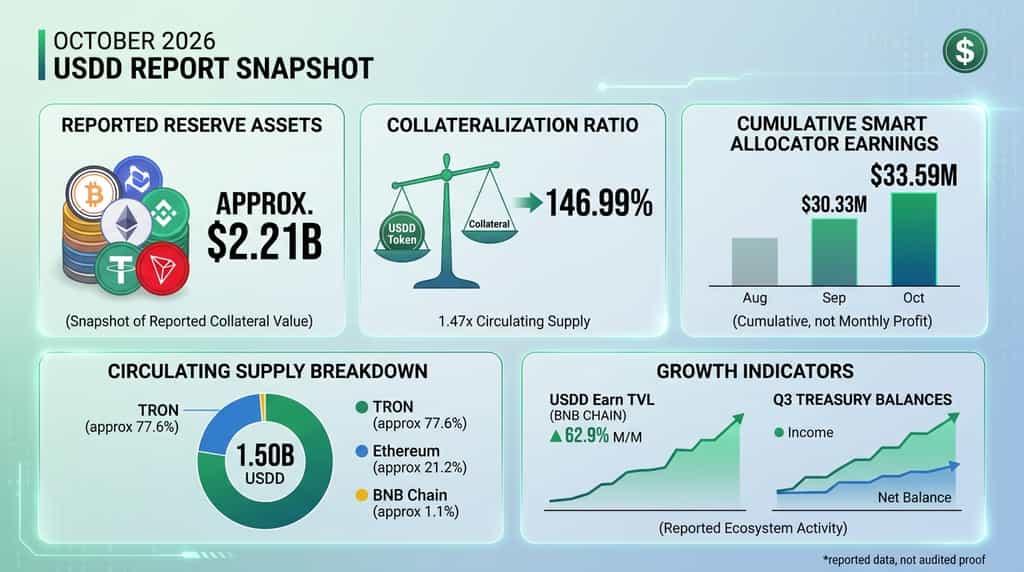
USDD’s October 2026 transparency report puts three figures in focus: approximately $2.21 billion in reported reserve assets, a 146.99% collateralization ratio, and $33.59 million in cumulative Smart Allocator earnings. The figures provide a snapshot of the stablecoin’s reported backing, supply distribution, and capital deployment. However, they need to be interpreted carefully: cumulative earnings are not the same as monthly profit, and a collateralization ratio above 100% does not eliminate liquidity, market, or smart contract risks.
The report was published by USDD through its official X account. This article examines the figures disclosed for October 2026, explains how the reported metrics relate to one another, and outlines what they do—and do not—tell users about USDD’s reserve position.
Key Takeways: What Are the Main Findings in USDD's October 2026 Report?
USDD’s October report states that, as of October 31, 2026, its circulating supply was approximately 1.50 billion USDD, against reported collateral assets worth approximately $2.21 billion. This represented a collateralization ratio of 146.99%.
The report also disclosed that:
-
Circulating supply: 1,502,271,910 USDD across TRON, Ethereum, and BNB Chain.
-
Reported collateral: $2,208,215,980.
-
Collateralization ratio: 146.99%.
-
Smart Allocator cumulative earnings: $33,593,204 at the end of October, up from $30,334,899 in September.
-
USDD Earn on BNB Chain: Month-end total value locked (TVL) increased 62.9% month over month.
-
Treasury: The Q3 2026 quarterly net balance increased 27.1% from the previous quarter, while the report stated that the overall treasury balance exceeded $30 million.
These are figures disclosed by USDD. They should not be interpreted as proof that all reserve assets are immediately liquid, independently audited, or immune to market and protocol risks.
How Much USDD Was in Circulation in October 2026?
USDD reported a circulating supply of 1,502,271,910 tokens on October 31, 2026. The tokens were distributed across three blockchain networks: TRON, Ethereum, and BNB Chain. TRON accounted for the largest share, representing approximately 77.6% of the reported total.
| Blockchain | Reported USDD supply | Approximate share |
| TRON | 1,166,192,474 | 77.60% |
| Ethereum | 319,016,717 | 21.20% |
| BNB Chain | 17,062,718 | 1.10% |
| Total | 1,502,271,910 | 100% |
The report also described changes in USDD issuance activity during the month. Its average daily minting volume increased 10.5% compared with September. Between October 12 and October 19, USDD’s market capitalization reportedly increased by $180.3 million.
On October 12, its circulating supply briefly exceeded 1.81 billion USDD, while TVL surpassed $2.51 billion. Both figures were described in the report as historical highs. These peak figures should be distinguished from the October 31 closing supply: the month-end figure was approximately 1.50 billion USDD, not 1.81 billion.
The difference illustrates why supply data should be read with its reporting date. A peak during the month does not represent the amount in circulation at month-end, and changes in circulating supply alone do not establish whether demand is sustainable.
What Does USDD's 146.99% Collateralization Ratio Mean?
USDD reported $2.208 billion in collateral assets against approximately $1.502 billion in circulating tokens, producing a collateralization ratio of 146.99%.
A collateralization ratio measures the value of assets backing a token relative to the value of the corresponding liabilities or circulating supply. In simplified terms, the calculation is:
Collateralization ratio = Collateral asset value ÷ Value of circulating USDD × 100%
This means that the reported collateral value was approximately 1.47 times the value of the circulating USDD supply at the reporting date.
Which assets make up USDD's reported reserves?
The report identifies several reserve asset categories:
-
USDT: A dollar-pegged stablecoin.
-
TRX: The native token of the TRON blockchain.
-
sTRX: A staked version of TRX.
-
WBTC: A token designed to represent Bitcoin on another blockchain.
-
ETH: The native asset of Ethereum.
The mix matters because these assets have different price and liquidity characteristics. Stablecoins are designed to track fiat currency values, while crypto assets such as TRX, WBTC, and ETH can experience substantial price fluctuations. Staked assets may also involve withdrawal conditions or additional protocol dependencies.
USDD publishes reserve-related data through its official data dashboard. Its official documentation on collateral assets and contract addresses also provides contract information that can help readers identify relevant on-chain records.
However, public contract addresses and visible token balances do not, by themselves, establish that every reported asset is freely available for redemption. They also do not replace an independent audit of ownership, liabilities, valuation, and liquidity.
What Happened to USDD Earn and the Treasury in October?
The October report also disclosed changes in USDD Earn, a set of yield-related products, and provided treasury figures for the third quarter of 2026.
On BNB Chain, USDD Earn’s month-end TVL increased by 62.9% compared with September. Its average daily TVL rose 15.7%, while the number of participating wallet addresses increased 2.6%.
These indicators measure different aspects of activity. Month-end TVL is a snapshot of assets deposited at a particular date; average daily TVL reflects the average amount held over the reporting period; and wallet counts indicate the number of participating addresses. None of these metrics, on its own, establishes the profitability or risk-adjusted performance of a product.
What do the Q3 2026 treasury figures show?
The report disclosed the following treasury figures for Q3 2026, compared with Q2:
| Indicator | Q2 2026 | Q3 2026 | Change |
| Treasury income | $7,656,616 | $9,704,294 | 0.267 |
| Treasury expenditure | $24,823 | $7,601 | -69.40% |
| Quarterly net balance | $7,631,793 | $9,696,693 | 0.271 |
The report also stated that more than $9.55 million in rewards were distributed during the third quarter and that the overall treasury balance exceeded $30 million for the first time.
The quarterly net balance and the overall treasury balance are not interchangeable. The former describes the reported net figure for a specific quarter, while the latter refers to the accumulated treasury balance. Keeping these measures separate is necessary when interpreting the protocol’s financial disclosures.
The report further describes a JST buyback and burn arrangement linked to revenue above a stated threshold after accounting for TRON subsidies. This is a separate mechanism from USDD’s reserve collateralization. Its implementation and financial effects should be assessed through the relevant governance and treasury disclosures rather than inferred from the stablecoin’s reserve ratio.
Conclusion
USDD’s October 2026 transparency report disclosed approximately $2.21 billion in collateral assets against a circulating supply of around 1.50 billion tokens, resulting in a reported collateralization ratio of 146.99%. It also reported $33.59 million in cumulative Smart Allocator earnings, growth in USDD Earn activity on BNB Chain, and an increase in the Q3 treasury net balance.
These figures provide insight into the stablecoin’s reported reserves, capital deployment, and ecosystem activity. Their significance, however, depends on how the underlying assets are valued, where they are held, and how accessible they remain under different market conditions. In particular, cumulative earnings should not be confused with monthly profit, and a collateralization ratio above 100% should not be treated as a guarantee of peg stability or immediate redemption.
For readers assessing USDD, the most useful approach is to compare the official report with its public dashboards, contract-level records, and independent data. This makes it possible to distinguish disclosed figures from independently verified information and to evaluate the risks associated with collateral assets and DeFi exposure.
FAQs
-
What was USDD's collateralization ratio at the end of October 2026?
USDD reported a collateralization ratio of 146.99% on October 31, 2026. The calculation was based on approximately $2.208 billion in reported collateral assets and a circulating supply of 1,502,271,910 USDD.
-
Does USDD's 146.99% collateralization ratio eliminate stablecoin risk?
No. The ratio is a point-in-time measure based on reported collateral values. Market volatility, asset liquidity, DeFi protocol exposure, smart contract vulnerabilities, and operational issues can still affect the value and availability of collateral.
-
Where can users check USDD's reserve and Smart Allocator data?
USDD provides a public data dashboard and a separate Smart Allocator page. These resources can be used alongside public blockchain records and independent data providers. They should not be regarded as substitutes for an independent audit.
Disclaimer
This general market information, possibly from third-party, commercial, or sponsored sources, is provided for reference and educational purposes only and does not constitute financial or investment advice, an offer, solicitation, or guarantee. We disclaim liability for its accuracy, completeness, reliability, and any resulting losses. Investments/trading are risky; past performance doesn’t guarantee future results. Users should research, judge prudently, and take full responsibility. For further details, please consult KuCoin’s Terms of Use and Risk Disclosure.