

TON Strategy Reports $13.1M Q3 2026 Revenue and $24M Net Loss Amid GRAM Price Decline
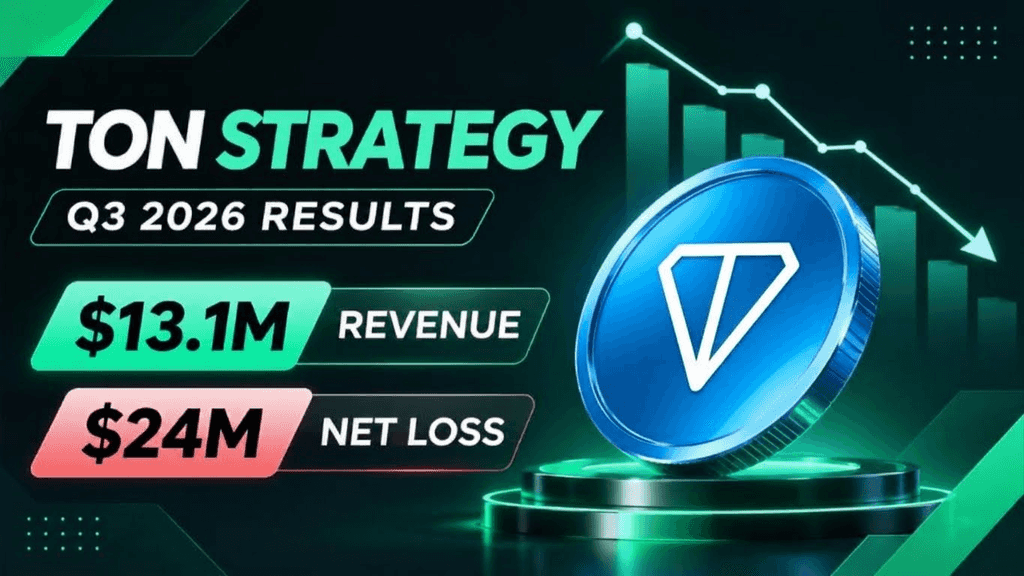
TON Strategy Company reported $13.1 million in revenue and a $24 million net loss for the third quarter of 2026, as declining GRAM cryptocurrency prices weighed on its financial results. According to its November 10 earnings release, revenue fell approximately 13% from the previous quarter, while a $27.2 million unrealized digital-asset valuation loss was the primary driver of the consolidated net loss. Despite these pressures, operating income improved to approximately $4 million as expenses declined. The results demonstrate how cryptocurrency price fluctuations can affect reported earnings even when staking operations remain profitable, raising important questions about treasury management, liquidity, and future financial performance.
Key Takeaways
-
Revenue declined approximately 13% to $13.1 million in Q3 2026, primarily due to lower GRAM prices despite stable staking activity.
-
Net loss reached $24 million, driven mainly by a $27.2 million unrealized GRAM valuation loss, despite positive operating income.
-
Operating expenses fell 39% to $8.4 million, helping operating income improve to approximately $4 million.
-
GRAM holdings totaled 235.1 million tokens, with 232.9 million staked at a reported 16% annualized gross yield.
-
Telegram's Gram Wallet rollout and TON network upgrades introduced new capabilities, although their future financial impact remains uncertain.
-
Liquidity risks persist, with approximately 119.1 million GRAM restricted and $25.3 million in cash and restricted cash at quarter-end.
TON Strategy Q3 2026 Revenue Falls to $13.1M as GRAM Prices Decline
TON Strategy Company reported $13.065 million in revenue for the quarter ended September 30, 2026, compared with approximately $15 million in Q2. Management attributed the sequential decline primarily to weaker GRAM cryptocurrency prices rather than a significant reduction in staking activity. Although lower token valuations reduced recognized revenue, the company improved its operating profitability through cost reductions. The contrasting results illustrate how cryptocurrency market conditions and operating efficiency can affect different parts of a digital-asset company's financial statements.
GRAM Staking Revenue Declines Despite Stable Token Rewards
TON Strategy's revenue primarily came from staking GRAM, the native cryptocurrency of The Open Network (TON). The company earned approximately 9.4 million GRAM during Q3 2026, broadly consistent with the previous quarter. However, staking rewards are recognized as revenue at their fair market value when earned, meaning lower GRAM prices reduce reported dollar revenue even when the number of tokens received remains stable. This accounting treatment explains why TON Strategy's revenue declined despite continued participation in network validation. The underlying proof-of-stake validation process uses staked cryptocurrency to support blockchain security and distribute rewards according to network rules.
The company recorded $12.4 million in gross profit, compared with $14.3 million in Q2, while maintaining a gross profit margin of approximately 95%. Cost of revenue totaled $701,000, indicating that direct staking-related costs remained relatively small compared with recognized revenue. Nevertheless, TON Strategy's financial performance remains sensitive to GRAM's market value because its staking rewards are denominated in cryptocurrency rather than fixed U.S. dollar payments. Recognized staking revenue also does not necessarily represent an equivalent amount of cash received during the reporting period, making cash-flow information important when evaluating the company's financial position.
Lower Operating Expenses Lift Quarterly Operating Income to $4M
Despite declining revenue, TON Strategy improved its operating performance through substantial cost reductions. Total operating expenses fell to $8.4 million, compared with $13.8 million in Q2, representing a 39% sequential decrease. Management attributed the reduction primarily to lower advisory fees, personnel costs, and professional services expenses, along with elevated noncash expenses recorded in the previous quarter. Higher legal expenses partly offset these savings. As a result, operating income from continuing operations increased to approximately $4 million from $500,000, demonstrating that lower expenses more than compensated for the decline in recognized staking revenue.
The company's unaudited financial statements provide additional details about its revenue composition and operating efficiency:
-
GRAM revenue: $8.804 million was classified as GRAM revenue, accounting for approximately 67.4% of total quarterly revenue.
-
Related-party revenue: Another $4.261 million was reported separately as GRAM-related-party revenue, representing approximately 32.6% of total revenue. This classification is relevant when assessing the company's revenue structure and related-party exposure.
-
Operating efficiency: Gross profit of $12.364 million exceeded total operating expenses of $8.387 million, leaving approximately $3.977 million in operating income from continuing operations.
These figures indicate that TON Strategy strengthened its operating efficiency while cryptocurrency price movements reduced the dollar value of staking rewards. However, operating profitability represents only one component of the company's financial results. Its substantial exposure to GRAM also creates earnings volatility through changes in the reported value of its digital-asset holdings.
Why Did TON Strategy Report a $24M Net Loss Despite Positive Operating Income?
TON Strategy reported a consolidated net loss of $23.975 million for Q3 2026, despite generating positive operating income from continuing operations. The main factor was a substantial unrealized valuation loss on its GRAM holdings, which affected earnings independently of day-to-day staking performance. The result illustrates why operating income and consolidated net income can differ considerably for cryptocurrency treasury companies, particularly when digital assets represent a large proportion of their balance sheets.
$27.2M Unrealized GRAM Valuation Loss Weighs on Q3 Earnings
The largest factor behind TON Strategy's quarterly loss was a $27.2 million unrealized loss associated with changes in the fair value of its GRAM holdings. Under fair-value accounting, changes in cryptocurrency market values can affect reported earnings even when the underlying assets have not been sold. Consequently, declining GRAM prices reduced the company's reported financial results without requiring an equivalent cash payment. The adjustment contributed to a $22.878 million pretax loss from continuing operations, demonstrating the significant influence cryptocurrency valuations can have on the earnings of a publicly traded digital-asset treasury company. The distinction between realized and unrealized profit and loss helps explain why changes in market value should not automatically be interpreted as completed asset sales.
Several additional figures provide important context for the earnings reversal:
-
Q2 valuation gain: TON Strategy recorded an $82.8 million net gain from digital-asset fair-value changes in the previous quarter, illustrating the scale of quarterly valuation swings.
-
Treasury valuation: The reported fair value of digital assets decreased from approximately $369.5 million on June 30 to $348.5 million on September 30, a reduction of about $21 million.
-
Accounting distinction: The decline in total treasury value is not identical to the $27.2 million unrealized loss because changes in token holdings and other treasury activity also affect the period-end asset balance.
These figures demonstrate why a company's digital-asset treasury should be assessed separately from its underlying operating performance. Fair-value adjustments may reverse as cryptocurrency prices change, but they remain relevant to financial reporting and the valuation of the company's assets. Investors examining TON Strategy's earnings therefore need to distinguish between the profitability of staking operations and changes in the market value of its cryptocurrency holdings.
Continuing and Discontinued Operations Explain the $24M Net Loss
TON Strategy's unaudited financial statements show that the company recorded a $22.878 million loss from continuing operations, with no income tax expense for the quarter. An additional $1.097 million loss came from discontinued operations associated with inherited legacy businesses, bringing the consolidated net loss to $23.975 million. The company reported a $23.968 million loss attributable to common shareholders, equivalent to $0.42 per share on both a basic and diluted basis. These distinctions matter because continuing operations reflect TON Strategy's GRAM-focused business, while discontinued operations represent activities outside its primary operating strategy.
The broader reporting period provides additional context for the company's financial performance. During the first nine months of 2026, TON Strategy recorded a consolidated net loss of approximately $38.4 million. Its reported earnings included substantial noncash digital-asset valuation adjustments, making net income an incomplete measure of immediate cash generation. Evaluating continuing operations separately from legacy expenses and treasury valuation changes provides a clearer assessment of the company's financial position and helps explain why improved quarterly operating income did not translate into consolidated profitability.
Restricted GRAM Holdings, Cash Reserves, and Treasury Liquidity Risks
TON Strategy's financial position also depends on its ability to manage cryptocurrency holdings alongside U.S. dollar liquidity requirements. At September 30, 2026, approximately half of its GRAM treasury was classified as restricted, limiting the company's ability to transfer or sell those tokens until applicable restrictions expire. During the quarter, approximately 42 million previously restricted GRAM became unrestricted, increasing the flexibility of part of its treasury. However, restricted tokens can still participate in staking and generate rewards, meaning their economic productivity differs from their immediate liquidity.
The company's financial disclosures highlight several additional considerations:
-
Treasury availability: Approximately 119.1 million GRAM remained restricted, compared with 116 million unrestricted tokens at quarter-end.
-
Cash position: Cash and restricted cash totaled approximately $25.3 million, down from $29 million at the end of Q2, while the company reported no outstanding debt.
-
Operating cash flow: Continuing operations used approximately $15.4 million in cash during the first nine months of 2026. This is a year-to-date figure rather than standalone third-quarter cash usage.
Although the absence of outstanding debt provides some financial flexibility, TON Strategy remains exposed to cryptocurrency price fluctuations, liquidity constraints, and ongoing operating requirements. Its ability to maintain sufficient cash while managing a concentrated GRAM treasury will remain important when assessing future financial performance. The availability of unrestricted assets, the sustainability of staking income, and decisions about how to fund operating expenses are particularly relevant if market conditions weaken or network reward economics change.
TON Strategy's GRAM Staking, Telegram Wallet Expansion, and TONX Stock Outlook
TON Strategy's longer-term outlook depends on the productivity of its GRAM treasury, the development of The Open Network, and the company's approach to capital allocation. Beyond its third-quarter financial results, management highlighted continued staking activity, blockchain infrastructure improvements, and Telegram's expanding integration with GRAM. These developments could influence future operating performance, although their financial impact will depend on cryptocurrency market conditions, network adoption, and the sustainability of staking rewards.
TON Strategy Holds 235.1M GRAM With a 16% Annualized Staking Yield
As of September 30, 2026, TON Strategy held approximately 235.1 million GRAM, with 232.9 million tokens, or roughly 99% of its holdings, deployed in staking. The company reported an annualized gross staking yield of approximately 16%, supported by changes to TON's validator reward structure following the Catchain 2.0 upgrade in April. According to management's November 10 earnings call, TON Strategy had accumulated 23.2 million GRAM in staking rewards since beginning these activities in August 2025, recognizing approximately $35.1 million in cumulative staking revenue. The figures demonstrate the scale of its participation in network validation, although the reported yield reflects historical conditions rather than a guaranteed future return.
The company's treasury management strategy also emphasizes increasing GRAM holdings relative to its outstanding shares. Management reported approximately 4.24 GRAM per common share at the end of September, up 9% from 3.89 at December 31, 2025. Its net treasury position increased by approximately 4.6 million GRAM during Q3, as staking rewards exceeded token sales used to support dollar liquidity. This approach can increase cryptocurrency exposure per share, but its economic value still depends on GRAM prices, validator economics, and the costs associated with maintaining treasury operations. The architecture and token utility of The Open Network provide broader context for how staking, transaction fees, and network governance interact within the blockchain ecosystem.
Telegram's Native Gram Wallet Rollout and TON Network Upgrades
Telegram began a limited rollout of its native Gram Wallet on August 31, 2026, marking another step toward integrating cryptocurrency transfers into its messaging platform. The wallet is designed to let eligible users send GRAM directly to Telegram contacts without manually entering blockchain addresses or opening a separate application. This approach addresses some of the usability challenges associated with cryptocurrency wallets and blockchain transactions, where users typically interact with public addresses and cryptographic keys. TON Strategy supported the associated infrastructure developments through its participation in network validator governance. Management views the integration as an opportunity to make GRAM more accessible for everyday transfers and digital services, although wallet availability alone does not establish widespread adoption or additional revenue for TON Strategy.
Two network upgrades are particularly relevant to the ecosystem's development. Config -123 introduced shared smart-contract architecture intended to allow wallet functionality to be updated through network governance without requiring users to migrate to new addresses. Meanwhile, Config 30 was designed to improve transaction throughput by up to 30%, strengthening the network's capacity to process additional activity. GRAM also has existing uses within Telegram-related services, including advertising payments, creator monetization, and blockchain-based digital assets. However, the potential financial benefits of these improvements remain uncertain until broader usage, transaction activity, and user retention can be measured consistently. The proposed throughput improvement should also be distinguished from independently demonstrated increases in real-world transaction processing.
TONX Stock Performance, Share Buybacks, and Future Earnings Risks
TON Strategy shares closed at $3.22 on November 10, 2026, the day of its earnings announcement, representing a 9.15% increase from the previous closing price of $2.95. Historical trading data show approximately 334,772 shares changed hands during the session. While the positive closing performance provides context for investor activity surrounding the financial results, it does not establish that earnings alone caused the movement. TONX remains exposed to company-specific developments and broader cryptocurrency market sentiment, meaning its share price can fluctuate independently of quarterly operating performance.
Capital allocation also remains an important consideration for the company's stock outlook. During Q3, TON Strategy repurchased approximately 1.8 million common shares for $5.7 million, contributing to a net reduction of about 1.1 million shares outstanding during the quarter after accounting for other share issuances. Management has emphasized balancing repurchases with the need to retain dollar liquidity and preserve income-generating cryptocurrency holdings. Its future performance will depend on several interconnected factors:
-
GRAM market performance: Changes in the token's value can affect the company's asset valuation, reported earnings, and the relationship between TONX's market capitalization and underlying treasury assets.
-
Staking economics: Changes in validator participation, network reward issuance, and operating costs could influence future token-denominated returns.
-
Telegram ecosystem adoption: Sustained wallet usage, transaction activity, and broader applications would provide stronger evidence of network development than the initial rollout alone.
-
Capital allocation: Future repurchases, treasury management decisions, and potential financing requirements could affect the company's GRAM exposure per outstanding share.
The main consideration for TON Strategy is whether it can translate its substantial GRAM holdings and participation in TON infrastructure into sustainable financial performance. Although staking activity and Telegram integration provide potential operational opportunities, the company's financial results and TONX stock valuation remain sensitive to cryptocurrency prices, execution risks, and the uncertain pace of network adoption. Future earnings reports will provide additional evidence of whether the company's strategy can maintain operating efficiency while managing these financial exposures.
Conclusion
TON Strategy's Q3 2026 results show that improved operating profitability does not necessarily translate into positive net earnings for a cryptocurrency treasury company. Although lower expenses strengthened its core financial performance, the substantial unrealized GRAM valuation loss exposed the sensitivity of its reported results to digital-asset prices. Its significant staking activity provides an ongoing source of token-denominated revenue, but the dollar value of those rewards remains subject to market fluctuations.
Looking ahead, TON Strategy's financial outlook will depend on sustainable staking returns, disciplined liquidity management, and the development of the broader TON ecosystem. Telegram's wallet integration and network upgrades offer potential opportunities for increased blockchain activity, although their commercial impact remains unproven. Future financial disclosures will be particularly important for assessing GRAM treasury restrictions, operating cash flows, staking economics, and whether improvements in operational efficiency translate into more consistent financial results.
FAQs
What is the difference between TONX stock and GRAM cryptocurrency?
TONX is the Nasdaq-listed stock of TON Strategy Company, while GRAM is the native cryptocurrency of The Open Network (TON). TONX represents an ownership interest in the company, whereas GRAM is used for blockchain transactions, staking, and network-related activities.
Is GRAM the same cryptocurrency as Toncoin?
Yes. Toncoin was rebranded as Gram (GRAM) in June 2026. The change updated the cryptocurrency's name and ticker without requiring holders to exchange their existing tokens. The underlying blockchain continues to operate as The Open Network (TON).
Do TONX shareholders directly own the company's GRAM tokens?
No. TONX shareholders own shares in TON Strategy Company rather than individual portions of its cryptocurrency treasury. They cannot automatically redeem their shares for GRAM. Their economic exposure depends on the company's assets, liabilities, operating performance, and stock valuation.
Does TON Strategy's 16% staking yield mean shareholders earn 16% annually?
No. The approximately 16% figure represents the company's reported annualized gross staking yield during Q3 2026. It does not represent a shareholder dividend, guaranteed return, or expected TONX stock performance. Actual shareholder outcomes depend on multiple financial and market factors.
Disclaimer
This general market information, possibly from third-party, commercial, or sponsored sources, is provided for reference and educational purposes only and does not constitute financial or investment advice, an offer, solicitation, or guarantee. We disclaim liability for its accuracy, completeness, reliability, and any resulting losses. Investments/trading are risky; past performance doesn’t guarantee future results. Users should research, judge prudently, and take full responsibility. For further details, please consult KuCoin’s Terms of Use and Risk Disclosure.