

Sui Mainnet Outage Lasted 6.7 Hours: How a Gas Logic Bug Froze $1 Billion in Assets
2026/05/29 16:38:00
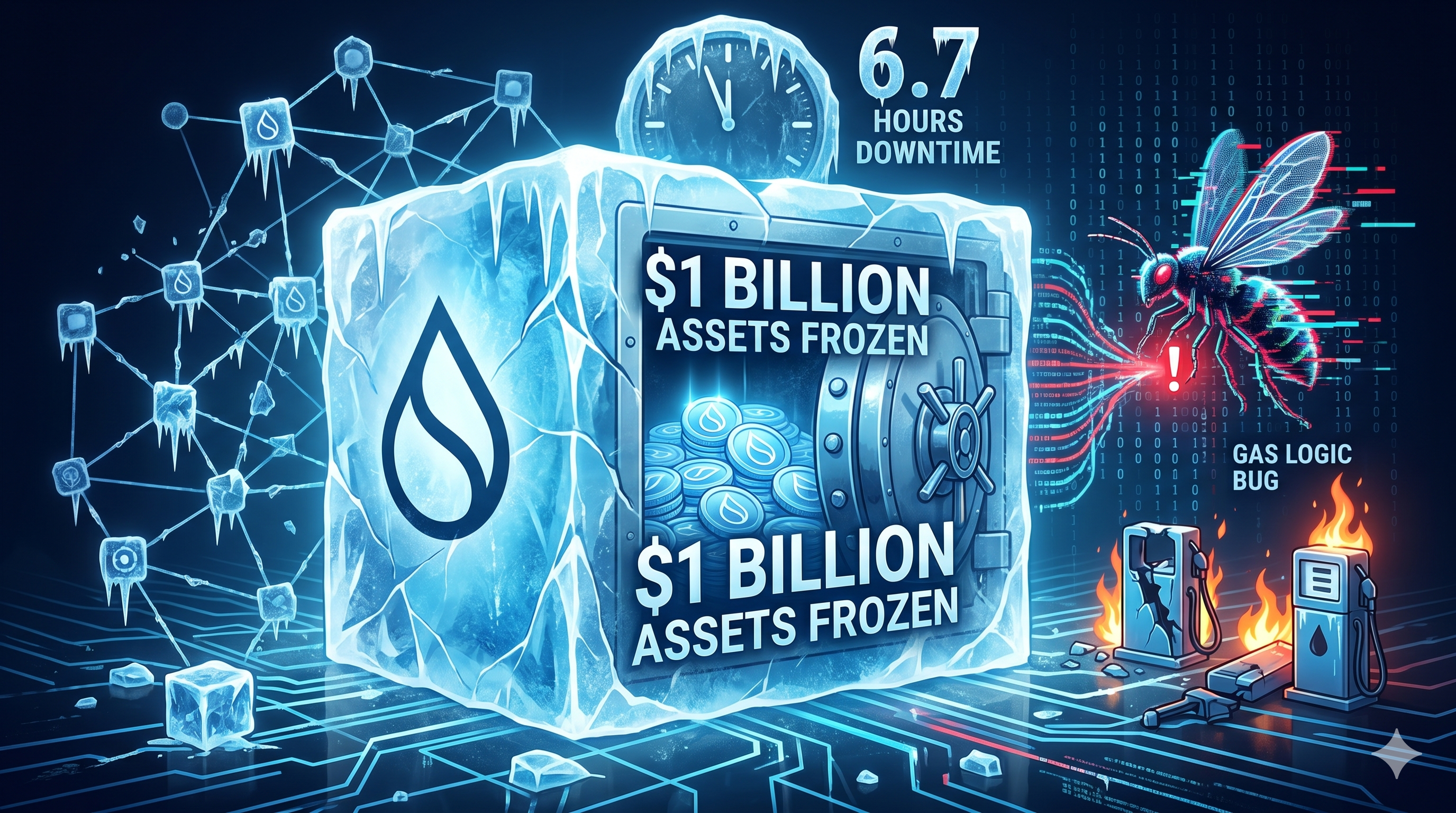
On May 28, 2026, Layer 1 blockchain Sui Mainnet suffered a critical 6-hour 44-minute outage caused by a gas charging logic bug in version v1.72. Approximately $1 billion in on-chain assets were temporarily frozen while all validators entered a crash loop, halting block production entirely. The SUI token dropped 8% during the incident, trading at $0.91 after falling from $0.99. This marks Sui's third major system-level failure since its 2023 mainnet launch, reigniting debates about Layer 1 stability and raising concerns among traders, DeFi users, and institutional investors about the network's readiness for large-scale adoption.
💡 Tips: New to crypto? KuCoin's Knowledge Base has everything you need to get started.
Key Takeaways
-
Network downtime: 6 hours 44 minutes (May 28, 21:48 to May 29, 04:32 UTC+8)
-
Root cause: Gas charging logic bug in v1.72, not a security hack or external attack
-
Assets affected: ~$1 billion in on-chain value temporarily frozen, but no funds lost
-
Price impact: SUI dropped 8% to $0.91, still volatile as of May 29
-
Recovery: >2/3 of staked value upgraded to fix; network fully operational
-
Historical context: Third major outage in 2 years vs. Solana's 18 months zero outage
-
Next steps: Full post-mortem report expected within days
Event Timeline: What Happened During 6.7 Hours?
The network was completely down for 6 hours 44 minutes with no blocks produced. All validators crashed simultaneously, making transactions impossible.
Detailed Timeline (UTC+8)
| Time | Event |
| May 28, 21:48 | Last block recorded; network began stalling |
| May 28, 21:50–23:00 | Community noticed failed transactions; validators showed anomalies |
| May 28, 23:00–May 29, 02:00 | Sui Core team confirmed issue and began developing fix |
| May 29, 02:00–04:00 | Fix released; validators began rolling out upgrades |
| May 29, 04:32 | Network restored; >2/3 of stake upgraded; blocks resumed |
During the outage, public RPC nodes remained accessible for read requests, but settlement and validation nodes could not coordinate. This meant while users could view chain data, no new transactions could be processed or confirmed.
Root Cause: What Is the Gas Logic Bug?
The outage was caused by a crash bug in the gas charging logic introduced in version v1.72, not by congestion, high transaction volume, or external attacks. Gas is the fee charged when executing blockchain transactions. In v1.72, Sui improved gas charging to more accurately estimate fees based on transaction complexity. However, the new logic contained an edge case defect. When a specific transaction structure appeared, gas calculation would error out, causing all validators to crash and enter a loop, halting the entire network. The bug type was a crash bug at the protocol-level code defect layer. It was not a security vulnerability, so no funds were stolen and no hack occurred. The trigger condition was a specific transaction structure combined with the v1.72 version. The impact scope affected all validators simultaneously. This is a classic upgrade-after-bug scenario. The issue was not in smart contracts or user applications, but in the core protocol layer.
Asset Safety: Is My SUI and DeFi Money Safe?
Yes, your funds are safe. No money was stolen, no transactions were rolled back, and no chain forks occurred. Approximately $1 billion in on-chain value was temporarily frozen, including SUI tokens, DeFi liquidity, and NFTs, but no funds were lost. After network restoration, assets automatically returned to normal. Already-certified transactions were not reversed, preventing double-spend issues. The Sui Foundation confirmed that no funds were stolen, no hack occurred, and all user assets remained secure throughout the incident. Certified transactions remained valid, and no chain split occurred because Sui's design prevents forks. Users do not need to re-sign transactions because all transactions auto-resume after restoration. If you were executing transactions during the outage, such as DeFi liquidations, transfers, or swaps, you may have experienced transaction failures or timeouts, liquidation delays causing excess losses, or DApps like Slush and SuiScan being inaccessible. The recommended action is to check your wallet and DeFi positions now to confirm everything is in order.
| Asset Safety Question | Answer | Evidence |
| Were funds stolen? | No | No loss, no hack |
| Were transactions rolled back? | No | Certified transactions remain valid |
| Were assets frozen? | Yes, temporarily | ~$1 billion immobile during outage |
| Will there be a chain split? | No | Sui's design prevents forks |
| Do users need to re-sign? | No | All transactions auto-resume |
Price Impact: Will SUI's 8% Drop Rebound?
SUI dropped 8% to $0.91 during the outage and remains volatile. Historical data shows quick rebounds after past outages, but this third failure raises more concerns. The pre-outage price was approximately $0.99, and the post-outage price was approximately $0.91, representing an 8% drop. The price remains volatile as of May 29. Looking at historical comparisons, during the transaction scheduling bug on November 21, 2024, SUI dropped 10% but rebounded quickly within 3 days. During the consensus divergence on January 14, 2026, SUI initially rose 4% but then oscillated with no clear trend. During this gas logic bug on May 28, 2026, SUI dropped 8% and remains volatile. For key support and resistance levels, the support zone is $0.85 to $0.88, and if this is broken, panic may continue. The current price of $0.91 sits in a short-term oscillation zone. The resistance zone is $0.95 to $1.00, and if this is broken, a possible V-shaped rebound may occur. In the bullish scenario, the post-mortem report releases, market confidence rebounds, and SUI returns to $0.95 within 3 days. In the neutral scenario, SUI oscillates in the $0.88 to $0.95 range for 1 to 2 weeks. In the bearish scenario, if the report exposes more issues, SUI may drop below $0.80.
Historical Comparison: Full Breakdown of Sui's Three Outages
Sui has experienced three major outages in two years, with downtime increasing from 2 hours to 6.7 hours. This is a red flag for stability.
| Event | Date | SUI Price Reaction | Follow-up Trend |
| Transaction Scheduling Bug | Nov 21, 2024 | Dropped 10% | Quick rebound within 3 days |
| Consensus Divergence | Jan 14, 2026 | Rised 4% initially | Oscillation, no clear trend news. |
| Gas Logic Bug | May 28, 2026 | Dropped 8% | Still volatile, TBD |
Three key findings emerge from this history. First, failure types evolved from scheduling to consensus to gas, exposing multi-layer stability issues. Second, downtime is getting longer, progressing from 2 hours to 6 hours to 6.7 hours. Third, the recurrence rate is high, with three major failures in 2 years. For a Layer 1 claiming high TPS and high stability, stability still needs verification.
Ecosystem Impact: How DeFi Protocols and Exchanges Were Affected
DeFi users faced liquidation risks and frozen liquidity. Major protocols like Scallop and Cetus were affected, and some exchanges temporarily suspended deposits and withdrawals. DeFi protocols experienced liquidation delays because users were unable to liquidate during the outage, which could cause excess losses. Approximately $1 billion in on-chain value was temporarily immobile, affecting liquidity across the ecosystem. DApps like Slush and SuiScan were inaccessible during the outage.
Major Sui decentralized finance protocols include Scallop, a combined lending and DEX protocol with approximately $600 million TVL and medium risk; Cetus, a DEX with approximately $500 million TVL and medium risk; and Navi Protocol, a lending protocol with approximately $400 million TVL and medium risk. The impact on exchanges varies. Upbit in South Korea suspended SUI deposits and withdrawals. Binance continued normal trading but increased monitoring. KuCoin and MEXC continued normal trading. There is also related security context to consider. In April 2026, Sui DeFi protocol Scallop was exploited with 150,000 SUI stolen from an old contract. After this mainnet outage, the market is concerned about whether hidden vulnerabilities remain.
Long-term Impact: Can Sui Still Compete With Solana?
Sui's three outages in 2 years contrast sharply with Solana's 18 months of zero downtime. This stability gap is a major concern for institutional adoption.
| Dimension | Sui | Solana | 3rd (Gas Logic Bug) |
| Outages (Past 2 Years) | 3 | 0 (18 months zero outage) | May 28, 2026 |
| Longest Outage | 6.7 hours | 0 hours | v1.72 Gas charging defect |
| Market Cap | ~$3.75B | ~$49.5B | ~6.7 hours |
| DeFi TVL | ~$1B | ~$9.2B | Dropped 8%, still volatile |
| Narrative | "Solana Killer" | High TPS Layer 1 leader | Gas charging layer |
| Institutional Confidence | Questioned | Strengthening | Safe |
The market narrative for Sui has shifted over time. In 2023 to 2024, the narrative was "Solana Killer, High TPS, Lightning Fast," which was partially realized. In 2025, the narrative was "Ecosystem Boom, DeFi Growth Rapid," which was partially realized. In 2026, the narrative is "Stability Questioned, High Recurrence," which is the current status. From an institutional perspective, in the short term, institutions may delay large-scale Sui investment. In the mid-term, they need to observe post-mortem transparency and fix effectiveness. In the long term, if recurrence remains high, institutions may shift to Solana or Aptos. Solana benefits from larger ecosystem, greater name recognition, and more established liquidity. Sui's advantage is its object model and parallel execution, but stability is now the critical question.
Official Response and Post-Mortem Report Release Date
Sui team confirmed the issue, fixed it quickly, and promised a full post-mortem within days. The Sui team quickly diagnosed and fixed the issue. More than two-thirds of staked value upgraded to the fixed version. The network was restored and transactions are flowing normally. A full incident review will be shared in coming days. The post-mortem report will be released within a few days and will include the root cause, timeline, fix, and preventive measures. The report will be published on the Sui official blog, Twitter/X, and GitHub. Expected preventive measures include increasing testnet coverage with more rigorous edge case testing, implementing a gray rollout mechanism with small-scale validation before network-wide deployment, and strengthening validator monitoring and alert systems.
Trader Action Plan and Key Watchpoints
Here is what traders and investors should do next, with specific price levels and action items. Short-term traders should watch the $0.85 to $0.88 support zone, and if it is broken, panic may continue. They should watch for a quick return to $0.95, which would indicate a possible V-shaped rebound. They should monitor news and market reaction after post-mortem release. They should set a stop-loss at $0.82 and consider reducing position if it breaks below that level.
Long-term investors should consider whether short-term volatility conflicts with long-term bull market logic when deciding whether to exit. They should consider if price drops below $0.80 whether this may be a buying opportunity when deciding whether to add. They should consider their risk tolerance regarding whether to accept occasional chain outages or shift to more stable chains. Key watchpoints include the official post-mortem release date and content transparency, whether SUI price can return to $0.95 within 3 days, whether exchanges suspend deposits and withdrawals, whether ecosystem DeFi protocol TVL significantly drops, whether institutions adjust Sui's rating, and whether another outage occurs within the next 3 months. Token holders should check wallet status and confirm assets are not lost. DeFi users should check positions in Scallop and Cetus to avoid liquidation delays. Traders should set stop-loss at $0.82 and watch $0.85 to $0.88 support. Long-term investors should wait for the post-mortem before deciding to add.
Start Trading SUI on KuCoin
If you're tracking SUI's price action and want to trade during this volatile period, KuCoin offers one of the most comprehensive SUI trading experiences in the industry. With SUI/USDT pairs available, you can execute spot, margin, and futures trades with deep liquidity and tight spreads.
🔥 What makes KuCoin stand out for SUI traders?
-
Low fees: Competitive maker/taker fees starting at 0.1%
-
Advanced tools: Trading bots, grid trading, and copy trading built-in
-
Real-time data: Live SUI price charts, order book depth, and 24h volume
-
Security: Industry-leading cold storage and multi-signature protection
Conclusion
Sui’s 6.7-hour mainnet disruption serves as a sharp reminder of the technical complexities built into modern, high-throughput digital asset networks. While the version 1.72 gas charging logic bug caused a significant multi-hour asset freeze, the core security structures of the Move execution layer proved resilient. No user capital was compromised, no exploit vectors were opened, and the ecosystem quickly pulled off an ordered V-shaped price recovery back to the $0.92 zone once the validator patch went live.
However, experiencing its second major network stall in 2026 means the project faces an uphill battle to repair its long-term reliability narrative among institutional enterprise partners. The upcoming release of the official technical post-mortem report will give the community a clear look at how the core development team plans to improve its engineering standards. Traders and long-term investors must keep a close eye on developer retention metrics, validator health indicators, and global TVL inflows to accurately assess if Sui can shake off these stability setbacks and continue its push to challenge Solana's market dominance.
FAQs
Will SUI price recover after the 8% drop?
Historically, SUI rebounded quickly after past outages within 3 days. However, this is the third outage in 2 years, so recovery timing is uncertain. Watch $0.85 to $0.88 support and $0.95 resistance.
Do I need to move my SUI to a different wallet?
No. Your SUI is safe in your current wallet. The outage was a network-level issue, not a wallet security problem.
Should I sell my SUI before the post-mortem report is released?
That depends on your risk tolerance. Short-term traders may wait for the report to avoid volatility. Long-term investors might view $0.85 to $0.88 as a buying opportunity if they believe in Sui's technology despite the outages.
Disclaimer: This article is for informational purposes only and does not constitute financial or investment advice. Cryptocurrency investments carry significant risk. Always conduct your own research before trading.