

Succinct SP1 Vulnerability Explained: Affected Versions, Risks, and Fix
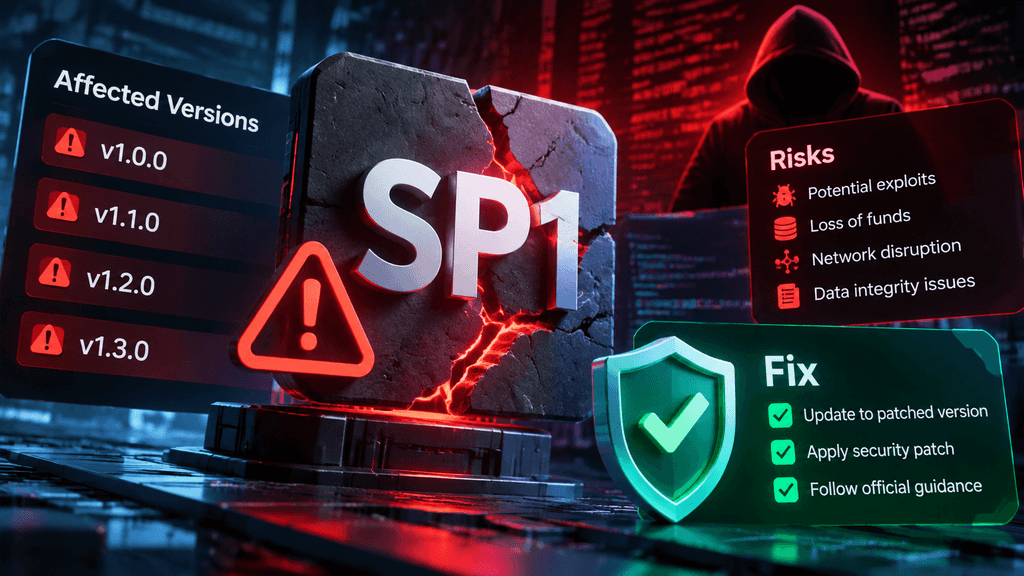
A flaw in a zero-knowledge proof verifier can undermine the reliability of an entire application without compromising a private key or directly draining a wallet. That is the concern behind a high-severity vulnerability disclosed in Succinct's SP1 proof system. Published on October 11, 2026, the official GitHub security advisory describes a flaw in the native Rust verifier that could allow invalid execution proofs to be accepted when proof data contains inconsistent tensor dimensions and storage lengths. The issue affects SP1 versions 6.0.0 through 6.8.0, with version 6.8.1 providing the fix.
Succinct has deployed the patched verifier to its mainnet Prover Network, the only known affected deployment identified in the advisory. However, developers operating their own native Rust verifiers must check their versions and upgrade if they accept proofs from untrusted parties. The incident highlights a fundamental security requirement for zero-knowledge infrastructure: verification software must reject malformed proof data consistently. Although the vulnerability created a potential path for invalid computations to pass verification, public disclosures have not established that it caused financial losses. Understanding its scope, technical cause, and remediation is therefore essential for developers and crypto investors assessing the incident.
Key Takeaways
-
Affected versions: SP1's native Rust verifier components from 6.0.0 through 6.8.0 were vulnerable.
-
Fixed release: SP1 6.8.1 adds tensor-length and shape validation.
-
Primary risk: A malicious prover could submit a proof of invalid execution that the affected verifier might accept.
-
Known exposure: Succinct's mainnet Prover Network was the only known affected deployment when the vulnerability was disclosed.
-
Important exception: Groth16 and Plonk verification paths using fixed-shape wrapped proofs are unaffected by this specific issue.
-
Required action: Operators running their own affected native Rust verifier should upgrade to 6.8.1 or a compatible later patched version.
What Is the Succinct SP1 Vulnerability?
The vulnerability, tracked as GitHub Security Advisory GHSA-p7v2-jjv3-8p8f, is a soundness flaw in SP1 V6's native Rust verifier. The official advisory rates it High and identifies mismatched tensor lengths as the underlying issue. It was discovered by Vitalis Salis and reported through the Immunefi bug bounty program.
SP1 is a zero-knowledge virtual machine (zkVM) developed by Succinct. It enables programs to produce cryptographic proofs that their computations followed specified rules. A verifier checks those proofs without necessarily repeating the entire computation, making proof verification useful for blockchain applications, rollups, and systems that rely on verifiable off-chain execution. The verifier's reliability is critical because applications may use its result to determine whether a state transition or computation should be accepted.
How Does the Tensor-Length Bug Work?
SP1 represents multidimensional data using a structure called a tensor, which contains a storage buffer and dimensions describing the data's shape. For example, a tensor declared to have two rows and three columns should contain six elements. A secure verifier must confirm that the actual number of stored elements matches the product of the declared dimensions.
In affected versions, the deserialization process did not adequately verify this relationship. Some verification paths subsequently relied on the declared dimensions without checking the underlying storage length. A malicious prover could supply tensor data with inconsistent dimensions and storage, causing different verification stages to process different portions of the same data. That inconsistency could break the assumptions required for sound verification and allow a proof for an invalid execution to be accepted.
The central problem was therefore not simply malformed data, but the verifier's failure to enforce structural consistency before using that data. This distinction matters because a proof system is only as reliable as the checks performed along its complete verification path.
Affected Versions and Systems
The official advisory identifies three affected Rust packages:
sp1_hypercube, sp1_prover, and sp1_sdk. Each is affected from version 6.0.0 through 6.8.0, with 6.8.1 listed as the patched release. Developers should check their dependency trees and deployed binaries rather than assuming that upgrading one top-level package automatically updates every component.| Component or configuration | Status | Recommended action |
| sp1_hypercube 6.0.0–6.8.0 | Affected | Upgrade to 6.8.1 or a compatible patched release |
| sp1_prover 6.0.0–6.8.0 | Affected | Upgrade to 6.8.1 or a compatible patched release |
| sp1_sdk 6.0.0–6.8.0 | Affected | Upgrade and verify resolved dependencies |
| SP1 6.8.1 | Patched | Confirm the deployed environment uses the fixed code |
| Groth16 and Plonk verification using fixed-shape wrapped proofs | Not affected by this issue | Continue following general security and dependency guidance |
Which Applications Face the Greatest Risk?
The vulnerability affects Core and Compressed proofs submitted directly to the affected native Rust verifier. Applications are exposed when they use that verifier to accept proofs supplied by untrusted provers. The precise impact depends on the proof mode and verification path involved.
At the time of disclosure, Succinct's mainnet Prover Network was the only known affected deployment. The network accepted proofs from third-party provers, creating the relevant exposure to potentially malicious proof inputs. Succinct subsequently deployed the patched verifier. Other projects using SP1 should independently review their architecture and version information rather than assume that every integration was affected or that every integration was automatically protected.
How the SP1 Verification Flaw Could Affect Crypto Applications
The main risk is that an application might rely on an invalid computation being accepted as valid. If a proof-verification result controls a state transition, settlement process, or other security-sensitive operation, an incorrect acceptance could affect the application that trusts that result. However, the actual consequences depend on how the verifier is integrated, what the proof represents, and whether additional checks exist elsewhere in the system.
Why This Matters for Zero-Knowledge Rollups
Zero-knowledge systems are designed to let applications verify computations efficiently while maintaining strong correctness guarantees. In a rollup architecture, proof verification can help establish that proposed state transitions satisfy the required rules. If the relevant verifier accepts an invalid proof, the application may lose an important layer of protection.
That does not mean every rollup or application using SP1 was compromised. The official advisory limits the affected paths and identifies one known affected deployment at the time of discovery. It also explicitly states that Groth16 and Plonk verification paths using fixed-shape wrapped proofs were not affected by this vulnerability. Developers must assess their specific verification architecture before drawing conclusions about exposure.
Was User Money Stolen?
The public advisory establishes a potential proof-soundness failure, not a confirmed theft of funds. As of the latest reports dated October 24, the disclosed information did not establish that attackers had used the flaw to cause a financial loss. The absence of a reported loss should not be interpreted as proof that every integration was safe, but it is equally important not to describe a theoretical exploitation path as a confirmed attack.
For crypto investors, the distinction is significant. Security incidents can affect confidence in infrastructure projects, but price reactions depend on the severity of actual consequences, the speed of remediation, the extent of adoption, and broader market conditions. There is insufficient evidence to conclude that this vulnerability alone will determine the price of Succinct's PROVE token or other related assets.
How Succinct Fixed the SP1 Vulnerability
Succinct addressed the flaw in SP1 6.8.1 by adding validation at two stages. First, the deserialization process now rejects tensors when their storage length differs from the product of their declared dimensions. Second, affected native verification paths check the physical tensor shape before relying on the declared dimensions or processing stored elements. These checks ensure that verification stages operate on consistent data and return an error for malformed proofs.
The patch was released on September 24, 2026, and Succinct deployed it to the mainnet Prover Network after the fixed release became available. The official advisory states that requesters using this network do not need to change their integration for the network-side update. However, organizations operating their own native Rust verifiers that accept proofs from untrusted parties are instructed to upgrade to 6.8.1.
What Developers Should Do Now
The first priority is to identify whether an application directly uses an affected native Rust verification path. Developers should inspect dependency manifests and lockfiles, confirm the versions resolved in production, and upgrade the relevant components. Merely changing a version declaration is not enough if a deployed binary continues to use older code.
After upgrading, teams should run their normal regression and security tests, verify that malformed proof inputs are rejected, and confirm that production deployments actually use the patched verifier. They should also review any historical security-sensitive operations that depended on the affected verification path before the patch was deployed. If suspicious proof submissions or inconsistent verification records are found, those events warrant a focused investigation.
What the Vulnerability Means for Succinct and the ZK-Proof Market
The incident illustrates why the security of zero-knowledge infrastructure depends on more than the underlying cryptographic protocol. A sound proof system can still be undermined by implementation errors in serialization, data handling, or verification logic. As zkVMs and proof systems become more widely integrated into blockchain infrastructure, robust input validation, independent audits, bug bounty programs, and timely software updates remain essential.
Conclusion
The Succinct SP1 vulnerability highlights a fundamental requirement for zero-knowledge infrastructure: verification software must validate the structure of proof data before trusting it. The flaw affected SP1 V6 native Rust verifier components from 6.0.0 through 6.8.0 and could allow invalid execution proofs to be accepted when declared tensor dimensions did not match actual storage lengths. The issue was rated High in the official GitHub advisory, and SP1 6.8.1 introduced the checks needed to address the problem.
Succinct has deployed the fix to its mainnet Prover Network, which was the only known affected deployment when the issue was disclosed. Developers operating their own native Rust verifiers must still check their versions and upgrade where necessary. Importantly, the official advisory does not establish that the flaw caused a financial loss, and Groth16 and Plonk verification using fixed-shape wrapped proofs were unaffected by this specific issue. The broader takeaway for the crypto industry is that strong cryptographic design must be matched by careful implementation, consistent validation, and disciplined maintenance. The most meaningful indicators of resolution are verified patch adoption, reliable operation, and transparent follow-up disclosures.
FAQs
Does the SP1 vulnerability have a CVE number?
The official GitHub security advisory lists no known CVE identifier for this issue. Its tracking reference is GHSA-p7v2-jjv3-8p8f.
Who discovered the SP1 vulnerability?
The official advisory credits Vitalis Salis, who identified the issue and reported it through the Immunefi bug bounty program.
Does the vulnerability affect every zero-knowledge proof system?
No. The advisory concerns specific SP1 V6 native Rust verifier components and particular proof-verification paths. It does not establish that other zero-knowledge systems are affected.
Can developers keep using SP1 after upgrading?
Yes. The vulnerability does not mean SP1 must be abandoned. Developers should use a patched compatible version and verify that their particular integration follows the relevant security guidance.
Where can readers find the authoritative technical details?
The primary reference is the official SP1 security advisory on GitHub, which documents the affected packages, version ranges, technical cause, impact, and remediation.
Disclaimer: This general market information, possibly from third-party, commercial, or sponsored sources, is provided for reference and educational purposes only and does not constitute financial or investment advice, an offer, solicitation, or guarantee. We disclaim liability for its accuracy, completeness, reliability, and any resulting losses. Investments/trading are risky; past performance doesn’t guarantee future results. Users should research, judge prudently, and take full responsibility. For further details, please consult KuCoin’s Terms of Use and Risk Disclosure.