

What Is Solana Transaction V1? 4,096-Byte Mainnet Upgrade Explained
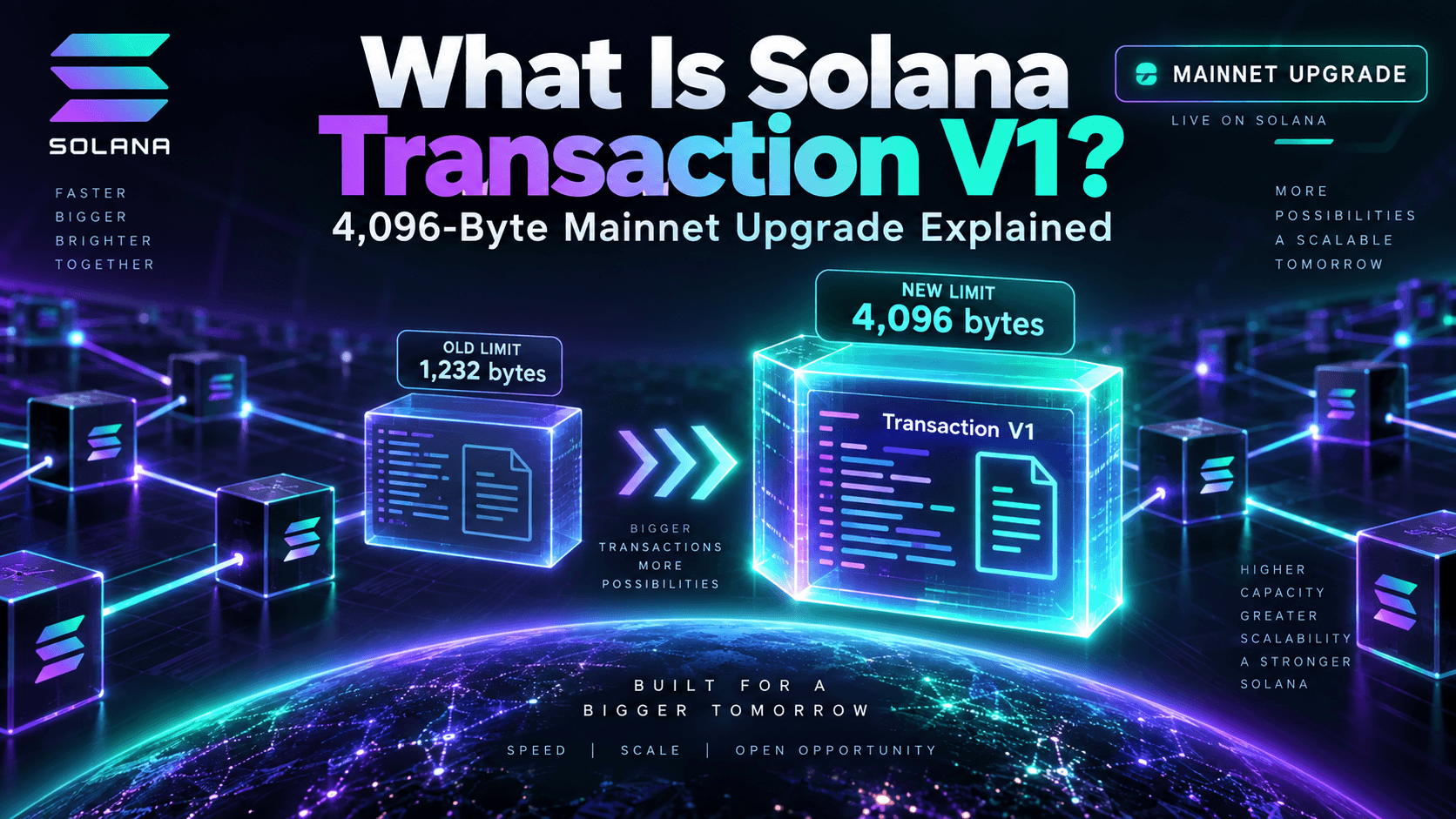
Solana has activated Transaction V1 on mainnet, raising the maximum serialized transaction size from 1,232 bytes to 4,096 bytes. The change gives developers roughly 3.3 times more room inside a single transaction, making it easier to handle data-heavy workloads such as zero-knowledge proofs, large multisig operations, confidential transfers and more complex DeFi interactions. Transaction V1 went live at Epoch 1035 on September 15, 2026, while the existing Legacy and V0 formats remain supported.
The headline number, however, can be misleading. Transaction V1 does not make Solana 3.3 times faster, nor does it automatically triple transactions per second. Instead, the upgrade expands the amount of serialized data that can fit into one atomic transaction and redesigns parts of the transaction format. That distinction matters because the biggest benefit is not simply “more bytes.” It is the ability to complete workflows in one transaction that previously had to be fragmented across several steps.
What Is Solana Transaction V1?
Transaction V1 is Solana’s new versioned transaction format, introduced through SIMD-0385 alongside the larger transaction-size proposal in SIMD-0296. Its most visible feature is the increase in the maximum serialized transaction size from 1,232 bytes to 4,096 bytes. V1 also reorganizes the wire format, removes Address Lookup Tables, and places resource requests such as compute-unit limits and priority fees directly in transaction configuration rather than relying on traditional Compute Budget instructions.
Importantly, V1 is an opt-in format rather than a mandatory replacement. Applications that do not need additional transaction space can continue using Legacy or V0 transactions. Ordinary SOL transfers, simple token transfers and many existing dApp interactions therefore do not suddenly need to consume 4,096 bytes or migrate to a new transaction type.
| Feature | Legacy | V0 | Transaction V1 |
| Maximum transaction size | 1,232 bytes | 1,232 bytes | 4,096 bytes |
| Versioned format | No | Yes | Yes |
| Address Lookup Tables | No | Yes | No |
| Resource configuration | Compute Budget instructions | Compute Budget instructions | Transaction config |
| Larger data-heavy atomic operations | Limited | Limited | Yes |
| Migration required | No | No | Opt-in |
The simplest way to understand the upgrade is that V1 gives applications a much larger transaction envelope while leaving older transaction formats intact.
Why Was Solana Limited to 1,232 Bytes?
The original 1,232-byte limit dates back to Solana’s networking architecture rather than an arbitrary decision about how complex applications should be. The network historically used a 1,280-byte IPv6 minimum MTU as a reference point. After accounting for network headers, 1,232 bytes remained available for transaction data. Solana documentation still identifies 1,232 bytes as the traditional PACKET_DATA_SIZE, even though V1 transactions can now exceed that packet payload by being transmitted across multiple QUIC frames.
A transaction must fit far more than the instruction a user actually wants to execute. It includes signatures, account addresses, a recent blockhash, instruction metadata and application-specific data. Every Ed25519 signature consumes 64 bytes, while a standard Solana public key is 32 bytes. Those numbers become significant when a transaction involves many signers, accounts or cryptographic proofs.
The 1,232-byte ceiling therefore became increasingly restrictive as Solana applications grew more sophisticated. It was rarely a serious obstacle for a simple token transfer, but it could force developers building advanced financial or cryptographic applications to redesign workflows around a networking limit created much earlier in Solana’s development.
Why Did Solana Raise the Limit to 4,096 Bytes?
Solana can now relax the old constraint partly because its networking stack uses QUIC, allowing a transaction larger than the original packet payload to be transmitted across multiple frames. That makes the old requirement that an entire serialized transaction fit inside a single MTU-sized payload less necessary. At the same time, larger transactions consume additional validator bandwidth, so simply removing the limit altogether would create a different set of networking and resource problems.
The new 4,096-byte, or 4 KiB, ceiling is therefore an engineering trade-off. It gives developers substantially more application space without making transaction size unbounded. Solana notes that larger transactions can consume more network bandwidth and may require higher priority fees than smaller transactions competing at a similar level of urgency.
That nuance is important. Transaction V1 is not Solana abandoning transaction-size constraints; it is Solana replacing a limit rooted in earlier network assumptions with a considerably larger ceiling designed for the applications the network now needs to support.
Solana V1 vs. V0: What Actually Changed?
V1 Removes Address Lookup Tables
V0 introduced Address Lookup Tables, or ALTs, as a workaround for the old transaction-size limit. Instead of placing every 32-byte account address directly into a transaction, an application could reference addresses stored in lookup tables using much shorter indices. That compression became widely used: Solana’s own analysis of sampled activity found that roughly 62% of observed V0 transactions referenced at least one ALT. V1 removes ALT support and instead places account addresses directly into the larger transaction envelope.
Removing ALTs simplifies part of the validator ingestion process, because validators no longer need to retrieve and resolve lookup-table state before knowing a transaction’s complete account set. But it also consumes some of the extra space V1 provides. Solana estimated that when existing transactions are represented under V1, half show less than about 420 bytes of additional serialized size, while 90% show less than about 1,400 bytes. Transactions that previously compressed many addresses through a small number of ALTs can see much larger expansion.
More Bytes Do Not Mean Unlimited Accounts
V1 also does not triple the number of accounts a transaction can access. Solana currently enforces a 64-account runtime limit, even though the underlying index representation has a higher theoretical ceiling. A separate feature could eventually raise the enforced account-lock limit to 128, but that is not automatically part of Transaction V1.
That means some account-heavy DeFi routes may still hit the account limit even when hundreds of transaction bytes remain unused. V1 creates particularly strong headroom for workloads that reuse an existing account set but need more instruction data, signatures or proofs; it is less transformative for strategies whose complexity mainly comes from touching many additional markets and accounts.
Resource Requests Move Into the Transaction
V1 also changes how transactions describe their resource requirements. Compute-unit limits, loaded-account-data limits, heap size and priority fees can live at fixed positions in the transaction configuration instead of being expressed through
ComputeBudgetProgram instructions. This lets network infrastructure identify important scheduling information earlier without scanning through the instruction list.For developers, this means the upgrade is more than a bigger byte allowance. Software that builds, decodes, indexes, sponsors or evaluates transactions must understand the new V1 structure rather than assuming every transaction behaves like Legacy or V0.
What Can 4,096-Byte Transactions Unlock?
Zero-Knowledge Proofs and Confidential Transfers
Zero-knowledge technology is one of the clearest beneficiaries because proofs can require substantial transaction data. Under the old limit, a developer might have enough compute capacity to verify an operation but not enough serialized transaction space to include the proof and all of the surrounding instructions in one transaction. The larger V1 envelope gives privacy and cryptographic applications considerably more room without increasing their compute or account limits. Solana specifically highlights ZK proofs and confidential-transfer workloads among the applications that benefit.
Token-2022 confidential transfers illustrate why this matters. Such workflows can involve proofs plus the instructions needed to establish context, perform the transfer and clean up associated state. With a larger transaction, operations that once had to be stitched together can potentially execute as one atomic action, reducing the number of intermediate states a user or developer must manage.
Larger Multisig and Cryptographic Operations
Multisig transactions also benefit because signatures consume meaningful serialized space. A 64-byte Ed25519 signature may be trivial in isolation, but a transaction requiring many independent approvals can quickly lose a significant part of the old 1,232-byte envelope before accounting for program instructions and addresses. V1 makes more room for sophisticated treasury management, institutional custody and authorization structures.
Solana has also pointed to other data-heavy cryptographic designs, including BLS-related workflows and advanced on-chain signature schemes. This matters for institutional applications because complex authorization, custody and privacy requirements are often much more demanding than a retail user sending tokens between two wallets.
More Complex Atomic Workflows
Perhaps the broadest advantage is atomicity. An atomic transaction either succeeds as a whole or fails as a whole. If a complex operation must be split into multiple transactions because the original transaction is too large, developers may need temporary state, extra confirmations or bundling systems to coordinate the steps.
With V1, some workflows can include more instructions and data in a single transaction. The value is therefore not simply that a transaction contains more information; it is that more of an application’s logic can potentially share the same all-or-nothing execution boundary.
What Does Transaction V1 Mean for DeFi?
DeFi applications frequently interact with multiple programs within a single user action. A sophisticated trade might involve a swap router, lending protocol, collateral adjustment and settlement step, while an arbitrage or liquidation strategy may need to coordinate several actions before its economics work. Under the old byte ceiling, transaction serialization could become a bottleneck even when the network had sufficient computational capacity to execute the intended instructions.
V1 creates more room for multi-step routes, extra validation logic and data-rich instructions. That can reduce reliance on fragmented workflows and may lower partial-execution risk. Routers and trading systems that can fit more logic into a single transaction may also offer a cleaner user experience because users need fewer signatures and confirmations for certain complex actions. CoinDesk highlighted multi-step trades as one of the immediate application categories benefiting from the upgrade.
However, the improvement has limits. Transaction bytes, compute units and account locks are different resources. Increasing the byte ceiling does not give an application unlimited compute or additional accounts. Solana’s V1 analysis specifically notes that the unchanged 64-account limit can remain the binding constraint for broad multi-pool or multi-venue strategies.
Will Transaction V1 Make Solana Faster or Cheaper?
Does V1 Increase Solana TPS?
Not by 3.3 times. The upgrade increases the maximum size of an individual transaction, not the number of transactions Solana can necessarily execute each second. Transaction throughput also depends on block compute limits, account contention, networking, transaction composition and other protocol constraints. Describing V1 as a “3.3x TPS upgrade” therefore confuses transaction capacity with transaction size.
Solana has separately increased its block compute limit from 60 million to 100 million compute units, a 66% expansion that activated on mainnet in July 2026. That upgrade directly adds more computational headroom per block and is distinct from V1.
V1 can still improve application-level efficiency. If a workflow that once required three coordinated transactions can now run as one, the user may experience fewer steps and less latency even though the network’s headline TPS has not tripled. That distinction is the best way to describe the performance benefit.
Could Transaction V1 Reduce Fees?
For some complex operations, potentially. Combining several steps into one atomic transaction can reduce duplicate signatures, repeated confirmations and other overhead that comes with splitting a workflow. That may lower the total cost of completing the entire action.
But the upgrade does not cut Solana’s base transaction fee by 3.3 times. In fact, Solana’s own documentation notes that larger transactions consume more validator bandwidth and may require higher priority fees to land than smaller transactions competing with similar priority.
The fee benefit should therefore be evaluated at the workflow level: a single larger transaction might cost more than a simple transfer but still be cheaper or operationally better than several smaller transactions needed to accomplish the same complex task.
What Developers and Wallets Need to Change
For ordinary users, Transaction V1 should be mostly invisible unless the application they use begins taking advantage of it. For infrastructure providers, the transition requires considerably more attention. Wallets and SDKs need to understand the new serialization format if they want to build or sign V1 transactions, while RPC services, explorers and indexers must be able to decode the new version correctly.
Even applications that do not intend to send V1 transactions may encounter them while reading blocks or transaction histories. Solana’s migration guidance warns transaction-reading systems to explicitly support transaction version 1. Systems that make assumptions based on V0 structures or search for traditional Compute Budget instructions may otherwise fail or report incorrect resource information.
This compatibility issue explains why the activation was moved to Epoch 1035 after ecosystem teams requested more time for testing and integration. The immediate post-launch question is therefore not simply how many developers start creating large transactions. It is whether wallets, RPC providers, indexers, fee sponsors and analytics platforms correctly understand V1 as it begins appearing in production.
What Does the Upgrade Mean for SOL?
Transaction V1 is fundamentally positive for Solana’s technical capabilities because it broadens the types of applications developers can reasonably build. More room for proofs, institutional multisig structures, sophisticated DeFi and privacy-oriented workflows can strengthen Solana’s case as infrastructure for applications that go beyond simple token transfers. That is a meaningful fundamental development, but it does not create a mechanical relationship between transaction size and the SOL token price.
The immediate market response has been relatively modest compared with the size of the technical headline. SOL was trading around $102 on September 15, with price data showing it roughly 35% above its level one month earlier but still subject to broader crypto-market volatility.
Investors may therefore get more useful information by watching adoption rather than the first day’s price candle. The relevant questions are whether V1 transactions become common, whether developers launch applications that were previously impractical, and whether DeFi, privacy, payments or institutional usage expands as a result. The economic value of the additional 2,864 bytes ultimately depends on what developers build with them.
How V1 Fits Into Solana’s Bigger Upgrade Roadmap
Transaction V1 is only one part of a broader effort to remove bottlenecks across Solana. The network has already raised block compute capacity to 100 million CUs, is phasing in sharply lower rent parameters, and is working toward shorter slot times. Agave 4.3 is expected to bring another major change with Alpenglow, Solana’s planned next-generation consensus architecture targeting substantially faster finality.
| Upgrade | Main Goal | Current Direction |
| 100M CU Blocks | Raise block compute limit from 60M to 100M CU | Live on mainnet |
| Transaction V1 | Raise max transaction size from 1,232 to 4,096 bytes | Live on mainnet |
| Reduced Rent | Cut on-chain storage rent parameters by up to 90% | Phased rollout |
| Reduced Slot Times | Move from 400ms toward 200ms slots | Feature rollout |
| Alpenglow | New consensus system targeting about 150ms finality | Planned with Agave 4.3 |
These upgrades address different constraints. Larger blocks create additional compute capacity, V1 expands transaction flexibility, lower rent reduces on-chain storage costs, shorter slots improve latency, and Alpenglow targets consensus and finality. Treating Transaction V1 as one part of this wider architecture is more accurate than presenting it as a single upgrade that suddenly makes every aspect of Solana three times better.
The broader strategy is to give applications more room at several layers simultaneously. If successful, Solana will not merely process more activity; developers should have fewer protocol-level constraints when designing complex applications.
What Should We Watch After the Mainnet Launch?
The first metric to watch is simply V1 adoption. Because the format is optional, mainnet activation does not tell us how quickly wallets, DeFi protocols, privacy projects or institutional applications will actually use it. Developers have strong reasons to stay with existing formats when transactions are already small and simple, so V1 adoption should initially be concentrated in applications where its additional capacity solves a genuine problem.
Infrastructure reliability will matter just as much. Transaction decoding, wallet signing, RPC compatibility, fee estimation and indexing all need to behave correctly as V1 activity increases. It will also be worth monitoring whether larger transactions place measurable new pressure on validator bandwidth or attract higher priority fees, as Solana’s design documentation anticipates.
Over the longer term, the more interesting indicators will be application-specific: growth in confidential transfers and ZK workloads, more sophisticated multisig designs, DeFi routes that require fewer fragmented transactions, and institutional workflows that would have been impractical under 1,232 bytes. The question after launch is no longer whether Solana can support 4,096-byte transactions, but whether developers discover enough valuable reasons to use them.
🔥 Beyond the Headlines: What KuCoin 5.0 Means for You
Market news moves fast — but where you act on it matters just as much. This October, KuCoin launches KuCoin 5.0, transforming KuCoin into a rebuilt platform. Here's what actually changes for you:
-
One account for everything. Older platforms split your money across separate "spot," "margin," and "futures" accounts and expected you to understand why. KuCoin 5.0's unified account removes that entirely — deposit once, and everything is simply there.
-
Stocks, indices, and commodities. KuCoin 5.0 expands beyond crypto into global markets. When crypto chops sideways and equities rally (or the reverse), you rotate in minutes instead of opening a brokerage account and waiting days for fiat rails.
-
Real-world assets (RWA). Tokenized exposure to traditional assets like commodities, right inside your crypto account. One of the fastest-growing segments in global finance is no longer reserved for institutions — you access it from the same balance you trade with.
-
Earn while you learn. Not ready to trade? KCUSD lets your stablecoins earn daily, auto-compounding interest. The lowest-stress way to put your idle deposit to work for 4% yield.
-
An AI assistant in plain language. Ask questions, get market context, understand what you're looking at — built into the platform, no jargon required.
-
An app that doesn't overwhelm. Faster, cleaner, and consistent — intuitive from the first tap, not after a tutorial.
-
Safety you can check, not just trust. A MiCAR-licensed EU entity, Proof of Reserves you can verify yourself, and internationally certified security (SOC 2 Type II, ISO 27001:2022).
Create your account in minutes — and start on the platform built for where crypto is going, not where it's been.
Conclusion
Solana Transaction V1 looks simple when reduced to one statistic: the network has raised its maximum transaction size from 1,232 bytes to 4,096 bytes. But the more important change is what those additional bytes can enable. Proofs, signatures, configuration data and multiple application instructions can fit inside a larger atomic execution boundary, potentially replacing some of the workarounds developers previously used to build around the old limit.
V1 does not make Solana 3.3 times faster, eliminate compute constraints or guarantee lower fees. Instead, it removes one increasingly important application-design bottleneck while introducing new trade-offs around address representation, infrastructure compatibility and network bandwidth. If the new format helps developers simplify ZK applications, institutional workflows and complex DeFi transactions, its long-term importance may come not from the 4,096-byte headline itself, but from the applications that were difficult to build before it existed.
FAQs
Can Users Still Send Legacy Solana Transactions?
Yes. Legacy and V0 transactions remain supported after V1 goes live. Transaction V1 is optional, so applications that do not need the larger transaction envelope can continue using existing formats.
Do I Need a New Wallet for Transaction V1?
Not necessarily. Ordinary users can continue using wallets that rely on Legacy or V0 transactions. However, wallets that want to construct, decode or sign V1 transactions need to add explicit support for the new format.
Does V1 Increase the Number of Accounts Per Transaction?
Not automatically. Solana currently enforces a 64-account runtime limit, which remains separate from the new 4,096-byte transaction-size ceiling. A future feature could raise the account-lock limit, but that is not part of the V1 size increase itself.
Are All V1 Transactions 4,096 Bytes?
No. The figure is a maximum, not a required size. A V1 transaction can be much smaller than 4,096 bytes, and developers have no reason to fill unused space simply because it is available.
What Are SIMD-0296 and SIMD-0385?
SIMD-0296 is the Solana improvement proposal associated with raising the maximum transaction size, while SIMD-0385 specifies the Transaction V1 format that supports the larger envelope and redesigned transaction structure.
Can Transaction V1 Use Address Lookup Tables?
No. Unlike V0, V1 does not support Address Lookup Tables. It includes account addresses directly in the transaction, simplifying transaction ingestion but consuming more serialized space for account-heavy workloads.
Disclaimer: This article is for informational purposes only and does not constitute investment advice. Crypto assets can be highly volatile, and market conditions, token liquidity and project developments may change rapidly. Readers should conduct their own research and assess their risk tolerance before making financial decisions.