

Who Benefits From the SEC’s Tokenized Stock Exemption? Coinbase, Robinhood, and Circle
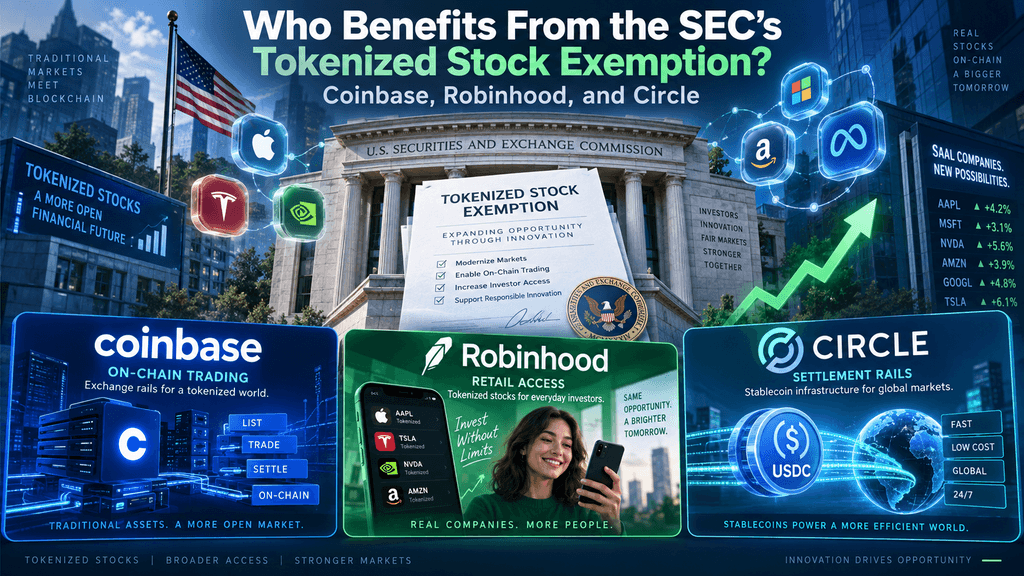
SEC’s Five-Year Exemption Opens a Regulatory Path for Tokenized Stock Trading
The U.S. Securities and Exchange Commission issued a five-year Innovation Exemption on September 17, 2026, creating a temporary, conditional path for Tokenized Securities Venues to facilitate secondary trading of tokenized National Market System stocks through permissioned automated market makers and liquidity pools on public blockchains. The order, available on the SEC website, exempts qualifying venues from the exchange definition under the Securities Exchange Act of 1934 and provides parallel relief for certain liquidity providers from dealer registration. Tokens must confer the same rights and privileges as traditional shares, including dividends and voting. Issuers receive notice and a 30-day window to object.
Volume and symbol limits apply, and trading must halt in tandem with the primary listing exchange. This framework positions Coinbase, Robinhood, and Circle to capture early opportunities in tokenization infrastructure, brokerage product expansion, and stablecoin settlement, according to analysts at Goldman Sachs and Citizens cited across multiple reports. The exemption does not award automatic licenses or revenue, yet it supplies regulatory optionality that these firms are structurally prepared to test while traditional exchanges face limited near-term volume displacement.
The Innovation Exemption establishes Tokenized Securities Venues as entities that supply AMM liquidity pools and set participant-access standards for permissioned trading of tokenized NMS stocks. Smart contracts must be auditable, public, and deployed on permissionless ledgers. Venues must publish operational notices, maintain books and records, coordinate trading stoppages with primary exchanges and verify that each token delivers equivalent shareholder rights. Liquidity providers using proprietary capital in these pools receive temporary dealer-registration relief. The five-year term runs through September 17, 2031, after which the Commission may extend, modify, or replace the relief based on observed data. Public comment is invited on all aspects. These conditions deliberately constrain scale: symbol counts and volume caps calibrated to limit-up/limit-down tiers prevent rapid migration of deep-liquidity names. The design prioritizes observation of onchain–offchain interaction over immediate market restructuring.
Market participants must still satisfy existing securities-law obligations outside the specific exemptions. Synthetic instruments that deliver only price exposure without ownership rights fall outside the relief. The framework therefore favors structures that maintain a direct beneficial claim on underlying shares held in regulated custody. This distinction immediately separates compliant 1:1 tokenized products from offshore derivative-style stock tokens already offered by some platforms. Data transparency requirements, including U.S. dollar-denominated price, size, time, pool address, and daily volume, will generate a public record the SEC can study for future rulemaking. Early adopters that already operate the necessary custody, issuance, and settlement rails gain a measurable head start in converting regulatory optionality into operational pilots.
Coinbase Positioned Across Custody, Tokenization, and Layer-2 Rails
Goldman Sachs analysts identified Coinbase as a primary potential beneficiary because its existing tokenized-equity products already incorporate many required features, including dividend rights comparable to the underlying shares. The firm’s institutional custody business and Coinbase Tokenize infrastructure for third-party on-chain assets further align with demand that the exemption may generate. Citizens analysts added Base, Coinbase’s Ethereum Layer-2 network, as a relevant distribution and settlement layer. Coinbase has already launched 1:1-backed tokenized stocks on Base for eligible non-U.S. users, beginning with Apple, Nvidia, Meta, and Alphabet and later expanding to additional names including Amazon, Microsoft, and Tesla. Each token represents a beneficial claim on shares held in regulated, bankruptcy-remote custody.
One structural gap remains. Coinbase’s primary matching engines rely on central limit order books, whereas the exemption centers on AMM liquidity pools. Operating a TSV directly would require new AMM infrastructure or routing of flow to existing AMM protocols already active on Base. The company can therefore participate as issuer, custodian, or infrastructure provider even if it does not immediately launch a full TSV. Its economic exposure to USDC distribution supplies an additional indirect channel should stablecoin settlement volume rise with onchain equity activity. Shares of Coinbase rose approximately 5 percent on the day the order was announced, reflecting investor recognition of this multi-layered positioning rather than any immediate revenue contract.
Robinhood already offers stock tokens outside the United States that provide economic exposure to U.S. equities. Those products operate through a derivative structure issued by a Jersey subsidiary and do not convey the full legal ownership rights, dividends, voting, and redemption, required under the Innovation Exemption. Goldman Sachs and Citizens both noted that Robinhood would need additional product development to bring a compliant version into the U.S. market. CEO Vlad Tenev has publicly indicated that share redemptions and voting rights are planned additions, suggesting the firm is already mapping the necessary upgrades.
The exemption’s issuer-objection mechanism adds a practical constraint. Robinhood faced public criticism earlier in September 2026 when AMC Entertainment’s CEO objected to the firm’s offering of AMC-linked tokens without company approval. Under the new rules, any third-party tokenization requires 30-day notice and can be blocked by the issuer. Robinhood’s Arbitrum-based Robinhood Chain and its existing offshore user base give it distribution advantages once product features are aligned. Success will depend on timely engineering of the ownership-rights layer and on issuer willingness to permit tokenization. Early volume is likely to concentrate in names that do not exercise the veto, creating a selective rather than universal opportunity set.
Circle Stands to Gain From Rising Demand for Onchain Settlement Cash
Both Goldman Sachs and Citizens flagged Circle as an indirect beneficiary. Increased trading of tokenized stocks on public blockchains can elevate demand for programmable, fully reserved digital dollars used as settlement and collateral assets. USDC already functions in multiple tokenized-securities workflows outside the United States, including partnerships that settle equity tokens in the stablecoin. The exemption does not mandate any particular stablecoin, yet the architecture of permissioned AMMs and atomic settlement favors assets that move natively on the same ledgers as the equity tokens.
Circle’s business model, issuing a regulated payment stablecoin whose reserves back every circulating unit, positions it to capture incremental reserve growth and transaction fees if TSV activity scales. Coinbase’s commercial relationship with USDC distribution further amplifies the potential feedback loop. Market reaction on September 17 reflected this optionality: Circle shares also advanced roughly 5 percent. The benefit remains contingent on venues choosing USDC as a settlement leg and on overall volume remaining within the exemption’s caps. Even modest adoption across a limited set of symbols could still expand Circle’s on-chain footprint in capital-markets use cases that previously relied on traditional cash rails.
Volume Caps and Issuer Opt-Outs Limit Near-Term Disruption to Traditional Exchanges
The exemption deliberately protects incumbent market structure. Symbol limits and volume caps calibrated by limit-up/limit-down tiers restrict the share of overall equity trading that can migrate on-chain. Goldman Sachs analysts concluded that new venues are unlikely to draw meaningful volume from Nasdaq or Intercontinental Exchange in the near term precisely because of these constraints and the relative shallowness of AMM liquidity for large-capitalization names. Issuers retain an explicit veto, further filtering the universe of available tokens.
This calibrated approach allows the SEC to gather operational data, price discovery quality, settlement finality, and interaction with traditional markets without destabilizing the primary listing venues. Traditional exchanges therefore face limited competitive pressure during the five-year pilot. Their clearing, custody, and data businesses remain largely insulated. The real competitive dynamic will appear among crypto-native firms racing to assemble compliant TSV stacks, custody solutions, and settlement rails. Firms already operating the necessary components can convert the regulatory opening into product experiments faster than pure newcomers.
Permissioned AMM Design Balances Innovation With Investor-Protection Guardrails
TSVs must operate in permissioned access environments even though the underlying ledgers are public and permissionless. Participants are screened according to standards set by the venue, satisfying sanctions compliance and investor protection objectives. The smart contract code must be auditable and publicly deployed. Trading must stop concurrently with any halt on the primary listing exchange. These requirements distinguish the Innovation Exemption from fully permissionless DeFi protocols and keep the experiment inside a controllable perimeter.
The design choice reflects the Commission’s dual mandate: facilitate technological experimentation while preserving core market-integrity principles. Liquidity providers receive dealer relief only when supplying proprietary capital inside these controlled pools, reducing the risk that unregistered dealing activity migrates wholesale into unregulated venues. The resulting data set, public transaction records, pool statistics, and stoppage coordination logs, will inform whether permanent rule changes are warranted after 2031. Early participants that can demonstrate robust compliance infrastructure will shape the evidence base the SEC ultimately reviews.
Custody and Tokenization Infrastructure Become Differentiating Assets
Beyond pure trading venues, the exemption elevates the value of regulated custody and tokenization platforms. Coinbase’s institutional custody franchise and its Coinbase Tokenize tooling already serve third-party issuers seeking to place assets on-chain. Firms that can demonstrate bankruptcy-remote segregation, accurate beneficial-ownership tracking, and reliable corporate-action processing gain a competitive edge when issuers evaluate whether to permit or sponsor tokenization.
Third-party tokenization remains possible, yet the 30-day notice-and-objection process introduces friction and relationship risk. Issuer-sponsored or issuer-authorized models may therefore proliferate faster. Platforms that already maintain direct relationships with public companies or that can offer turnkey compliance packages will convert that advantage into market share. The five-year window rewards firms that can scale these services while volumes remain deliberately constrained, building operational track records that may prove decisive if the Commission later expands or permanentizes the relief.
Stablecoin Settlement Rails Offer Parallel Revenue Opportunity
Onchain equity trading creates natural demand for onchain cash. When a tokenized share moves between wallets or liquidity pools, the corresponding payment leg can settle in a stablecoin rather than through traditional bank wires or clearinghouses. USDC’s existing integrations with tokenized-securities platforms and its multi-chain availability make it a ready candidate. Circle does not need to operate a TSV to benefit; it needs only for venues and intermediaries to select USDC as the preferred settlement asset.
This dynamic extends beyond pure spot trading. Collateral use in lending protocols, margin arrangements, and automated market-making strategies can further increase stablecoin velocity and outstanding supply. Coinbase’s distribution role in the USDC ecosystem creates a secondary exposure that compounds its direct business lines. The magnitude of the opportunity remains bounded by the exemption’s volume caps, yet even limited adoption establishes a precedent for stablecoin use inside regulated capital-markets workflows.
Market Reaction Reflected Optionality Rather Than Immediate Revenue
On the day the order was published, Coinbase shares advanced approximately 5 percent, Circle shares rose a similar amount, and Robinhood also posted gains. These moves occurred without any firm announcing a live TSV launch or signed customer contract. Investors priced regulatory optionality: a clearer route to build, custody, or settle on-chain equity products inside a defined five-year sandbox.
The reaction underscores that the exemption’s primary near-term value is strategic positioning. Firms that already possess the necessary technology, licenses, and customer relationships can begin internal pilots and external discussions with issuers and liquidity providers. Pure-play traditional brokers without blockchain infrastructure face a steeper ramp. The five-year clock starts now; the first movers that convert optionality into operational capability will enter any subsequent permanent regime with demonstrated track records.
Issuer Relations and Corporate-Action Handling Will Determine Product Viability
Because tokens must deliver identical rights, including dividends, voting, and proxy participation, successful implementations require robust corporate-action processing. Custody providers must ensure that token holders receive economic and governance benefits on the same timetable as traditional shareholders. Any lag or discrepancy risks both regulatory non-compliance and issuer dissatisfaction. Platforms that already manage these flows for traditional assets or that have engineered onchain equivalents gain an operational advantage.
The issuer-objection right further elevates relationship management. Companies concerned about liquidity fragmentation, voting-list integrity, or brand association can simply decline. Early volume is therefore likely to concentrate among issuers that view tokenization as additive rather than competitive. Firms that cultivate constructive issuer dialogue and can demonstrate seamless rights transfer will expand the eligible universe more rapidly than those that treat tokenization as a purely technical exercise.
Ecosystem Favors Integrated Crypto-Native Platforms
Traditional exchanges retain structural advantages in deep liquidity and established clearing, yet the exemption’s design limits their near-term volume exposure. Crypto-native platforms that already combine exchange, custody, stablecoin, and Layer-2 capabilities can assemble compliant TSV stacks more quickly. Coinbase’s combination of Base, custody, tokenization tooling, and USDC exposure illustrates the integrated model. Robinhood’s brokerage reach and chain infrastructure offer a parallel path once product features are upgraded. Circle supplies a critical settlement primitive without needing to operate the venue itself.
New entrants face higher fixed costs to satisfy the permissioning, audit, notice, and transparency conditions. The five-year horizon rewards speed of execution among firms that already clear those hurdles. Over time, successful pilots may pressure traditional venues to develop complementary onchain offerings or partnership models, but the immediate competitive intensity sits inside the crypto-native cohort.
Five-Year Pilot Window Sets Stage for Data-Driven Permanent Rules
The temporary nature of the relief is intentional. Commissioner statements and the order itself emphasize observation: how tokenized NMS stocks behave in onchain environments, how traditional and distributed-ledger markets interact, and whether investor-protection outcomes meet expectations. Public transaction data and venue disclosures will form the evidentiary record. At the end of the five-year term, the Commission can expand, contract, or codify the framework.
Firms that participate early and generate clean operational histories will influence that assessment. Those that remain on the sidelines will confront a more developed competitive field if the relief is made permanent or broadened. The Innovation Exemption therefore functions simultaneously as a regulatory experiment and a competitive starting gun. Coinbase, Robinhood, and Circle enter the race with distinct but complementary structural advantages that analysts have already mapped.
What Issuers and Market Participants Need to Know
Issuers must decide whether to permit third-party tokenization or to sponsor their own. The 30-day notice period and objection right give them control, yet silence or consent opens a new distribution channel. Liquidity providers evaluating AMM participation must weigh the dealer-registration relief against the operational demands of permissioned pools and proprietary-capital requirements. Investors gain access to 24/7 trading and potential composability with other onchain assets, subject to the same rights and the same regulatory perimeter that govern traditional shares.
The exemption does not eliminate risk. Smart-contract vulnerabilities, custody failures, or corporate-action mismatches remain possible. The SEC’s conditions, auditable code, concurrent trading halts, and public transparency seek to mitigate those risks while still allowing innovation. Market participants that treat the framework as a controlled pilot rather than a free-for-all will be best positioned to extract durable value.
🔥 Beyond the Headlines: What KuCoin 5.0 Means for You
Market news moves fast — but where you act on it matters just as much. This October, KuCoin launches KuCoin 5.0, transforming KuCoin into a rebuilt platform. Here's what actually changes for you:
-
One account for everything. Older platforms split your money across separate "spot," "margin," and "futures" accounts and expected you to understand why. KuCoin 5.0's unified account removes that entirely — deposit once, and everything is simply there.
-
Stocks, indices, and commodities. KuCoin 5.0 expands beyond crypto into global markets. When crypto chops sideways and equities rally (or the reverse), you rotate in minutes instead of opening a brokerage account and waiting days for fiat rails.
-
Real-world assets (RWA). Tokenized exposure to traditional assets like commodities, right inside your crypto account. One of the fastest-growing segments in global finance is no longer reserved for institutions — you access it from the same balance you trade with.
-
Earn while you learn. Not ready to trade? KCUSD lets your stablecoins earn daily, auto-compounding interest. The lowest-stress way to put your idle deposit to work for 4% yield.
-
An AI assistant in plain language. Ask questions, get market context, understand what you're looking at — built into the platform, no jargon required.
-
An app that doesn't overwhelm. Faster, cleaner, and consistent — intuitive from the first tap, not after a tutorial.
-
Safety you can check, not just trust. A MiCAR-licensed EU entity, Proof of Reserves you can verify yourself, and internationally certified security (SOC 2 Type II, ISO 27001:2022).
Create your account in minutes — and start on the platform built for where crypto is going, not where it's been.
FAQs
What exactly does the SEC Innovation Exemption allow?
The order grants temporary, conditional relief so that Tokenized Securities Venues can operate permissioned automated market maker liquidity pools for secondary trading of tokenized NMS stocks without registering as national securities exchanges. Certain liquidity providers also receive temporary relief from dealer registration when supplying proprietary capital inside those pools. Tokens must carry full shareholder rights, issuers can object, and volume and symbol limits apply. The relief expires five years after publication.
Why do analysts single out Coinbase, Robinhood, and Circle?
Goldman Sachs and Citizens point to Coinbase’s existing tokenized-equity products, custody franchise, tokenization infrastructure, and Base network; to Robinhood’s offshore stock-token distribution and planned rights upgrades; and to Circle’s USDC stablecoin as a potential settlement and collateral asset for on-chain equity activity. Each firm already operates components that map onto the exemption’s requirements.
Do tokenized stocks under the exemption carry the same rights as traditional shares?
Yes. The order requires that any tokenized NMS stock made available for trading provide holders the same rights and privileges as the traditional security of an equivalent class, including dividends and voting rights. Structures that deliver only price exposure without ownership rights fall outside the relief.
Can companies prevent their stocks from being tokenized?
Yes. Before a TSV can list a tokenized version created by an unaffiliated third party, it must provide written notice to the issuer. The issuer has an opportunity to object; if it does so within the prescribed period, the token cannot trade under the exemption.
Will traditional stock exchanges lose significant volume?
Analysts at Goldman Sachs judge that near-term volume displacement is unlikely. Symbol limits, volume caps, and the relative capacity of AMM liquidity pools for large-capitalization names constrain migration. Traditional exchanges retain advantages in deep liquidity and established infrastructure during the pilot.
Disclaimer: This content is for informational purposes only and does not constitute investment advice. Cryptocurrency investments carry risk. Please do your own research (DYOR).