

Scroll Compass Pivot: How the ZK L2 Plans a Private AI Network
Introduction
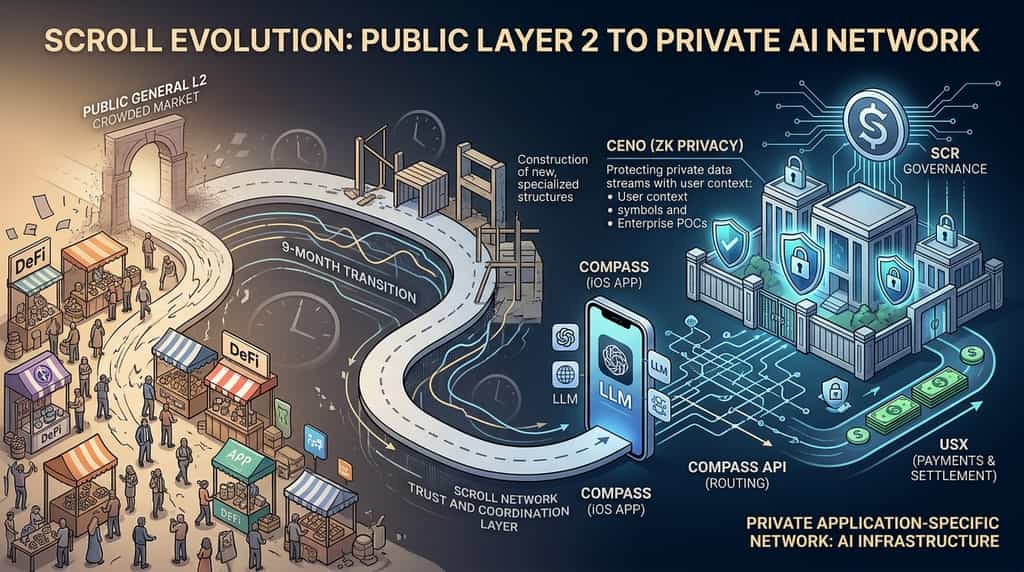
Can a general-purpose Ethereum Layer 2 still win by staying general? Scroll’s answer is no. According to a September 8, 2026 update on the official Scroll Governance Forum, the team plans to evolve Scroll from a public general-purpose network into a private, application-specific network built around Compass and a connected AI product stack, with the broader transition expected to take about nine months.
The plan is still an update, not a formal DAO vote. It already outlines the product stack: Compass, Compass API, CENO, USX, SCR, and the Scroll network as the trust and coordination layer. SCR is slated to move to Ethereum mainnet with unchanged supply and tokenomics, while remaining the governance token.
This article explains why Scroll is pivoting, what Compass actually is, how CENO and ZK proofs fit, what happens to SCR, and what traders should watch during the nine-month transition.
Why Is Scroll Leaving the General-Purpose L2 Model?
Scroll is leaving the general-purpose L2 model because the team no longer believes a public, everything-for-everyone chain is the best way to differentiate or support the products it is building.
According to the September 8, 2026 Scroll Governance Forum post, the team spent recent months applying AI across operations and product development. Work that previously required more than 20 engineers for core chain operations is now run by a smaller group of dedicated engineers supported by AI agents, while the team says it has maintained established uptime and security standards.
That internal experiment produced a product thesis, not just a cost-saving story. Different jobs need different models based on performance, privacy, reliability, and cost. Agents can automate a large share of work, but they should not have unrestricted control. Someone still has to define what an agent may do, what it may not do, and who can change those rules.
Blockchain can act as a trusted coordination layer for those rules. Zero-knowledge proofs can let agents interact with credentials, private data, and compute without exposing the underlying information. Scroll spent years building ZK infrastructure and operating a production network. The team now wants that stack to serve a narrower problem: secure, private infrastructure for AI agents.
The public L2 market is crowded. Remaining one more general-purpose execution environment does not give Scroll a durable edge. Specializing around Compass and agent workflows is the bet: fewer public DeFi use cases, more private coordination for models, credentials, payments, and compute.
The September forum post is explicit that details remain open. The exact operating model and detailed transition path still need work. The current expectation is a gradual change over nine months, followed by a separate DAO proposal when those details are ready.
What Is Compass and How Does the AI Product Stack Fit Together?
Compass is the consumer-facing entry point in Scroll’s AI stack: an iOS app designed to give users access to large language models and Compass API features, plus VPN and eSIM functionality.
According to the same official forum update, the pieces that once looked like separate projects are becoming one connected stack:
-
Compass is the iOS app for models and related features, including VPN and eSIM.
-
Compass API is AI routing infrastructure with access to 30+ LLM models.
-
CENO is the ZK trust layer for credentials, agent context, and privacy-preserving compute.
-
USX is intended to support payments and settlement across the stack.
-
SCR continues to coordinate governance and may support broader ecosystem participation.
-
Scroll Network is the trust and coordination layer so agent owners stay in control of rules and data.
The team’s one-line map is simple. Compass is where demand comes in. Compass API routes it. CENO protects the interaction. USX supports settlement. SCR coordinates governance. The network holds the rules and the trust.
The official Scroll website now presents the project as a gateway to frontier models, cheaper and secured by ZK tech. Compass is framed as “every model under one place.” Compass API is framed as keys to leading models secured with ZK proofs. The site also references AI hardware still being built, with a stated direction of running local agents and linking unlimited prompting to staking SCR.
That hardware line is early. The September forum post focuses on software products and network direction. Compass itself remains in early consumer validation. Compass API is still being built and oriented around that product direction. The stack is real as a roadmap, not finished as a fully shipped consumer business.
Distribution is part of the plan. According to the forum post, Scroll has been rebuilding content across Instagram, YouTube, TikTok, X, and LinkedIn. One Instagram page has grown to more than 17,000 followers, and the strongest posts have generated more than five million views. The next stated step is turning that reach into active users, repeat usage, and revenue.
What Does CENO Do, and Why Does Scroll Need a Private Network?
CENO is the privacy and trust layer that makes the private-network thesis concrete. It uses ZK technology to secure credentials, agent context, and privacy-preserving compute interactions.
According to the Scroll Governance Forum post dated September 8, 2026, CENO has reached more than 30 prospective customers, with 12 participating in proof-of-concept testing. That pipeline is early enterprise signal, not booked revenue. It is still the most concrete demand figure the team has published for the new stack.
The private-network plan follows from the agent problem. As agents become more capable, they will interact with credentials, proprietary data, payments, private workflows, and compute. Those interactions need more than cheap execution. They need rules, verification that rules were followed, and protection for sensitive information.
A public general-purpose chain is optimized for open composability. Anyone can deploy. Anyone can inspect state. That is useful for DeFi. It is less useful when an enterprise agent must prove it followed a policy without revealing the underlying files, keys, or customer data.
A private, application-specific network can restrict who writes state, who reads context, and which proofs are required before an action settles. Scroll’s argument is that ZK plus a coordination layer can keep owners in control while agents still act.
“Private” here does not automatically mean a fully closed, unaccountable system. The team still describes Scroll Network as the place rules and trust live, and SCR as the governance token. The operating model is unfinished. Readers should treat “private application-specific network” as a product direction, not a finished architecture diagram.
The nine-month horizon matters because existing public-chain users and apps will need a path. Community replies on the forum already asked for a clear exit or migration process for remaining users and apps, plus a precise explanation of what SCR holders can decide once the network is private.
What Happens to the SCR Token During the Transition?
SCR is planned to move to Ethereum mainnet so it can stay broadly accessible and liquid, with no change to supply or overall tokenomics, and with SCR continuing as the Scroll network’s governance token.
That is the current plan in the official September 8, 2026 forum update. The post is not a vote. A later proposal will cover decisions that need DAO approval.
Market context is useful for traders, not a valuation case. According to CoinMarketCap data available in September 2026, SCR’s circulating supply is 190 million, total and max supply are 1 billion, and live market-cap ranking sat in the roughly #1300–#1350 range depending on the snapshot, with a live price near $0.02 and a 24-hour volume in the multi-million-dollar range. CoinMarketCap also listed an all-time high of $1.45 on October 16, 2024 and an all-time low of $0.01837 on July 29, 2026.
According to CoinGecko chain and token pages in the same period, circulating supply is likewise 190 million SCR, total supply is 1 billion, and on-chain TVL for the Scroll chain has been in the low-to-mid single-digit millions of dollars on recent snapshots that rank the chain far below leading L2s. Those figures help explain why a product pivot is not happening from a position of dominant DeFi share.
L2BEAT’s Scroll TVS breakdown timestamped September 8, 2026 listed native SCR value around $4.09 million at a price near $0.02. That is a specialized-data snapshot of token value on the chain, not a full ecosystem health score. It does show how small native token value looks relative to the original L2 growth narrative.
The tokenomics message from the team is conservative: same supply, same overall design, same governance role, new home on Ethereum mainnet for access and liquidity. What is not yet specified is how governance rights bind a private application-specific network and the Compass stack. That gap is one of the main items a future DAO proposal will need to close.
Beyond the Headlines: What KuCoin 5.0 Means for You
Market news moves fast — but where you act on it matters just as much. This October, KuCoin launches KuCoin 5.0, transforming KuCoin into a rebuilt platform. Here's what actually changes for you:
-
One account for everything. Older platforms split your money across separate "spot," "margin," and "futures" accounts and expected you to understand why. KuCoin 5.0's unified account removes that entirely — deposit once, and everything is simply there.
-
Stocks, indices, and commodities. KuCoin 5.0 expands beyond crypto into global markets. When crypto chops sideways and equities rally (or the reverse), you rotate in minutes instead of opening a brokerage account and waiting days for fiat rails.
-
Real-world assets (RWA). Tokenized exposure to traditional assets like commodities, right inside your crypto account. One of the fastest-growing segments in global finance is no longer reserved for institutions — you access it from the same balance you trade with.
-
Earn while you learn. Not ready to trade? KCUSD lets your stablecoins earn daily, auto-compounding interest. The lowest-stress way to put your idle deposit to work for 4% yield.
-
An AI assistant in plain language. Ask questions, get market context, understand what you're looking at — built into the platform, no jargon required.
-
An app that doesn't overwhelm. Faster, cleaner, and consistent — intuitive from the first tap, not after a tutorial.
-
Safety you can check, not just trust. A MiCAR-licensed EU entity, Proof of Reserves you can verify yourself, and internationally certified security (SOC 2 Type II, ISO 27001:2022).
Create your account in minutes — and start on the platform built for where crypto is going, not where it's been.
Conclusion
Scroll is planning to stop competing as a general-purpose public L2 and instead build a private, application-specific network around Compass. According to the official Scroll Governance Forum update on September 8, 2026, the connected stack is Compass for user demand, Compass API for routing across 30+ models, CENO for ZK-secured credentials and private compute, USX for settlement, SCR for governance, and the Scroll network for rules and trust.
The transition is expected to take about nine months. The September post is an update, not a vote. SCR is planned to migrate to Ethereum mainnet with unchanged supply and tokenomics while remaining the governance token. CENO’s early pipeline — more than 30 prospective customers and 12 POCs — is the clearest demand signal published so far. Compass is still in early consumer validation.
Market data from CoinMarketCap, CoinGecko, and L2BEAT in September 2026 shows a small circulating token market and a modest on-chain footprint compared with leading L2s. That backdrop helps explain the specialization bet. It also means traders should treat announcements as high-volatility events, not as completed fundamentals.
The open work is operational: migration paths for remaining users, a binding governance design for a private network, and proof that Compass and CENO can convert attention and POCs into retained usage. Until the DAO proposal lands, the Compass pivot is a direction with a timeline — not a finished chain.
FAQs
Is the Scroll Compass network already live as a private chain?
No. The September 8, 2026 forum post describes a planned evolution over about nine months, with the exact operating model and transition path still to be defined.
Will SCR’s total supply change if it moves to Ethereum?
No, not under the current plan. According to the official forum update, supply and overall tokenomics stay the same, and SCR remains the governance token.
What is the difference between Compass and Compass API?
Compass is the iOS app for users, including model access plus VPN and eSIM features. Compass API is the routing infrastructure that provides access to 30+ LLM models.
Does CENO already have paying customers?
The team has not published paying-customer counts in the September update. It reported more than 30 prospective customers and 12 proof-of-concept tests.
Can DeFi apps stay on Scroll if the network becomes application-specific?
That is unresolved in official detail. The destination is a private network designed around the AI stack, and remaining public apps will need a published migration or exit path in a later proposal.
Disclaimer: This article is for informational purposes only and does not constitute financial, legal, or investment advice. Always conduct your own research before interacting with digital assets.