

Privacy Coins Surge to $33.6B Market Cap as ZEC Soars 2,496% : 2026’s Top Crypto Sector
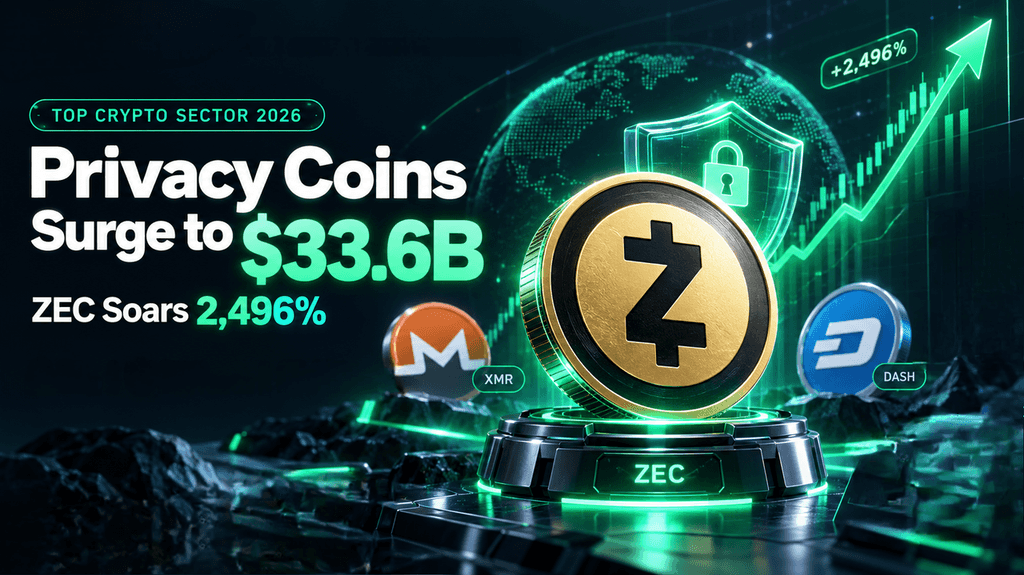
Privacy coins have emerged as one of the strongest cryptocurrency narratives of 2026, with the sector reaching approximately $33.6 billion in market capitalisation as Zcash (ZEC), Monero (XMR), Dash (DASH) and other privacy-focused assets outperformed much of the broader crypto market. Zcash has been the standout performer: Glassnode data showed ZEC gaining approximately 2,496% over the year ending in early September 2026, helping push privacy assets far above their levels when Bitcoin reached its October 2025 peak.
The rally has developed alongside several important changes in the Zcash ecosystem, including the launch of the ZCSH Zcash ETF, greater corporate exposure to ZEC and renewed interest in privacy-preserving blockchain technology. At the same time, sharp price gains, increased derivatives activity and regulatory pressure mean the privacy coin outlook is not without substantial risks. Understanding why ZEC has led the market, whether other privacy coins are participating and what could influence the next phase of the trend is increasingly important for crypto investors watching the sector.
Why Privacy Coins Surged to a $33.6B Market Cap as the Sector Outperformed Crypto in 2026
Privacy coins became one of the standout crypto market themes of 2026 as capital moved towards assets designed to provide greater transaction confidentiality. Glassnode's tracked privacy basket expanded rapidly over the preceding year, supported by Zcash's extraordinary performance and broader gains among established privacy cryptocurrencies. The trend stood out because much of the wider digital asset market remained below levels reached around Bitcoin's October 2025 peak.
Privacy Coin Market Cap Climbed to $33.6B as the Sector Beat the Broader Crypto Market
Glassnode data showed the market capitalisation of the tracked privacy sector increasing from approximately $7.1 billion to $33.6 billion over one year. Relative to October 6, 2025, when Bitcoin reached its market peak, privacy assets were about 213% higher, while Bitcoin itself remained around 36% below that reference point. Privacy also led the major crypto sectors over the previous 30 days with an increase of roughly 90%.
The divergence is notable because the wider crypto market was also recovering. Around 91.5% of the top 200 cryptocurrencies had risen during the latest 30-day period, yet relatively few assets remained above their October 2025 levels. Privacy coins therefore combined short-term market momentum with unusually strong longer-term relative performance, helping the sector stand apart from categories such as DeFi and gaming.
Zcash Led the Privacy Coin Rally as Broader Sector Demand Strengthened
Zcash had the largest impact on the sector, accounting for approximately 62% of the measured privacy coin market cap after ZEC gained about 2,496% over the previous year. The scale of that repricing is also visible through current ZEC price and market data, which tracks its valuation, circulating supply and trading activity. However, the broader sector's performance was not entirely dependent on Zcash. Glassnode's analysis indicated that excluding ZEC, the remaining privacy basket was still approximately 85% higher over the year, while Monero, Dash and Horizon also contributed to the wider trend.
Several developments helped privacy become a broader crypto theme rather than a single-token story:
-
Monero remained a major privacy asset, with Monero's privacy model providing a different approach from Zcash's optional shielded transaction architecture.
-
Stronger DASH and ZEN performance broadened participation beyond the sector's two largest names.
-
Greater public concern around financial data visibility and blockchain traceability continued to support interest in privacy-preserving technology.
-
Advances in zero-knowledge cryptography increased attention on privacy applications extending beyond simple anonymous payments.
-
Privacy's relative strength attracted momentum traders and investors looking at crypto sectors outperforming Bitcoin and traditional altcoin categories.
This broader participation matters because a sustainable sector trend is generally stronger when demand extends across multiple assets rather than depending exclusively on one rapidly appreciating token.
Why Zcash Soared 2,496% as the ZCSH ETF, Institutional Demand and Privacy Adoption Boosted ZEC
Zcash became the centre of the privacy coin resurgence after ZEC's approximately 2,496% one-year gain transformed its market position. The move cannot be explained by one catalyst alone. Easier access through a U.S.-listed investment vehicle, growing corporate ZEC holdings, reduced Zcash-specific regulatory uncertainty and renewed attention to shielded transactions all strengthened the investment narrative around the cryptocurrency.
ZCSH ETF Expanded Regulated Access to Zcash
One of the most significant developments was the conversion of the former Grayscale Zcash Trust into The Zcash ETF (ZCSH). SEC filings show that the trust changed its name on August 24, 2026, with its shares approved to trade on NYSE Arca under the ZCSH ticker. The fund's purpose is to hold ZEC, allowing investors to obtain Zcash exposure through an exchange-traded security rather than directly purchasing and storing the cryptocurrency.
The product quickly became a meaningful source of traditional-market exposure to ZEC. Grayscale's official figures showed approximately $463.2 million in assets and 444,608 ZEC in the fund as of September 4, with roughly 5.55 million shares outstanding. Rising ZEC prices can increase a fund's total asset value even without equivalent new inflows, so assets under management should not automatically be treated as a measure of fresh institutional buying. Even so, the ETF created another route for brokerage-based investors to obtain exposure to Zcash.
Corporate ZEC Holdings and Regulatory Clarity Strengthened Institutional Interest
Institutional interest was also developing outside the ETF market. Cypherpunk Technologies reported in August that its treasury holdings had increased to 323,394.38 ZEC, continuing a strategy centred on Zcash and privacy technology. Earlier SEC filings showed the company had accumulated 294,743.10 ZEC by March and described a longer-term objective of expanding its share of ZEC supply, subject to available capital and market conditions.
Another important development came when the Zcash Foundation announced in January 2026 that the U.S. Securities and Exchange Commission had concluded an investigation connected to a 2023 subpoena and did not intend to recommend enforcement action against the Foundation. That outcome did not remove the wider regulatory risks surrounding privacy coins, but it reduced one source of Zcash-specific uncertainty.
Together, several developments strengthened ZEC's institutional-market profile:
-
ETF access: ZCSH created an exchange-traded route to ZEC price exposure.
-
Corporate treasury demand: Cypherpunk built a substantial direct ZEC position as part of its privacy-focused strategy.
-
Capital-market infrastructure: custody and ETF creation and redemption mechanisms brought ZEC closer to traditional financial-market structures.
-
Lower Zcash-specific legal uncertainty: the SEC investigation's conclusion removed one outstanding regulatory issue surrounding the Zcash Foundation.
These developments do not prove that institutional demand caused the entire ZEC rally, but they provided investors with fundamental catalysts beyond short-term price momentum.
Zcash Privacy Adoption and Network Development Reinforced the ZEC Narrative
Zcash's technology remained another important component of the rally. The network's Zcash privacy architecture combines transparent and shielded transactions, allowing transaction information to be protected while the network can still verify that transactions are valid. A July network snapshot showed approximately 4.4 million ZEC, or 26.13% of chain supply, held in shielded pools. Importantly, shielded supply measures assets held within those pools and should not be interpreted as the same thing as daily private payment volume or the number of individual users.
At the centre of Zcash's privacy model are zk-SNARKs, a form of zero-knowledge cryptography that can verify information without publicly revealing the underlying transaction details. Development has also focused on making private transactions easier and faster to use, with improvements to wallet and proving technology reducing some of the computational friction historically associated with shielded transfers. These advances do not guarantee higher ZEC prices, but more practical privacy tools can strengthen the long-term utility case for a network whose core differentiator is confidential digital transactions.
Can the Privacy Coin Rally Continue? What ZEC, XMR, DASH, Regulation and Market Trends Signal Next
The privacy coin rally could continue if demand remains broad across ZEC, XMR and DASH, spot-market participation stays strong and privacy technology continues attracting users and capital. However, the sector now faces a more demanding setup after such substantial gains. Increased leverage, profit-taking and tighter regulations could create significant volatility, meaning continued performance is likely to depend increasingly on fundamentals rather than price momentum alone.
ZEC, XMR and DASH Strength Could Determine Whether the Privacy Rally Broadens
The next phase of the privacy coin trend may depend on whether capital continues spreading beyond Zcash. Recent market action has provided some evidence of broader participation, with ZEC and DASH recording strong gains during the wider crypto-market recovery while Monero has remained one of the largest privacy-focused cryptocurrencies. A continuation led simultaneously by ZEC, XMR and DASH would provide stronger evidence of sector-level demand, whereas weakening performance outside Zcash could suggest that the rally is becoming increasingly concentrated in a single asset.
Rising ZEC Leverage Could Increase Volatility After the Privacy Coin Surge
Derivatives activity is an important risk to monitor after ZEC's rapid appreciation. Recent trading periods have seen substantial futures open interest and liquidations as traders increased leveraged exposure around Zcash's breakout. Short liquidations can temporarily accelerate a rally because bearish positions are forced to close, but leverage works in both directions. If sentiment reverses, forced position closures can intensify declines, making spot trading activity and underlying demand increasingly important measures of whether momentum is sustainable.
Privacy Coin Regulation Remains a Major Long-Term Risk for ZEC, XMR and DASH
Regulatory policy remains one of the biggest uncertainties facing privacy-focused cryptocurrencies. The European Union's Regulation (EU) 2024/1624 specifically defines “anonymity-enhancing coins” as crypto assets with built-in features intended to make transfer information anonymous, either systematically or optionally. Article 79 places restrictions on regulated crypto-asset service providers regarding accounts that allow customer anonymisation or increased transaction obfuscation, including through anonymity-enhancing coins.
These rules do not amount to a universal ban on individuals owning privacy coins or using self-hosted wallets, but they illustrate how compliance requirements can affect exchange access, custody and liquidity. As the sector develops, the balance between growing demand for financial confidentiality and increasingly detailed regulatory requirements could become one of the most important factors influencing ZEC, XMR, DASH and the wider privacy coin market.
Conclusion
Privacy coins have become one of the most distinctive crypto market stories of 2026, with Glassnode's tracked sector expanding to approximately $33.6 billion while Zcash delivered a 2,496% one-year gain and established itself as the dominant asset within the category. Importantly, the rally has extended beyond ZEC, with Monero, Dash and other privacy-focused assets contributing to a broader resurgence in demand for financial confidentiality and privacy-preserving blockchain technology.
Zcash has also gained new structural catalysts through the ZCSH ETF, corporate ZEC holdings, reduced Zcash-specific regulatory uncertainty and continued development of shielded transactions. Those factors give the rally a deeper foundation than price momentum alone, but they do not eliminate risk. After such rapid gains, leverage, valuation, market concentration and regulatory restrictions could all influence what happens next. The key signal will be whether privacy coins can translate their 2026 market momentum into sustained network usage, deeper liquidity and broader adoption. If demand continues expanding across ZEC, XMR and DASH while privacy infrastructure improves, the sector could remain an important crypto narrative. If momentum becomes increasingly speculative or regulatory access narrows, however, the same concentration and leverage that helped accelerate the rally could also amplify a correction.
🔥 Beyond the Headlines: What KuCoin 5.0 Means for You
Market news moves fast — but where you act on it matters just as much. This October, KuCoin launches KuCoin 5.0, transforming KuCoin into a rebuilt platform. Here's what actually changes for you:
-
One account for everything. Older platforms split your money across separate "spot," "margin," and "futures" accounts and expected you to understand why. KuCoin 5.0's unified account removes that entirely — deposit once, and everything is simply there.
-
Stocks, indices, and commodities. KuCoin 5.0 expands beyond crypto into global markets. When crypto chops sideways and equities rally (or the reverse), you rotate in minutes instead of opening a brokerage account and waiting days for fiat rails.
-
Real-world assets (RWA). Tokenized exposure to traditional assets like commodities, right inside your crypto account. One of the fastest-growing segments in global finance is no longer reserved for institutions — you access it from the same balance you trade with.
-
Earn while you learn. Not ready to trade? KCUSD lets your stablecoins earn daily, auto-compounding interest. The lowest-stress way to put your idle deposit to work for 4% yield.
-
An AI assistant in plain language. Ask questions, get market context, understand what you're looking at — built into the platform, no jargon required.
-
An app that doesn't overwhelm. Faster, cleaner, and consistent — intuitive from the first tap, not after a tutorial.
-
Safety you can check, not just trust. A MiCAR-licensed EU entity, Proof of Reserves you can verify yourself, and internationally certified security (SOC 2 Type II, ISO 27001:2022).
Create your account in minutes — and start on the platform built for where crypto is going, not where it's been.
FAQs
What are privacy coins and how are they different from Bitcoin?
Privacy coins are cryptocurrencies designed to reduce the amount of transaction information exposed on a public blockchain. Bitcoin transactions are pseudonymous but remain publicly traceable, whereas privacy-focused networks use cryptographic techniques to conceal some transaction details. Zcash offers shielded transactions, while Monero uses privacy protections such as ring signatures, stealth addresses and RingCT to protect information about senders, recipients and transaction amounts.
How is Zcash different from Monero for transaction privacy?
Zcash and Monero take different approaches to financial privacy. Zcash supports both transparent and shielded transaction mechanisms, allowing users and wallets to select privacy-preserving transaction paths. Monero, by contrast, applies privacy protections to transactions by default. Monero combines ring signatures, stealth addresses and RingCT, while Zcash relies heavily on zero-knowledge cryptography for its shielded transaction system.
What should investors check before buying ZEC, XMR or DASH after a major rally?
Investors should consider more than recent price performance when analysing ZEC, XMR or DASH. Useful indicators include spot trading volume, liquidity, derivatives open interest, exchange availability, network activity, developer progress and regulatory developments. It is also worth assessing whether gains are being supported by spot-market demand or increasingly driven by leveraged positions. Strong historical performance does not guarantee future returns.
Can privacy coin regulation affect where ZEC, XMR and DASH can be traded?
Yes. Regulation can influence whether exchanges, brokers and other regulated crypto service providers support privacy-focused cryptocurrencies. Requirements vary by jurisdiction, and restrictions targeting anonymity-enhancing assets may affect listings, custody, transfers or liquidity without necessarily preventing the underlying blockchain from operating. Users should check the laws and platform availability applicable to their own jurisdiction.
Disclaimer
The information provided on this page may originate from third-party sources and does not necessarily represent the views or opinions of KuCoin. This content is intended solely for general informational purposes and should not be considered financial, investment, or professional advice. KuCoin does not guarantee the accuracy, completeness, or reliability of the information, and is not responsible for any errors, omissions, or outcomes resulting from its use. Investing in digital assets carries inherent risks. Please carefully evaluate your risk tolerance and financial situation before making any investment decisions. For further details, please consult KuCoin’s Terms of Use and Risk Disclosure.