

Kucoin vs Coinbase: Which One is Better?
Key Takeaways
-
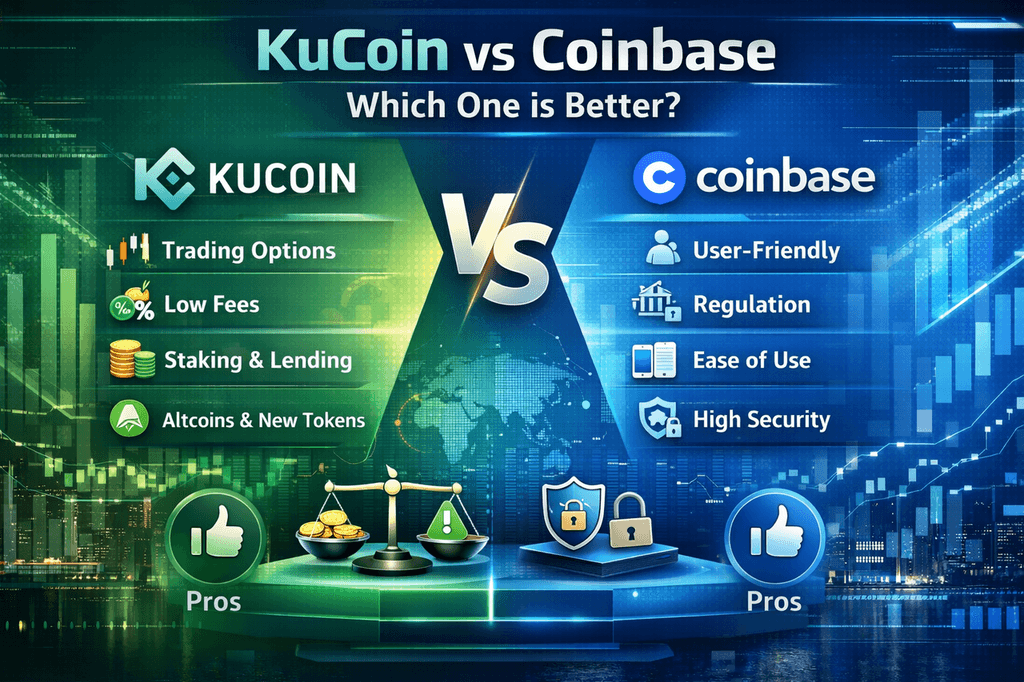
Target Audience: Coinbase is the premier choice for beginners and US-based investors seeking a regulated environment. KuCoin is built for advanced global traders hunting for high-growth altcoins and low-cap gems.
-
Cost Efficiency: KuCoin offers significantly lower trading fees (starting at 0.1% or less), whereas Coinbase is notably more expensive, especially on its "Simple Trade" interface.
-
Asset Variety: KuCoin leads with over 700+ supported cryptocurrencies and advanced instruments like trading bots and futures. Coinbase maintains a curated list of approximately 250+ highly vetted assets.
-
Security & Regulation: Coinbase is a publicly-traded, US-regulated entity with robust insurance and compliance. KuCoin operates internationally with a focus on Proof of Reserves and high-tech encryption but lacks a US license.
-
User Experience: Coinbase wins on simplicity and "one-click" functionality. KuCoin provides a feature-rich, data-heavy dashboard that may have a steeper learning curve for novices.
-
Passive Income: Both offer staking, but KuCoin typically provides a wider array of high-yield lending and "Earn" products, while Coinbase focuses on a safer, albeit lower-yield, staking experience.
In the rapidly evolving world of digital assets, choosing the right infrastructure for your investments is as critical as the assets themselves. For most traders, the debate often boils down to two titans of the industry: Kucoin vs Coinbase.
While both platforms serve as gateways to the blockchain, they cater to fundamentally different philosophies. Coinbase has built its empire on regulatory compliance and simplicity, becoming the "gold standard" for Western retail investors. Kucoin, conversely, is known as the "People’s Exchange," offering a massive treasury of altcoins and advanced trading tools that appeal to those looking for the next 100x moonshot.
Kucoin Introduction
Launched in 2017 and headquartered in Seychelles, Kucoin has rapidly grown into one of the largest cryptocurrency exchanges by trading volume. Its primary claim to fame is its "altcoin hunter" reputation. While most exchanges list only the most established projects, Kucoin is often the first major platform to support emerging tokens, giving traders early access to high-potential projects.
Kucoin operates on a global scale, supporting over 700 cryptocurrencies and providing a comprehensive suite of services, including spot trading, margin trading, futures, and a dedicated "Earn" section for passive income. It is a feature-rich ecosystem designed for those who want to do more than just "HODL." However, it is important to note that Kucoin does not hold a license to operate in the United States, which has significant implications for American users.
Coinbase Introduction
Founded in 2012 in San Francisco, Coinbase is the most recognizable name in the crypto industry. It is a publicly-traded company (NASDAQ: COIN) and is widely regarded as the most regulated and secure exchange in the world. For many, Coinbase was the first app they ever used to buy Bitcoin.
The platform is designed with a "user-first" mentality, stripping away the complexity of order books and technical charts to provide a clean, intuitive interface. Coinbase is divided into two primary experiences: the standard "Coinbase" app for beginners and "Coinbase Advanced" (formerly Coinbase Pro) for more experienced traders. Because it follows strict US regulatory guidelines, it offers a high level of consumer protection, though this comes at the cost of a smaller asset selection compared to international competitors.
Kucoin vs Coinbase: Trading Fees, Transaction Costs, and Charges Compared
When evaluating Kucoin vs Coinbase, the fee structure is often the deciding factor for high-volume traders. There is a stark contrast between these two platforms regarding how they monetize their services.
Kucoin’s Fee Model:
Kucoin is widely considered one of the most affordable exchanges in the market. It utilizes a tiered Maker/Taker fee structure.
-
Spot Trading: Starts at a low 0.1% for both makers and takers.
-
Discounts: If you hold the native Kucoin Token (KCS), you can pay your fees in KCS to receive a 20% discount.
-
Futures: The fees are even lower, starting around 0.02% for makers and 0.06% for takers.
Coinbase’s Fee Model:
Coinbase has historically been criticized for its high and sometimes opaque fee structure, especially on its standard "Simple Trade" interface.
-
Simple Trade: Fees can range from 0.5% to as high as 3.99% depending on the payment method (credit cards being the most expensive).
-
Coinbase Advanced: To compete with Kucoin, Coinbase launched "Advanced Trade," which uses a tiered maker/taker model starting at approximately 0.40% maker and 0.60% taker for the lowest volume tier.
-
Staking Fees: Coinbase takes a significant commission (up to 25%) on rewards earned through their staking services.
The Verdict: If you are sensitive to costs, Kucoin wins by a landslide. However, for many retail users, the "convenience fee" of Coinbase is a price they are willing to pay for peace of mind.
Kucoin vs Coinbase: Key Features, Perks, and Account Benefits
Beyond basic buying and selling, both platforms offer "sticky" features designed to keep users within their ecosystem.
Kucoin Perks:
-
Trading Bots: Kucoin offers free, built-in trading bots (Grid, DCA, Rebalancing) that allow users to automate their strategies without paying for third-party software.
-
Kucoin Earn: A massive array of lending, staking, and "BurningDrop" opportunities where users can lock up tokens to earn high APYs on new projects.
-
Spotlight: A launchpad for new tokens, allowing KCS holders to participate in Initial Exchange Offerings (IEOs).
Coinbase Perks:
-
Coinbase Learning: A unique feature where users can watch short educational videos about new tokens and earn small amounts of that crypto (usually $3–$10) for free.
-
Coinbase Card: A Visa debit card that allows users to spend their crypto or USD balance at any retailer while earning crypto rewards back.
-
Institutional Services: Coinbase provides the most robust "Prime" services for hedge funds and corporations, which adds to the platform's overall liquidity and stability.
Kucoin vs Coinbase: Ease of Use and User-Friendliness
In the Kucoin vs Coinbase debate, "Ease of Use" is where Coinbase shines the brightest.
Coinbase Experience:
The onboarding process for Coinbase is similar to opening a traditional bank account. The interface is minimalist, using clear language and "Buy/Sell" buttons. It hides the complexity of "Limit Orders" and "Slippage" from the average user. For someone who just wants to buy $100 of Bitcoin and forget about it, Coinbase is the perfect tool.
Kucoin Experience:
Kucoin’s interface can be overwhelming for a novice. The screen is often filled with scrolling tickers, flashing "Hot" tokens, and complex charts. Because it offers so many products (Futures, Margin, Bots, Lending), it takes time to learn where everything is. However, for a professional trader, this "clutter" is actually valuable data.
Kucoin vs Coinbase: Customer Support and Help Options
Customer service remains a pain point for the entire crypto industry, but there are differences in how these two handle issues.
-
Coinbase: Has made massive strides in recent years. They now offer 24/7 live phone support and chat for users in certain jurisdictions. Their help center is incredibly detailed, covering everything from tax reporting to account recovery.
-
Kucoin: Primarily relies on a ticket-based system and a 24/7 live chat bot. While they have a large community on Telegram and Reddit where moderators help users, the lack of a direct phone line can be frustrating during a "black swan" market event when users are locked out of their accounts.
Kucoin vs Coinbase: Security Features and Safety Comparison
Security is the non-negotiable pillar of any crypto exchange.
Coinbase Security:
-
Regulation: As a US-based, publicly-traded company, Coinbase undergoes regular audits and maintains transparent financial records.
-
Insurance: Coinbase carries crime insurance that protects a portion of digital assets held in their systems against losses from theft, including cybersecurity breaches. (Note: This does not cover individual account hacks due to weak user passwords).
-
Cold Storage: 98% of customer funds are stored offline in geographically distributed cold vaults.
Kucoin Security:
-
History: Kucoin suffered a major hack in 2020 where over $280 million was stolen. However, the exchange handled it professionally, recovering most funds and using their insurance fund to reimburse users completely.
-
Proof of Reserves: Following the collapse of FTX, Kucoin was one of the first to implement a Merkle Tree Proof of Reserves system, allowing users to verify that their funds are actually backed 1:1 on the exchange.
-
Encryption: They use industry-standard encryption and multi-factor authentication (MFA).
Pros and cons of Kucoin
Pros:
-
Asset Selection: Access to over 700 tokens, many of which aren't available anywhere else.
-
Low Fees: Some of the most competitive rates in the industry.
-
No Mandatory KYC (for some features): Though this is changing due to global regulations, Kucoin remains more accessible to the global unbanked population.
-
Advanced Tools: Free trading bots and high-leverage futures.
Cons:
-
Regulatory Risk: Not licensed in the US; users in certain regions may face sudden account restrictions.
-
Complex UI: Steep learning curve for beginners.
-
Limited Fiat On-ramps: While you can buy crypto with fiat, the options and fees are not as seamless as Coinbase.
Pros and cons of Coinbase
Pros:
-
High Trust: Regulated, audited, and publicly traded in the USA.
-
Beginner Friendly: The most intuitive app on the market.
-
Fiat Integration: Easy links to US bank accounts (ACH) and instant withdrawals.
-
Free Crypto: Earn money just by learning about blockchain.
Cons:
-
High Fees: Standard trades are significantly more expensive than competitors.
-
Strict Listing Policy: You won't find small-cap "hidden gems" here until they are already established.
-
Centralization: Strong adherence to government requests, which may bother "privacy maximalists."
Kucoin vs Coinbase: which one is better for you?
The winner of the Kucoin vs Coinbase battle depends entirely on your profile as a trader.
-
Choose Coinbase if: You live in the US, you value security and regulation above all else, and you prefer a simple interface for long-term investing. It is the best "set and forget" platform.
-
Choose Kucoin if: You are an active trader, you want to explore the world of altcoins, you want to use automated trading bots, and you are looking for the lowest possible fees.
Conclusion
In the kucoin vs coinbase matchup, there is no "wrong" choice—only a choice that fits your specific needs. Coinbase provides the safety and simplicity required for the masses, while Kucoin provides the power and variety required for the crypto enthusiast. As your crypto journey evolves, you may find that having an account on both is the ultimate strategy.
Join 30 million global users on the world’s leading crypto exchange by signing up for your free account now. Register Now!
FAQs
-
Is Kucoin legal in the US?
Kucoin is not licensed as a Money Services Business in the US. While some US users previously used the platform without KYC, Kucoin has recently moved toward mandatory KYC, making it difficult for US residents to use the platform legally.
-
Which exchange is safer?
Coinbase is generally considered safer due to its regulatory status as a US public company and its insurance policies. However, Kucoin has proven its resilience by fully reimbursing users after its 2020 hack.
-
Can I transfer crypto between Kucoin and Coinbase?
Yes. You can easily send supported assets between the two by copying the wallet address from the receiving exchange and pasting it into the "Withdraw" section of the sending exchange. Always ensure you are using the correct network (e.g., ERC-20 vs. BEP-20).
-
Does Coinbase or Kucoin have better staking?
Kucoin generally offers higher APYs and a wider variety of "soft staking" options. Coinbase staking is easier to use but takes a much larger "commission" from your earnings.
-
Which is better for beginners?
Coinbase is the undisputed winner for beginners. Its "Learning" rewards and simple interface make the transition into crypto much less intimidating.
Disclaimer: The information on this page may have been obtained from third parties and does not necessarily reflect the views or opinions of KuCoin. This content is provided for general informational purposes only, without any representation or warranty of any kind, nor shall it be construed as financial or investment advice. KuCoin shall not be liable for any errors or omissions, or for any outcomes resulting from the use of this information. Investments in digital assets can be risky. Please carefully evaluate the risks of a product and your risk tolerance based on your own financial circumstances. For more information, please refer to our Terms of Use and Risk Disclosure.