

KuCoin Ventures Weekly Report: Miners Pivot to AI and Rate Structures Emerge, While Crypto Market Stabilization Remains Pending
1. Weekly Market Highlights
Crypto Infrastructure Strengthens Predictable Revenue and Rate Structures: Miners Accelerate AI/HPC Expansion as Aave Moves into Fixed-Rate Lending
Last week, two areas of crypto-native infrastructure saw notable business shifts. On one side, Bitcoin miners continued accelerating their transition toward AI and High-Performance Computing (HPC) data centers, with some companies seeing their revenue mix shift from mining toward long-term compute and data center contracts. On the other, Aave Labs acquired fixed-rate lending team Avon, further incorporating fixed-rate products and maturity structures into its on-chain lending ecosystem. Against a backdrop of relatively weak crypto-native market conditions and pressure on on-chain yield opportunities, these developments suggest that some industry participants are exploring more stable revenue sources and more predictable funding costs, although the underlying drivers and stages of development differ significantly across the two sectors.
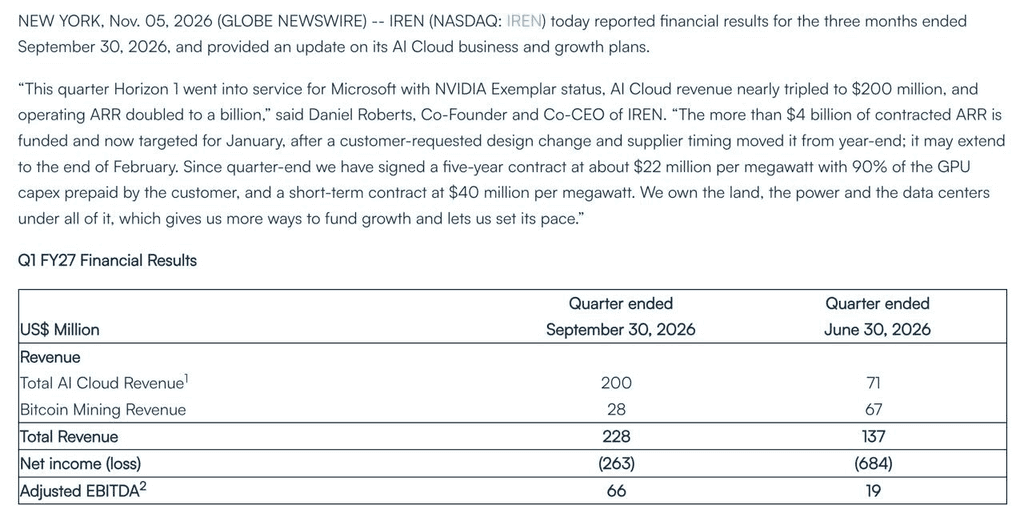
The shift on the mining side is already becoming visible in financial results. IREN, a Nasdaq-listed company that originated as a Bitcoin miner and now controls more than 5GW of secured power capacity, reported its FY2027 first-quarter results on November 5. AI Cloud revenue increased 182% quarter over quarter to $200 million, while Bitcoin Mining revenue declined from $67 million in the previous quarter to $28 million. The company’s AI Cloud annualized revenue target of more than $4 billion is now covered by contracted commitments, while it continues to expand its land, power, and data center resources. Power and data center capacity that was historically used primarily for Bitcoin mining is increasingly being allocated to AI compute businesses with stronger demand and longer contract durations.
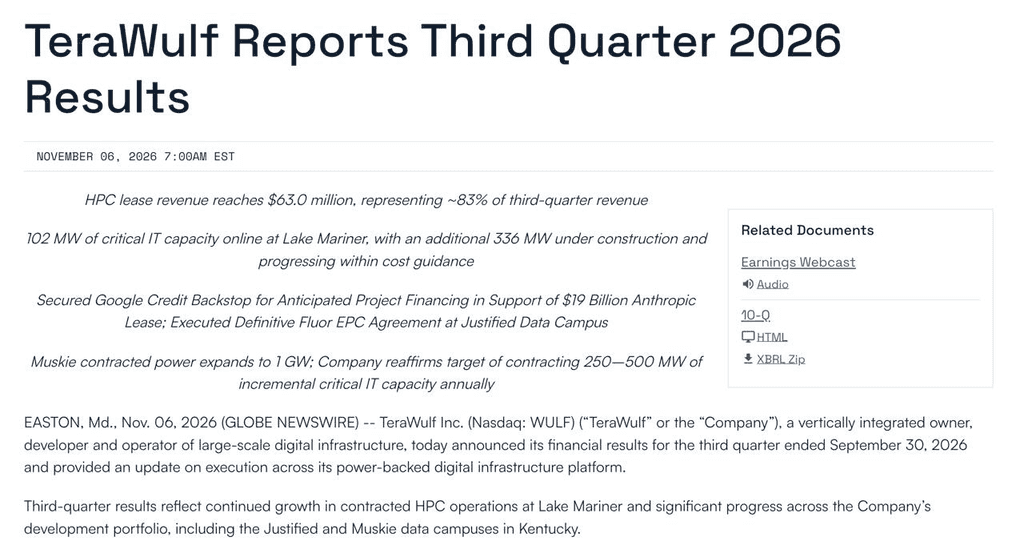
TeraWulf, another representative U.S.-listed Bitcoin miner, has shown a similar shift. At the end of 2025, the company still operated approximately 9.3 EH/s of proprietary Bitcoin mining capacity, equivalent to roughly 0.9% of the global network hashrate at the time. By the third quarter of this year, however, HPC lease revenue had reached $63 million, accounting for approximately 83% of total revenue, while digital asset mining revenue declined to around $13.2 million. The company also signed a roughly 401MW data center lease agreement with Anthropic, with an initial 20-year term and approximately $19 billion in contracted revenue. TeraWulf has explicitly positioned HPC data center development and long-term leasing as a core business direction.
Source: https://iren.gcs-web.com/news-releases/news-release-details/iren-reports-q1-fy27-results
https://investors.terawulf.com/news-events/press-releases/detail/149/terawulf-reports-third-quarter-2026-results
This does not mean that AI businesses are broadly replacing Bitcoin mining. However, for some listed miners with large-scale access to power, land, and data center infrastructure, AI/HPC provides an alternative way to monetize those assets. Compared with mining revenue, which is jointly affected by Bitcoin prices, network hashrate, and electricity costs, long-term data center leases can improve visibility into future revenue. As a result, the factors shaping miner valuations are beginning to extend beyond Bitcoin hashrate and price exposure toward power resources, data center development capabilities, and long-term customer contracts. Reuters has also previously described the shift of companies such as IREN and TeraWulf toward AI infrastructure as part of a broader repricing of U.S. data center power resources.
On the on-chain lending side, there are also further efforts to improve the predictability of funding costs. On November 6, Aave Labs announced the acquisition of Avon’s team and technology, including fixed-rate and floating-rate lending protocols as well as an on-chain order book, and identified fixed-rate lending as one of its future expansion areas. Aave currently has more than $33 billion in deposits and $13 billion in active loans, but like most DeFi lending protocols, its core markets have historically relied primarily on floating rates that adjust dynamically based on capital utilization.
Fixed-rate lending and yield trading are not new areas in DeFi. Protocols such as Notional and Term Finance previously experimented with fixed-term, fixed-rate loans, while Pendle allows users to lock in or trade future yields by separating principal from future yield rights. Pendle itself has already reached meaningful scale: as of November 6, Pendle V2 had approximately $965 million in TVL, with cumulative trading volume of around $94.6 billion, indicating that on-chain yield trading has already achieved relatively broad adoption. However, Pendle is fundamentally closer to a yield-trading market and does not directly represent the scale of fixed-rate lending.
By comparison, fixed-rate, fixed-term lending remains significantly smaller than mainstream floating-rate lending markets, although product design and distribution channels are gradually expanding. Morpho launched its fixed-rate, fixed-term protocol Midnight in July and integrated it with Coinbase in September, allowing users to borrow USDC against BTC collateral at predetermined rates and maturities. By comparison, Coinbase’s existing Morpho-powered floating-rate lending product had more than $1.4 billion in active loans at the time. Morpho has also recently announced plans to connect approximately $5 billion in Morpho Vaults to Midnight, allowing existing liquidity pools to allocate capital into fixed-rate markets in the future.
At the same time, Pendle has expanded beyond traditional yield stripping into direct interest-rate trading. Its Boros platform allows users to trade the difference between perpetual futures funding rates and fixed rates, and this year further introduced funding-rate spread markets across trading venues. However, as of early November, Boros had approximately $7.8 million in locked collateral, remaining at a relatively early stage compared with Pendle V2 itself. This suggests that while yield products have already achieved some scale, more complex on-chain interest-rate derivatives and fixed-rate credit markets are still in the process of building stable demand and liquidity.
Aave’s acquisition of Avon is therefore better understood as a leading lending protocol continuing to add fixed-rate and maturity-management capabilities, rather than the re-emergence of a new fixed-rate narrative. Pendle has demonstrated that on-chain yield trading can achieve meaningful scale, while Morpho Midnight has begun bringing fixed-rate lending into major distribution channels such as Coinbase. Aave’s move to add similar capabilities suggests that fixed-rate products are gradually moving from relatively standalone niche protocols into the product stacks of mainstream lending platforms. Whether they can ultimately develop liquidity and user demand comparable to floating-rate lending, however, remains to be seen.
Mining and DeFi lending have no direct business connection, but both have recently shown a similar direction worth monitoring: in an environment of elevated market volatility and relatively limited crypto-native yield opportunities, more predictable revenue and rate structures are receiving greater attention. For some miners, this takes the form of converting power and data center resources into long-term AI/HPC contracts; for DeFi lending, it involves adding fixed-term and fixed-cost financing tools alongside floating-rate products. Going forward, the key question is how large these models can become and whether they can materially improve revenue stability, capital efficiency, and real user demand.
2. Weekly Selected Market Signals
Key Supports Broken, Capital Outflows Persist: Crypto Market Stabilization Still Awaits Confirmation
This week, volatility in the U.S. equity market intensified, with technology stocks serving as the primary direction of the correction. On November 5, the S&P 500 index fell by approximately 4.4%, while the Nasdaq 100 index declined by about 6.4%. Discussions surrounding AI infrastructure have further shifted from the scale of investment and demand growth toward financing arrangements, construction progress, and cash returns. For companies that made substantial early-stage investments and rely on external financing for expansion, whether project deliveries can actually be fulfilled has become an important factor in the market’s revaluation of these companies.
Uncertainty related to data center construction was one of the key focuses this week. Texas’s newly elected governor, Gina Hinojosa, publicly proposed during her campaign to pause data center construction and wait for legislation to improve mechanisms for community participation as well as guarantees for water and electricity resources. This could lead to significant changes in the state’s data center policies and has triggered market concerns along with a certain degree of panic.
For investors, what merits closer attention is the linkage between construction progress and financing arrangements. Taking the recently controversial company CoreWeave’s disclosed second-quarter financial data as an example, the company reported quarterly revenue of $2.575 billion, with net interest expenses reaching $640 million—approximately one-quarter of revenue. As of the end of June, the revenue backlog stood at about $104 billion, but realization of this backlog still depends on conditions such as delivery and service availability. The substantial order backlog provides demand support, yet it also imposes requirements on infrastructure delivery and capital arrangements.
At present, the valuation divergence among AI-related assets may depend more on whether companies can convert orders into revenue and cash flow. If construction is delayed and financing costs rise, the cash recovery cycle could lengthen further; conversely, the securing of financing and on-schedule delivery can help alleviate market doubts. For the crypto market, such adjustments primarily affect investor sentiment and risk appetite, while also extending to the valuation benchmarks of AI-related narratives.
Source: CME FedWatchTool
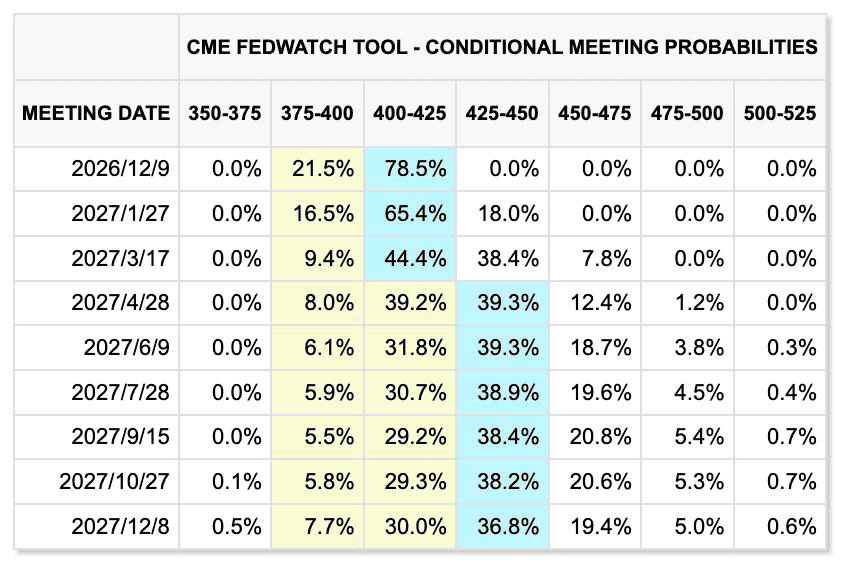
The Federal Reserve currently maintains the federal funds rate target range at 3.75%–4.00%. According to the provided CME FedWatch screenshot, the market’s implied probability of a 25-basis-point rate hike at the December 9 meeting (raising the range to 4.00%–4.25%) stands at 78.5%, while the probability of holding rates unchanged is 21.5%. A rate hike remains the primary scenario priced into futures markets, and near-term monetary policy expectations have not yet shifted toward easing. This expectation also extends into next year, with markets still assigning a significant probability to further rate increases from current levels; a decline in financing costs has not yet become a dominant expectation.
For the crypto market, the current funding environment still lacks consistent support. Although the rebound in bank reserves has provided some buffer, rate-hike expectations, net outflows from spot ETFs, and the contraction in stablecoin supply continue to constrain risk appetite and fresh buying. This week’s CPI and PPI data warrant close attention: if inflation comes in below expectations, rate-hike pricing may ease somewhat; if price pressures persist, elevated funding costs could continue to weigh on the valuation recovery of technology stocks and crypto assets.
Crypto Assets and ETFs: Mainstream Assets Close Lower, Market Performance Remains Divergent
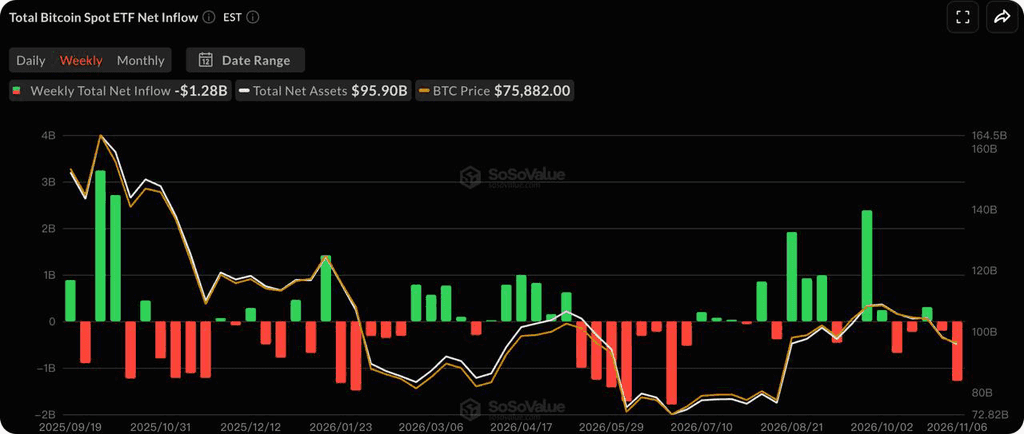
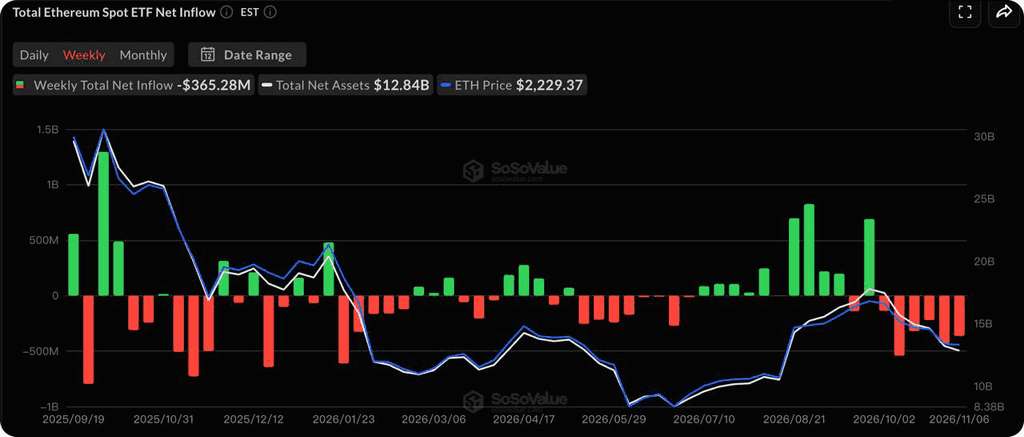
BTC’s weekend price was approximately $75,966, down 2.43% on the week; ETH was around $2,239, down 1.09% on the week. From the performance of major assets, the market as a whole remains under pressure, though the extent of the declines has not been uniform. ETH showed relative resilience this week, while some other major coins posted larger losses, and a broad-based recovery has yet to emerge. Going forward, it will be important to watch whether price stabilization is accompanied by a recovery in spot demand and whether any rebound can broaden to a wider range of assets.
Source: SoSoValue
According to SoSoValue data, ETF fund flows have also failed to provide sustained support for a rebound. This week, U.S. spot Bitcoin ETFs recorded net outflows of approximately $1.282 billion, about 6.3 times the previous week’s figure. The brief net inflows on Wednesday failed to continue; Thursday and Friday together saw net outflows of roughly $842 million, accounting for nearly two-thirds of the full week’s total. This means that even as prices moved sideways on Friday, large-scale redemptions were still occurring through the ETF channel, with no signs yet of sustained rebalancing or inflows.
U.S. spot Ethereum ETFs have now posted six consecutive weeks of net outflows, totaling about $2.018 billion. This week’s net outflows were approximately $365 million—down roughly 15% from the prior week, but still higher than the $221 million recorded two weeks ago—and have not yet established a trend of sustained narrowing. The simultaneous breach of key price levels and continued redemptions continues to pressure ETH’s recovery prospects.
The altcoin market has been even more subdued. Excluding BTC and stablecoins, total market capitalization has fallen by about $200 billion from its previous local high, retracing nearly two-thirds of the gains recorded from mid-August through the end of September. Over the past several weeks, the price trend for altcoins has deteriorated; while a few individual tokens have risen against the broader market, the majority remain in adjustment.
Stablecoins: Total Supply Continues to Contract, Incremental Funding Support Remains Weak
Source: DeFiLlama
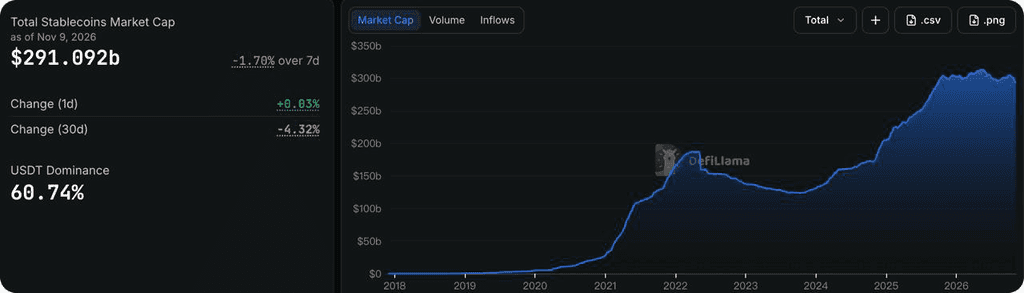
DeFiLlama data shows that as of November 9, the total market capitalization of stablecoins stood at approximately $291.092 billion, down 1.70% over the past seven days (an estimated reduction of about $5.03 billion). Over the past 30 days, the total has declined by a cumulative 4.32%, remaining in a state of contraction for nearly a month.
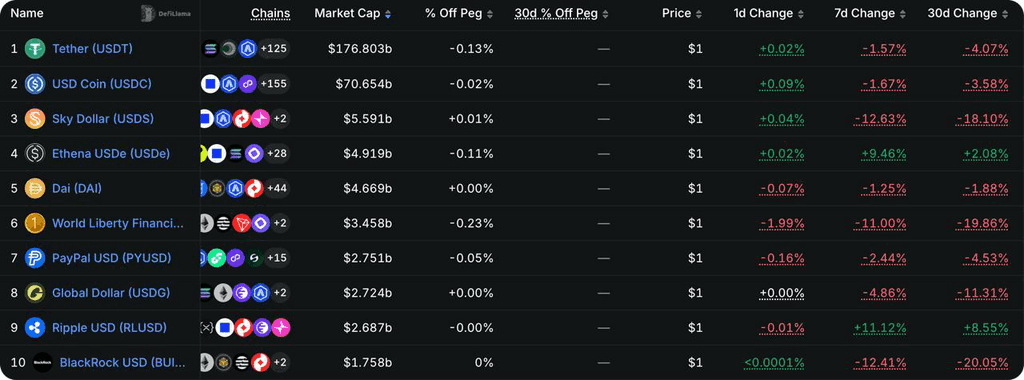
Overall performance among stablecoins has been mixed: USDS fell 12.63% over the past seven days, while USDe rose 9.46%. However, the circulating supply of major stablecoins as a whole is declining. Combined with this week’s ETF net outflows, both the stablecoin stock and the ETF subscription/redemption channels indicate that funding support for the crypto market remains weak. Going forward, key points to watch will be whether USDT and USDC can resume sustained expansion and whether the overall stablecoin market capitalization can stabilize and rebound.
Key Events to Watch This Week:
Market focus this week centers on U.S. inflation data and earnings releases from AI infrastructure companies. Against a backdrop dominated by rate-hike expectations and lingering concerns over tech-sector financing, CPI and PPI readings will influence subsequent rate pricing, while the earnings reports of cloud providers CoreWeave and Nebius will help assess companies’ financing and delivery capabilities.
-
November 10 : U.S. October CPI release. Focus on month-over-month changes in core inflation and the impact of energy prices on headline inflation, and observe whether the data can temper market expectations for a December rate hike.
-
November 11 : CoreWeave earnings call. Key areas of interest include financing arrangements, interest burden, capital expenditure, data-center delivery progress, and the conversion of backlog orders into revenue.
-
November 12 : Nebius earnings call. Watch for new order intake, cash reserves, and construction plans, particularly whether funding required for expansion has been secured and whether projects are advancing on schedule.
-
November 13: U.S. October PPI release. Combined with CPI, assess whether price pressures are easing and monitor the implications of relevant components for subsequent PCE inflation expectations.
Overall, two main themes warrant close tracking this week: first, whether inflation data can cool rate-hike expectations; and second, whether AI companies can alleviate market concerns through clear financing and delivery arrangements. For the crypto market, it will also be important to observe whether these developments are accompanied by ETF inflows. A sustained recovery is more likely when improved macro expectations are reinforced by a resumption of spot buying.
Primary Market Funding Observation:
Source: RootData
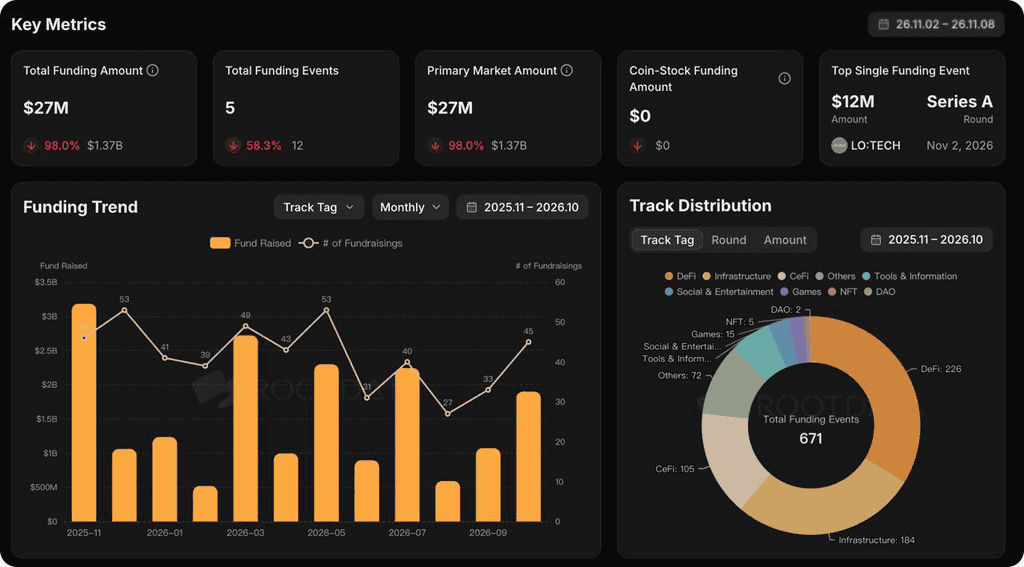
According to RootData, from November 2 to 8, five disclosed funding rounds totaled approximately $27 million, a decline of about 98% from the prior week’s roughly $1.37 billion. The list also includes additional funding and M&A events with undisclosed amounts. The largest single disclosed round this week was market maker LO:TECH’s $12 million Series A, which together with Takenos’s $7 million round accounted for about 70% of the total disclosed amount.
Takenos: Connecting Regional Cross-Border Payments and Local Payments with Stablecoins
This week, Latin American fintech platform Takenos announced the completion of a $7 million seed-extension round led by North Island Ventures and Road Capital Management, bringing its total funding to $12 million. Founded in 2022, the company has disclosed that it currently operates in six Latin American markets, including Argentina and Bolivia, and processes more than $5 billion in annual transaction volume. The new capital will be used to expand local payment rails, grow its enterprise API business, and strengthen the team. Takenos plans to expand its service coverage to more than 15 countries by 2027.
Takenos’s products cover personal digital dollar accounts, card payments, corporate cross-border collections and payments, as well as enterprise-oriented payroll and treasury management interfaces. Its business accounts support collections and payments via ACH, Wire, SWIFT, and local-currency channels, allowing users to manage overseas customer receipts, supplier payments, and cross-border team expenses on a single platform. The combination of stablecoin settlement with local payment and collection channels is a key source of product value: after a cross-border transfer is completed, funds still need to be exchangeable, withdrawable, and usable for spending in order to become truly embedded in the daily operations of businesses and individuals.
From a business-development perspective, Takenos is attempting to apply the same payment infrastructure across individual users, SMEs, and large enterprises. Use cases such as corporate payroll and supplier settlements involve recurring demand; if the company can continue to reduce settlement times and overall costs, it should help generate relatively stable transaction volume. The key to its expansion lies in replicating this service capability: whether new countries can attract consistently active customers, whether the enterprise API can contribute meaningful revenue, and whether growth in transaction scale can translate into improved gross margins.
Embedding on-chain technology into existing financial activities and competing for customers on the basis of execution quality, settlement speed, and service cost is a common characteristic of companies currently raising capital. For the primary market, the focus after a new funding round remains whether an expanded product footprint can be converted into sustainable business growth.
About KuCoin Ventures
KuCoin Ventures, is the leading investment arm of KuCoin Exchange, which is a leading global crypto platform built on trust, serving over 40 million users across 200+ countries and regions. Aiming to invest in the most disruptive crypto and blockchain projects of the Web 3.0 era, KuCoin Ventures supports crypto and Web 3.0 builders both financially and strategically with deep insights and global resources.
As a community-friendly and research-driven investor, KuCoin Ventures works closely with portfolio projects throughout the entire life cycle, with a focus on Web3.0 infrastructures, AI, Consumer App, DeFi and PayFi.
Disclaimer This general market information, possibly from third-party, commercial, or sponsored sources, is not legal, compliance, financial, or investment advice, an offer, solicitation, or guarantee. We make no express or implied representations or warranties regarding its accuracy, completeness, or reliability, and disclaim liability for any resulting losses. Investments/trading are risky; past performance doesn't guarantee future results. Users should research, judge prudently, and take full responsibility. Please consult professional legal, tax, or financial advisors if necessary.