

From BTC to ETH: How Institutional Funds Are Being Reallocated
2026/05/11 17:54:02

Bitcoin has long been the first choice for institutional investors entering the crypto market. Its deep liquidity, strong brand recognition, and “digital gold” narrative made BTC the most accessible digital asset for hedge funds, asset managers, family offices, corporate treasuries, and long-term allocators.
For years, institutional crypto exposure was almost synonymous with Bitcoin. When traditional investors wanted access to digital assets, BTC was usually the first asset considered because it had the clearest investment case. It was scarce, decentralized, widely traded, and easier to explain than the rest of the crypto market.
But institutional crypto strategies are now evolving. Large investors are no longer looking at Bitcoin alone. As the digital asset market matures, Ethereum is becoming a more important part of institutional crypto allocation. ETH offers exposure to smart contracts, tokenization, stablecoins, decentralized finance, and the broader growth of on-chain financial infrastructure.
This does not mean institutions are abandoning Bitcoin. Instead, they are building more diversified crypto portfolios. BTC remains the core holding, while ETH is emerging as a growth-oriented allocation tied to blockchain adoption and digital finance. The movement from BTC to ETH is best understood as a broadening of institutional exposure, not a complete rotation away from Bitcoin.
Institutions Are Rebalancing Beyond Bitcoin
Institutional crypto allocation is no longer centered on Bitcoin alone. While BTC remains the primary entry point for large investors, funds are increasingly looking beyond it to capture broader blockchain growth, yield opportunities, and sector-specific exposure.
This shift reflects a more mature approach to digital assets. In earlier market cycles, many institutions treated Bitcoin as the only acceptable crypto investment. Today, portfolio managers are beginning to separate crypto assets by function. Bitcoin is viewed as a monetary asset, while Ethereum is viewed as infrastructure for digital finance.
That difference is important. Bitcoin gives institutions exposure to scarcity, liquidity, and macro uncertainty. Ethereum gives them exposure to blockchain usage, decentralized applications, tokenized assets, and settlement activity. As a result, BTC and ETH are increasingly serving different roles inside institutional portfolios.
Bitcoin still acts as the foundation of most institutional crypto portfolios. Its liquidity, regulatory recognition, and strong store-of-value narrative make it the preferred asset for long-term allocation. For large investors, BTC offers clear advantages: it has the deepest market, the strongest brand, and the simplest investment story. Institutions can explain Bitcoin as a hedge against currency debasement, an alternative store of value, or a scarce digital commodity.
Ethereum, however, is becoming the growth allocation. Its role in smart contracts, tokenization, stablecoins, and decentralized finance gives ETH a different investment profile from BTC. Where Bitcoin is often treated as a macro asset, Ethereum is increasingly viewed as a technology and infrastructure asset.
Investors who buy ETH are not only betting on price appreciation. They are also gaining exposure to applications built on Ethereum, including decentralized exchanges, lending protocols, stablecoin networks, layer-2 ecosystems, and tokenized real-world assets. This makes ETH more complex than BTC, but it also gives Ethereum a broader growth story.
Rather than replacing Bitcoin, institutions are adding Ethereum as a complementary position. This creates a more balanced crypto portfolio, with BTC serving as the defensive anchor and ETH offering higher-growth exposure. This is why the phrase “BTC to ETH rotation” can be misleading. In many cases, the shift is not about selling Bitcoin to buy Ethereum. It is about expanding from a single-asset Bitcoin strategy into a multi-asset digital asset portfolio.
ETF Flows Are Reshaping Institutional Crypto Allocation
Exchange-traded funds have played a major role in institutional crypto adoption. Spot crypto ETFs make it easier for traditional investors to gain exposure to Bitcoin and Ethereum without directly managing wallets, private keys, custody, or on-chain transactions.
This matters because operational barriers have historically slowed institutional adoption. Many funds were interested in crypto but hesitant to deal with custody risks, compliance concerns, regulatory uncertainty, and technical complexity. ETFs reduce those barriers by offering regulated and familiar access.
Bitcoin ETFs helped turn BTC into a more accessible institutional asset. They allowed investors to gain exposure through traditional brokerage accounts, model portfolios, and fund structures. Because Bitcoin ETFs are more mature, they remain the dominant institutional vehicle in the crypto market. They are widely tracked, heavily traded, and often used as a benchmark for institutional demand. Investors can also monitor Bitcoin price and market data on KuCoin to track BTC’s role as the leading digital asset.
Ethereum ETFs are still developing, but they give institutions another route into the crypto market. Instead of holding ETH directly, investors can gain exposure through a familiar financial product. This is important for institutions that want Ethereum exposure but are restricted by compliance rules, custody requirements, or internal investment mandates.
As Ethereum ETF products mature, they could play a larger role in how capital moves between BTC and ETH. If ETH ETFs attract sustained inflows, they may strengthen Ethereum’s position as a core institutional asset alongside Bitcoin. For readers looking to understand how these products work, this Ethereum ETF guide from KuCoin explains the basics of Ethereum ETF exposure.
ETF flows are also becoming one of the most important indicators of institutional crypto demand. When Bitcoin ETFs see strong inflows, it often suggests institutions are increasing core crypto exposure. When Ethereum ETFs attract inflows, it may signal a stronger appetite for growth-oriented blockchain infrastructure exposure.
However, ETF flows can be cyclical. During risk-off periods, institutions may favor Bitcoin because of its liquidity and store-of-value narrative. During risk-on periods, Ethereum may attract more attention because of its higher growth potential.
How Ethereum Is Capturing the Next Wave of Institutional Capital
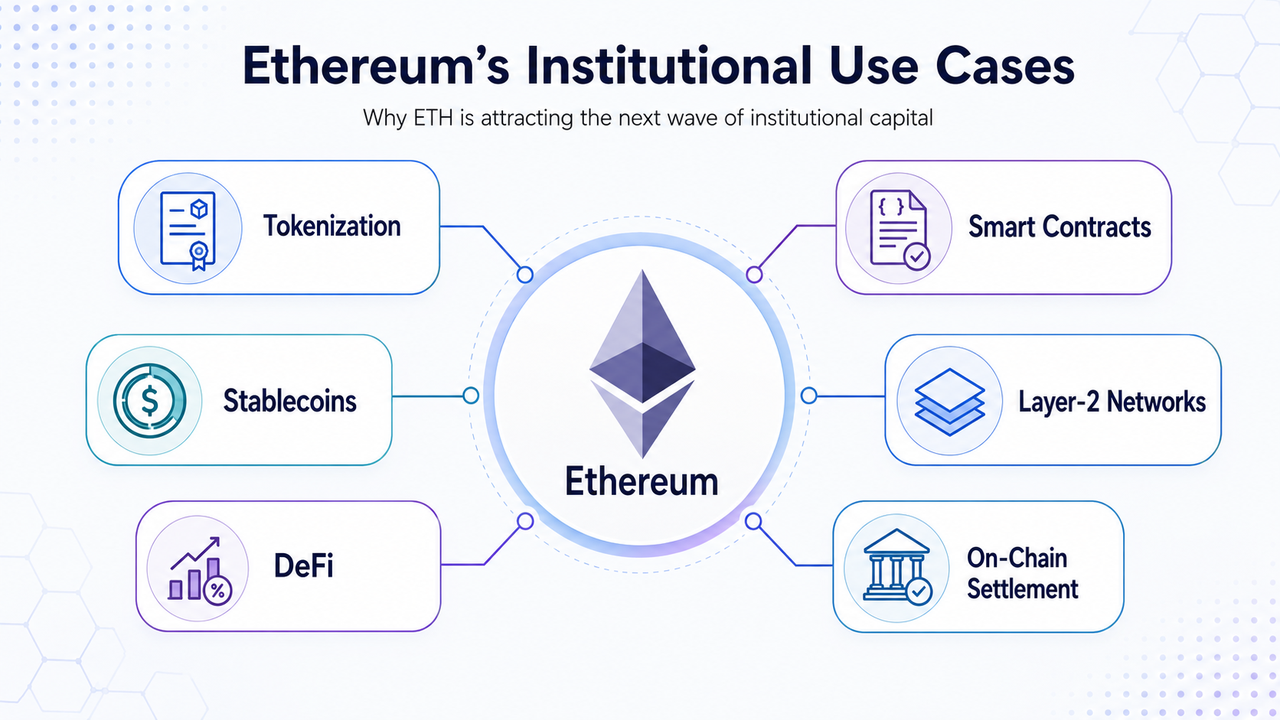
Ethereum is becoming a stronger destination for institutional capital as investors look beyond Bitcoin’s store-of-value role and seek exposure to blockchain-based financial infrastructure.
Ethereum’s strength lies in utility. It is not only a digital asset; it is also the foundation for a large ecosystem of financial applications. That gives institutions a different reason to allocate capital.
Institutional investors are not only buying ETH as a speculative asset. They are increasingly viewing Ethereum as infrastructure for digital finance, where network activity, settlement demand, and application growth can support a long-term investment thesis.
This makes Ethereum different from Bitcoin. Bitcoin’s value is largely tied to scarcity, security, and its role as a store of value. Ethereum’s value is connected to usage. The more activity that takes place on Ethereum and its wider ecosystem, the stronger the case becomes for ETH as an infrastructure-linked asset. Investors can follow Ethereum price and market data on KuCoin to track how ETH performs as institutional interest develops.
One of the biggest drivers of institutional interest is tokenization. Tokenization refers to the process of representing real-world assets such as bonds, funds, money-market products, private credit, and real estate on blockchain networks. As traditional finance explores faster settlement, programmable assets, and on-chain ownership records, Ethereum becomes a natural platform for institutional experimentation.
Stablecoins add another layer to Ethereum’s investment case. Stablecoins are widely used for payments, trading, settlement, liquidity management, and cross-border transfers. Because Ethereum supports significant stablecoin activity, institutions can connect ETH exposure to real economic usage. This is especially important for investors who want more than a speculative story.
DeFi also keeps Ethereum at the center of on-chain finance. Decentralized finance platforms allow users to trade, lend, borrow, stake, and provide liquidity without relying on traditional intermediaries. While many institutions are cautious about directly participating in DeFi, they recognize its importance as a testing ground for financial innovation.
Over time, regulated institutions may adopt parts of DeFi technology, including automated settlement, transparent collateral, programmable yield, tokenized liquidity, and smart contract-based financial products. Even if institutions do not fully embrace open DeFi, they may still use Ethereum-based infrastructure or Ethereum-compatible technology to build more efficient financial systems.
Bitcoin Still Dominates Institutional Allocation
Even as Ethereum gains attention, Bitcoin continues to lead institutional crypto portfolios. BTC has the clearest narrative, the deepest liquidity, and the strongest institutional track record, making it the first choice for many large investors.
-
A Clear and Simple Investment Narrative
Bitcoin’s investment thesis is easy for institutions to understand and explain. It is scarce, decentralized, highly liquid, and widely recognized across global markets.
For portfolio managers, this clarity is valuable. Bitcoin can be presented as digital gold, an inflation hedge, a non-sovereign store of value, or an alternative monetary asset. That makes BTC easier to defend in traditional investment committees.
-
Stronger Liquidity for Large Allocations
Liquidity is one of Bitcoin’s biggest advantages. Institutions need assets that can absorb large orders without excessive slippage, and Bitcoin has the deepest market in crypto.
This matters because liquidity affects execution quality, risk management, position sizing, and exit strategy. Large investors need confidence that they can enter and exit positions efficiently, especially when managing significant capital.
-
A More Established Institutional Track Record
Bitcoin has been the main institutional crypto asset for years. It has a longer history of adoption, broader market recognition, and more established investment products than Ethereum.
This gives BTC an advantage among conservative investors. While Ethereum offers broader utility, Bitcoin remains easier to allocate to because it has already proven itself as the benchmark digital asset.
-
Easier Communication With Traditional Investors
Ethereum requires a more technical explanation involving smart contracts, gas fees, staking, layer-2 networks, stablecoins, tokenization, and decentralized applications.
That does not make Ethereum weaker. It simply makes ETH harder to communicate to investors who are new to crypto. Bitcoin’s simplicity gives it an edge in institutional adoption because its role is easier to define.
-
Benchmark Status Across the Crypto Market
Bitcoin is still the benchmark for the wider digital asset market. When institutions assess crypto sentiment, they usually look at BTC first.
Its price action, ETF flows, trading volume, and market dominance often shape broader sentiment across digital assets. As a result, Ethereum may continue gaining allocation, but Bitcoin still leads the institutional conversation.
What the BTC-to-ETH Reallocation Really Means
The movement from BTC to ETH should not be misunderstood as a complete market reversal. Institutions are not simply dumping Bitcoin and rushing into Ethereum. Instead, they are building more sophisticated crypto portfolios.
This is a sign of market maturity. In the past, institutional crypto exposure was often limited to Bitcoin. Now, investors are beginning to think in categories: store of value, infrastructure, yield, applications, settlement, and tokenized assets.
Bitcoin remains the base allocation. It is the asset institutions buy for long-term crypto exposure, macro hedging, liquidity, and portfolio diversification. For many institutions, BTC is the safest way to participate in crypto because it has the strongest track record, the most established market structure, and the clearest role in a portfolio.
Ethereum is the next layer of allocation. It gives institutions exposure to blockchain-based finance, tokenization, stablecoins, decentralized applications, and programmable settlement. ETH is more complex than BTC, but that complexity also creates more growth potential.
Flows between BTC and ETH will likely remain cyclical. Ethereum inflows may rise during periods of stronger risk appetite and fall during cautious markets. Bitcoin, by contrast, may continue to attract capital even during uncertain periods because of its defensive store-of-value narrative.
This means the BTC-to-ETH reallocation will not move in a straight line. There will be periods when ETH gains market share and periods when BTC reasserts dominance. The key signal to watch is sustained institutional demand for Ethereum over multiple market cycles.
Key Drivers Behind the BTC-to-ETH Reallocation
Several forces are pushing institutions to look beyond Bitcoin and consider Ethereum as part of a broader crypto strategy.
-
Search for higher returns: Bitcoin is already widely recognized and more deeply owned by institutions than most other digital assets. Some investors believe Ethereum may offer greater upside because it is tied to the growth of blockchain applications and infrastructure.
-
Demand for blockchain infrastructure exposure: Institutions are increasingly interested in the infrastructure behind digital assets. Ethereum gives them exposure to smart contracts, decentralized applications, tokenized assets, and on-chain settlement. This makes ETH more than a monetary asset; it becomes a way to invest in the broader development of blockchain-based finance.
-
Growth of tokenized real-world assets: Tokenization could become one of the most important institutional blockchain use cases. If more traditional assets are issued, traded, or settled on-chain, Ethereum could benefit from its established developer base and network effects.
-
Expansion of stablecoin settlement: Stablecoins are one of the clearest examples of real blockchain adoption. Since Ethereum supports major stablecoin activity, institutions may view ETH as connected to the growth of digital payments and settlement.
-
Improved access through ETFs: Bitcoin ETFs opened the door for institutional crypto exposure, and Ethereum ETFs are expanding the opportunity set. As ETF products become more liquid and widely accepted, institutional reallocation between BTC and ETH becomes more efficient.
Risks That Could Slow Ethereum’s Institutional Adoption
Although Ethereum’s institutional case is strengthening, several risks could slow capital reallocation from BTC to ETH.
The first risk is complexity. Ethereum’s ecosystem is rich, but harder to understand. Institutions must evaluate smart contracts, staking, layer-2 networks, gas fees, validator economics, and regulatory questions. This complexity can slow adoption among conservative investors.
Regulatory uncertainty is another concern. Digital asset regulation is still evolving, and institutions need clarity before making large allocations. Any uncertainty around staking, DeFi, tokenized assets, or ETH’s regulatory classification can affect demand. Bitcoin’s regulatory narrative is generally simpler, which gives BTC an advantage.
Competition from other blockchains could also pressure Ethereum’s investment case. Ethereum is the leading smart contract ecosystem, but it is not the only one. Other networks compete on speed, cost, scalability, and developer incentives. If institutional applications move to alternative blockchains, Ethereum’s role could become more contested.
Volatility is another factor. Ethereum often behaves like a higher-beta asset. That can attract institutions during bull markets, but it can also lead to sharper outflows during downturns. For risk-managed portfolios, this volatility must be carefully controlled.
Will Ethereum Close the Institutional Gap?
Ethereum’s institutional role is likely to grow if three conditions develop: ETF demand becomes more consistent, tokenization expands, and stablecoin settlement continues to scale.
If these trends strengthen, Ethereum could become a more permanent part of institutional crypto portfolios. It may not replace Bitcoin, but it could become the second major pillar of institutional digital asset allocation.
The most likely outcome is not a full BTC-to-ETH flip. Instead, institutions may increasingly treat Bitcoin and Ethereum as two separate but complementary exposures. BTC gives them access to digital scarcity and macro diversification. ETH gives them access to blockchain infrastructure and application growth.
This distinction could define the next phase of institutional crypto investing. Bitcoin will likely remain the starting point for many institutions, but Ethereum may become the asset that broadens their exposure from digital money to digital infrastructure.
Conclusion
The institutional shift from Bitcoin to Ethereum is not a clean rotation. It is a broadening of exposure.
Bitcoin still holds the central role in institutional crypto allocation. It remains the most liquid, familiar, and widely accepted digital asset. For many institutions, BTC is still the first and most important crypto position.
Ethereum, however, is becoming harder to ignore. Its connection to tokenization, stablecoins, DeFi, smart contracts, and on-chain settlement gives it a growth profile that Bitcoin does not offer. Institutions that want exposure to the future of blockchain-based finance are increasingly looking at ETH as the next major allocation.
The future of institutional crypto portfolios is likely to be a barbell structure: BTC as the core holding and ETH as the growth engine. Bitcoin provides stability, liquidity, and macro exposure. Ethereum provides infrastructure exposure, innovation potential, and higher-beta upside.
In other words, institutions are not moving away from Bitcoin. They are moving beyond Bitcoin.
FAQs
Are institutions moving from Bitcoin to Ethereum?
Institutions are not fully moving away from Bitcoin. Instead, many are expanding their crypto portfolios by adding Ethereum alongside BTC. Bitcoin remains the core holding, while Ethereum is gaining attention as a growth and infrastructure allocation.
Why are institutions interested in Ethereum?
Institutions are interested in Ethereum because it provides exposure to smart contracts, tokenization, stablecoins, DeFi, and on-chain financial infrastructure. These use cases give ETH a broader growth narrative than Bitcoin.
Is Ethereum replacing Bitcoin in institutional portfolios?
Ethereum is not replacing Bitcoin. BTC remains the main institutional crypto asset because of its liquidity, simplicity, and store-of-value narrative. ETH is increasingly being added as a complementary allocation.
How do ETFs affect BTC and ETH allocation?
ETFs make it easier for institutions to gain exposure to Bitcoin and Ethereum without managing crypto custody directly. Bitcoin ETFs have already become a major institutional gateway, while Ethereum ETFs are helping expand institutional access to ETH.
What is the main difference between BTC and ETH for institutions?
Bitcoin is mainly viewed as a store-of-value and macro asset. Ethereum is viewed as a blockchain infrastructure that supports smart contracts, tokenization, stablecoins, DeFi, and decentralized applications.
Disclaimer
The information provided on this page may originate from third-party sources and does not necessarily represent the views or opinions of KuCoin. This content is intended solely for general informational purposes and should not be considered financial, investment, or professional advice. KuCoin does not guarantee the accuracy, completeness, or reliability of the information, and is not responsible for any errors, omissions, or outcomes resulting from its use. Investing in digital assets carries inherent risks. Please carefully evaluate your risk tolerance and financial situation before making any investment decisions. For further details, please consult KuCoin’s Terms of Use and Risk Disclosure.