

ZetaChain to Shut Down Layer-1 and Migrate ZETA to Solana After 99.4% Vote
For years, the prevailing consensus across Web3 dictated that launching an independent Layer-1 blockchain represented the pinnacle of technological prestige and economic independence. Projects dedicated vast engineering resources and millions of dollars to bootstrapping decentralized validator sets, constructing custom consensus engines, and maintaining isolated network security. Today, however, the financial and operational realities of blockchain infrastructure are triggering a fundamental reevaluation across the industry, proving that raw infrastructure without self-sustaining consumer demand quickly turns into an unsustainable liability.
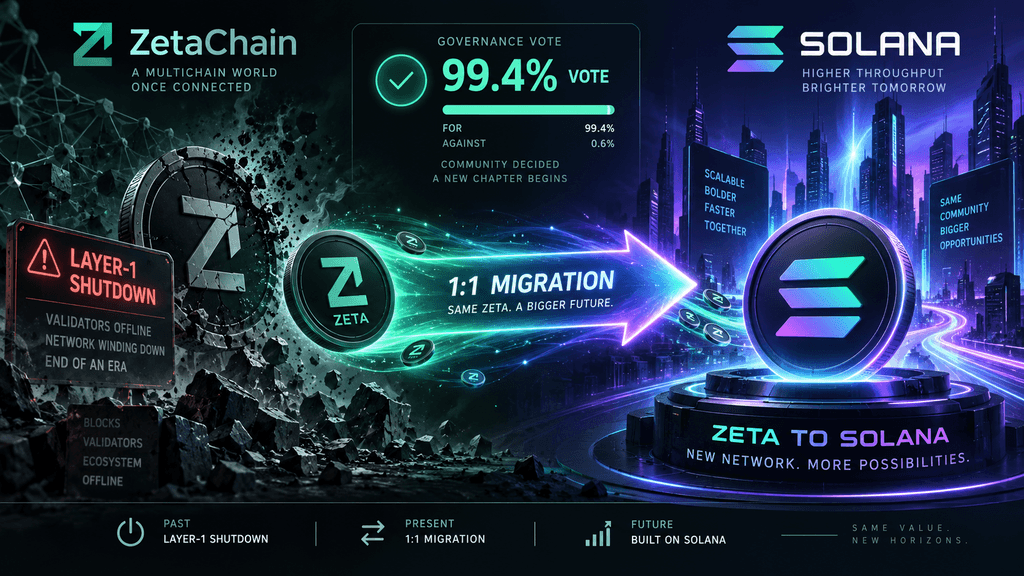
In late September 2026, ZetaChain delivered one of the most consequential examples of this shifting paradigm when its community overwhelmingly ratified Proposal 68. By an extraordinary 99.4% majority, token holders authorized the planned decommissioning of ZetaChain’s sovereign Layer-1 blockchain and the complete migration of its native ZETA token to Solana. This landmark decision marks an abrupt departure from generalized cross-chain infrastructure toward application-level specialization, transforming ZetaChain into a dedicated artificial intelligence application ecosystem powered by Solana’s high-throughput architecture.
What Happened? Inside Proposal 68 and the 99.4% Vote
The approval of Proposal 68 demonstrated an almost unprecedented degree of strategic alignment between a protocol’s founding team and its broader community. The governance vote concluded with a 58% turnout rate, comfortably surpassing the mandatory 40% quorum requirement. Out of the ballots cast, 99.4% voted in favor of winding down the standalone network, reflecting a mutual recognition that sustaining an independent blockchain layer had become counterproductive to the project’s future viability.
Under the framework outlined in the approved resolution, native ZETA tokens issued on ZetaChain’s sovereign ledger will be converted to Solana SPL tokens on a strict 1:1 basis. The foundational tokenomics will remain completely intact: the ticker symbol will remain ZETA, the maximum aggregate token supply will not be altered, and no newly minted tokens will be injected into circulation. Existing vesting schedules for institutional backers, advisors, and core contributors will carry over seamlessly to their corresponding Solana addresses without alteration to their original release milestones.
The transition from a Cosmos-based execution environment to Solana necessitates a key technical calibration regarding token precision. While native ZETA currently functions with an 18-decimal precision model standard across Ethereum Virtual Machine and Cosmos SDK environments, Solana’s native SPL standard enforces a maximum of 9 decimals. Consequently, balances will be re-denominated to 9 decimal places upon conversion, with dust amounts smaller than nine decimal units rounded down. For standard retail and institutional portfolios, this fractional adjustment will be functionally imperceptible.
| Migration Parameter | Current State (ZetaChain L1) | Future State (Solana SPL) |
| Consensus & Base Layer | Cosmos SDK / Tendermint Proof-of-Stake | Solana Proof-of-History / Tower BFT |
| Token Format | Native L1 / Cosmos Denom | Native Solana SPL Token |
| Conversion Ratio | 1 Native ZETA | 1 Solana SPL ZETA |
| Decimal Precision | 18 Decimals | 9 Decimals (Sub-precision dust truncated) |
| Maximum Supply | Fixed per original tokenomics | Identical (Zero inflationary minting) |
| Vesting Schedules | Enforced via native smart contracts | Mirrored via Solana-based escrow vaults |
Why Shut Down a Custom Layer-1? The Hidden Costs
Operating an independent Layer-1 requires navigating immense structural overhead that often detracts from building high-utility software. The decision to abandon ZetaChain’s bespoke consensus layer is rooted in the operational frictions of maintenance, coordination, and escalating systemic risk.
The Heavy Burden of Cosmos SDK Maintenance
ZetaChain was architected on top of the Cosmos SDK, a robust modular framework that nonetheless forces individual development teams to act as full-time operating system maintainers. Whenever upstream updates, consensus patches, or security revisions are released by the Cosmos repository, core developers must dedicate substantial engineering cycles to auditing, adapting, and testing those changes against custom chain logic.
Furthermore, applying these technical upgrades requires coordinating with dozens of decentralized validator operators scattered across multiple time zones. Orchestrating complex network hard forks, negotiating validator upgrade windows, and triaging synchronization failures create administrative drag that drains developer mindshare. For a project pivoting toward high-velocity consumer software, the friction of operating an independent validator infrastructure inevitably slowed application-level iteration to a crawl.
Escalating Security Pressures in Blockchain Infrastructure
The macro environment for custom blockchain security has become increasingly hazardous as sophisticated automated exploits multiply. In August 2026, the vulnerability of customized consensus stacks was highlighted when six interconnected EVM chains built on Cosmos frameworks were breached, draining roughly $5.7 million in cumulative exploit events. While ZetaChain was unaffected by those particular attacks, the incident served as a wake-up call regarding the systemic exposure inherent to maintaining isolated bridge and consensus infrastructure.
Securing a bespoke Layer-1 requires continuous economic vigilance, extensive external code audits, and substantial native token incentives to keep validators profitably aligned. If the market value of the native asset fluctuates significantly, the absolute cost of attacking the consensus layer can drop to levels that attract hostile capital. By migrating ZETA directly to Solana, the protocol offloads base-layer consensus security, block generation, and cryptographic settlement to a battle-tested network secured by billions of dollars in decentralized capital.
The Pivot to AI: Why Solana is the New Home for ZETA
The sunsetting of ZetaChain’s Layer-1 is not a liquidation or a wind-down of operations, but a calculated redeployment of capital and talent toward the convergence of decentralized finance and artificial intelligence.
Anuma and ZetaChain’s AI Ambitions
The catalyst for this migration is Anuma, a privacy-preserving decentralized artificial intelligence application developed under the ZetaChain umbrella. Anuma has demonstrated rapid market traction, accumulating over 300,000 active users and processing millions of programmatic inference queries across an ecosystem of 35 distinct machine learning models.
The core team recognized that Anuma’s growth trajectory was fundamentally constrained by the developer ecosystem and tooling limitations of an isolated Layer-1 chain. Maintaining a custom blockchain did not provide Anuma with a broader consumer audience or enhanced artificial intelligence infrastructure; rather, it fragmented liquidity and isolated users behind bespoke cross-chain bridge interfaces. Moving ZETA entirely to an established ecosystem allows the team to refocus their efforts on scaling Anuma as a premier consumer application.
The Synergy Between AI and Solana’s Architecture
The operational requirements of autonomous AI agents differ fundamentally from standard human financial transactions. Autonomous agents require continuous, high-frequency, sub-cent payments to compensate compute clusters, license datasets, and settle automated API calls. Solana’s low-latency block pipeline and parallel transaction execution engine offer the low fees and high throughput necessary to support real-time machine-to-machine micro-settlement.
Within this new operational framework, ZETA’s token utility will evolve from a network gas asset into the primary fuel for the Anuma AI economy. Users and corporate clients will be able to stake or lock their Solana-based ZETA to obtain subsidized compute quotas, access specialized privacy-preserving inference models, and participate in application-level platform governance. This transition replaces speculative base-layer block production incentives with direct, product-driven utility rooted in real consumer software consumption.
What Does This Mean for ZETA Holders?
For existing market participants, the approval of Proposal 68 raises pressing questions regarding portfolio safety, custodial handling, and on-chain rights. Understanding how different token formats will be treated across various networks is critical during this transitional phase.
Existing allocations, team vesting unlocks, and long-term treasury reserves will carry over to the new Solana ledger without any deviation from established release schedules. Investors will not be diluted by newly created supply, as the migration is strictly an architecture swap rather than an inflationary restructuring. Furthermore, ZETA tokens circulating on external secondary environments—specifically standard ERC-20 tokens on Ethereum and BEP-20 assets on BNB Chain—remain completely outside the scope of the Layer-1 shutdown. Holders of these multi-chain assets are not required to participate in the native token migration, as their balances will continue to exist alongside the newly minted Solana SPL assets.
| Asset Location | Underlying Standard | Direct Impact of Proposal 68 | Action Required by Holder |
| ZetaChain L1 (Native) | Native PoS Token | Converted 1:1 to Solana SPL via formal snapshot | Monitor for Proposal 2 migration instructions |
| Ethereum Mainnet | ERC-20 Smart Contract | Unaffected; smart contract and supply remain isolated | No immediate action required |
| BNB Chain | BEP-20 Smart Contract | Unaffected; external wrapped supply remains isolated | No immediate action required |
| Centralized Exchanges | Varies by CEX Deposit Rail | Most platforms will execute the swap automatically | Await official announcements from specific exchanges |
During the interim period before full migration execution, ZetaChain’s native Layer-1 continues to operate as normal. Block production remains active, network fees continue to be collected, and existing staking positions continue to generate standard emissions. The core team has confirmed that they are actively modeling mechanisms to replicate decentralized staking rewards directly on Solana, ensuring that long-term delegators and token holders retain avenues for earning yields on their capital once the migration is finalized.
Next Steps: The Timeline and How Investors Should Prepare
The ratification of Proposal 68 represents the formal authorization of an operational roadmap, rather than an immediate execution trigger. The technical sunset of the physical Layer-1 network will occur systematically across a multi-stage rollout governed by follow-up protocol proposals.
Before any network shutdown procedures can commence, the core development team will submit Proposal 2 to the on-chain governance portal. This subsequent proposal will codify the precise execution parameters, including the final snapshot block height, the exact smart contract mechanics governing the token bridge and redemption window, and the operational timelines for permanent node termination. Most importantly, the team has pledged that no irreversible migration steps will be initiated until leading global centralized exchanges—such as Binance, OKX, and Coinbase—formally verify and configure their back-end systems to support the automatic conversion of native ZETA deposits to Solana SPL tokens.
Consequently, individual token holders and institutional treasuries are advised to take no manual action at this time. Rushing to interact with unverified third-party bridges or speculative decentralized tools introduces unnecessary counterparty danger. During major blockchain migrations, malicious actors regularly deploy sophisticated phishing campaigns featuring fake token claim portals, fraudulent snapshot validation forms, and malicious social media announcements offering "priority migration access." All users should rely exclusively on official protocol communications and official exchange notifications to navigate the eventual migration rollout safely.
🔥 Beyond the Headlines: What KuCoin 5.0 Means for You
Market news moves fast — but where you act on it matters just as much. This October, KuCoin launches KuCoin 5.0, transforming KuCoin into a rebuilt platform. Here's what actually changes for you:
-
One account for everything. Older platforms split your money across separate "spot," "margin," and "futures" accounts and expected you to understand why. KuCoin 5.0's unified account removes that entirely — deposit once, and everything is simply there.
-
Stocks, indices, and commodities. KuCoin 5.0 expands beyond crypto into global markets. When crypto chops sideways and equities rally (or the reverse), you rotate in minutes instead of opening a brokerage account and waiting days for fiat rails.
-
Real-world assets (RWA). Tokenized exposure to traditional assets like commodities, right inside your crypto account. One of the fastest-growing segments in global finance is no longer reserved for institutions — you access it from the same balance you trade with.
-
Earn while you learn. Not ready to trade? KCUSD lets your stablecoins earn daily, auto-compounding interest. The lowest-stress way to put your idle deposit to work for 4% yield.
-
An AI assistant in plain language. Ask questions, get market context, understand what you're looking at — built into the platform, no jargon required.
-
An app that doesn't overwhelm. Faster, cleaner, and consistent — intuitive from the first tap, not after a tutorial.
-
Safety you can check, not just trust. A MiCAR-licensed EU entity, Proof of Reserves you can verify yourself, and internationally certified security (SOC 2 Type II, ISO 27001:2022).
Create your account in minutes — and start on the platform built for where crypto is going, not where it's been.
Conclusion
The overwhelming 99.4% approval of ZetaChain’s Proposal 68 captures a pivotal transition within the digital asset sector. The era wherein projects could justify the immense economic and technical overhead of maintaining an isolated Layer-1 without demonstrable consumer demand is drawing to a close. By sunsetting its custom consensus engine and transferring its primary capital asset to Solana, ZetaChain is acknowledging that the future of competitive Web3 enterprise lies in specialized, high-utility application design rather than redundant infrastructure replication.
This structural pivot positions ZETA to shed the operational burdens of node maintenance, consensus security, and cross-chain vulnerability, while directly integrating with the capital depth, user liquidity, and transaction speed of the Solana ecosystem. While executing a cross-chain migration of this magnitude presents complex operational hurdles, the unified mandate from the community highlights a collective determination to evolve. If successfully executed, ZetaChain’s transformation from a bespoke interoperability layer into an AI-powered consumer platform may establish a viable blueprint for other struggling infrastructure projects seeking sustainable relevance in a consolidating market.
FAQs
Will my staked ZETA tokens be automatically unstaked for the migration?
The exact handling of active validator delegations will be defined in the forthcoming Proposal 2. The core team is evaluating automated snapshot mechanisms that will capture bonded balances alongside unbonded balances, enabling holders to claim their equivalent Solana SPL allocations without requiring manual unbonding periods.
Can I continue to trade ZETA on spot markets during the transition?
Yes, normal secondary market trading across major centralized and decentralized exchanges remains fully operational. Exchanges will eventually announce a brief maintenance window to suspend deposits and withdrawals while they convert their custodial reserves to Solana SPL tokens, but standard trading functions are expected to continue uninterrupted until that transition window.
What will happen to third-party decentralized applications deployed on ZetaChain?
Independent applications currently running on ZetaChain's Layer-1 will have to wind down their operations on the native chain before the scheduled network termination. Developers will need to re-deploy their protocol architectures directly to Solana or migrate their smart contracts to alternative EVM-compatible ecosystems.
Why is the token precision changing from 18 decimals to 9 decimals?
The token precision adjustment is an unavoidable architectural requirement of the destination network. While Ethereum and Cosmos blockchains standardly use 18 decimal places for transactional accounting, Solana’s native SPL token program restricts precision to a maximum of 9 decimals, necessitating the truncation of sub-precision dust balances.
Does the move to Solana mean the original ZetaChain cross-chain bridge is permanently retired?
Yes, the team is formally moving away from operating an independent generalized cross-chain messaging and bridging network. Future technological development will center entirely on building, scaling, and commercializing the Anuma privacy-preserving AI platform within the broader Solana application ecosystem.
Disclaimer: This content is for informational purposes only and does not constitute investment advice. Cryptocurrency investments carry risk. Please do your own research (DYOR).