

Elon Musk Says AI Could Lift US GDP Growth to 4%: Capex Data and What It Means
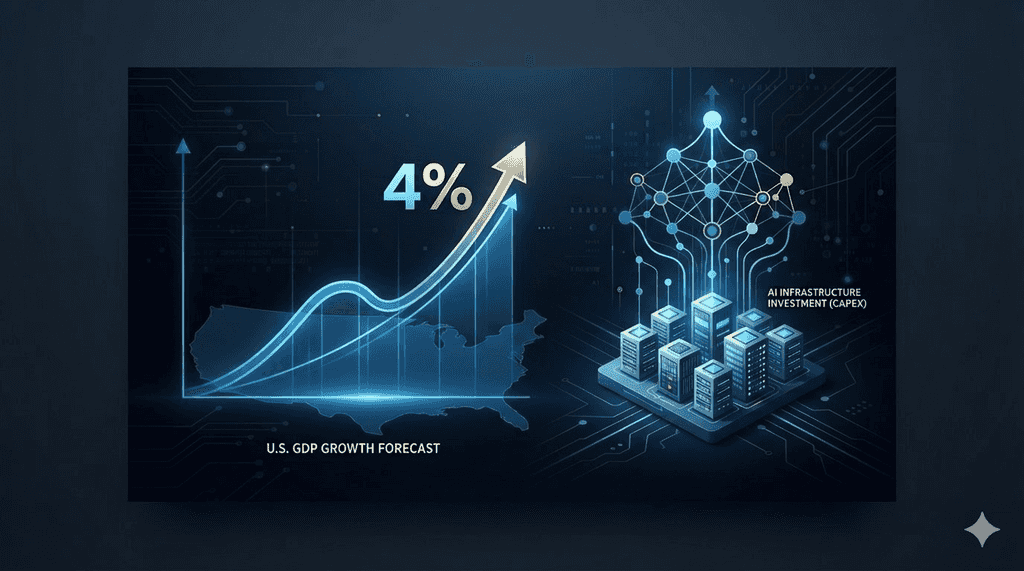
In mid-September 2026, Elon Musk, Chief Executive Officer of Tesla and xAI, issued an economic forecast regarding the macroeconomic impact of artificial intelligence. In a public statement on the X platform, Musk estimated that AI could lift US real Gross Domestic Product (GDP) growth from its historical baseline of roughly 2% to 4% or higher as early as next year.
Musk attributes this 4% target to compounding productivity gains across software development, scientific research, and enterprise workflow automation. In contrast, institutional economists and central banks caution that elevated interest rates, utility grid limits, and monetization lags will slow the transmission of technology into top-line economic growth.
The debate centers on a fundamental economic question: can the historic volume of capital expenditure currently directed into data centers, electrical infrastructure, and semiconductor silicon translate into measurable, near-term macroeconomic output?
Key Takeaways
-
Tesla and xAI CEO Elon Musk estimated that artificial intelligence could double US real GDP growth from approximately 2% to 4% or higher by 2027, driven by automated productivity gains.
-
The Federal Reserve's economic projections released in mid-September 2026 place 2027 US real GDP growth at a more moderate 2.4%, pointing toward structural economic friction and transition lags.
-
Apollo Global Management projects that US AI-related capital expenditures (capex) will reach roughly 3% of total GDP between 2027 and 2029, with Moody's projecting cumulative hardware and data center outlays approaching $1 trillion.
-
The heavy asset requirements of AI infrastructure face testing in a higher-rate regime, with the federal funds rate at 3.75%–4.00% and rising debt financing costs for technology hyperscalers.
-
As centralized hyperscalers navigate elevated capex depreciation and power bottlenecks, decentralized compute protocols (DePIN) and AI-aligned crypto assets are emerging as alternative resource-allocation mechanisms.
Elon Musk’s 4% GDP Vision vs. Institutional Forecasts
Sustained economic growth exceeding 4% in a developed economy represents a notable historical divergence. Over the past three decades, the United States has averaged real annual GDP growth between 1.8% and 2.5%, constrained by labor force demographics, capital depreciation, and measured total factor productivity (TFP) trends.
The Accelerated Productivity Hypothesis
Musk’s thesis relies on the direct substitution and augmentation of knowledge labor through generative foundational models, specialized autonomous agents, and synthetic workflow automation. In this framework, software iteration cycles collapse from months to hours, drug discovery timelines shrink, and industrial robotics integration accelerates manufacturing throughput.
Earlier in September, Musk extended this outlook to the international economy, proposing that advanced artificial intelligence could eventually expand global economic output by 20% to 30%, adding between $20 trillion and $30 trillion in annual production over the long run.
The Federal Reserve and Institutional Skepticism
Central banks and traditional credit rating agencies maintain a more measured stance. On September 16, 2026, the Federal Reserve published its Summary of Economic Projections (SEP), forecasting 2027 US real GDP growth at 2.4%.
Financial institutions, including Morningstar and major Wall Street investment banks, project that economic growth could moderate toward 1.8%–2.0% in 2027 due to tight monetary policy and elevated real interest rates. While traditional economists acknowledge the deflationary and labor-enhancing potential of AI, they point out that physical hardware constraints, corporate implementation schedules, and legal compliance structures typically prevent rapid, single-year accelerations in national output.
The $1 Trillion Infrastructure Buildout: Capex Data Overview
The primary quantitative foundation for optimistic productivity projections is the scale of capital expenditure committed by technology hyperscalers, sovereign wealth funds, and private equity sponsors.
| Analytical Metric | Pre-AI Cycle (2023) | Current / Projected Cycle (2027–2029) | Primary Source |
| Annual US AI Capex as % of GDP | ~0.6% | ~3.0% of total GDP | Apollo Global Management |
| Cumulative US Data Center & Chip Spend | ~$220 Billion | ~$1.0 Trillion | Moody's Ratings |
| Comparative Spend: Mainland China | ~$60 Billion | ~$165 Billion | Industry Estimates |
| Primary Capital Focus | General Cloud Storage & SaaS | High-Density Compute, Power Grids, HBM Memory | Corporate Disclosures |
The Apollo and Moody’s Estimates
According to Torsten Slok, Chief Economist at Apollo Global Management, aggregate US capital expenditure directly tied to AI data centers, specialized accelerators, and utility generation could reach 3% of total US GDP between 2027 and 2029. By comparison, capital expenditure for general enterprise IT infrastructure accounted for only 0.6% of GDP as recently as 2023.
Data from Moody’s Ratings aligns with this capital concentration. Moody's projects that total corporate investment in advanced silicon, specialized memory modules, liquid cooling systems, and electrical transmission lines will approach $1 trillion in the United States by 2027. In contrast, total enterprise infrastructure spend across Chinese technology firms over the comparable window is projected at approximately $165 billion, underscoring the high concentration of physical compute investment taking place within North America.
Shift from Asset-Light to Asset-Heavy Models
This capital outlay represents a departure from the business models that characterized the Web2 expansion. The previous era of technology growth was defined by asset-light software deployment, in which companies scaled digital platforms with marginal costs approaching zero.
The current cycle is characterized by asset-heavy industrial engineering. Building and powering high-density gigawatt-scale data center clusters requires substantial allocations toward structural steel, concrete, high-voltage transformers, water treatment, and specialized power purchase agreements (PPAs) with nuclear and natural gas operators.
Capital Costs, Monetization, and Diffusion Lags
While the volume of capital deployment is historically high, translating that physical capital into a 4% GDP growth rate presents three clear macroeconomic challenges.
Elevated Financing Costs
A report by brokerage Dolat Capital highlights that the current buildout is undergoing its first direct pressure test within a restrictive monetary regime. On September 16, 2026, the Federal Reserve raised its policy target range to 3.75%–4.00%, accompanied by elevated long-term US Treasury yields.
In a zero-interest-rate environment, multi-year capital projects face low hurdle rates. Under borrowing benchmarks near 4.00% to 5.00%, corporate treasuries face substantial debt servicing costs and heightened hurdle rates on capital investments. Technology firms issuing corporate bonds to finance facilities must generate higher baseline cash flows to justify these investments against alternative fixed-income returns.
Token Deflation and the ROI Equation
A primary concern for financial analysts is the ongoing monetization gap between capital inputs and realized software revenues.
The underlying cost to process natural language tokens has declined by more than 80% year-over-year as open-source model weights improve and inference hardware optimizes. While falling inference costs expand consumer access, they create pricing pressure for model providers. Technology companies face rapid depreciation on high-cost hardware clusters that may be superseded by newer silicon architectures within 24 to 36 months, requiring accelerated write-downs before the original capital outlays achieve full amortization.
The Historical Technology Diffusion Lag
Economic history demonstrates that major general-purpose technology revolutions do not lift national GDP figures overnight.
-
The Electric Motor (1890s–1920s): Manufacturing productivity remained flat for nearly 30 years after the development of electric dynamos because factories required complete physical redesigns to replace steam shafts.
-
The Personal Computer and Internet (1970s–1990s): As economist Robert Solow observed in 1987, "You can see the computer age everywhere but in the productivity statistics." It was not until the late 1990s that enterprise restructuring allowed IT investments to show up clearly in official US productivity metrics.
If generative AI follows a similar diffusion trajectory, the broad enterprise reorganization required to realize its full output potential will unfold over a multi-year horizon, rather than producing an abrupt doubling of national economic growth within twelve months.
The Web3 Angle: How the AI Capex Race Drives Decentralized Compute
The physical and financial constraints of centralized artificial intelligence infrastructure are creating touchpoints with the digital asset ecosystem. As centralized hyperscalers encounter grid connection delays, hardware backlogs, and rising interest burdens, decentralized physical infrastructure networks (DePIN) and AI-focused cryptocurrency protocols offer alternative operational models.
DePIN and Distributed GPU Aggregation
Decentralized compute networks (such as Render Network, Akash, and io.net) address resource allocation inefficiencies by pooling idle enterprise and consumer-grade GPUs across the globe.
Instead of waiting several years for a dedicated multi-gigawatt facility to secure environmental permits and electrical substation connections, machine learning teams can route batch inference, 3D rendering, and fine-tuning workloads across decentralized nodes. Smart contracts govern task execution, verify cryptographic proofs of compute completion, and settle payments in real time using native protocol tokens.
Open-Source Models and On-Chain Verification
The parallel expansion of open-source artificial intelligence requires verifiable, tamper-resistant data pipelines. Blockchain networks provide transparent, immutable ledgers capable of recording training dataset provenance, tracking model weight alterations, and managing synthetic identity verification.
Furthermore, autonomous AI agents conducting automated market making, software purchasing, and API interactions require programmatic payment rails. Because AI agents cannot hold conventional commercial bank accounts without centralized human intervention, dollar-backed stablecoins and Layer-1 settlement layers provide native monetary infrastructure for machine-to-machine commerce.
Conclusion
Elon Musk’s projection that artificial intelligence could elevate US GDP growth to 4% or higher highlights the growing role of advanced automation in contemporary economic planning. The scale of investment is substantial, with total capital outlays approaching $1 trillion and annual spending projected to reach 3% of US economic output.
However, macroeconomic realities present real headwinds to near-term growth targets. With central bank benchmark interest rates hovering between 3.75% and 4.00%, capital efficiency and return on investment will face heightened scrutiny. Combined with physical electrical grid constraints and historical adoption lags, a full doubling of economic growth will likely require sustained infrastructural adaptation rather than an immediate single-year surge.
As the industry balances heavy centralized capital spending against structural economic limits, decentralized compute architectures and Web3 infrastructure will continue to see testing as supplementary mechanisms to distribute, verify, and settle the computational demands of the modern economy.
🔥 Beyond the Headlines: What KuCoin 5.0 Means for You
Market news moves fast — but where you act on it matters just as much. This October, KuCoin launches KuCoin 5.0, transforming KuCoin into a rebuilt platform. Here's what actually changes for you:
-
One account for everything. Older platforms split your money across separate "spot," "margin," and "futures" accounts and expected you to understand why. KuCoin 5.0's unified account removes that entirely — deposit once, and everything is simply there.
-
Stocks, indices, and commodities. KuCoin 5.0 expands beyond crypto into global markets. When crypto chops sideways and equities rally (or the reverse), you rotate in minutes instead of opening a brokerage account and waiting days for fiat rails.
-
Real-world assets (RWA). Tokenized exposure to traditional assets like commodities, right inside your crypto account. One of the fastest-growing segments in global finance is no longer reserved for institutions — you access it from the same balance you trade with.
-
Earn while you learn. Not ready to trade? KCUSD lets your stablecoins earn daily, auto-compounding interest. The lowest-stress way to put your idle deposit to work for 4% yield.
-
An AI assistant in plain language. Ask questions, get market context, understand what you're looking at — built into the platform, no jargon required.
-
An app that doesn't overwhelm. Faster, cleaner, and consistent — intuitive from the first tap, not after a tutorial.
-
Safety you can check, not just trust. A MiCAR-licensed EU entity, Proof of Reserves you can verify yourself, and internationally certified security (SOC 2 Type II, ISO 27001:2022).
Create your account in minutes — and start on the platform built for where crypto is going, not where it's been.
FAQs
What did Elon Musk say about AI and US GDP growth?
In mid-September 2026, Elon Musk estimated that artificial intelligence could double US real GDP growth from its historical baseline of roughly 2% to 4% or higher by 2027, driven by widespread productivity gains from autonomous software agents and automated knowledge workflows.
Why do the Federal Reserve and Wall Street disagree with Musk's forecast?
The Federal Reserve projects 2027 US real GDP growth at 2.4%, while private consensus estimates hover near 1.9%. Institutional analysts emphasize that restrictive monetary policy, historical lags in enterprise technology adoption, electrical grid capacity limits, and the high cost of data center financing will moderate the pace at which AI investments translate into top-line macroeconomic growth.
How much are tech companies spending on AI infrastructure?
According to estimates from Apollo Global Management, AI-related capital expenditures in the United States could reach approximately 3% of total GDP between 2027 and 2029, up from 0.6% in 2023. Additionally, Moody's Ratings projects that cumulative outlays on chips, electrical systems, and data center infrastructure will approach $1 trillion by 2027.
What is the relationship between the AI capex boom and cryptocurrency?
The centralized AI buildout faces power bottlenecks, high financing costs, and hardware shortages. Decentralized physical infrastructure networks (DePIN) and AI compute tokens provide alternative systems by aggregating idle global GPUs through permissionless blockchains. Additionally, public ledgers and stablecoins serve as the native financial and verification layers for autonomous AI agents executing machine-to-machine payments.
Disclaimer
The information provided on this page may originate from third-party sources and does not necessarily represent the views or opinions of KuCoin. This content is intended solely for general informational purposes and should not be considered financial, investment, or professional advice. KuCoin does not guarantee the accuracy, completeness, or reliability of the information, and is not responsible for any errors, omissions, or outcomes resulting from its use. Investing in digital assets carries inherent risks. Please carefully evaluate your risk tolerance and financial situation before making any investment decisions. For further details, please consult KuCoin’s Terms of Use and Risk Disclosure.