

CoinEx Shutdown 2026: What Mid-Tier Crypto Exchange Closures Signal
Introduction
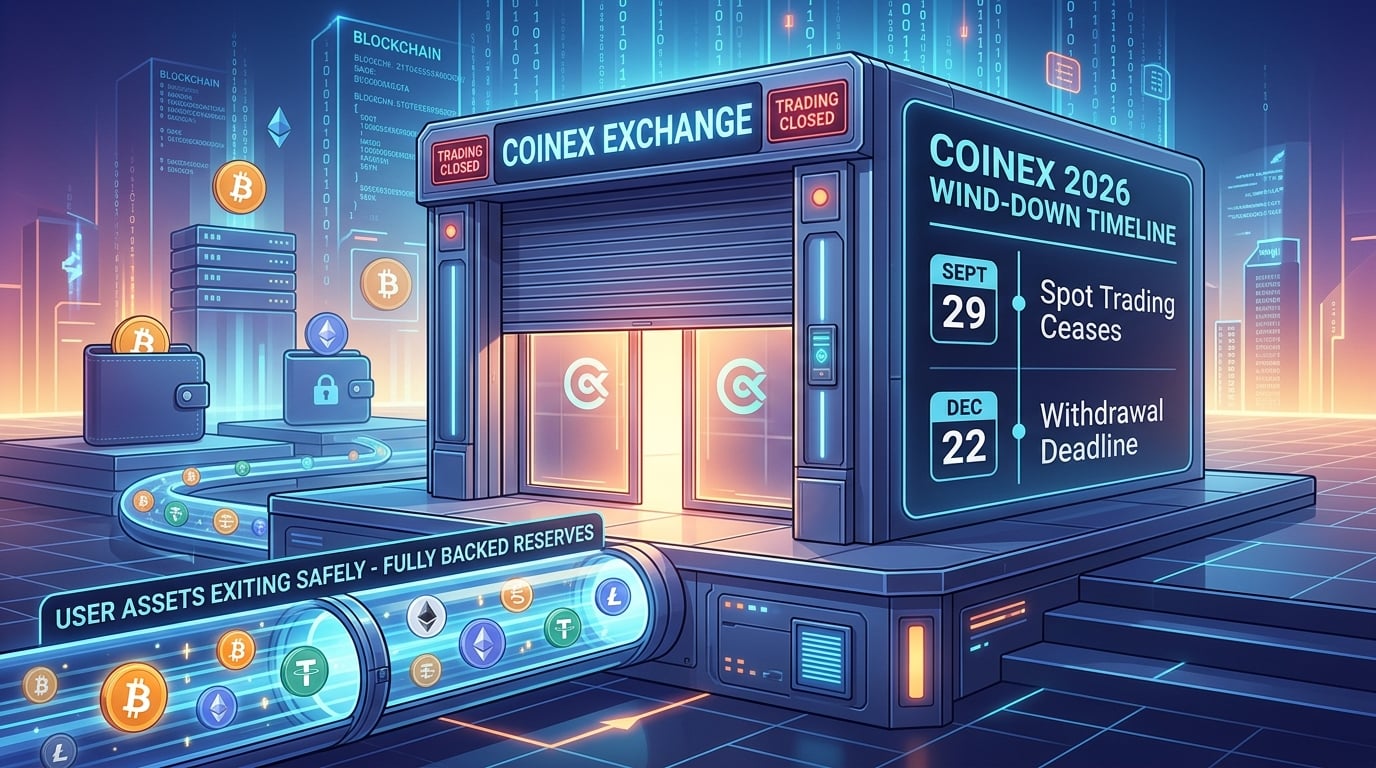
Nine years after launch, CoinEx is closing its exchange business. According to CoinEx’s official notice published on 14 September 2026, the platform will stop most trading by 29 September 2026 and keep withdrawals open until 22 December 2026. CoinEx said reserves exceed 100% and user assets remain fully backed.
The closure is not a surprise isolated event. Mid-tier venues are being squeezed by thinner spot volume, higher compliance costs, and liquidity that now clusters at a handful of large exchanges. For users, the practical question is narrower: can funds leave on time, and which venues still have the scale to absorb that flow?
Why Is CoinEx Shutting Down in 2026?
CoinEx is shutting down because it says market conditions, liquidity, and compliance costs have moved beyond a sustainable range. The official announcement lists a prolonged downturn, a contraction in industry trading volume and liquidity, rising regulatory requirements across major jurisdictions, and operational uncertainty.
That combination hits mid-tier exchanges first. Fixed costs for custody, security, listings, and licensing do not fall as fast as retail volume. A venue can stay solvent and still fail commercially if fee income no longer covers those costs.
Founder Haipo Yang framed the choice as a clean wind-down rather than a sale. The exchange launched in December 2017 and is closing on the same calendar date nine years later. That timeline matters because it is an operational exit with a published calendar, not an unannounced freeze.
What Is the CoinEx Wind-Down Timeline?
The wind-down is staged so trading stops before withdrawals close. According to CoinEx’s official cessation notice, the calendar is:
|
Date (2026)
|
What stops
|
|
15 September
|
New registrations, referral rewards, new fiat/margin/loan/Earn/staking/strategy orders; futures move to reduce-only
|
|
22 September
|
All non-spot services; most on-chain deposits (CET deposits continue until 29 September)
|
|
29 September
|
Spot trading, CSC, OneSwap; leftover CET auto-bought at 0.005 USDT
|
|
22 December
|
Withdrawals end; remaining USDT moves to independent custody
|
Users who want assets in original form must withdraw them before 02:00 UTC on 29 September 2026. After that, liquid non-USDT balances may be sold into USDT in batches. Illiquid tokens may be delisted, after which CoinEx says it will no longer maintain wallets or redemption.
After 22 December 2026, leftover USDT is placed in independent custody. CoinEx said the monthly custody fee is 5% of the original balance at the end of the withdrawal period. Claims run through official email and may require identity re-verification. The claim deadline is 22 August 2028.
CoinEx also stated that this notice is its final official announcement. Later messages that claim new rules under the CoinEx name should be treated as fraud. CoinEx Wallet and CoinEx Vault are separate products and are not part of the exchange shutdown.
How Large Was CoinEx Relative to Other Exchanges?
CoinEx was a mid-tier venue, not a top-volume platform. According to CoinMarketCap’s CoinEx exchange page in mid-September 2026, 24-hour spot volume was about $81.0 million and reported total assets were about $145.6 million.
That scale is far below leading centralized exchanges tracked by CoinGecko, where several top venues print daily volumes in the billions of dollars. The gap explains the business pressure: security, proof-of-reserves tooling, and multi-jurisdiction compliance still have to be funded even when daily spot flow sits well under $100 million.
Concentration at the top is the other side of the same story. According to CoinMarketCap data cited in market-structure reporting around the same week, a small group of large venues accounted for the bulk of tracked volume in August 2026, with Binance alone holding more than 40% share in that sample. Mid-tier books become thinner when order flow migrates up the ladder.
CET, the exchange token, is being retired at a fixed 0.005 USDT repurchase price with no quantity cap. From 15 to 29 September 2026, CoinEx said it would keep bids on CET/USDT and waive fees on that pair. Remaining CET is then converted automatically. Token utility ends with the venue.
What Does the CoinEx Closure Signal for Mid-Tier Crypto Exchanges?
It signals that mid-tier exchanges now compete on staying power, not just listing count. Volume winters raise the minimum viable size of a centralized venue. Compliance spend has become a floor cost, not an optional upgrade.
Several peers already announced exits or wind-downs in 2026, including BitMEX and BitMart. The pattern is consistent: older brands with limited share face the same three constraints — weaker retail spot activity, thinner long-tail liquidity, and higher regulatory overhead.
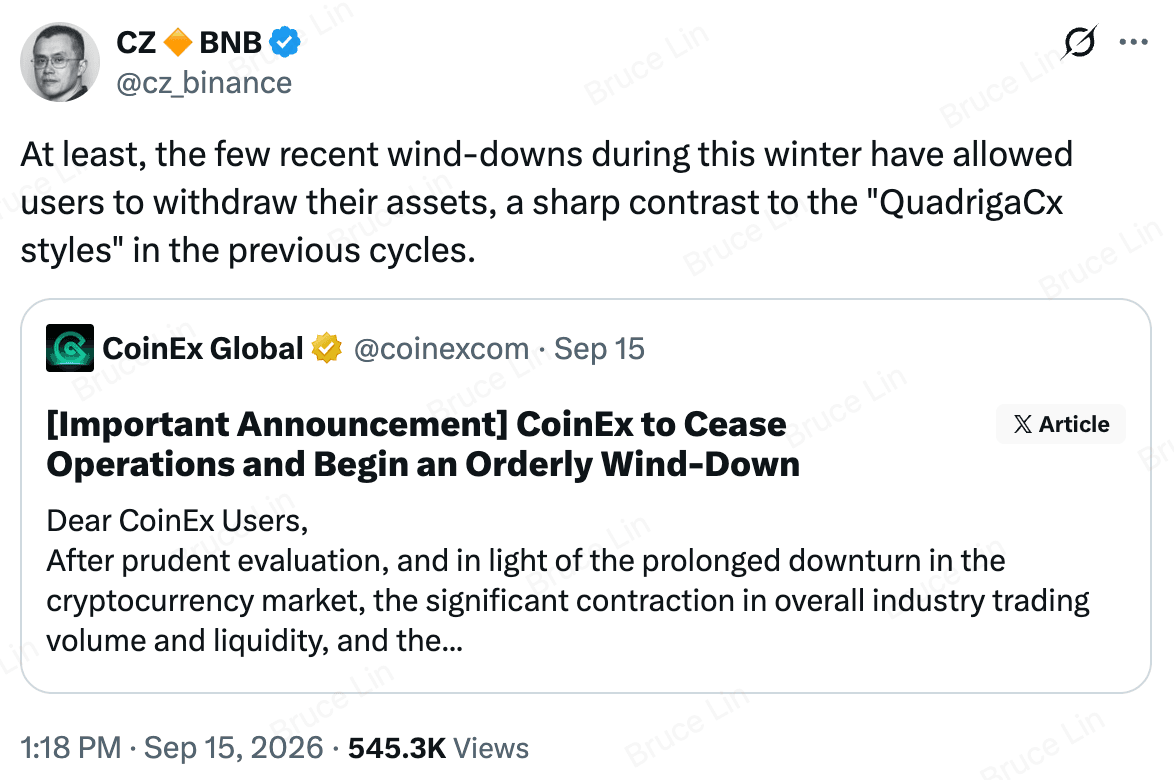
The constructive signal is process quality. Binance founder Changpeng Zhao (CZ) wrote on X on 15 September 2026: “At least, the few recent wind-downs during this winter have allowed users to withdraw their assets, a sharp contrast to the ‘QuadrigaCx styles’ in the previous cycles.” An orderly calendar with open withdrawals is a higher standard than the frozen-account failures of earlier cycles.
That standard is still not a guarantee. Users must complete KYC, test small withdrawals, and move funds before congestion hits. Proof of reserves above 100% is useful evidence of backing. It does not replace a completed on-chain transfer.
Mid-tier platforms that remain open will likely need deeper books, clearer licensing, and more conservative product lines. Long-tail listings and high-yield wrappers are expensive to supervise. Scale venues can spread that cost. Smaller venues cannot.
Why Are Compliance Costs Forcing Mid-Tier Exchanges to Exit?
Compliance costs force exits because they scale with jurisdictions served, not only with revenue. Serving many countries means KYC, travel-rule tooling, listing reviews, sanctions screening, and local restrictions. Those systems stay expensive after volume falls.
CoinEx said regulatory requirements and compliance costs had “exceeded reasonable boundaries.” That language matches a market where regional rules keep tightening even when prices are weak. A mid-tier book that once supported a global user base can become uneconomic once several regions drop out.
Security spend is similar. After a major hot-wallet incident in 2023, CoinEx rebuilt wallet systems and compensated users. Insurance-style buffers and 24/7 monitoring do not shrink just because daily volume does. For a venue with tens of millions of dollars in daily spot flow, that overhead is a large share of the P&L.
The result is consolidation. Liquidity prefers venues that can fund both market-making depth and regulatory infrastructure through a full cycle. Mid-tier brands either specialize narrowly or leave.
Should You Trade on KuCoin After Mid-Tier Exchange Closures?
KuCoin is still a good choice, if you want a large, actively maintained venue while mid-tier platforms wind down. KuCoin remains a full-service exchange for spot, futures, and earn products, with deep pairs that can absorb funds leaving closing venues.
Users leaving CoinEx can move USDT or major coins to KuCoin after a small test withdrawal. Complete identity verification first so large transfers are not delayed. Keep a portion in self-custody if you do not need it for active trading.
KuCoin’s listing coverage and order-book depth matter in a consolidation phase. When smaller venues exit, execution quality concentrates on platforms that still attract professional liquidity. That is the practical difference between a mid-tier book and a scaled venue.
Register on KuCoin, enable security controls (2FA, anti-phishing code, withdrawal whitelist), and only then route size. Do not wait until another platform’s final week. Withdrawal windows look long on a calendar and short when networks congest.
Beyond the Headlines: What KuCoin 5.0 Means for You
Market news moves fast — but where you act on it matters just as much. This October, KuCoin launches KuCoin 5.0, transforming KuCoin into a rebuilt platform. Here's what actually changes for you:
-
One account for everything. Older platforms split your money across separate "spot," "margin," and "futures" accounts and expected you to understand why. KuCoin 5.0's unified account removes that entirely — deposit once, and everything is simply there.
-
Stocks, indices, and commodities. KuCoin 5.0 expands beyond crypto into global markets. When crypto chops sideways and equities rally (or the reverse), you rotate in minutes instead of opening a brokerage account and waiting days for fiat rails.
-
Real-world assets (RWA). Tokenized exposure to traditional assets like commodities, right inside your crypto account. One of the fastest-growing segments in global finance is no longer reserved for institutions — you access it from the same balance you trade with.
-
Earn while you learn. Not ready to trade? KCUSD lets your stablecoins earn daily, auto-compounding interest. The lowest-stress way to put your idle deposit to work for 4% yield.
-
An AI assistant in plain language. Ask questions, get market context, understand what you're looking at — built into the platform, no jargon required.
-
An app that doesn't overwhelm. Faster, cleaner, and consistent — intuitive from the first tap, not after a tutorial.
-
Safety you can check, not just trust. A MiCAR-licensed EU entity, Proof of Reserves you can verify yourself, and internationally certified security (SOC 2 Type II, ISO 27001:2022).
Create your account in minutes — and start on the platform built for where crypto is going, not where it's been.
Conclusion
CoinEx’s 2026 shutdown is an orderly mid-tier exit, not a sudden freeze. Officially, trading winds down through 29 September 2026 and withdrawals remain open until 22 December 2026, with claimed reserves above 100%. CET is retired at 0.005 USDT. Unclaimed USDT after the deadline can face a 5% monthly custody fee.
The broader signal is structural. Mid-tier exchanges are being squeezed by weaker volume, concentrated liquidity at large venues, and compliance costs that do not fall with revenue. CZ’s comment on this winter’s wind-downs — users can still withdraw, unlike “QuadrigaCx styles” in past cycles — sets the right benchmark. Process quality is improving. Business models for smaller global venues are not.
Users should treat dates as hard stops, withdraw original assets before 29 September 2026 when possible, and move remaining USDT early. Choose destinations with scale, published reserves, and working support. Consolidation favors platforms that can fund security and regulation through a full market cycle.
FAQs
Can I still trade on CoinEx after 15 September 2026?
Only within the published limits. New registrations stopped on 15 September 2026. Futures are reduce-only until 22 September 2026. Spot trading ends on 29 September 2026.
What happens to CET after the repurchase?
Remaining CET in accounts is converted at 0.005 USDT on 29 September 2026. CoinEx said no further repurchase or redemption will be offered after that date.
Are CoinEx Wallet and CoinEx Vault closing too?
No. CoinEx stated those products are independent of the exchange and continue under their own terms.
What if I miss the 22 December 2026 withdrawal deadline?
Remaining USDT is moved to independent custody. CoinEx said a 5% monthly fee applies to the original balance, claims go through official email, and the claim cutoff is 22 August 2028.
Disclaimer: This article is for informational purposes only and does not constitute financial, legal, or investment advice. Always conduct your own research before interacting with digital assets.