

Cboe Seeks SEC Approval for 3x Bitcoin and Ether ETFs: What Investors Need to Know
2026/08/17 15:29:00
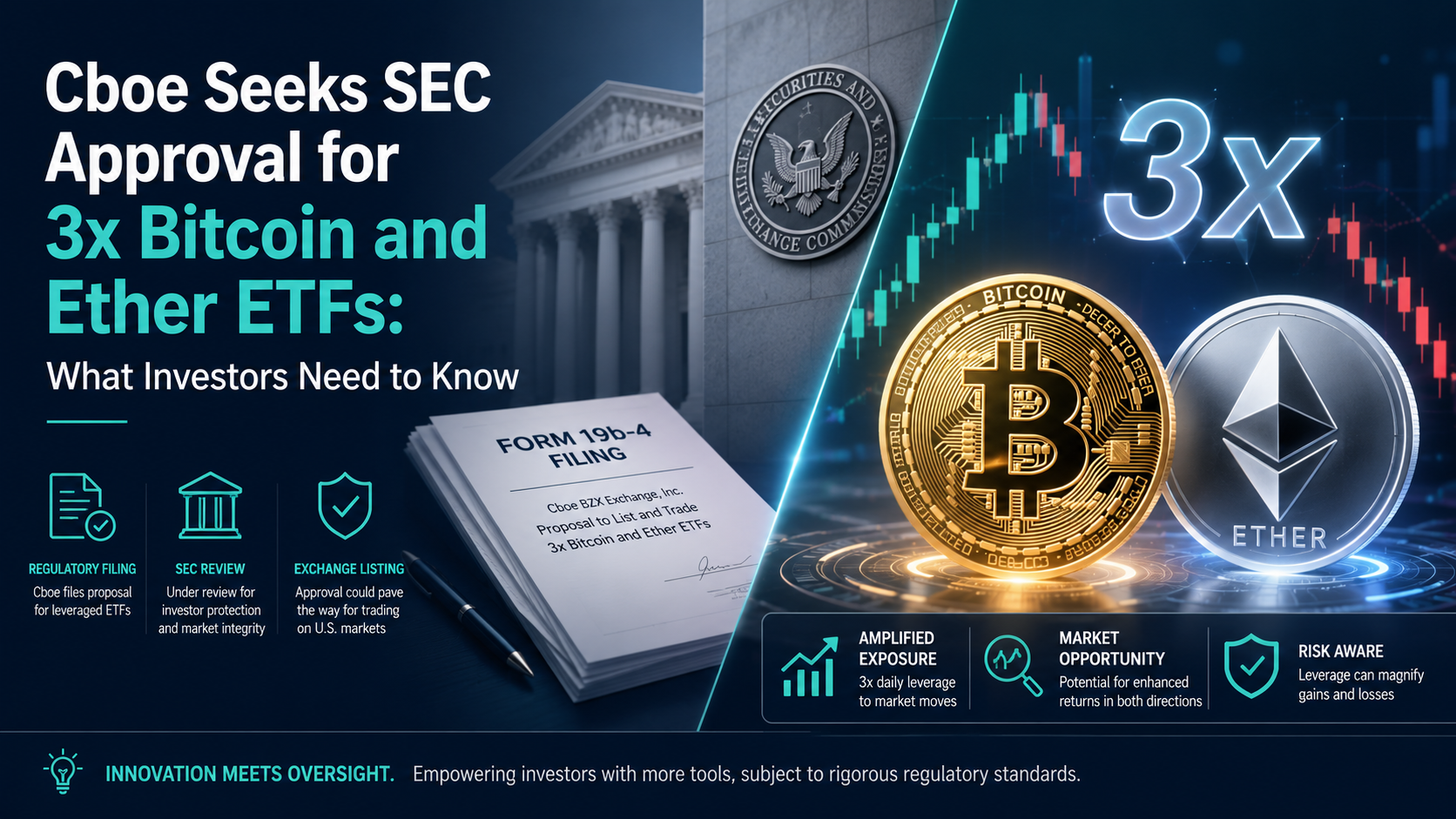
The U.S. crypto ETF market could be moving toward a new level of leverage. Cboe BZX Exchange has filed a proposed rule change with the U.S. Securities and Exchange Commission (SEC) to list a 3x Bitcoin ETF and a 3x Ether ETF sponsored by Volatility Shares. The proposed funds would seek to deliver three times the daily performance of their respective crypto benchmarks, primarily through regulated futures contracts rather than direct holdings of Bitcoin or Ether. The SEC published notice of the filing on August 14, 2026, but the products have not been approved.
That distinction matters. These products would not simply be faster versions of spot Bitcoin or Ether ETFs. They would be highly leveraged, daily-resetting trading vehicles whose performance can diverge sharply from three times the return of BTC or ETH over longer periods. At the same time, the filing raises a broader question for the U.S. market: after opening traditional brokerage accounts to crypto exposure, how far will regulators allow ETF issuers to push leverage and product complexity?
What Did Cboe File With the SEC?
Cboe BZX submitted proposed rule change SR-CboeBZX-2026-065, seeking permission to list six leveraged commodity-linked products: 3x ETFs tied to gold, silver, Bitcoin, Ether, crude oil and natural gas. For crypto investors, the Bitcoin and Ether products are the main attraction. Each would be a series of the VS Trust, with Volatility Shares LLC serving as sponsor and managing the funds' assets. Volatility Shares is already active in leveraged crypto products through funds such as the 2x Bitcoin Strategy ETF (BITX) and 2x Ether ETF (ETHU).
The important point is that Cboe is asking the SEC for permission to list and trade the products under a product-specific rule filing. The filing itself is not an approval order, nor does it mean trading is about to begin. The registration statement for the trust is not yet effective, and the SEC filing explicitly states that the shares cannot cannot trade until the relevant regulatory requirements have been satisfied.
| Detail | What Investors Should Know |
| Exchange | Cboe BZX Exchange |
| Sponsor | Volatility Shares LLC |
| Proposed crypto products | 3x Bitcoin ETF and 3x Ether ETF |
| Investment target | 3x the daily performance of the relevant benchmark, before fees and expenses |
| Main instruments | CME Bitcoin and Ether futures |
| Direct BTC/ETH holdings | No, the proposed funds primarily use futures |
| Current status | SEC review; not approved for trading |
For that reason, headlines suggesting that the SEC has already approved a 3xBitcoin ETF would be premature. The more accurate description is that Cboe is seeking approval for a structure that falls outside its existing generic listing rules.
How Would a 3x Bitcoin or Ether ETF Actually Work?
A 3x crypto ETF sounds simple on the surface: if Bitcoin rises 5%, the fund should rise about 15%. But the structure underneath is quite different from buying three times as much Bitcoin. The proposed funds would use derivatives to create leveraged economic exposure while keeping part of their assets in cash or cash equivalents for collateral and margin purposes.
The Funds Would Use Futures, Not Simply Buy More Crypto
According to Cboe's filing, the 3x Bitcoin ETF would primarily invest in first- and second-month Bitcoin futures contracts traded on the Chicago Mercantile Exchange. It would not invest directly in physical Bitcoin. The Bitcoin futures benchmark would periodically roll positions from the nearest-expiring contract into the following contract over a five-day period. The Ether product would follow a similar futures-based structure.
A simplified example helps illustrate the idea. Suppose a fund has $100 million in net assets. Instead of buying $300 million worth of Bitcoin in the spot market, it could use futures to obtain roughly $300 million of economic exposure to movements in its benchmark. The actual portfolio would be more complicated because the fund must manage futures positions, margin, collateral, creations, redemptions and changing asset values throughout the trading cycle. If the main benchmark futures become difficult to use because of position limits, margin requirements or other constraints, the filing allows the fund to use additional futures, crypto-linked ETPs, ETFs and exchange-traded options.
The Most Important Word Is “Daily”
The proposed funds seek approximately three times the daily performance of their benchmarks before fees and expenses. If the Bitcoin benchmark gains 4% during one trading day, the 3x Bitcoin ETF would target a gain of roughly 12%. If the benchmark falls 4%, the fund would target a loss of roughly 12%. That relationship resets after each trading day.
This daily reset is the key to understanding the product. It means investors should not assume that holding a 3x ETF for a month or a year will produce exactly three times Bitcoin or Ether's return over the same period. The longer the holding period, the more the final result depends on the path prices take from one day to the next.
Why 3x Does Not Mean Triple Your Long-Term Bitcoin Returns
Consider a simple two-day example. Bitcoin begins at 100, rises 10% on the first day and then falls about 9.09% on the second day. Bitcoin finishes back around 100. A daily-resetting 3x product behaves differently because leverage is reapplied to the new value after the first day's move.
| Start | Day 1 | Day 2 | Total Return | |
| Bitcoin benchmark | 100 | 110 | 100 | ~0% |
| Hypothetical 3x daily ETF | 100 | 130 | 94.55 | ~-5.45% |
The ETF loses money even though Bitcoin finishes roughly where it started. This is a consequence of compounding and path dependency rather than an error in the fund. Daily leveraged ETFs are designed around one-day objectives, so repeated gains and losses compound from a changing base. Volatility Shares itself describes its existing BITX product as a daily-resetting leveraged ETF whose investment objective applies to a single day rather than another holding period.
The effect can work in either direction. A sustained trend with relatively low day-to-day reversals can sometimes allow compounded leveraged returns to exceed a simple three-times calculation. A volatile sideways market, however, can be particularly punishing because repeated gains and losses erode the value from which the next day's leveraged return is calculated. That is why a 3x Bitcoin ETF should not be understood as a conventional long-term Bitcoin holding with a performance multiplier attached.
Why Does Cboe Need Special SEC Approval?
Cboe cannot simply list these products under the same generic rules used for qualifying commodity-based exchange-traded products. BZX Rule 14.11(e)(4)(F) prohibits a trust relying on those generic standards from seeking returns corresponding to a specified multiple of a benchmark. Since the proposed funds aim for three times their benchmarks' daily performance, they fall outside that provision and require separate SEC approval through a Section 19(b) rule filing.
The Structure Is Different From a Typical Spot Crypto ETF
The VS Trust also occupies a different regulatory category from a conventional investment-company ETF. The filing states that the trust operates as a commodity pool registered with the Commodity Futures Trading Commission, and the proposed funds would also operate as CFTC-registered commodity pools. Volatility Shares is registered as a commodity pool operator. Neither the trust nor the proposed funds would be registered as investment companies under the Investment Company Act of 1940.
Cboe's argument is therefore not that the leverage restriction does not exist. It explicitly acknowledges that the products fail that particular generic listing standard. Instead, the exchange argues that a product-specific approval is justified because the principal futures instruments are traded on regulated markets, the funds would remain subject to surveillance and disclosure requirements, and leverage does not fundamentally change the underlying futures markets being monitored. The SEC is effectively being asked to decide whether those protections are sufficient for 3x commodity-linked products to trade on a national securities exchange.
Why Are 3x Crypto ETFs Being Proposed Now?
The filing arrives as the ETF industry moves beyond simple market access toward increasingly specialized ways of expressing a view on digital assets. For years, the main debate was whether investors should be able to access Bitcoin or Ether through mainstream brokerage accounts at all. Once crypto exposure became more established in exchange-traded products, product development naturally moved toward leveraged, inverse and strategy-based exposures. Volatility Shares already offers 2x crypto-linked products across several digital assets, showing how quickly this segment has expanded beyond plain 1x exposure.
The regulatory backdrop is evolving at the same time. In June 2026, the SEC issued a broad request for public comment on what it calls “Novel ETFs,” explicitly identifying crypto assets, commodity-focused products, single-stock strategies and heightened leverage among the areas raising new questions. The Commission asked for feedback on investor protection, market surveillance, ETF arbitrage, disclosure and whether current rules adequately address increasingly complex products.
That makes the Cboe filing part of a larger shift from crypto access to crypto financial engineering. The question is no longer simply whether Bitcoin belongs in an exchange-traded product. Issuers and exchanges are now testing how much leverage, tactical exposure and derivative complexity regulators will permit around assets that are already highly volatile on their own.
What Could 3x Bitcoin and Ether ETFs Mean for Crypto Markets?
For crypto traders, perhaps the most important market question is whether approval would create a major new source of buying pressure for Bitcoin and Ether. The answer is more complicated than it was for spot ETFs because these proposed products primarily obtain their exposure in the futures market.
The Impact on Spot BTC and ETH Would Be More Indirect
A spot Bitcoin ETF can translate investor inflows into demand for Bitcoin held by the fund or its associated creation mechanism. A futures-based 3x ETF works differently. New demand for the product would primarily require the fund to adjust derivatives exposure, especially CME futures, rather than purchase three dollars of spot Bitcoin for every dollar invested.
| Feature | 3x Futures-Based Crypto ETF | Spot Crypto ETF |
| Core objective | 3x daily benchmark performance | Track underlying crypto more closely |
| Main exposure | Futures and other permitted derivatives | Direct crypto holdings |
| Daily leverage reset | Yes | No |
| Compounding impact | Potentially substantial | No leveraged daily-reset effect |
| Link to spot buying | Mainly indirect | More direct |
| Typical use case | Tactical or short-term exposure | Broader directional or longer-term exposure |
That does not mean futures demand is irrelevant to the spot market. Futures and spot prices are connected through basis trading, hedging and arbitrage. Large changes in CME positioning can therefore feed into broader crypto market activity. But a hypothetical $1 billion inflow into a 3x Bitcoin ETF should not be interpreted as an automatic $3 billion purchase of spot BTC. The transmission mechanism is materially different.
Daily Rebalancing Could Matter During Large Market Moves
A leveraged ETF also has to adjust exposure as its net asset value changes. If Bitcoin rises sharply, a fund that wants to restore its 3x daily target may need to increase exposure; after a large decline, it may need to reduce exposure. These adjustments are part of maintaining the investment objective rather than a discretionary market call by the portfolio manager.
At a small asset size, those flows may be insignificant relative to global Bitcoin and Ether trading. If leveraged crypto ETFs eventually attract substantial assets, however, their rebalancing could become another source of derivatives-market activity during already volatile sessions. It would be too strong to claim that 3x ETFs would automatically make Bitcoin more volatile, but under certain conditions they could amplify short-term futures and hedging flows, particularly when large price moves and concentrated positioning occur at the same time.
Who Are These ETFs Really For?
The convenience of an ETF wrapper should not obscure the purpose of the product. A 3x Bitcoin or Ether ETF would give traders a way to obtain amplified daily exposure through a conventional brokerage account without individually setting up and managing futures positions. Cboe itself argues that leveraged products can provide efficient tactical exposure and allow market professionals to hedge portfolio positions without directly trading the underlying derivative instruments.
That makes the structure potentially useful for experienced traders who understand leverage, have a defined short-term view and actively manage risk. Someone expecting a brief Bitcoin breakout, for example, could potentially use a 3x ETF as a capital-efficient tactical instrument rather than opening a crypto derivatives position. Institutions and professional traders might also use such products as part of hedging or relative-value strategies.
The same features make the product poorly suited to investors who interpret “3x Bitcoin” as “three times Bitcoin's long-term return.” Daily reset, compounding, futures tracking differences, financing costs and extreme crypto volatility all matter. A trader who buys the fund and ignores it for months could receive a result very different from the simple multiplier implied by the name.
What Could Stop the SEC From Approving Them?
Investor protection is likely to remain one of the central issues. Bitcoin and Ether can already experience price moves that would be considered extreme in many traditional asset classes. Multiplying those daily moves by three produces a product in which gains can accumulate rapidly but losses can also become severe. The SEC's recent request for comment on novel ETFs specifically asks whether new strategies raise concerns around investor understanding, market structure and fair and orderly trading.
Product complexity is another concern. Investors often associate the ETF wrapper with relatively straightforward passive exposure, yet leveraged daily-resetting products behave differently from conventional index ETFs. The SEC has asked whether additional steps are needed to help investors understand what distinguishes novel ETFs from more traditional products. That concern becomes especially relevant when the underlying asset is already known for rapid price swings.
Cboe, however, has several counterarguments. The filing points out that dozens of 3x or -3x exchange-traded investment products already trade on U.S. national securities exchanges. It also emphasizes that the Bitcoin and Ether futures would trade primarily on CME, that the relevant markets are subject to regulatory surveillance, and that each fund would publish daily NAV data while an intraday indicative value would be disseminated every 15 seconds during regular trading hours. In other words, the debate is less about whether leveraged trading exists and more about whether 3x crypto exposure can be safely packaged in this particular exchange-listed structure.
What Happens Next?
The SEC must now consider Cboe's proposed rule change through its standard exchange-rule review process. The filing states that, following publication of the notice in the Federal Register, the Commission generally has 45 days to approve the proposed rule change, disapprove it or institute proceedings to determine whether it should be disapproved. That initial period can be extended to as long as 90 days under specified conditions.
For investors, two distinctions are worth keeping in mind: a filing is not an approval, and an approval is not necessarily an immediate launch. Even if Cboe receives permission to list the products, the relevant registration statement and operational requirements must also be in place before trading can begin.
The next meaningful developments will therefore come from SEC notices, amendments to the filing, potential extensions or proceedings, and eventual product announcements from Cboe or Volatility Shares. Until those steps occur, any ticker, launch date, fee structure or expected asset inflow should be treated cautiously unless confirmed in official documents.
The Bigger Picture for Crypto ETFs
The significance of this filing extends beyond two prospective funds. The first era of U.S. crypto exchange-traded products was largely about access: could investors obtain regulated exposure to Bitcoin and Ether through familiar securities accounts? The emerging phase is about what kind of exposure those accounts can provide. That includes leverage, derivatives, tactical strategies and increasingly complex product structures.
The SEC itself is now studying this broader evolution. Its 2026 request for comment asks how regulators can facilitate ETF innovation while maintaining investor protection and orderly markets. The Cboe proposal sits squarely inside that debate because it combines two categories the SEC has specifically identified as novel: crypto exposure and heightened leverage.
If 3x Bitcoin and Ether ETFs eventually win approval, the milestone would therefore matter for more than their initial trading volume. It could help define how far U.S. regulators are prepared to let crypto ETFs evolve toward the sophisticated product ecosystem already available around equities, indexes and commodities. A rejection, by contrast, could establish a clearer boundary between existing leveraged crypto products and even more aggressive structures.
Conclusion
Cboe's proposed 3x Bitcoin and Ether ETFs show how quickly the crypto ETF market is evolving. The industry has moved from debating basic access to testing leverage, derivatives and more sophisticated trading strategies inside conventional exchange-listed products. Yet the SEC has not approved these funds, and the filing still faces a regulatory process centered on market structure, product design and investor protection.
For crypto investors, the most important takeaway is also the simplest: a 3x Bitcoin ETF would not be a faster version of owning Bitcoin. It would be a daily leveraged trading instrument, primarily using futures and resetting its exposure each trading day. That difference affects everything from long-term returns to risk management and potential market impact.
Whether the SEC ultimately approves the proposal or draws a line at 3x leverage, the decision could become an important signal for where the next phase of U.S. crypto ETFs is headed.
FAQs
Can Investors Lose More Than They Invest in a 3x Crypto ETF?
Generally, investors buying ETF shares in a cash account cannot lose more than the amount invested. However, the leveraged structure means losses can accumulate very quickly.
Would Every Brokerage Offer a 3x Bitcoin ETF?
No. Even if the ETF is approved and listed, individual brokers may restrict access to leveraged products or require additional eligibility checks.
Could a 3x Crypto ETF Be Held in a Retirement Account?
Possibly, but availability would depend on the brokerage platform and account rules. Some retirement accounts may restrict leveraged ETFs.
What Happens During Extreme Crypto Market Moves?
Trading could be halted during severe market disruptions or pricing issues. Extreme volatility may also widen spreads and make it harder for the fund to maintain its target exposure.
Could Other Cryptocurrencies Get 3x ETFs?
Possibly, but approval of Bitcoin and Ether products would not guarantee approval for other cryptocurrencies. Future products would still face separate regulatory and market-structure requirements.
🔥 KuCoin Offers A More Stable Option in A Volatile Market
If you worry about the frequent ups and downs in the market, and pursue a more stable option to earn money passively, KuCoin is the right place to come:

Simple Earn: Deposit and withdraw tokens anytime, earning stable returns.
Kucoin Earn: Earn stable profits with professional asset management.
Hold to Earn: Earn rewards by holding assets in Funding, Trading, Margin, Futures, Mining, and Unified Accounts.
Staking: Unlock the earning potential of on-chain assets.
Advanced Investments: Advanced Investments offer a variety of structured products to help your money grow in any market.
Shark Fin: Principal Protection and Guaranteed Gains
Dual Investment: Buy low and sell high with transparent return calculations.
Snowball: High yields, with price protection.
Discount Buy: Buy crypto at discount prices.
KCS Loyalty: Level up to enjoy exclusive perks by staking ≥ 1 KCS.
KuCoin Wealth: Discover future value and begin your smart investing journey.
KCS Benefits: Hold and stake KCS to access benefits across the platform.
KCS Staking 2.0: Participate in KCS on-chain governance to earn yield.
Disclaimer: This content is for informational purposes only and does not constitute investment advice. Cryptocurrency investments carry risk. Please do your own research (DYOR).