

Bitcoin Stalls, Dogecoin Rallies: Is Crypto Capital Rotating Back Into Altcoins?
2026/08/13 16:52:00
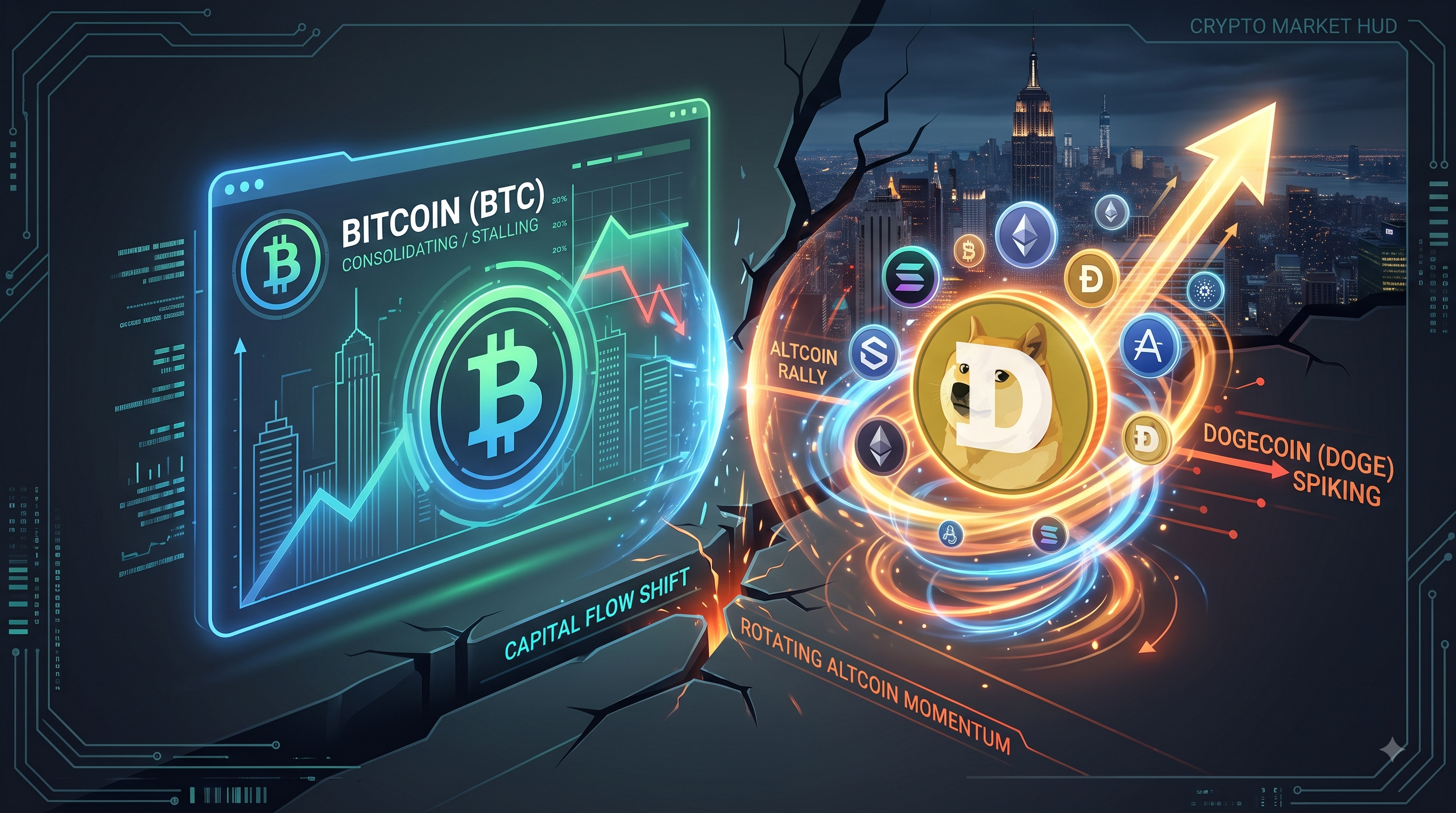
Bitcoin has spent another stretch struggling to generate a decisive move, but Dogecoin briefly broke from the pack. On August 12, DOGE climbed almost 3% to just above $0.07 while Bitcoin slipped toward $63,700, making the meme coin one of the strongest performers among major cryptocurrencies. BNB gained around 2%, while Ether, Solana and XRP posted much smaller moves.
The divergence immediately raised a bigger question than whether Dogecoin could hold a one-day rally: is speculative capital starting to rotate away from Bitcoin and back into altcoins? There are reasons to take that possibility seriously. Whale accumulation has picked up, leveraged DOGE positioning is elevated, and some higher-beta assets are showing relative strength. Yet the evidence remains mixed. DOGE surrendered much of its advance the following day, while Bitcoin stayed near the middle of its recent range. That makes the current market look less like a confirmed altseason and more like an early test of whether investors are ready to move further out on the crypto risk curve.
What Happened to Dogecoin While Bitcoin Stalled?
The contrast between Bitcoin and Dogecoin was unusually clear during the August 12 session. DOGE rose nearly 3% to slightly above seven cents, extending its weekly gain to a similar level. Bitcoin, meanwhile, slipped toward $63,700 and was the only major cryptocurrency tracked by CoinDesk that was lower on both the day and the week. BNB followed Dogecoin with a roughly 2% advance to around $614, while XRP gained a little more than 0.5%. Ether and Solana moved only modestly higher.
That matters because crypto traders rarely judge altcoin strength only by whether a token is rising in dollar terms. Relative performance against Bitcoin is often more revealing. If BTC gains 8% while DOGE rises 3%, Dogecoin is technically going up but losing ground within the crypto market. When Bitcoin is flat or falling and DOGE rises instead, the signal is different: investors appear more willing to accept additional risk for the possibility of higher short-term returns.
| Asset | Market Behavior During the Move | What It Suggested |
| Bitcoin | Slipped toward $63,700 | Market leader lacked momentum |
| Dogecoin | Rose nearly 3% | Strong speculative demand |
| BNB | Rose about 2% | Some large-cap altcoin strength |
| Ethereum | Slightly higher | No clear ETH-led rotation yet |
| XRP / SOL | Modest or mixed gains | Rotation remained selective |
The rally did not hold cleanly, however. By August 13, DOGE had fallen back toward $0.07 and was down almost 3% on the day, while Bitcoin remained near $63,500. That reversal is important because it prevents the initial move from being treated as proof of a durable trend. It does, however, give traders a useful case study in how quickly speculative capital can move when Bitcoin stops dominating short-term momentum.
Why Is Dogecoin Outperforming Bitcoin?
Dogecoin did not begin its move from a position of obvious strength. Before the rally, DOGE had been trading near the lower part of its recent range and remained far below longer-term trend levels. That created a setup in which even a modest improvement in buying pressure could produce an outsized percentage move. Analysis published before the rally placed short-term support near $0.0676 and resistance around $0.074, meaning DOGE was essentially attempting to recover inside a still-fragile technical structure rather than breaking from an established bull trend.
Whale Accumulation Helped Build Support
Large DOGE addresses provided one possible source of that buying pressure. Wallets holding between 10 million and 100 million DOGE increased their balances by around 180 million tokens during the preceding pullback, according to Santiment data cited by AMBCrypto and KuCoin. Their share of total DOGE supply rose from approximately 11.85% to 11.97%. The data requires some caution because wallets in this category can include exchanges or custodians, so a higher balance does not automatically mean individual whales are making directional bets. Still, the increase suggested that larger holders were not uniformly selling into the weakness.
The other important element was positioning. When a cryptocurrency sits near support after a prolonged decline, short sellers may become increasingly confident that another leg lower is coming. If the downside fails to materialize, even a relatively small rise can force traders to reduce bearish exposure. That buying can amplify an initial rebound. In DOGE's case, the combination of accumulation, deep liquidity and a highly active derivatives market made it particularly capable of producing a fast move even without a broader crypto breakout.
Leverage Is Becoming a Bigger Part of the DOGE Story
The derivatives market may now be more important to Dogecoin's short-term outlook than the original 3% price increase. DOGE futures open interest climbed to approximately $1.21 billion by August 13, up from roughly $930 million in late June. Measured in DOGE rather than dollars, outstanding futures positioning had risen to about 17.18 billion DOGE, close to levels last seen in October 2025 even though Dogecoin's price is now dramatically lower than it was then.
That tells traders two things at once. First, speculative interest in Dogecoin is clearly alive. Second, an increasingly leveraged market can become more fragile. CoinDesk reported that the number of long DOGE accounts on Binance exceeded short accounts by more than three to one, while the ratio on OKX was above five to one. Those account ratios do not mean the dollar value of longs is five times larger—every futures contract has both sides—but they do show that bullish positioning has become crowded among participating accounts.
The distinction between spot demand and leveraged demand is therefore critical. A rally supported by sustained spot purchases can continue even as traders reduce leverage. A rally driven mainly by futures can reverse much faster when price momentum disappears. Earlier data already showed DOGE open interest near $1.17 billion while funding remained positive, with analysts warning that stronger spot buying would be needed to clear the $0.074 resistance area convincingly. The fact that DOGE subsequently gave back much of its gain makes that warning particularly relevant.
Is Crypto Capital Really Rotating Into Altcoins?
Capital rotation is often described too literally. Traders do not need to sell one dollar of Bitcoin and immediately put the same dollar into Dogecoin for an altcoin rotation to occur. Rotation can also happen when Bitcoin receives fewer new speculative inflows while fresh capital, stablecoins or leveraged traders increasingly target assets with higher expected volatility.
A classic crypto rotation often develops in stages. Bitcoin establishes a strong move first because it has the deepest liquidity and is generally perceived as the least risky major crypto asset. When BTC later consolidates without collapsing, traders begin looking for additional upside elsewhere. Ethereum and large-cap altcoins can then strengthen, followed by smaller tokens and, in highly speculative phases, meme coins. The important ingredient is not that Bitcoin must fall. In fact, a relatively stable Bitcoin market can be more favorable for altcoins than a rapidly declining one because investors still feel confident enough to take risk.
The current market only partially fits that pattern. DOGE and BNB outperformed during the August 12 session, but performance across major cryptocurrencies was not uniformly strong. Ether and Solana only edged higher, XRP's gain was limited, and HYPE declined. The following session was even less convincing: DOGE reversed lower while much of the crypto market remained subdued. For now, selective risk rotation is a better description than a broad altseason.
What Bitcoin Dominance Can Tell Us
Bitcoin remains the key reference point because altcoin rallies usually depend on what BTC does next. One of the most widely watched indicators is Bitcoin dominance, which measures Bitcoin's share of the total cryptocurrency market capitalization. A sustained decline in dominance during a stable or rising overall crypto market can indicate that altcoins are capturing a growing share of capital.
However, falling dominance should never be interpreted in isolation. If Bitcoin falls sharply and the total market contracts, some altcoins may still outperform BTC on a relative basis while losing substantial value in dollar terms. What traders generally want to see for a healthier rotation is a combination of stable or gradually rising total crypto capitalization, Bitcoin holding major support and an increasing number of altcoins outperforming BTC.
| Bitcoin Environment | Typical Implication for Altcoins |
| BTC rallies aggressively | Capital often concentrates in Bitcoin first |
| BTC trades sideways near support | Often the most favorable setup for rotation |
| BTC rises slowly while dominance falls | Constructive for broader altcoin participation |
| BTC breaks sharply lower | Higher-beta altcoins can face amplified losses |
Bitcoin's current behavior therefore creates both an opportunity and a risk. BTC was still hovering near $63,500–$63,700 around the DOGE move, and even an in-line U.S. inflation report failed to generate a sustained crypto breakout. If Bitcoin continues to hold its range without attracting all available speculative capital, altcoins may get more room to move. If BTC breaks materially lower, however, that same high-beta characteristic that helped DOGE outperform could quickly work in the opposite direction.
Why Meme Coins Often Move Before the Rest of the Market
Dogecoin occupies a unusual position in the crypto market. It is a meme coin, but unlike thousands of smaller speculative tokens, DOGE has years of trading history, broad exchange availability, deep derivatives markets and strong brand recognition. That combination makes it an efficient vehicle for traders who want exposure to changes in speculative sentiment without moving into extremely illiquid tokens.
This is why DOGE can sometimes behave like a barometer for risk appetite. When traders become more optimistic but Bitcoin offers limited short-term movement, they may prefer an asset where a relatively small change in demand can produce a larger percentage move. Dogecoin fits that profile. Its August 12 outperformance is therefore more interesting than the 3% figure alone: it showed that at least some market participants were willing to move further along the risk spectrum even while BTC itself lacked momentum.
But meme-coin leadership has two interpretations. If DOGE rises first and Ethereum, Solana, XRP, BNB, DeFi tokens and other sectors later follow, the move can be viewed as an early risk-on signal. If DOGE rallies largely because futures traders pile into leveraged positions while the broader altcoin market remains quiet, it is closer to isolated speculation. The rapid rebuilding of DOGE open interest while price remains near seven cents means traders should currently take both possibilities seriously.
What Would Confirm a Real Altcoin Rotation?
A sustained altcoin rotation needs breadth. Dogecoin can start the conversation, but one token cannot confirm a market-wide shift. The strongest evidence would be a coordinated change across Bitcoin, Ethereum, large-cap altcoins, trading volumes and sector performance rather than a sequence of isolated pumps.
| Confirmation Signal | Why It Matters |
| Bitcoin holds its range | Reduces systemic downside pressure |
| BTC dominance trends lower | Suggests capital is spreading beyond BTC |
| ETH begins outperforming BTC | Often signals stronger large-cap risk appetite |
| Multiple major altcoins rise together | Shows the rally has breadth |
| Spot volume expands | Makes the move less dependent on leverage |
| Strength spreads across sectors | Indicates rotation is broader than meme speculation |
Ethereum is particularly important here. A market in which DOGE rallies while ETH remains structurally weak is very different from one in which ETH begins outperforming BTC and major altcoins rise together. Ethereum has historically served as a bridge between Bitcoin-dominated markets and more aggressive altcoin speculation because it sits between BTC and smaller tokens in liquidity, market capitalization and perceived risk.
Spot activity will be equally important. The current DOGE setup already contains a large amount of futures positioning, with open interest around $1.21 billion as of August 13. If DOGE eventually clears resistance while spot participation expands and leverage becomes less concentrated, the move would look considerably healthier. If open interest continues rising while price stalls near $0.07, the market may instead be building the conditions for another liquidation-driven move.
Macro Conditions Still Matter for Altcoins
The DOGE rally also took place around a major U.S. inflation event, which helps explain why Bitcoin remained hesitant. July CPI ultimately rose 0.1% month over month and 3.4% year over year, while core CPI increased 0.2% monthly and eased to 2.5% annually. The report was broadly in line with economists' forecasts.
Markets reacted positively but not dramatically. U.S. equity indexes opened higher, Treasury yields declined and the dollar weakened slightly as the inflation figures reduced some concern about an immediate Federal Reserve rate increase. Futures were pricing roughly a 55% probability that the Fed would leave its policy rate unchanged at the September meeting after the data. (Reuters) Bitcoin, however, received only a short-lived boost and soon returned toward $63,500. CoinDesk described the report as sufficient to remove a downside risk but not surprising enough to create a lasting catalyst for BTC.
That distinction matters for altcoins. A macro environment that does not force investors out of risk assets but also does not send Bitcoin sharply higher can create space for relative-value and speculative trades elsewhere in crypto. At the same time, oil prices, future inflation data and Federal Reserve policy remain potential volatility sources. Capital rotation is much easier to sustain when macro uncertainty is contained than when investors are rapidly reducing risk across markets.
What Could Stop the Dogecoin Rally?
The clearest threat is a Bitcoin breakdown. Altcoins can outperform BTC while Bitcoin consolidates, but they rarely remain insulated when the market's largest asset enters a sharp risk-off move. Because DOGE tends to exhibit higher volatility, a major Bitcoin selloff could translate into disproportionately large losses for the meme coin. The current setup is therefore dependent not only on DOGE holding its own support but also on BTC avoiding a destabilizing move lower.
Leverage is the second major risk. DOGE futures open interest has risen sharply since late June, and bullish account ratios on several major exchanges are already heavily skewed toward longs. If traders continue adding leverage while DOGE struggles to make new highs, the market becomes increasingly vulnerable to a long squeeze. A relatively small decline can then force leveraged positions to close, adding automatic selling and accelerating the move.
Finally, the technical recovery remains unfinished. The $0.074 region was identified as an important near-term resistance area before the latest rally, with support around $0.0676 and a potential upside path toward $0.08 only if DOGE could close convincingly above resistance. The fact that DOGE briefly strengthened and then returned toward seven cents reinforces the need for confirmation rather than assuming that a 3% session marked a permanent change in trend.
What Should DOGE and Altcoin Traders Watch Next?
For Dogecoin itself, the first question is whether buyers can defend the area around $0.07 and eventually challenge the $0.074 resistance zone again. A sequence of higher lows combined with stronger spot participation would be more constructive than another brief futures-driven spike. Conversely, a sustained move below the lower end of the recent range would make the August rally look increasingly like temporary positioning rather than the beginning of a larger recovery.
Bitcoin's range is the second piece of the puzzle. BTC does not necessarily need to rally for altcoins to perform well. What may be more useful is stability: Bitcoin holding support while volatility contracts and traders begin searching for returns elsewhere. The macro backdrop will remain part of that equation. After July CPI came in largely as expected, the next major catalysts include additional labor-market data, central-bank communication and the next inflation release.
The final indicator is market breadth. Traders should ask whether DOGE remains an isolated leader or whether strength starts moving through Ethereum and other liquid altcoins. The difference between those scenarios is significant.
| Next Market Scenario | Likely Interpretation |
| DOGE rises and major altcoins follow | Rotation thesis becomes stronger |
| DOGE rises but ETH and other majors lag | Selective speculative trade |
| ETH/BTC strengthens while BTC holds | More convincing altcoin setup |
| DOGE open interest rises but price stalls | Leverage risk increases |
| Bitcoin breaks sharply lower | Rotation thesis weakens considerably |
| Strength spreads across sectors | Indicates rotation is broader than meme speculation |
This framework is more useful than trying to identify an exact date when “altseason” begins. Capital rotation is a process, not a switch. The broader the participation and the stronger the spot demand, the more confidence traders can place in the move.
Conclusion: DOGE Is a Signal, Not Yet Proof of Altseason
Dogecoin's brief 3% rally mattered because of when it happened. Bitcoin was struggling for direction near $64,000, yet DOGE attracted enough speculative demand to outperform nearly every major cryptocurrency. Whale accumulation, elevated derivatives activity and a search for higher-beta opportunities all contributed to an environment in which Dogecoin could move faster than BTC.
But the following session provided an equally important reminder: DOGE quickly gave back much of the gain while futures positioning remained elevated. The most reasonable interpretation is therefore not that a new altseason has already begun, but that crypto capital is testing the waters outside Bitcoin. If BTC remains stable, Ethereum begins outperforming, Bitcoin dominance weakens and stronger spot demand spreads across major altcoins, the rotation argument will become much more convincing. Until then, Dogecoin should be viewed as an early signal of returning speculative appetite—not definitive proof that the entire altcoin market has changed direction.
FAQs
What does the TOTAL3 crypto market cap measure?
TOTAL3 is commonly used by crypto traders to track the combined market capitalization of cryptocurrencies excluding Bitcoin and Ethereum. Because it removes the two largest assets, it can provide a clearer view of whether capital is flowing into the broader altcoin market rather than simply reflecting movements in BTC or ETH.
Why do traders watch the DOGE/BTC pair?
DOGE/BTC shows how Dogecoin is performing relative to Bitcoin rather than the U.S. dollar. If DOGE/USD rises while DOGE/BTC falls, Bitcoin is actually outperforming Dogecoin. A rising DOGE/BTC pair can therefore provide stronger evidence that speculative capital favors DOGE over BTC.
How can stablecoin liquidity affect an altcoin rally?
Stablecoins often function as readily deployable capital within crypto markets. When stablecoin liquidity is abundant and investors become more willing to take risk, that capital can move rapidly into altcoins. Weak liquidity conditions, by contrast, can make it harder for broad rallies to continue even when individual tokens temporarily surge.
What is the difference between open interest and spot trading volume?
Open interest measures the value of derivatives contracts that remain outstanding, while spot volume measures actual trading of the underlying cryptocurrency. Rising open interest can indicate growing speculative exposure, but strong spot demand generally provides better evidence that buyers are acquiring the asset without relying primarily on leverage.
Why can Dogecoin move sharply during low-liquidity periods?
DOGE is highly sensitive to changes in speculative positioning. During periods when market liquidity is thinner, relatively modest buying or selling pressure can have a larger price impact. If leveraged traders are heavily positioned at the same time, liquidations can amplify the move in either direction.
🔥 KuCoin Offers A More Stable Option in A Volatile Market
If you worry about the frequent ups and downs in the market, and pursue a more stable option to earn money passively, KuCoin is the right place to come:
Simple Earn: Deposit and withdraw tokens anytime, earning stable returns.
Kucoin Earn: Earn stable profits with professional asset management.
Hold to Earn: Earn rewards by holding assets in Funding, Trading, Margin, Futures, Mining, and Unified Accounts.
Staking: Unlock the earning potential of on-chain assets.
Advanced Investments: Advanced Investments offer a variety of structured products to help your money grow in any market.
Shark Fin: Principal Protection and Guaranteed Gains
Dual Investment: Buy low and sell high with transparent return calculations.
Snowball: High yields, with price protection.
Discount Buy: Buy crypto at discount prices.
KCS Loyalty: Level up to enjoy exclusive perks by staking ≥ 1 KCS.
KuCoin Wealth: Discover future value and begin your smart investing journey.
KCS Benefits: Hold and stake KCS to access benefits across the platform.
KCS Staking 2.0: Participate in KCS on-chain governance to earn yield.
Disclaimer: This content is for informational purposes only and does not constitute investment advice. Cryptocurrency investments carry risk. Please do your own research (DYOR).