

Bitcoin Rebounds Above $80K: Is Strategy (MSTR) Really Out of Danger?
Introduction
Bitcoin traded above $81,000 on August 25, 2026 — a rebound of roughly 38% from its late-June closing low near $58,600. Days later, Strategy (NASDAQ: MSTR) confirmed buying 4,603 BTC at an average of $80,318, its first purchase in ten weeks.
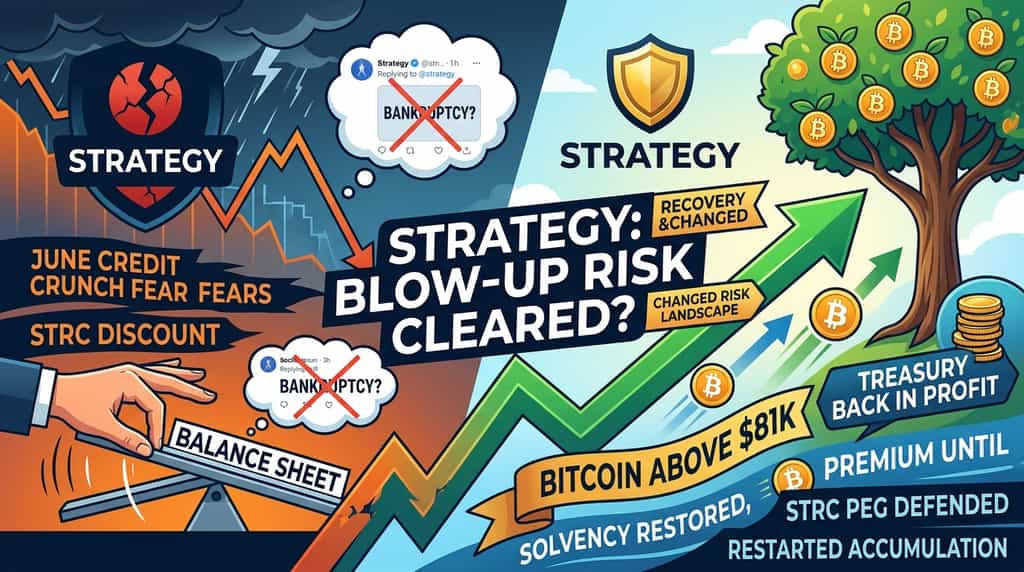
Is Strategy's blow-up risk finally over? Short answer: the acute phase has passed, but the risk has changed shape rather than disappeared. The June collapse narrative was always structurally flawed, and the balance sheet is now visibly stronger. Below, we break down what actually protected Strategy, what changed with its June credit framework, why it sold low and bought back high, and what its "Bitcoin bank" ambition means for investors.
Has Strategy Cleared Its Blow-Up Risk Now That Bitcoin Is Back Above $80K?
Yes on near-term solvency — no on full risk elimination. Every major stress indicator that flashed red in June 2026 has meaningfully improved over the past two months.
Bitcoin closed at about $80,959 on September 4, comfortably above Strategy's average cost basis of $75,412 per coin. The company's treasury is back in profit: its 845,050 BTC are worth roughly $68.4 billion against a total cost of about $63.7 billion, based on data from bitcointreasuries.net as of early September. That is a remarkable swing from late July, when Galaxy Research noted the company was sitting on an unrealized loss of roughly $14 billion.
The credit side has healed as well. STRC, Strategy's perpetual preferred stock and the market's real-time gauge of its creditworthiness, traded at $97.82 on September 3 — up from an all-time low of $71.25 hit on June 26. Strategy also maintained STRC's dividend rate at 12.00% for September, per its August 31 announcement, and resumed Bitcoin accumulation with a $369.7 million purchase funded by a $602.8 million equity raise, as reported by Yahoo Finance on September 1.
| Metric | Latest Reading |
| BTC holdings | 845,050 BTC (as of August 30, 2026) |
| Average cost basis | $75,412 per BTC |
| Total cost / market value | ~$63.7B / ~$68.4B |
| Latest purchase | 4,603 BTC at $80,318 average (August 24-30) |
| STRC price | $97.82 (September 3, TradingView) |
| STRC dividend rate | 12.00% (maintained for September 2026) |
| USD Reserve | $2.55B, covering ~17.4 months of obligations (June 28 disclosure) |
| mNAV | ~1.08x enterprise / ~0.81x basic (early September) |
The verdict: the question is no longer whether Strategy can survive — it demonstrably can — but how efficiently its funding flywheel can run at a much lower valuation premium than it enjoyed in 2024.
Why Didn't Strategy Collapse When Bitcoin Crashed?
Strategy never faced forced liquidation because its balance sheet contains no forced-selling mechanism at all. Much of the panic narrative earlier this year was simply wrong on the mechanics.
No Margin Calls, No Liquidation Price
Strategy's Bitcoin is not pledged to any lender, and its convertible notes are unsecured. The bond indentures contain no clause that triggers repayment if Bitcoin falls to a specific price. There is no margin loan, no liquidation level, and no collateral ratio attached to the treasury. Even if Bitcoin dropped to $20,000, no creditor could compel the company to sell a single coin. This is the single most misunderstood fact about the company — the "bankruptcy" scenario that trended on social media in June had no contractual path to happen.
Governance: No Creditor Coup Is Possible
Michael Saylor holds roughly 47% of the company's voting power through his Class B shares. Even in a worst-case scenario, bondholders cannot seize control of the board and force a fire sale of the Bitcoin treasury. Control risk, which sank leveraged crypto lenders in 2022, is structurally absent here.
What actually happened in June was not a solvency crisis but a confidence crisis — and the difference matters, because confidence crises are fixed with liquidity management, not bankruptcy courts.
What Is the Digital Credit Capital Framework Strategy Launched in June?
The Digital Credit Capital Framework, launched on June 29, 2026, is Strategy's formal rulebook for defending its credit products under stress. It marked the company's shift from one-way fundraising to active capital management.
The trigger was STRC's de-anchoring. In mid-to-late June, the preferred stock fell to around $73 — a roughly 27% discount to its $100 stated amount — as investors questioned Strategy's cash flow, dividend capacity, and financing channel. A broken peg threatened the entire funding model: if STRC cannot be issued near par, new capital becomes expensive or unavailable.
The framework has five components:
-
USD Reserve policy. The company ring-fenced $2.55 billion in cash (as of June 28) exclusively for preferred dividends and debt interest, covering about 17.4 months of its roughly $1.76 billion in annual obligations, with a minimum requirement of 12 months of coverage.
-
STRC dividend resets. Strategy raised STRC's rate to 12.00% effective July 1 and has held it there through September, per its August 31 announcement — buying back market confidence with yield.
-
$1 billion Digital Credit repurchase program, allowing buybacks of discounted STRC, STRF, STRD, and STRK.
-
$1 billion MSTR buyback authorization.
-
BTC monetization. The board authorized up to $1.25 billion of Bitcoin sales to build reserves, extending total coverage to roughly 25.9 months of obligations, according to company disclosures.
Crucially, Strategy actually used the new toolkit. The company sold about 7,000 BTC between June and August — under 1% of its holdings — with proceeds funding Stretch dividends, and CEO Phong Le described the sale as tiny and not price-driven, according to TradingView data published September 3. Its first-ever Bitcoin sale, just 32 BTC in late May, also went toward a dividend payment.
The significance is easy to miss: Strategy's doctrine has quietly shifted from "never sell" to "sell a little when it protects the structure." That pragmatism lowers the probability of a sudden default even further — but it also changes what the company is, which leads to the market's biggest confusion.
Why Did Strategy Sell Bitcoin Low and Buy Back High?
Strategy sold low and bought back higher because its true engine is not the Bitcoin price — it is the premium of MSTR stock relative to the company's Bitcoin net asset value, and that premium dictates which funding source is cheapest at any moment.
The Flywheel: How the Bitcoin Treasury Machine Works
When MSTR trades above the net value of its Bitcoin holdings, Strategy can issue common or preferred shares, raise dollars, and buy more BTC. If the new Bitcoin added per share exceeds the dilution from new shares, each share ends up backed by more BTC than before — the metric Saylor calls "BTC Yield."
The flywheel then reinforces itself: Bitcoin rises, MSTR rises faster, the premium widens, financing gets cheaper, and fresh purchases deepen the company's Bitcoin exposure. This loop powered Strategy's expansion for years.
When the Flywheel Reverses
The same machine slows or runs backward when Bitcoin falls. MSTR's mNAV peaked near 3.4x in November 2024 but briefly dipped below 1.0x in June 2026, and SimpleMining reported a basic mNAV reading of just 0.68x on August 3. With the stock at or below the value of its coins, issuing equity becomes dilutive rather than accretive. Yet preferred dividends of roughly $1.76 billion a year still come due, and STRC's peg near $100 still needs defending.
At that point, selling a small slice of Bitcoin — under 1% of the stack — is simply the cheapest source of cash available. That is what the June-August sales were: not a loss of faith, but balance-sheet plumbing.
Why Buying Back at $80,318 Makes Sense
The August 24-30 purchase signals the flywheel has restarted. Bitcoin's rebound repaired the asset side of the balance sheet, MSTR's recovery reopened the equity window — the company raised $602.8 million by issuing 4.53 million shares, per Yahoo Finance — and stronger dollar reserves eased pressure on dividends and debt. Buying 4,603 BTC at $80,318, above the June sale prices, is not a trading blunder; it is proof the premium channel works again. Selling low and buying high is the price of keeping the credit structure intact, and it cost shareholders far less than a distressed financing would have.
What Is Strategy's Long-Term Plan to Become a Bitcoin Bank?
Strategy's endgame is to evolve from a leveraged Bitcoin holder into a Bitcoin-backed credit institution — effectively, a Bitcoin digital bank. Saylor first articulated this vision in October 2024, telling Bernstein that the goal is to be "the leading bitcoin bank," issuing Bitcoin capital market instruments across equity, convertibles, fixed income, and preferred shares, as reported by Forbes.
That vision is now operational. STRC is marketed on Strategy's own website as "short-duration high-yield credit," with roughly $9.8 billion in notional outstanding and a 12.00% dividend as of September 2026. Alongside STRF, STRK, STRD, and the euro-denominated STRE, the company has built what amounts to a yield curve of Bitcoin-backed credit products. Earlier this year, Saylor described the ambition plainly on the Bankless podcast: bank-style accounts paying around 8%, funded by Bitcoin-backed credit yielding more. The long-term target, repeated across his interviews, is a trillion-dollar Bitcoin balance sheet whose appreciation funds an entire credit system.
This framing explains the past three months better than any trading logic. A bank does not panic-sell its reserve asset — but it absolutely manages liquidity, defends the price of its liabilities, and protects depositor confidence. The Digital Credit Capital Framework, the STRC rate hikes, the discounted buybacks, and the small BTC sales are all moves straight out of a bank's playbook. Strategy's darkest hour was never about insolvency; it was about whether its deposit-like instrument, STRC, would hold its peg. With STRC back near $98, that question has been answered for now.
What Risks Does Strategy Still Face?
Strategy's risk has shifted from sudden collapse to slow erosion — and four pressure points remain worth watching.
A thin premium. The enterprise mNAV of roughly 1.08x (early September) is a fraction of the 3.4x peak of November 2024, and basic readings from third-party trackers still sit below 1.0x. (Note that Strategy redefined its own dashboard mNAV methodology on July 23, so company and tracker figures are not directly comparable, per SimpleMining.) A thin premium means every new share issue is only marginally accretive — the flywheel is turning, but at low speed.
Growing obligations. Annual preferred dividends and interest run at about $1.76 billion and rise each time new preferred stock is issued. The $2.55 billion reserve is a buffer, not a solution, and it depletes with every payment cycle.
Narrative risk. If occasional Bitcoin sales become recurring sales, investors may reprice the entire model. As Alex Thorn of Galaxy Research put it in July, per CryptoNews, the open question is whether the framework solves Strategy's capital-structure issues or merely postpones them.
Market risk. Bitcoin is still down roughly 31% from a year ago. A re-test of the $60,000 region would re-stress the premium, the peg, and the reserve all at once. Shareholders also continue to absorb dilution, with 4.53 million new shares issued for the latest raise alone.
Trade the Setup on KuCoin and Enter the Prize Pool
When a market narrative is in motion, the next step is not only to decide the view, but to place it where liquidity, tools, and extra incentives line up. KuCoin’s KuLeague (Fall Season 2026) futures trading competition runs from August 31 to September 21, 2026 (UTC+8) and offers a 400,000 USDT prize pool, split across a Team Battle (100,000 USDT), a Solo PnL Contest (60,000 USDT), and a Grand Lucky Draw (240,000 USDT).
Trade $500 in a day to unlock a daily spin with a 100% prize rate. Use the same positions you would take for the story above — and compete for rewards at the same time:

Conclusion
Strategy has not eliminated its risks, but it has decisively moved past the acute danger zone. The June stress test proved three things: the company's balance sheet has no forced-selling trigger, its leadership cannot be dislodged by creditors, and its new Digital Credit Capital Framework works under real pressure — STRC's recovery from $71.25 to nearly $98 is the market's own verdict.
The August purchase of 4,603 BTC confirms the funding flywheel has restarted, with Bitcoin back above the company's $75,412 average cost and its treasury showing roughly $4.7 billion in unrealized profit instead of July's $14 billion paper loss. Yet the long-term picture is more nuanced than the rescue narrative suggests. Strategy is transitioning from a pure accumulator into an active manager of a Bitcoin-backed credit system — a Bitcoin bank in the making. Its remaining risks are structural rather than existential: a thin equity premium, a growing dividend bill, and a model that still depends on capital markets staying open. For Bitcoin holders, that is broadly good news — the largest corporate buyer is stabilizing, not exiting.
FAQs
Is STRC the same as a bank savings account?
No. Strategy states on its own website that STRC is neither a bank deposit nor FDIC insured, and it lacks the regulatory protections of bank accounts or money market funds. Its 12.00% dividend is variable, reviewed monthly, and not guaranteed.
What is the difference between buying MSTR and a spot Bitcoin ETF?
MSTR is an operating company whose value depends on capital-market execution, not just Bitcoin's price — it can trade at a premium or discount to its holdings, as its 0.68x to 3.4x mNAV range shows. A spot Bitcoin ETF simply tracks the Bitcoin price minus a small management fee.
Does Strategy earn yield on its Bitcoin?
No. Strategy does not lend or stake its Bitcoin, and the treasury generates no interest income. The "BTC Yield" figure the company promotes measures growth in Bitcoin per share from accretive financing — it is an accounting metric, not cash yield.
Disclaimer: This article is for informational purposes only and does not constitute financial, legal, or investment advice. Always conduct your own research before interacting with digital assets.