

Bitcoin-Gold Correlation Hits 6-Year High: Why the Debasement Trade Is Back in 2026
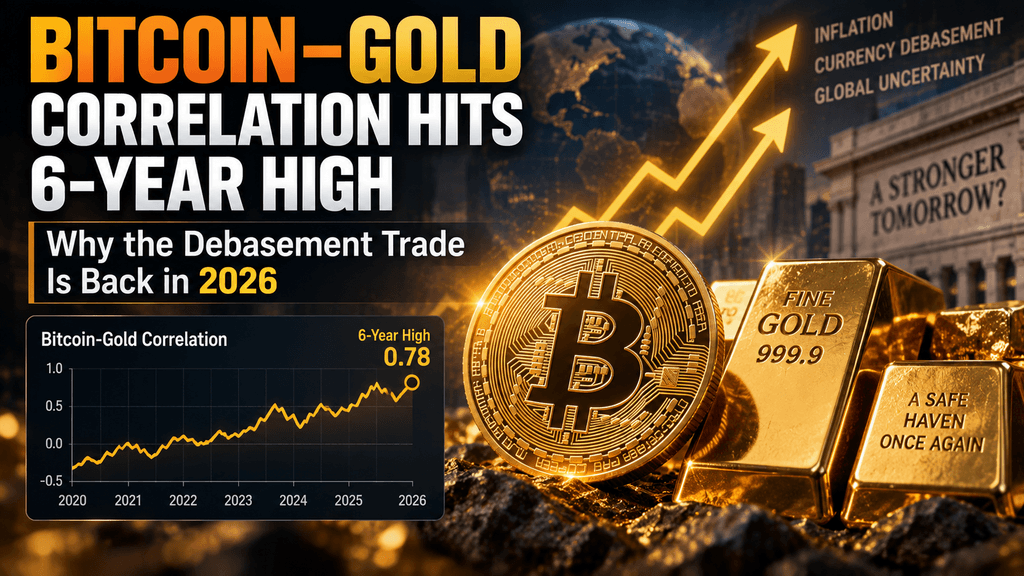
Bitcoin and gold are moving together again—and this time the relationship is unusually strong. By late August 2026, Bitcoin's 90-day rolling correlation with gold had climbed to its highest level in nearly six years, according to Bitwise data. At the same time, Bitcoin remained negatively correlated with the U.S. Dollar Index, while its relationship with the Nasdaq 100 weakened to around a one-year low. Bitwise described the shift as a clear revival of the debasement trade, a macro strategy built around scarce assets that may preserve value when investors become increasingly concerned about government debt, fiscal policy and the long-term purchasing power of fiat currencies.
The timing is significant. U.S. federal debt has crossed $40 trillion, long-term Treasury yields have climbed to levels not seen in years, and government bond markets around the world are under pressure. Bitcoin, meanwhile, surged roughly 25% in August and reclaimed $80,000, while gold gained close to 10% during the month.
Does this mean Bitcoin is finally becoming digital gold? The answer is more complicated. The latest correlation suggests investors are increasingly using BTC and gold to express the same macroeconomic concern, but it does not prove that Bitcoin has permanently stopped behaving like a risk asset.
Why Bitcoin and Gold Are Rallying Together
The latest Bitcoin and gold rally is closely tied to what happened in the U.S. Treasury market during August. Long-term government bond yields rose sharply as investors became increasingly concerned about inflation, heavy government borrowing and the sheer volume of debt that markets must absorb. On August 18, the 30-year Treasury yield moved above 5% and reached its highest level since 2007. Similar pressure was appearing across government bond markets in Japan and Europe.
The U.S. Treasury responded by expanding buybacks of longer-dated debt, helping relieve some pressure at the long end of the yield curve. Markets interpreted the intervention as a sign that policymakers may be increasingly sensitive to the economic consequences of persistently high borrowing costs. Bitcoin reacted particularly aggressively, recording a roughly 30% surge during the broader rebound, while gold also benefited from renewed demand for scarce monetary assets.
The important point is that Bitcoin and gold were not simply rising at the same time by coincidence. Investors were increasingly using both assets to express a similar macro view: if fiscal pressure makes it difficult for policymakers to tolerate ever-higher interest rates, the adjustment could eventually show up through easier financial conditions or a weaker currency. That is the basic foundation of the debasement trade.
What Does a 6-Year-High Bitcoin-Gold Correlation Mean?
Correlation measures how closely two assets have moved together over a given period. A reading closer to +1 indicates stronger positive co-movement, while a reading near zero suggests little consistent relationship. Negative correlation means the two assets have tended to move in opposite directions.
Bitwise's 90-day rolling measure showed Bitcoin's correlation with gold reaching its strongest level in nearly six years by late August. The firm also said the latest reading sat at the extreme end of its historical distribution. Separate shorter-term data cited by The Block showed the Bitcoin-gold relationship strengthening substantially as both assets reacted to pressure in sovereign bond markets.
This does not mean Bitcoin and gold have suddenly become interchangeable assets. Gold remains a much older, deeper and less volatile market, while Bitcoin trades around the clock and remains much more sensitive to crypto leverage, ETF flows and speculative positioning. High correlation simply tells us that the same macro force is currently influencing both assets more strongly than usual.
What Is the Debasement Trade?
The debasement trade is based on concern that the real value of government-issued money may decline over time as debt, fiscal deficits and monetary accommodation increase. Investors responding to that risk often look for assets whose supply cannot easily be expanded by policymakers.
Gold has played this role for centuries. Its supply grows slowly, no government controls its issuance and central banks around the world hold it as a reserve asset. Bitcoin offers a newer version of the same scarcity argument. Its monetary policy is defined by code, its maximum supply is capped at 21 million BTC and no government or central bank can unilaterally create additional coins.
The debasement trade is therefore broader than a simple bet on higher consumer inflation. Markets can worry about currency credibility even when near-term inflation readings are stable. Persistent deficits, rising debt-service costs, intervention in government bond markets and declining confidence in fiscal discipline can all strengthen demand for assets perceived as politically independent stores of value.
Why America’s $40 Trillion Debt Is Reviving the Trade
The macro backdrop has become increasingly difficult to ignore. U.S. federal debt crossed $40 trillion for the first time in August 2026, according to Treasury data reported by Reuters. Rising spending commitments and interest costs have continued to outpace revenue, while higher bond yields make refinancing the government's enormous debt load increasingly expensive.
Federal Reserve Governor Christopher Waller added to the debate in early September when he argued that the traditional “safety premium” attached to U.S. Treasuries has largely disappeared. He also said structural reforms would be needed to address the country's roughly $40 trillion debt burden and highlighted the difficulty of bringing large budget deficits back toward sustainable levels.
For Bitcoin and gold investors, the concern is not necessarily that the United States is about to default. The more relevant question is how such a large debt burden is ultimately managed. If aggressive spending cuts or tax increases prove politically difficult and economic growth cannot reduce the debt ratio fast enough, markets may increasingly consider the possibility that inflation, easier financial conditions or currency depreciation will absorb part of the adjustment. That possibility strengthens the appeal of scarce assets.
Why Treasury Buybacks Mattered So Much
The Treasury's expansion of long-dated bond buybacks became an especially important catalyst because it arrived after long-term yields had climbed to multi-decade highs. Citigroup's macro strategists told Reuters that more aggressive efforts to support longer-dated Treasuries could weigh on the dollar, particularly if investors viewed the measures as limiting the market's ability to demand higher yields for fiscal risk.
The transmission mechanism is important. If yields rise indefinitely, government, household and corporate borrowing costs increase. But if policymakers intervene more aggressively to stabilize those yields, investors may instead question whether the currency will bear more of the adjustment. That can make gold and Bitcoin more attractive as alternatives to dollar-denominated financial claims.
Treasury buybacks should not, however, be confused with formal Yield Curve Control. The United States has not announced a fixed ceiling for long-term Treasury yields. What matters for markets is the perception that policymakers have become increasingly uncomfortable with disorderly increases in long-term financing costs. That perception alone can be enough to influence the dollar, gold and Bitcoin.
Why Bitcoin Is Moving Faster Than Gold
Bitcoin and gold may currently express the same macroeconomic view, but they do not express it with the same intensity. During the late-August move following Treasury-market intervention, Bitcoin gained more than 20% in a week while gold rose by roughly 5%. The Block cited Bitwise research describing Bitcoin as increasingly behaving like an amplified version of gold when currency-debasement concerns become dominant.
There are structural reasons for the difference. Gold has an enormous and mature global market supported by central banks, institutional investors, jewelry demand and physical ownership. Bitcoin is smaller, more volatile and more heavily influenced by derivatives. Its 24/7 trading structure also means macroeconomic repricing can occur immediately, while short squeezes and leveraged positions can amplify moves once momentum develops.
This makes the “digital gold” comparison more useful if Bitcoin is viewed as high-beta digital gold rather than a direct substitute for bullion. The same macro catalyst might lift gold by several percentage points while pushing Bitcoin considerably further in either direction.
Is Bitcoin Finally Becoming Digital Gold?
The evidence in August was unusually supportive of Bitcoin's digital-gold narrative. Its correlation with gold reached a nearly six-year high, its relationship with the dollar remained clearly negative, and its correlation with the Nasdaq 100 declined toward a one-year low. That is much closer to how Bitcoin supporters have historically argued the asset should behave: as a scarce monetary alternative rather than simply another technology-driven risk trade.
Bitcoin's supply mechanics strengthen that argument. Unlike gold, whose supply can gradually expand as higher prices encourage more mining, Bitcoin's maximum supply is fixed. Institutional access has also improved considerably since the launch of U.S. spot Bitcoin ETFs, making it easier for traditional portfolios to compare BTC directly with gold when considering alternative monetary assets.
But calling the debate settled would be premature. Bitcoin remains significantly more volatile than gold and still reacts strongly to liquidity, leverage and investor risk appetite. The current data therefore supports a narrower conclusion: Bitcoin is behaving more like digital gold in the present macro regime, but its market identity remains flexible.
Is Bitcoin Really Decoupling From Stocks?
The weakening relationship between Bitcoin and equities is almost as important as the strengthening relationship with gold. Bitcoin has often traded like a high-beta technology asset, particularly when changes in interest-rate expectations drive both BTC and the Nasdaq in the same direction.
That pattern weakened during the August rally. Bitwise reported Bitcoin's correlation with the Nasdaq 100 at roughly a one-year low, while Glassnode found that Bitcoin's 30-day correlation with the S&P 500 had fallen toward zero. U.S. equities were relatively subdued as Bitcoin and gold surged, strengthening the argument that a different macro narrative was temporarily dominating BTC price action.
Still, Glassnode cautioned that similar equity decorrelations during previous sovereign-bond selloffs often proved short-lived. Bitcoin may therefore be decoupling because the dominant market driver has changed, not because its connection with equities has permanently disappeared. If liquidity conditions or technology-stock momentum again become the strongest forces in global markets, the BTC-equity correlation could return.
Why the Dollar Matters More Than the Gold Correlation
Focusing only on Bitcoin and gold can miss the most important third part of the relationship: the U.S. dollar.
Bitwise's late-August data showed Bitcoin maintaining a significantly negative correlation with the Dollar Index while its gold correlation strengthened. The firm interpreted the pattern as evidence that investors were increasingly treating both BTC and gold as “anti-dollar” investment vehicles during the latest Treasury-market stress.
That makes DXY particularly important for the next phase of the trade. A weaker dollar can improve global liquidity conditions and make dollar-priced scarce assets more attractive. A sharp dollar rebound can produce the opposite effect. Bitcoin's current relationship with gold may therefore be less about the two assets directly influencing each other and more about both reacting to a shared third force: expectations for the dollar's purchasing power and global role.
Why the Debasement Trade Can Still Reverse
The biggest mistake would be assuming that the debasement trade only moves in one direction. Late August and early September already showed how quickly the macro backdrop can change.
Gold slipped to a near two-week low on August 31 after Federal Reserve Chair Kevin Warsh's hawkish comments increased expectations for a September rate hike. Spot gold fell as Treasury yields and the dollar strengthened, even though the metal still finished August with a gain of around 9.7%.
Only days later, Fed Governor Waller's more cautious position reduced fears of an imminent hike, helping bond markets stabilize and weakening the dollar again. By September 4, markets were pricing roughly a 50% probability of a September increase, compared with substantially higher odds earlier in the week.
This rapid reversal shows why the debasement trade should be understood as a macro regime, not a permanent Bitcoin catalyst. If the Fed becomes more hawkish, real yields rise and the dollar strengthens, both BTC and gold can come under pressure even while longer-term concerns about government debt remain unresolved.
What Should Investors Watch Next?
The first variable is the dollar. Continued DXY weakness would reinforce the current “anti-dollar” interpretation of Bitcoin and gold, while a sustained rebound would test it. Long-term Treasury yields are equally important. If 10-year and 30-year yields continue climbing because investors demand more compensation for inflation and fiscal risk, policymakers may face increasing pressure to respond.
Federal Reserve policy will determine how much room markets have to trade the debasement narrative. A tighter Fed can strengthen the dollar and raise real yields, which generally works against non-yielding assets. A more accommodative stance, particularly alongside persistent fiscal deficits, could strengthen the argument for holding scarce assets. U.S. Treasury issuance, buybacks and future fiscal policy will therefore matter almost as much as conventional inflation data.
For Bitcoin specifically, investors can also watch spot ETF flows and derivatives leverage. If macro demand for Bitcoin is accompanied by sustained ETF inflows and relatively controlled funding rates, the digital-gold argument becomes more convincing. If the rally becomes dominated by leveraged futures while spot demand weakens, Bitcoin could quickly revert to the highly speculative behavior that has defined many earlier crypto cycles.
The two broad scenarios are straightforward:
| Macro Environment | Potential Market Effect |
| Dollar weakens, fiscal stress remains high, yields are contained | Debasement trade may strengthen; BTC and gold could remain closely aligned |
| Dollar strengthens, real yields rise, Fed stays hawkish | Debasement trade may weaken; BTC could shift back toward risk-asset behavior |
The objective is not to predict a specific Bitcoin or gold price. It is to understand which macro regime is currently determining how investors value scarce assets.
What the 6-Year-High Correlation Really Means
Bitcoin's strongest correlation with gold in nearly six years is meaningful, but not because it proves that the two assets have permanently merged into one trade.
Instead, it shows that the macro environment has become powerful enough to temporarily override some of Bitcoin's usual risk-asset behavior. U.S. debt has crossed $40 trillion, long-term borrowing costs have reached multi-year extremes, Treasury-market intervention has increased and investors are again questioning how governments will manage enormous fiscal burdens. In that environment, both Bitcoin and gold offer a form of scarcity that fiat currencies cannot provide.
Bitcoin remains younger, more volatile and more leveraged than gold, which means its correlation can change quickly when the dominant market narrative changes. But the latest move does demonstrate something important: when fiscal stress, dollar weakness and concerns about monetary debasement dominate global markets, investors are increasingly willing to treat Bitcoin and gold as two versions of the same scarce-asset trade—with Bitcoin acting as the higher-beta alternative.
FAQs
Can Bitcoin and Gold Have a Negative Correlation?
Yes. Bitcoin and gold are not permanently linked, and their relationship can turn weak or negative when different forces dominate their markets. Bitcoin may respond more strongly to crypto liquidity or technology stocks while gold reacts to central-bank demand or geopolitical risk.
Does Gold Usually Rise When the Dollar Falls?
A weaker dollar often supports gold because the metal is priced globally in dollars, making it relatively cheaper for non-dollar buyers. However, real interest rates, central-bank purchases and geopolitical conditions can also influence gold independently.
Do Central Banks Hold Bitcoin Like They Hold Gold?
Not on a comparable scale. Gold is a well-established reserve asset held by central banks worldwide, while government and central-bank adoption of Bitcoin remains far more limited.
Can Bitcoin Hedge Inflation Better Than Gold?
There is no consistent answer. Bitcoin has a stricter supply cap, but gold has a much longer history as a store of value and significantly lower volatility. Their performance can vary substantially across different inflation and liquidity regimes.
Why Do Higher Real Yields Hurt Bitcoin and Gold?
Neither Bitcoin nor physical gold produces a fixed yield. When inflation-adjusted returns on government bonds rise, investors receive more compensation for holding interest-bearing assets, increasing the opportunity cost of holding BTC or gold.
Can Bitcoin and Gold Both Fall During a Currency Crisis?
Yes. During an acute liquidity shock, investors may sell even traditional hedges to raise cash or meet margin requirements. Long-term concerns about currency debasement can therefore remain intact even while Bitcoin and gold decline temporarily.
🔥 KuCoin Offers A More Stable Option in A Volatile Market
If you worry about the frequent ups and downs in the market, and pursue a more stable option to earn money passively, KuCoin is the right place to come:
Simple Earn: Deposit and withdraw tokens anytime, earning stable returns.
Kucoin Earn: Earn stable profits with professional asset management.
Hold to Earn: Earn rewards by holding assets in Funding, Trading, Margin, Futures, Mining, and Unified Accounts.
Staking: Unlock the earning potential of on-chain assets.
Advanced Investments: Advanced Investments offer a variety of structured products to help your money grow in any market.
Shark Fin: Principal Protection and Guaranteed Gains
Dual Investment: Buy low and sell high with transparent return calculations.
Snowball: High yields, with price protection.
Discount Buy: Buy crypto at discount prices.
KCS Loyalty: Level up to enjoy exclusive perks by staking ≥ 1 KCS.
KuCoin Wealth: Discover future value and begin your smart investing journey.
KCS Benefits: Hold and stake KCS to access benefits across the platform.
KCS Staking 2.0: Participate in KCS on-chain governance to earn yield.
Disclaimer: This content is for informational purposes only and does not constitute investment advice. Cryptocurrency investments carry risk. Please do your own research (DYOR).