

Bitcoin Falls Below $66,000 While Nvidia Reaches Record Highs: Is Capital Rotating From Crypto to AI?
2026/06/05 11:42:00
Introduction
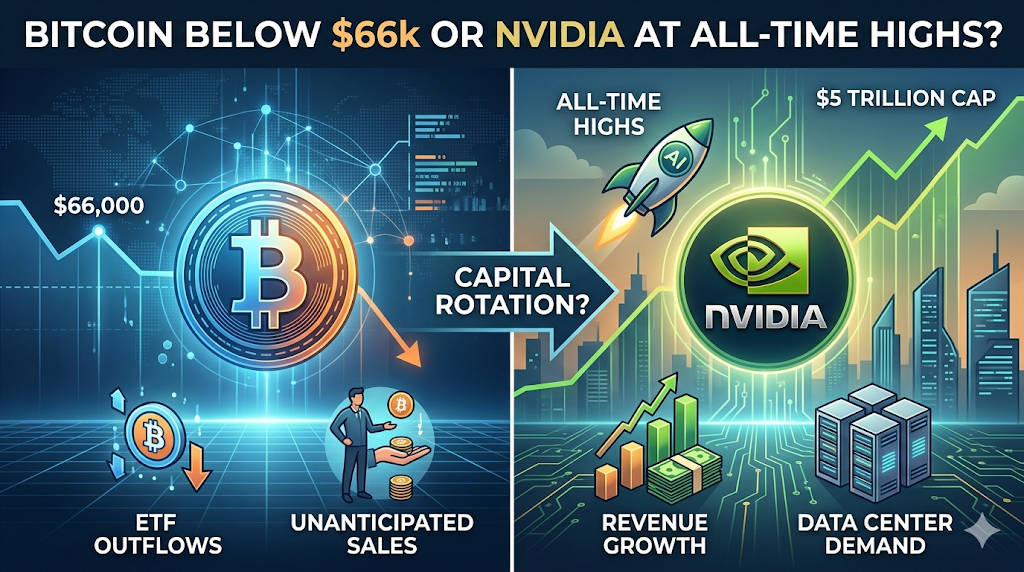
Bitcoin was once considered the ultimate high-growth asset, but recent market action has challenged that narrative. In early June 2026, Bitcoin briefly fell below $66,000 while Nvidia and other AI-related stocks continued pushing toward new all-time highs. At the same time, some of crypto's most vocal long-term advocates appeared to be reducing exposure, sparking debate across the investment community. According to recent market reports, Bitcoin experienced significant ETF outflows while AI-driven equities continued attracting institutional capital.
The key question is straightforward: Is money permanently leaving Bitcoin for AI stocks, or is this simply another temporary market rotation that long-term crypto investors have seen before?
This article examines why Bitcoin is underperforming, why AI stocks are attracting capital, and what investors should consider before making emotional decisions based on short-term market movements.
Why Is Bitcoin Trading Below $66,000 Despite Growing Institutional Adoption?
Bitcoin's recent decline is primarily driven by capital outflows, profit-taking, and weakening short-term sentiment rather than a collapse in its long-term investment thesis.
According to recent market reports, Bitcoin briefly dropped below $66,000 after a combination of heavy ETF outflows, geopolitical uncertainty, leveraged liquidations, and several high-profile bearish developments impacted investor confidence.
Several factors have contributed to the selloff:
| Factor | Impact on Bitcoin |
| ETF outflows | Reduced institutional demand |
| Leveraged liquidations | Accelerated downside volatility |
| Strategy's BTC sale | Damaged market sentiment |
| Mt. Gox wallet transfers | Increased supply concerns |
| AI market boom | Diverted speculative capital |
The most significant factor appears to be institutional fund flows. Reports indicate that Bitcoin-related ETFs have experienced billions of dollars in net outflows in recent weeks, suggesting investors are reallocating capital elsewhere.
Importantly, this decline is occurring despite Bitcoin's strongest institutional adoption environment in history. Spot ETFs remain active, corporations continue holding Bitcoin on balance sheets, and regulatory clarity has improved compared to previous market cycles. The disconnect between adoption and price performance is what makes the current situation unusual.
Why Are AI Stocks Outperforming Bitcoin?
AI stocks are outperforming because investors currently see stronger earnings growth, clearer cash-flow generation, and more immediate catalysts.
Unlike Bitcoin, which relies primarily on demand and scarcity, companies participating in the AI infrastructure boom generate measurable revenue and profits. Investors can evaluate their growth using traditional valuation metrics.
Nvidia remains the clearest example. The company has surpassed a $5 trillion market capitalization and continues benefiting from unprecedented demand for AI hardware and data-center infrastructure. Recent reports show Nvidia's revenue growth remains exceptionally strong, helping justify investor enthusiasm.
The AI Investment Narrative Is Easier to Quantify
Investors can directly measure AI adoption through:
-
Revenue growth
-
Earnings expansion
-
Data-center spending
-
Enterprise AI adoption
-
Semiconductor demand
This creates a simpler investment thesis than Bitcoin.
When Nvidia reports rising revenue, investors can immediately connect AI demand to corporate performance. Bitcoin does not provide earnings reports, dividends, or cash flows, making valuation more dependent on macroeconomic sentiment and future expectations.
Institutional Investors Prefer Visibility
Large funds generally allocate capital toward assets with predictable growth drivers. Recent market commentary suggests many institutions currently view AI infrastructure as having clearer near-term upside than digital assets. This perception has helped attract significant investment into AI-related equities.
That does not necessarily mean Bitcoin has lost its appeal. It simply means capital is currently prioritizing a different opportunity set.
Are Prominent Bitcoin Supporters Really Selling?
Yes, some well-known Bitcoin advocates have reduced exposure, but the details matter more than the headlines.
One of the most discussed developments was Strategy's sale of 32 BTC, marking the company's first disclosed Bitcoin sale in years. While the transaction generated significant media attention, it represented only a tiny fraction of the firm's overall holdings. Reports indicate Strategy still controls more than 843,000 BTC.
Similarly, discussions around investor actions by public figures such as Mark Cuban and warnings from long-time Bitcoin supporters have amplified concerns among retail investors. These developments became a major topic of discussion across crypto communities.
Selling Does Not Always Signal Bearish Conviction
Investors sell assets for many reasons:
-
Portfolio rebalancing
-
Liquidity needs
-
Tax planning
-
Risk management
-
Diversification
A small sale does not necessarily indicate a complete loss of confidence. Many market participants have interpreted these actions as evidence that even Bitcoin's strongest supporters are becoming cautious. Others argue that the market is overreacting to relatively minor portfolio adjustments.
Is Capital Actually Rotating From Crypto Into AI?
Evidence suggests that some capital rotation is occurring, although the trend may not be permanent. Market observers have noted a growing divergence between crypto assets and AI-related equities. While global stock indexes continue reaching new highs, Bitcoin has struggled to maintain momentum.
This divergence has fueled the argument that speculative capital is moving toward sectors offering stronger short-term returns.
Why Investors May Be Choosing AI Over Bitcoin
Investors are increasingly attracted to AI because it currently offers:
-
Strong revenue growth.
-
Positive earnings momentum.
-
Clear corporate beneficiaries.
-
Government and enterprise spending support.
-
Ongoing technological breakthroughs.
In contrast, Bitcoin's primary catalysts remain macroeconomic conditions, adoption growth, and investor sentiment. When one asset class is delivering visible earnings growth and another is consolidating after a major bull run, short-term capital often follows performance.
Historical Cycles Suggest Rotations Are Normal
Market rotations are not unique to 2026. Over the past decade, capital has rotated between:
-
Technology stocks
-
Growth equities
-
Commodities
-
Real estate
-
Cryptocurrencies
-
Artificial intelligence
The strongest-performing asset class rarely remains the market leader indefinitely. For this reason, investors should be cautious about assuming that today's winners will automatically remain tomorrow's winners.
Should Investors Sell Bitcoin and Buy AI Stocks Instead?
For most investors, an all-or-nothing approach is usually unnecessary. The current market environment does not require choosing between Bitcoin and AI. Both assets serve different roles within a diversified portfolio.
Bitcoin remains:
-
A scarce digital asset.
-
A hedge against monetary expansion.
-
A long-term adoption play.
AI stocks remain:
-
Revenue-generating businesses.
-
Beneficiaries of technological innovation.
-
Participants in a rapidly expanding industry.
Many professional investors allocate capital across both themes rather than treating them as mutually exclusive opportunities. The key is matching investment choices with risk tolerance, time horizon, and portfolio objectives.
Conclusion
Bitcoin's drop below $66,000 while Nvidia and other AI-related stocks reached record highs has created one of the most interesting market divergences of 2026. Recent ETF outflows, profit-taking, and shifting investor sentiment have pressured Bitcoin prices, while AI infrastructure companies continue benefiting from powerful earnings growth and institutional demand.
Although some prominent Bitcoin advocates have reduced exposure, the broader picture remains more nuanced than headlines suggest. Bitcoin still enjoys stronger institutional adoption than in previous market cycles, even as short-term capital flows favor AI investments.
History shows that market leadership changes frequently. Technology stocks, commodities, cryptocurrencies, and AI have each experienced periods of dominance. Investors who react emotionally to recent performance often end up buying assets after major rallies and selling after major declines.
Rather than viewing Bitcoin and AI as competing narratives, investors may benefit from understanding how each asset class fits within a diversified portfolio. The coming months will reveal whether the current divergence represents a temporary rotation or the beginning of a longer-term shift in market leadership.
FAQs
-
Why did Bitcoin fall below $66,000?
Bitcoin fell below $66,000 due to ETF outflows, leveraged liquidations, geopolitical uncertainty, and negative market sentiment following several high-profile developments in the crypto industry.
-
Why is Nvidia outperforming Bitcoin in 2026?
Nvidia is outperforming because investors are rewarding strong AI-related revenue growth, earnings expansion, and increasing demand for data-center infrastructure.
-
Did Strategy sell all of its Bitcoin?
No. Reports indicate Strategy sold only 32 BTC while continuing to hold more than 843,000 BTC.
-
Is money permanently leaving crypto for AI?
There is currently evidence of capital rotation toward AI, but historical market cycles show that investment flows frequently shift between asset classes over time.
-
Can Bitcoin and AI both perform well in the future?
Yes. Bitcoin and AI stocks have different investment drivers and can potentially generate returns simultaneously under favorable market conditions.