

Anthropic IPO Filing: $4.59B Revenue, $42B Loss, and Founder Control
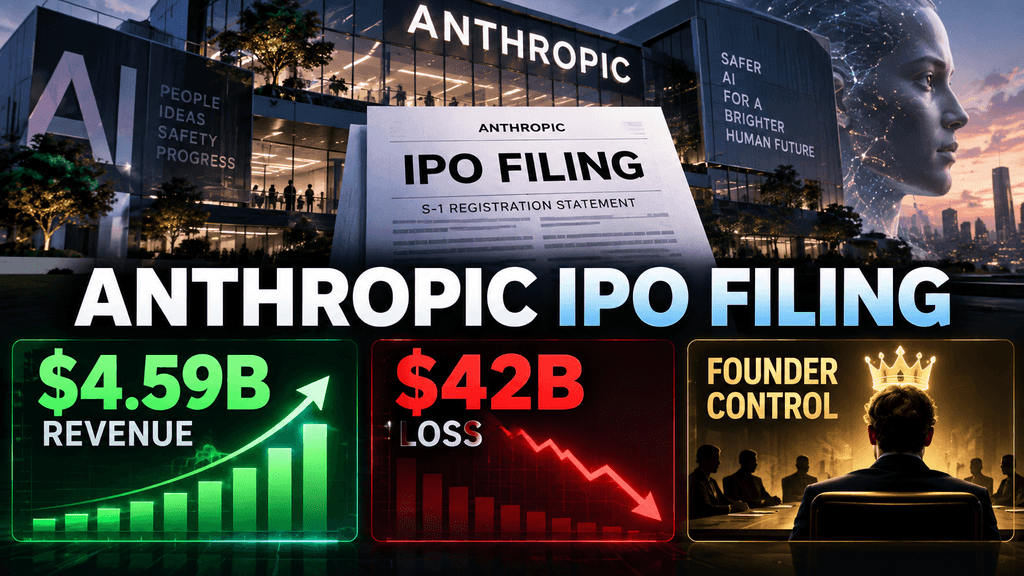
Anthropic’s Explosive Growth Comes With Massive Costs and Long-Term Commitments
Anthropic’s confidential IPO prospectus, reviewed by Reuters in late September 2026, offers the first detailed public look at the financial reality behind one of the leading frontier AI companies. Revenue reached $4.59 billion in 2025, a jump of roughly 1,088 percent from $386 million the prior year, driven by rapid adoption of its Claude models. At the same time, operating losses widened to $8.06 billion, and the GAAP net loss hit approximately $41.97 billion, largely because of a $34 billion non-cash accounting charge tied to the rising value of convertible financing instruments. Compute and infrastructure spending alone climbed to $7.33 billion, representing more than half of total operating expenses.
The company also disclosed $518 billion in future cloud, computing, and infrastructure obligations and ended the year with $20.28 billion in cash and short-term investments. Two customers each accounted for about 12 percent of revenue. The filing underscores that Anthropic’s extraordinary top-line growth coexists with extreme capital intensity and a governance structure designed to keep decision-making power with its seven co-founders even after a public listing that could value the firm above $2 trillion.
Revenue Growth Accelerates Twelve-Fold Amid Enterprise Demand for Claude
Anthropic generated $4.59 billion in recognized revenue during 2025, compared with $386 million in 2024. That expansion reflects strong commercial uptake of Claude across enterprise customers who pay via metered token usage and subscriptions. By early 2026, the company had already reported annualized run rates exceeding $30 billion and later figures approaching $65 billion, indicating that demand continued to accelerate after the calendar year closed. More than 1,000 customers were spending over $1 million annually by spring 2026, a figure that had doubled in a short period. The growth trajectory positions Anthropic as one of the fastest-scaling AI developers, yet the absolute revenue base remains modest relative to the multi-trillion-dollar valuation discussions surrounding the planned IPO.
The concentration of sales among a limited set of large clients introduces measurable risk. The two largest direct customers each contributed roughly 12 percent of 2025 revenue, for a combined 24 percent share. Many of those contracts lack long-term lock-in provisions, allowing customers to reduce or pause spending with limited notice. This dependency means that any slowdown in enterprise AI budgets or shifts toward competing models could quickly affect top-line results. Management has emphasized diversification efforts, but the prospectus still flags customer concentration as a material factor for investors evaluating the sustainability of the reported growth rates.
Operating Losses Widen as Compute Costs Dominate the Expense Base
Operating losses expanded to $8.06 billion in 2025 from $2.98 billion the year before. Total operating expenses reached $12.65 billion, with compute and infrastructure accounting for $7.33 billion, or about 58 percent of that total. The nearly threefold increase in compute spending reflects the rising expense of training and serving successively larger models while competing against other frontier labs. Even after excluding non-cash items, the core business continued to consume far more capital than it generated in revenue, highlighting the capital-intensive nature of current-generation AI development.
Cash and short-term investments stood at $20.28 billion at year-end 2025. That liquidity provides a buffer, yet the scale of ongoing losses means the company must continue raising substantial external capital or achieve rapid improvements in unit economics. Later reports indicated that adjusted operating results turned positive for two consecutive quarters in 2026, suggesting that higher utilization and pricing power may be beginning to offset the high fixed costs of infrastructure. Investors will need to assess whether those sequential improvements can scale sufficiently to close the gap between revenue and the much larger compute outlays still required.
GAAP Net Loss of $42 Billion Includes Large Non-Cash Accounting Charge
The reported GAAP net loss of approximately $41.97 billion to $42 billion for 2025 requires careful interpretation. Roughly $34 billion of that figure stems from a non-cash accounting charge linked to the increased estimated fair value of financing liabilities that may convert into Anthropic shares. As private-market valuations rose, the accounting value of those instruments also rose, producing a large paper loss rather than an equivalent cash outflow. Stripping out the charge leaves an operating loss near $8 billion, still substantial but far more reflective of actual business cash burn.
This distinction matters for valuation analysis. Headline losses of this magnitude can create the impression of severe financial distress, yet the non-cash component does not reduce the cash available to fund operations or infrastructure. Prospective public investors will focus on free cash flow trends, gross margins on token usage, and the trajectory of compute cost per unit of revenue. The prospectus itself separates these elements, giving market participants the data needed to distinguish accounting effects from underlying operating performance.
Future Infrastructure Commitments Total $518 Billion Across Multiple Partners
Anthropic disclosed planned spending of at least $518 billion on cloud, computing, and infrastructure obligations over the coming years. A significant portion of those commitments is described as non-cancelable or payable regardless of actual usage. Reported allocations include more than $111 billion with Google, $110 billion with Amazon, and $31 billion with Microsoft across multi-year horizons. Additional partnerships cover chip supply and data center capacity. These figures illustrate the scale of capital required to remain competitive at the frontier of model development.
The size of the commitments creates both opportunity and constraint. Securing long-term access to scarce high-end compute reduces the risk of capacity shortages that have constrained other AI developers. At the same time, the obligations lock in large future cash outflows that must be funded through operating cash flow, additional equity, or debt. The company’s shift toward a mix of cloud services and its own data centers and directly leased chips aims to improve cost control over time, yet the absolute dollar amounts remain among the largest infrastructure programs disclosed by any technology firm of comparable age.
Potential Valuation Above $2 Trillion Would Double May 2026, Mark
Market discussions surrounding the IPO center on a potential valuation exceeding $2 trillion. That level would more than double the $965 billion post-money valuation assigned in the May 2026 Series H financing. SpaceX’s earlier public debut set a high bar; an Anthropic listing at the upper end of current expectations would establish a new benchmark for pure-play frontier AI companies. The offering size itself has been discussed in ranges that could reach tens of billions of dollars, potentially including anchor investments from major technology participants.
Valuation multiples implied by these figures rest on continued rapid revenue expansion and eventual margin improvement. At a $2 trillion equity value, the multiple on 2025 revenue would be extreme, requiring investors to underwrite multi-year growth trajectories that push annual revenue into the hundreds of billions. The prospectus and subsequent commentary provide the financial baseline against which those expectations will be tested once the company begins marketing the shares after the November 2026 midterm elections.
Founder LLC Structure Preserves 50.1 Percent Voting Control
Anthropic is establishing a Founders LLC controlled by its seven co-founders, including CEO Dario Amodei. Under the arrangement, a majority vote among those founders determines the issuance of a single Class F share that carries 50.1 percent of total voting power on key matters, including certain board elections. The structure is intended to maintain what the company describes as a low-ego, truth-seeking environment and to balance commercial pressures against its public-benefit mission.
Public shareholders would therefore acquire economic exposure without obtaining proportional voting influence over fundamental strategic decisions. This dual-class-style mechanism is common among technology companies that prioritize founder continuity, yet the explicit 50.1 percent threshold and the public-benefit corporation status add distinctive features. Investors must weigh the benefits of stable long-term leadership against the reduced ability of outside shareholders to influence governance outcomes if disagreements arise over resource allocation or risk tolerance.
As a Delaware public benefit corporation, Anthropic carries statutory obligations to consider the broader interests of humanity alongside financial returns to shareholders. The prospectus acknowledges that certain governance decisions could diverge from the pure financial preferences of Class A shareholders. The Founder LLC reinforces that framework by concentrating voting power with the original research team that left OpenAI over differences in safety and governance philosophy.
This legal form is intended to protect the company’s stated commitment to responsible AI development even under the pressures of public markets. Whether the structure successfully reconciles those dual mandates will be tested once the firm reports quarterly results and faces activist or institutional scrutiny. The filing’s extensive risk-factor discussion, including warnings about catastrophic or existential AI risks, further signals that safety considerations will remain central to how management presents the business to investors.
Customer Concentration and Contract Flexibility Represent Material Risks
Nearly one-quarter of 2025 revenue came from only two customers. The prospectus notes that many large clients operate under flexible arrangements rather than multi-year fixed commitments. A decision by either major customer to reduce spend, switch providers, or negotiate lower pricing could therefore produce an outsized impact on reported results. Diversification across thousands of smaller accounts and the rapid growth in the number of million-dollar-plus customers help mitigate the risk, yet the concentration remains a clear disclosure item.
Enterprise AI purchasing decisions are still evolving. Budget cycles, internal productivity gains from existing deployments, and competitive offerings from other model providers all influence renewal and expansion rates. Anthropic’s ability to convert early large accounts into sticky, multi-year relationships while broadening the customer base will be a key metric for assessing the durability of its growth narrative after the IPO.
Rivalry Deepens Across the Frontier AI Landscape
Anthropic competes directly with OpenAI, Google, Meta, and xAI in the race to develop more capable large language models. The prospectus frames AI as a technology that could reshape the global economy on a scale comparable to industrialization or the internet. Success depends on continuous model improvements, reliable infrastructure, and the ability to attract both research talent and enterprise budgets. Recent product releases, including newer Claude versions, are positioned as responses to competitive momentum from rival systems.
The capital requirements disclosed in the filing illustrate why only a handful of organizations can sustain frontier development. Compute budgets measured in the tens of billions annually create high barriers to entry. Public-market capital raised through the IPO is expected to help fund the next phase of that competition, but it will also subject Anthropic’s progress to continuous comparison against the financial and technical milestones of its peers.
Timing Targets Period After November Midterm Elections
The IPO is expected to price after the U.S. midterm elections in November 2026. Marketing is anticipated to begin in mid-to-late October once the public prospectus is available. Lead underwriters include major investment banks, and discussions have included potential anchor investments that could support a large primary raise. The confidential draft S-1 was submitted in June 2026 following the $65 billion Series H round.
Market conditions, interest-rate expectations, and broader sentiment toward high-growth technology listings will influence final pricing and demand. The delay relative to earlier informal timelines has allowed the company to report additional quarters of accelerating revenue and sequential improvements in adjusted profitability, data points that will feature prominently in the roadshow presentation.
Cash Position and Capital Structure Support Near-Term Flexibility
Ending 2025 with $20.28 billion in cash and short-term investments provides Anthropic with substantial near-term runway. Combined with prior private fundraising that exceeded $125 billion since founding, the balance sheet can absorb continued high levels of infrastructure investment while the company works toward sustained positive free cash flow. Additional credit facilities under discussion further expand available liquidity.
The capital structure also includes the convertible instruments that generated the large non-cash charge. Conversion of those instruments into equity upon or after the IPO would dilute existing holders but simultaneously reduce future liability accounting volatility. Investors analyzing the post-IPO balance sheet will focus on the interaction between cash burn, commitment funding, and the pace of margin expansion.
Path to Profitability Hinges on Scaling Efficiency and Pricing Power
Later 2026 commentary indicated that adjusted operating income had turned positive for two consecutive quarters while the annualized revenue run rate continued to climb. Gross margins on usage-based revenue and the ratio of compute cost to revenue will determine how quickly GAAP profitability can follow. The shift toward owned or directly leased capacity is intended to improve long-term unit economics relative to pure cloud reliance.
Achieving durable profitability at the scale implied by a multi-trillion-dollar valuation requires both continued volume growth and meaningful reductions in the cost of delivering each incremental unit of model capability. The prospectus supplies the baseline numbers against which subsequent quarterly reports will be measured, giving public investors a clear framework for tracking progress.
Investors Weigh Anthropic’s Growth Potential Against Rising Capital Demands
The combination of rapid revenue expansion, heavy ongoing losses, enormous forward commitments, and founder-controlled governance creates a distinctive risk-reward profile. Public shareholders gain exposure to one of the leading AI platforms but accept limited voting influence and the possibility that mission-related decisions may diverge from short-term financial optimization. The filing’s detailed risk factors, including customer concentration and the potential for advanced AI systems to pose catastrophic risks, reinforce that the opportunity comes with substantial uncertainty.
Market participants will ultimately decide whether the growth trajectory and strategic positioning justify the capital intensity and governance trade-offs. The numbers released in the prospectus establish the factual foundation for that assessment as Anthropic prepares to test public-market appetite for frontier AI equities.
🔥 Beyond the Headlines: What KuCoin 5.0 Means for You
Market news moves fast — but where you act on it matters just as much. This October, KuCoin launches KuCoin 5.0, transforming KuCoin into a rebuilt platform. Here's what actually changes for you:
-
One account for everything. Older platforms split your money across separate "spot," "margin," and "futures" accounts and expected you to understand why. KuCoin 5.0's unified account removes that entirely — deposit once, and everything is simply there (only available to VIPs for now).
-
Stocks, indices, and commodities. KuCoin 5.0 expands beyond crypto into global markets. When crypto chops sideways and equities rally (or the reverse), you rotate in minutes instead of opening a brokerage account and waiting days for fiat rails.
-
Real-world assets (RWA). Tokenized exposure to traditional assets like commodities, right inside your crypto account. One of the fastest-growing segments in global finance is no longer reserved for institutions — you access it from the same balance you trade with.
-
Earn while you learn. Not ready to trade? KCUSD lets your stablecoins earn daily, auto-compounding interest. The lowest-stress way to put your idle deposit to work for 4% yield.
-
An AI assistant in plain language. Ask questions, get market context, understand what you're looking at — built into the platform, no jargon required.
-
An app that doesn't overwhelm. Faster, cleaner, and consistent — intuitive from the first tap, not after a tutorial.
-
Safety you can check, not just trust. A MiCAR-licensed EU entity, Proof of Reserves you can verify yourself, and internationally certified security (SOC 2 Type II, ISO 27001:2022).
Create your account in minutes — and start on the platform built for where crypto is going, not where it's been.
FAQs
What does the $42 billion net loss actually represent for Anthropic’s cash position?
The majority of the $42 billion GAAP net loss, approximately $34 billion, is a non-cash accounting charge reflecting the higher estimated value of convertible financing instruments as Anthropic’s private valuation increased. The underlying operating loss of about $8.06 billion more accurately reflects cash consumed by the business. The company ended 2025 with $20.28 billion in cash and short-term investments, indicating that the headline loss figure does not equate to an equivalent reduction in available liquidity.
How significant is the $518 billion in future infrastructure commitments?
Anthropic has outlined at least $518 billion in cloud, computing, and infrastructure obligations spanning multiple years and partners. A large share of these commitments is non-cancelable. The scale underscores the capital required to train and serve frontier models at competitive levels. Funding will come from operating cash flow, existing reserves, future equity raises, and credit facilities. Success in converting revenue growth into positive free cash flow will determine how comfortably the company can meet these obligations without repeated large capital raises.
Why does the Founder LLC structure matter for public investors?
The seven co-founders will control a Class F share representing 50.1 percent of voting power on key matters through a majority vote of the Founder LLC. Public shareholders therefore hold economic interest without proportional control over board composition or certain strategic decisions. The arrangement is designed to preserve the company’s public-benefit mission and research culture. Investors must evaluate whether the continuity of founder leadership outweighs the reduced ability of outside shareholders to influence governance.
What portion of revenue comes from the largest customers?
In 2025, the two largest direct customers each accounted for approximately 12 percent of revenue, combining for roughly 24 percent. Many large-client arrangements lack long-term contractual lock-ins, creating the possibility that spending could decline relatively quickly. The company has expanded its base of high-spend customers, yet concentration remains a disclosed risk factor that could amplify volatility in reported results if either major account reduces activity.
When is the IPO expected to occur and at what valuation range?
Current expectations point to a listing after the November 2026 U.S. midterm elections, with marketing potentially beginning in mid-to-late October. Discussions around valuation have centered on a figure above $2 trillion, more than double the $965 billion mark from the May 2026 financing. Final pricing will depend on market conditions, investor demand, and the specific share count offered. The offering could raise substantial primary capital to support ongoing infrastructure needs.
How does Anthropic’s revenue growth compare with its compute spending?
Revenue grew roughly twelvefold to $4.59 billion in 2025, while compute and infrastructure expenses rose to $7.33 billion, nearly triple the prior-year level and more than half of total operating expenses. The disparity illustrates the current economics of frontier model development. Subsequent quarters in 2026 showed accelerating revenue run rates and sequential improvement in adjusted operating results, suggesting that higher utilization may be beginning to improve the ratio of compute cost to revenue.
Disclaimer: This content is for informational purposes only and does not constitute investment advice. Investments carry risk. Please do your own research (DYOR).