

AMD Hits $1 Trillion Market Cap as Chip Stocks Rally on Meta Muse and Agentic AI Demand
Introduction
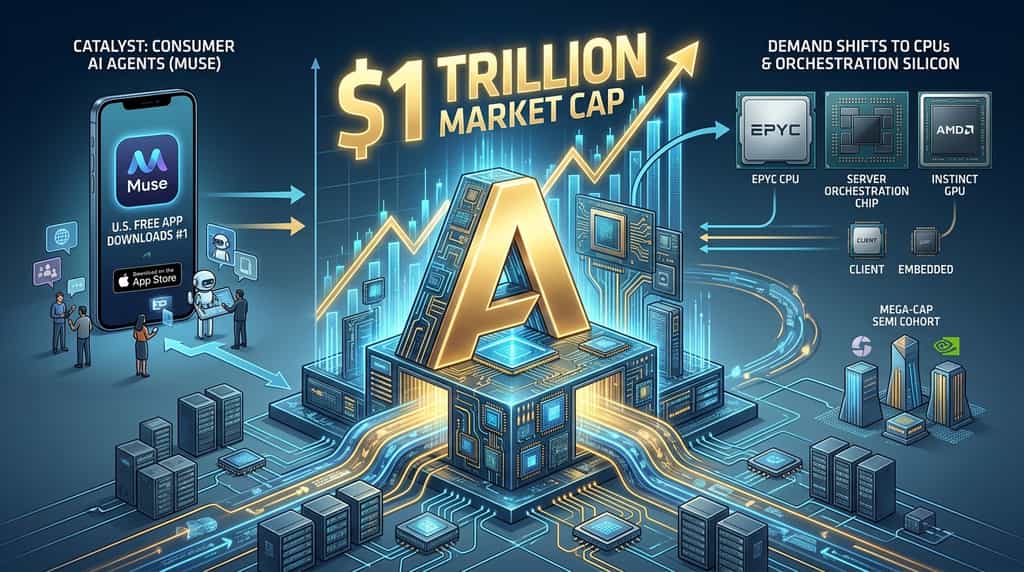
Advanced Micro Devices crossed a $1 trillion market cap after a single-session surge of nearly 10%, according to CompaniesMarketCap data as of September 21, 2026. The milestone arrived as investors repriced semiconductor demand around consumer AI agents rather than training-only GPU cycles. Meta's Muse app reached the top of U.S. free iPhone downloads, reinforcing the thesis that agentic workloads need more CPUs, memory, and orchestration silicon.
AMD closed at $615.52, with market value of about $1.004 trillion, placing it among a small group of U.S. chipmakers at that scale. This article explains what the valuation means, why Muse moved CPU names, and how AMD's official results support the rally.
Why Did AMD Cross a $1 Trillion Market Cap?
AMD crossed $1 trillion because its share price rose 9.95% to $615.52 on September 21, 2026, on roughly 1.63 billion shares outstanding. That math produced an end-of-day value of about $1.004 trillion. The close followed a five-session advance of about 24.75% and a one-month gain of 30.06%, based on TradeSmith market statistics dated September 22, 2026.
The valuation is not a one-day curiosity. CompaniesMarketCap ranked AMD as the world's 16th most valuable company at that reading. One-year price change stood near 285%, while year-to-date market-cap growth for 2026 reached about 187% versus the 2025 year-end level of $350.01 billion. Those figures show a multi-quarter rerating, not a single headline spike.
Investors treated the $1 trillion print as confirmation that AMD now sits in the same mega-cap semiconductor cohort as Nvidia, Broadcom, and Micron. The market did not wait for a new product launch that day. It capitalized existing EPYC CPU demand, Instinct GPU deployments, and a consumer signal that agentic software can scale quickly.
How Does Meta Muse Change the AI Chip Demand Story?
Muse changes the demand story by shifting attention from training clusters toward always-on agents that coordinate browsers, forms, bookings, and background tasks. Those workloads still use accelerators for model inference, but they also consume large amounts of general-purpose CPU time. AMD management has argued for months that agentic sandboxes can become a major share of total addressable market. Muse gave that argument a visible consumer proof point.
Sensor Tower download rankings, cited across market reports after the September 8, 2026 launch, placed Muse first among free U.S. iPhone apps for multiple sessions. The product is designed to keep working after a user closes the app. Persistent sessions raise demand for cloud CPUs, memory bandwidth, storage, and secure execution environments. That mix favors server CPU vendors as well as GPU suppliers.
Meta is also a commercial AMD customer. AMD's February 2026 filings and subsequent 10-Q discussion describe a multi-year arrangement under which Meta intends to deploy up to 6 gigawatts of AMD data center GPUs, with the first gigawatt tied to Instinct MI450-series products. AMD also issued a warrant structure to Meta as part of that relationship. The commercial link matters because Muse is not an abstract software story for AMD. It sits next to an existing infrastructure partnership.
What Do AMD's Latest Official Results Show?
AMD's official second-quarter 2026 results show the financial base under the rally. According to AMD's August 4, 2026 earnings release and Form 8-K, Q2 revenue was $11.536 billion, up 50% year over year from $7.685 billion. GAAP net income was $2.3 billion. Data Center segment revenue reached $6.718 billion, up 107% from $3.240 billion a year earlier.
Those Data Center numbers include EPYC server CPUs and Instinct GPUs. AMD said EPYC demand accelerated and Instinct deployments scaled. Client revenue was $3.062 billion, up from $2.499 billion. Embedded revenue was $977 million. GAAP gross margin was 54%. Non-GAAP diluted EPS was $1.66.
Cash, cash equivalents, and short-term investments were $13.1 billion as of June 27, 2026, according to the company's Q2 2026 10-Q. Operating cash flow for the first half was $5.3 billion. AMD guided Q3 2026 revenue to about $13 billion, plus or minus $300 million, implying roughly 41% year-over-year growth at the midpoint.
The official commentary is explicit. Chair and CEO Lisa Su said Data Center revenue more than doubled year over year and that AI is expanding compute demand across AMD's markets. That statement is more useful than price-target chatter because it comes from the company's own results package.
Why Are Chip Stocks Rallying Around Agentic AI?
Chip stocks are rallying because agentic AI increases total compute hours rather than replacing one chip type with another. Training still needs dense accelerators. Agents add orchestration, tool use, retrieval, browser control, and long-running jobs. Those tasks keep CPUs busy even when a model sits on a GPU.
AMD raised its view of the server CPU market during 2026. Company presentations and earnings discussion pointed to a server CPU TAM above $120 billion by 2030, with growth above 35% annually in management's framing. At Advancing AI 2026 in July, AMD also said the AI accelerator market could reach about $1.4 trillion by 2030 and that server CPU demand could exceed $200 billion by the end of the decade in a later management discussion of customer pipelines.
Peer moves on September 21 confirmed the sector read-through. Market reports showed Intel and Arm posting double-digit gains the same day AMD crossed $1 trillion. The Philadelphia Semiconductor Index extended a multi-session advance. Investors were not isolating AMD. They were buying the CPU-plus-accelerator stack.
Competition remains intense. Nvidia still dominates AI accelerators. Arm-based server designs are gaining share conversations. Nvidia has also pushed its own CPU products for AI factories. AMD's case is that it can sell both EPYC CPUs and Instinct accelerators into the same racks, including Helios rack-scale systems now moving toward second-half 2026 deployments.
What Risks Still Sit Under a $1 Trillion Valuation?
A $1 trillion market cap prices in continued execution, not just one app ranking. AMD's trailing P/E near 157, based on stock-analysis market pages using TTM EPS around $3.90 to $3.92, is high versus historical semiconductor multiples. Forward P/E estimates near the mid-50s still assume rapid earnings growth.
Supply-chain and power constraints remain real. AMD's 10-Q lists large future purchase commitments and data-center leases, including leases signed after quarter-end with $9.5 billion of future payments. AI factories need power, packaging, HBM memory, and advanced foundry capacity. Any bottleneck can delay recognized revenue even when demand is visible.
Export controls, China restrictions, and competitive GPU share are still active risks. AMD previously recorded inventory charges tied to U.S. export controls on certain Instinct products. Nvidia's software stack and installed base remain advantages in training. Arm and custom silicon at hyperscalers can pressure CPU pricing over time.
Insider selling and valuation stretch can also increase volatility after a 30% one-month move. A $1 trillion print can reverse if Muse engagement fades or if Q3 results miss the $13 billion guidance midpoint.
Beyond the Headlines: What KuCoin 5.0 Means for You
Market news moves fast — but where you act on it matters just as much. This October, KuCoin launches KuCoin 5.0, transforming KuCoin into a rebuilt platform. Here's what actually changes for you:
-
One account for everything. Older platforms split your money across separate "spot," "margin," and "futures" accounts and expected you to understand why. KuCoin 5.0's unified account removes that entirely — deposit once, and everything is simply there.
-
Stocks, indices, and commodities. KuCoin 5.0 expands beyond crypto into global markets. When crypto chops sideways and equities rally (or the reverse), you rotate in minutes instead of opening a brokerage account and waiting days for fiat rails.
-
Real-world assets (RWA). Tokenized exposure to traditional assets like commodities, right inside your crypto account. One of the fastest-growing segments in global finance is no longer reserved for institutions — you access it from the same balance you trade with.
-
Earn while you learn. Not ready to trade? KCUSD lets your stablecoins earn daily, auto-compounding interest. The lowest-stress way to put your idle deposit to work for 4% yield.
-
An AI assistant in plain language. Ask questions, get market context, understand what you're looking at — built into the platform, no jargon required.
-
An app that doesn't overwhelm. Faster, cleaner, and consistent — intuitive from the first tap, not after a tutorial.
-
Safety you can check, not just trust. A MiCAR-licensed EU entity, Proof of Reserves you can verify yourself, and internationally certified security (SOC 2 Type II, ISO 27001:2022).
Create your account in minutes — and start on the platform built for where crypto is going, not where it's been.
Conclusion
AMD's first $1 trillion market cap, recorded around a $615.52 close and $1.004 trillion value on September 21, 2026 according to CompaniesMarketCap, marked a sector shift as much as a company milestone. The immediate catalyst was Meta Muse topping U.S. free iPhone downloads and reviving the agentic-AI case for CPUs. The fundamental backdrop was already in AMD's official Q2 2026 results: $11.5 billion in revenue, Data Center sales of $6.7 billion up 107% year over year, and named multi-gigawatt GPU agreements with Meta, OpenAI, and Anthropic.
The rally spread to other CPU-exposed names because agents raise orchestration demand, not only training FLOPs. AMD's own TAM comments put server CPUs on a path above $120 billion by 2030, with accelerator markets still expanding. Valuation risk is equally clear. A triple-digit trailing P/E and a 30% one-month move leave little room for execution misses against Q3 guidance near $13 billion.
The durable takeaway is structural. Consumer agents make compute persistent. Persistent compute needs CPUs, GPUs, memory, and power. AMD is selling more than one of those layers. Whether the $1 trillion level holds will depend on Helios ramps, EPYC shipments, and whether Muse-like products keep converting downloads into data-center load.
FAQs
Did AMD officially report a $1 trillion market cap in an SEC filing?
No. Market cap is a live market calculation of share price times shares outstanding. CompaniesMarketCap and exchange-linked data put AMD near $1.004 trillion on September 21, 2026, after the $615.52 close.
What official AMD number best supports the rally?
Q2 2026 Data Center revenue of $6.718 billion, up 107% year over year, from AMD's August 4, 2026 earnings release.
Is Muse an AMD product?
No. Muse is Meta's consumer AI agent. AMD benefits if agent usage lifts server CPU and GPU demand, and Meta is already an AMD infrastructure customer under a multi-gigawatt GPU plan disclosed in AMD filings.
How many U.S. chip companies are above $1 trillion?
Market-cap trackers in September 2026 grouped Nvidia, Broadcom, Micron, and AMD in that set, with exact ranks moving daily with prices.
Does a $1 trillion cap mean AMD overtook Nvidia?
No. Nvidia's market cap remained several times larger, near $5.49 trillion on CompaniesMarketCap comparison tables at the same time.
Disclaimer: This article is for informational purposes only and does not constitute financial, legal, or investment advice. Always conduct your own research before interacting with digital assets.