AI Data Center Debt Risks in 2026: Elon Musk's Compute Ambitions vs. Jensen Huang's Growth Outlook
AI Data Center Debt Risks in 2026: Elon Musk's Compute Ambitions vs. Jensen Huang's Growth Outlook
Introduction
Artificial intelligence is driving one of the largest infrastructure investment cycles in the technology industry, but a critical question is emerging: can future AI revenue justify the enormous cost of building data centers? Elon Musk's expanding computing ambitions and NVIDIA CEO Jensen Huang's bullish view of AI demand represent different perspectives on the same challenge — scaling computing capacity quickly enough to serve a growing market while ensuring that the investment generates sustainable returns.
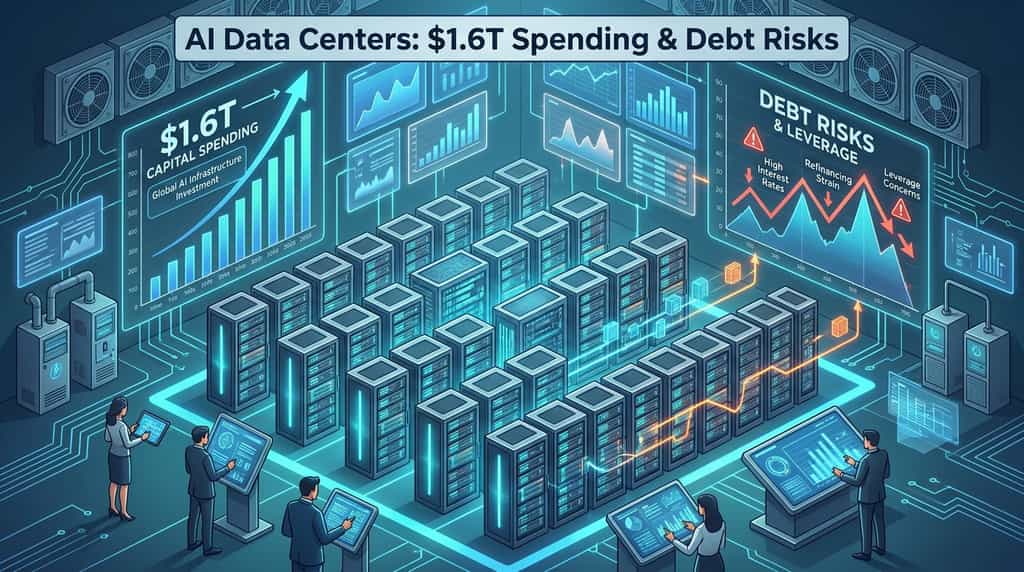
The financing question is becoming increasingly important. According to J.P. Morgan Asset Management's October 23, 2026 analysis, cumulative AI capital spending has reached approximately $1.6 trillion since 2023, while the buildout is becoming more dependent on debt financing. The concern is not simply whether demand for computing exists, but whether companies can convert that demand into sufficient cash flow to support their investments and financing costs.
For investors, the distinction between AI demand and AI profitability is essential. NVIDIA and other infrastructure suppliers may benefit from continued spending, while data center developers and AI companies carrying heavier financing burdens face different risks. J.P. Morgan's analysis points to a market increasingly shaped by execution, funding costs, and the ability to turn computing capacity into revenue.
How Do Elon Musk and Jensen Huang Differ on AI Infrastructure Growth?
Elon Musk is bullish on the long-term importance of AI computing but skeptical that many specialized AI cloud providers, known as neoclouds, can sustain their current business models. Jensen Huang, by contrast, has emphasized the extraordinary demand for AI computing capacity and the need to expand the infrastructure supply chain. Their positions highlight a key distinction in the AI boom: growing demand for computing does not mean every company building or financing that capacity will be profitable.
In public comments on October 25, 2026, Musk warned that more than 200 neocloud providers could face severe consolidation and business failures. According to Musk's warning on neocloud, he argued that lenders may become reluctant to finance companies whose revenue depends primarily on AI data centers. These businesses must commit substantial capital to GPUs, networking equipment, data-center facilities, and electricity before they can generate enough revenue to cover operating expenses and financing costs.
Musk also drew a distinction between neoclouds and SpaceX. He said SpaceX had secured approximately $40 billion in debt financing to purchase GPUs, supported by its broader business and revenue sources, including Starlink and launch services. His argument is that diversified revenue and stronger credit access can provide a financing advantage over companies that depend heavily on renting out AI computing capacity. His prediction does not mean that every neocloud will fail; rather, it points to potential consolidation among providers with weaker financing, less differentiated services, or insufficient cash flow.
Huang's public position has focused more on the scale of AI infrastructure demand and the need to expand the capacity required to serve it. In an October 21, 2026 announcement, NVIDIA outlined plans with supply-chain partners to increase production capacity for critical infrastructure components, including a targeted 2.5-fold increase in substrate capacity over three years. The announcement reflects NVIDIA's view that supply constraints remain a significant factor in the expansion of AI infrastructure.
These positions are not necessarily contradictory. Huang's emphasis is on the market's need for more computing capacity, while Musk's warning concerns which providers can finance that capacity and earn sustainable returns. AI demand may continue to grow even as individual infrastructure companies encounter high borrowing costs, customer concentration, pricing pressure, or rapid hardware depreciation.
For investors assessing the sector, the distinction between infrastructure demand and company-level financial resilience is therefore essential. Orders for GPUs and new data-center capacity can indicate strong demand, but they do not independently establish that every operator will generate sufficient cash flow to repay debt and earn an adequate return on invested capital.
Why Is J.P. Morgan Warning About AI Data Center Debt Risks?
J.P. Morgan's recent analysis highlights a growing financing challenge: AI infrastructure spending is expanding rapidly, and debt is playing a larger role in funding projects whose future cash flows remain uncertain. The concern is particularly relevant to specialized AI cloud providers, which may need to purchase expensive hardware and secure facilities before they earn enough revenue to cover their financing costs.
According to J.P. Morgan Asset Management, AI infrastructure investment has accumulated to approximately $1.6 trillion since 2023. The analysis says spending is becoming more dependent on debt markets and notes that financing concerns have contributed to volatility in AI-related equities and infrastructure debt. It also emphasizes that risks vary across companies according to their balance sheets, customer contracts, and financing structures.
A key distinction is between large, diversified cloud providers and specialized AI cloud businesses. Major cloud providers generally have multiple revenue streams and established customer relationships, which can help them absorb financing costs. Specialized providers may depend more heavily on a smaller group of customers and on the spread between the price they charge for computing and the cost of financing and operating their hardware.
J.P. Morgan's October 19, 2026 global research outlook projected that global AI capital expenditure could reach $900 billion in 2026 and $5.5 trillion cumulatively by 2030. These are forecasts, not confirmed future spending. Their significance lies in the scale of the capital commitment: the industry needs enough revenue, utilization, and operating efficiency to support infrastructure built over multiple years.
How Does Data Center Debt Create Financial Risk?
Debt becomes a risk when the cash generated by a data center arrives later than expected, falls below forecasts, or fails to cover interest and principal payments. Because AI infrastructure requires substantial upfront capital, a project can face financial pressure even when demand for computing remains strong.
Several factors determine whether a debt-funded project is financially sustainable:
Customer concentration: A provider relying on a small number of large customers faces greater exposure if a customer delays deployment, reduces capacity commitments, or fails to pay.
Hardware depreciation: AI accelerators and related equipment can lose economic value as newer generations improve performance or reduce the cost of computing. Debt may remain outstanding even when equipment has become less competitive.
Interest and refinancing costs: Higher borrowing costs can reduce the profitability of projects financed with debt, particularly when the original business plan assumes stable financing conditions.
Construction and power delays: A completed contract cannot generate the expected revenue if the data center is not ready, connected to sufficient power, or equipped with the required hardware.
Utilization and pricing: A facility may need high utilization to generate enough revenue to cover its fixed costs. If demand weakens or competing providers lower prices, operating margins may shrink.
The structure of the financing matters as well. Corporate debt is generally supported by a company's broader balance sheet, while project-level debt depends more heavily on the cash flows and assets associated with a specific project. Project financing can help separate risks, but it does not remove the need for the facility to generate sufficient cash.
For investors, the crucial issue is not simply the amount of debt outstanding. It is whether a company's expected cash flow, customer commitments, asset life, and funding structure are consistent with its repayment obligations.
Could AI Data Center Debt Trigger a Wider Market Correction?
AI data center debt could contribute to a broader market correction if financing difficulties spread across infrastructure providers, lenders, suppliers, and major technology companies. However, debt-related stress at individual companies does not automatically mean that demand for AI computing is collapsing or that the entire sector faces the same level of risk.
A potential stress scenario could begin with a highly leveraged infrastructure provider facing higher borrowing costs or delays in bringing new capacity online. If its cash flow is insufficient to service debt, lenders may demand stronger protections, refinancing may become more expensive, and planned projects could be delayed. Reduced spending could then affect hardware suppliers and construction partners, while investors might reassess the valuations of other companies with similar financing profiles.
The impact would depend on how widespread the problem becomes. J.P. Morgan's October 23 analysis distinguishes between specialized infrastructure providers with more concentrated exposures and larger cloud companies with stronger balance sheets and diversified revenue. This distinction is important because financial stress is not evenly distributed across the AI ecosystem.
A more constructive scenario is also possible. If AI services generate sufficient revenue and customer demand remains strong, companies may use that cash flow to support existing facilities and fund further expansion. Stronger providers could also gain market share if weaker competitors reduce investment. The main uncertainty is whether the revenue generated by AI applications will grow quickly enough to justify the capital already committed.
Investors should therefore watch for changes in customer commitments, infrastructure utilization, credit spreads, borrowing costs, project schedules, and operating cash flow. These indicators can reveal whether financing pressure is contained within individual businesses or becoming a broader constraint on AI investment.
Conclusion
The rapid expansion of AI infrastructure has created opportunities for computing suppliers, cloud providers, and AI developers, but it has also increased the importance of financing discipline. Elon Musk's computing ambitions illustrate the demands of building infrastructure for an AI ecosystem, while Jensen Huang's NVIDIA strategy reflects the opportunity to supply hardware and systems across a wider market. Their approaches differ, but both depend on sustained demand and the ability to deploy capacity effectively.
J.P. Morgan's October 2026 analysis highlights why data center debt deserves close attention. AI spending is substantial, and external financing is playing a larger role as companies build facilities, purchase hardware, and secure power. The main risk is that revenue and utilization may not develop quickly enough to cover financing costs, especially for specialized providers with concentrated customers or limited financial flexibility.
The outlook is not uniform across the industry. Large cloud providers may be better positioned to absorb higher costs, while more leveraged operators can face greater refinancing and execution pressure. Investors should focus on cash flow, customer commitments, debt structure, power availability, and hardware economics rather than assuming that rising AI demand guarantees strong financial returns. The long-term opportunity remains tied to whether AI services can turn today's infrastructure spending into durable, profitable business activity.
FAQs
1. Why are AI data centers becoming more dependent on debt?
AI data centers require large upfront investments in buildings, power systems, cooling, networking, and computing hardware. As spending expands beyond what some companies can fund through internal cash flow, debt and other external financing sources can help fund construction and equipment purchases.
2. What is the difference between a hyperscaler and a specialized AI cloud provider?
A hyperscaler is a large cloud or technology provider with extensive infrastructure and diversified business operations. A specialized AI cloud provider focuses more directly on supplying computing capacity for AI workloads and may have a narrower customer base and greater exposure to financing costs.
3. Why does hardware depreciation matter for AI data center debt?
AI hardware may become less competitive as newer products improve performance or reduce computing costs. If equipment loses economic value before a project has generated enough cash to repay its debt, the operator may face weaker returns and more difficult refinancing decisions.
4. Does strong demand for AI computing mean data center companies will be profitable?
No. Demand is only one part of the business model. Profitability also depends on pricing, utilization, electricity costs, financing expenses, construction timelines, and the useful life of equipment. A company can have strong demand but still earn insufficient returns if its costs are too high.
5. How could higher interest rates affect AI infrastructure investment?
Higher interest rates can raise borrowing and refinancing costs, reduce project returns, and make future cash flows less valuable in present-value terms. The effect is generally more significant for highly leveraged companies and projects with uncertain or delayed revenue.
Disclaimer
This general market information, possibly from third-party, commercial, or sponsored sources, is provided for reference and educational purposes only and does not constitute financial or investment advice, an offer, solicitation, or guarantee. We disclaim liability for its accuracy, completeness, reliability, and any resulting losses. Investments/trading are risky; past performance doesn’t guarantee future results. Users should research, judge prudently, and take full responsibility. For further details, please consult KuCoin’s Terms of Use and Risk Disclosure.