

AI Agents Are Choosing Bitcoin: Why Machine Economies May Favor BTC Over Traditional Money
2026/06/23 16:15:00
Introduction
What if the next billion economic participants are not humans but software? That idea no longer belongs to science fiction. In 2026, autonomous AI agents are already executing payments, purchasing APIs, accessing compute resources, and interacting with digital services without direct human intervention.
The short answer is this: AI agents are increasingly adopting crypto-based payment rails because programmable, borderless, and machine-native money works better for autonomous systems than traditional banking infrastructure. Among the available monetary assets, Bitcoin has emerged as a surprisingly strong candidate for value storage and economic coordination, even though stablecoins currently dominate payment settlement.
This shift does not mean AI has officially declared Bitcoin the winner. But recent research and early infrastructure development suggest that machine economies may naturally favor properties Bitcoin was originally designed to provide.
What Does It Mean That AI Agents "Choose" Bitcoin?
AI agents choosing Bitcoin does not mean robots independently formed an ideology. It means that when researchers and developers give autonomous systems neutral financial objectives, Bitcoin repeatedly appears as a preferred monetary option.
Recent experiments conducted by the Bitcoin Policy Institute evaluated more than 9,000 controlled scenarios across 36 frontier AI models from multiple providers. According to the study, AI systems selected Bitcoin more frequently than fiat currencies when asked to optimize for monetary characteristics and selected Bitcoin overwhelmingly for long-term value storage.
The significance is not that AI likes Bitcoin. The significance is that Bitcoin's design appears to align with objective optimization criteria.
What Is an AI Agent?
An AI agent is software capable of taking actions autonomously rather than only generating responses. Unlike traditional chatbots, AI agents can:
-
Access APIs
-
Execute transactions
-
Compare alternatives
-
Hold wallets
-
Trigger workflows
-
Purchase digital services
Instead of asking a person for permission at every step, agents can operate within predefined rules. Examples include:
-
Trading agents managing portfolios
-
Commerce agents buying cloud services
-
Research agents purchasing data access
-
Developer agents renting compute resources
Once money enters the loop, infrastructure becomes the bottleneck.
Why Traditional Money Is Difficult for Autonomous Agents
Bank accounts and card networks were designed for human identity verification, not machine execution. AI agents require payment systems with several characteristics:
| Requirement | Why AI Agents Need It |
| Programmability | Transactions must execute automatically |
| Global Access | Agents operate across jurisdictions |
| Micropayments | Many transactions are fractions of a dollar |
| Instant Settlement | Delays interrupt workflows |
| API Accessibility | Machines need direct integration |
Traditional payment systems struggle to satisfy these conditions simultaneously. Machine economies do not naturally fit approval chains, card forms, banking hours, or regional restrictions. This is why blockchain-based settlement has become an active area of experimentation.
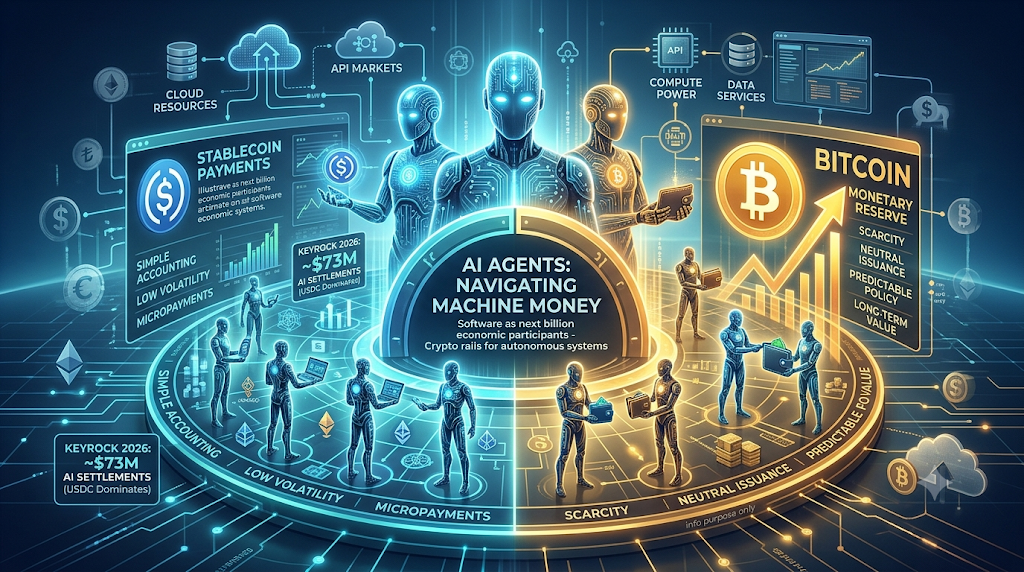
According to a 2026 Keyrock report, autonomous AI agents settled approximately $73 million through roughly 176 million blockchain transactions between May 2025 and April 2026, with average transaction values near $0.31. That transaction profile strongly favors programmable rails over traditional financial infrastructure.
Are AI Agents Actually Using Bitcoin Today?
Not exactly for most payments — but increasingly for monetary preference. Today, most autonomous transactions settle using stablecoins.
According to Keyrock research, more than 98% of observed AI-agent payment volume currently uses USDC. This dominance makes sense because agents purchasing services need stable unit pricing. But payment currency and monetary preference are not identical.
Stablecoins Win Payments
Stablecoins currently dominate because they provide:
-
Low volatility
-
Simple accounting
-
Predictable pricing
-
Existing integrations
Major infrastructure providers including Coinbase, Stripe, Visa, and cloud providers have started building machine-payment frameworks around stablecoin rails.
Bitcoin Wins Monetary Properties
Bitcoin increasingly appears attractive where agents optimize for:
-
Scarcity
-
Neutral issuance
-
Long-term storage
-
Decentralization
-
Global accessibility
Research published during 2026 found that AI systems frequently rank Bitcoin above fiat currencies under autonomous economic scenarios.
That distinction matters. Machines may spend stablecoins but reserve value elsewhere.
Why Would AI Agents Prefer Bitcoin Over Fiat Currency?
Bitcoin aligns unusually well with machine requirements. Human money evolved around institutions, trust relationships, and national boundaries. Machine money optimizes differently.
Predictable Monetary Policy
Bitcoin's issuance schedule does not depend on committees or geopolitical decisions. For autonomous systems making long-horizon decisions, predictability becomes valuable. An agent managing capital over years benefits from rules that do not change unexpectedly.
Permissionless Access
Bitcoin does not require corporate onboarding or national identity. Machines can interact directly through wallet infrastructure. That architecture reduces friction.
Native Digital Ownership
AI agents cannot open bank accounts independently. Blockchain wallets create a programmable ownership layer. Research into agent economies increasingly treats wallet infrastructure as a foundational requirement.
Global Settlement
Machine economies are not geographically constrained. Bitcoin and blockchain networks provide settlement across jurisdictions. That characteristic becomes increasingly relevant for AI systems purchasing digital goods globally.
Conclusion
AI agents have not officially declared Bitcoin their currency, but early evidence suggests they increasingly value the properties Bitcoin offers. Machine economies require money that is programmable, borderless, globally accessible, and resistant to arbitrary change. Traditional financial rails were designed for humans, not autonomous software.
Current data shows stablecoins dominate real-world AI payments because they enable low-cost, predictable settlement. However, research increasingly points to Bitcoin emerging as a preferred reserve asset and monetary benchmark for autonomous systems.
The most important takeaway is not that AI will pump Bitcoin. It is that autonomous software changes the criteria for what good money looks like.
If machine economies continue expanding, the next phase of digital finance may not be determined by national borders or payment processors. It may be shaped by whichever monetary network machines find most efficient to use.
FAQs
-
Are AI agents buying Bitcoin autonomously today?
Some experimental systems can hold and transact crypto autonomously, but large-scale independent Bitcoin accumulation remains limited.
-
Why are stablecoins more common than Bitcoin in AI payments?
Stablecoins reduce pricing volatility and support predictable micropayments.
-
Can AI agents own crypto wallets?
Yes. Wallet infrastructure already allows software agents to execute transactions under predefined permissions.