

How to Mine Zcash (ZEC) in 2026 Using Equihash ASICs: A Complete Guide to Profitability and Halving Impact
Introduction
Most people still picture cryptocurrency mining as rows of GPUs running nonstop in a basement. That image is not entirely wrong, but it is no longer the full story. For Zcash in 2026, the network has matured, mining difficulty has increased, and profitability is now shaped by a more complex mix of hardware choices rather than a single dominant setup.
Originally built around the Equihash algorithm, Zcash was designed to be GPU-friendly. Over time, however, ASICs have entered the ecosystem, shifting the efficiency curve without completely displacing GPUs. The result is a more nuanced mining environment where both options exist, but with very different cost structures, performance profiles, and risk trade-offs.
Whether you are a first-time miner deciding where to start or an experienced operator recalculating margins after recent reward adjustments, the focus has shifted from what hardware can mine ZEC to what remains viable under current network conditions.
This article covers the full picture: what Zcash is, how its proof-of-work algorithm shapes your hardware choices, which ASIC miners lead in 2026, how to join a pool, and what the block reward halving schedule means for your bottom line.
What Is Zcash and Why Does It Still Matter in 2026
Zcash launched on October 28, 2016, created by cryptographer Zooko Wilcox-O'Hearn and his team at the Electric Coin Company. The project began as a fork of Bitcoin's codebase with one core difference: privacy. Zcash introduced shielded transactions powered by zero-knowledge proofs, a cryptographic method first developed in the 1980s that allows one party to prove knowledge of information without revealing the information itself.
In practical terms, this means users can send and receive ZEC on a public blockchain while keeping the sender, receiver, and transaction amount completely private. Businesses and individuals who want financial confidentiality without abandoning a decentralized network have a compelling reason to use Zcash that no general-purpose chain offers.
The supply model mirrors Bitcoin precisely. There will only ever be 21 million ZEC in existence. Mining rewards are cut in half approximately every four years through scheduled halvings, and the network runs on proof-of-work consensus, meaning miners secure the blockchain and earn newly issued ZEC in return.
As of 2026, ZEC trades on every major exchange including KuCoin, carries deep liquidity, and remains one of the most recognized privacy-focused assets in the market. The mining ecosystem supporting it has professionalized significantly, and understanding how to participate profitably requires knowing the technology underneath it.
Understanding the Equihash Algorithm: Why It Shapes Every Mining Decision
Zcash does not use the SHA-256 algorithm that secures Bitcoin. It uses Equihash, a proof-of-work algorithm developed by Professor Alex Biryukov and Dr. Dmitry Khovratovich and formally presented at the Network and Distributed System Security Symposium in February 2016.
Equihash was designed to be memory-hard. Rather than requiring raw computational speed, it demands a large amount of RAM to generate a valid proof. The original intention was to keep mining accessible to GPU and CPU miners by making it prohibitively expensive to build application-specific hardware. The logic was straightforward: memory is expensive and standardized, so dedicated chips would offer less advantage over commodity hardware.
That calculation changed in 2018 when Bitmain released the AntMiner Z9 Mini, the first Equihash ASIC. Purpose-built for a single algorithm, it delivered hashrates that no GPU setup could match. The competitive landscape shifted overnight, and by 2026 ASIC mining is not just recommended for serious Zcash miners, it is essentially the only viable path for anyone who wants to earn consistent rewards against the current network difficulty.
Equihash uses a parameter set expressed as two numbers, most commonly written as Equihash (200,9) for Zcash. These parameters define the memory requirements and the complexity of the problem miners must solve. The Zcash community evaluated changing these parameters to restore ASIC resistance, but in a governance vote, participants chose not to make ASIC resistance a core priority. That decision has remained in place, and the mining ecosystem has built up around ASIC hardware accordingly.
For miners, this means the algorithm is stable. You are not at risk of a sudden fork invalidating your hardware the way some altcoin communities have used algorithm changes to reset the mining landscape.
How Zcash Mining Works: Block Rewards and the Halving Schedule
Every 75 seconds, a new block is added to the Zcash blockchain. The miner or mining pool that wins that block receives a reward in freshly issued ZEC. Understanding the exact mechanics of this reward is essential to any profitability calculation.
The current block reward as of 2026 is 1.5625 ZEC per block. Zcash launched with a reward of 12.5 ZEC, which was reduced to 6.25 ZEC via the 2019 Blossom upgrade, then halved to 3.125 ZEC in November 2020, and halved again to 1.5625 ZEC in November 2024. The next halving, expected in late 2028, will reduce the reward to 0.78125 ZEC.
The halving's impact on mining profitability is direct and significant. When the block reward is cut in half, miners receive fewer ZEC per block for the same amount of work. If the price of ZEC does not increase to compensate, revenue falls by roughly 50% overnight. Electricity costs do not change. Hardware depreciation does not change. Pool fees do not change.
This is not a reason to avoid mining. It is a reason to plan carefully.
Historically, Bitcoin halvings have been followed by price appreciation, though the timing and magnitude have varied considerably. Zcash has followed a similar, if less dramatic, pattern. Miners who understand the halving calendar and account for it in their financial projections are better positioned than those who discover it retroactively on their revenue statement.
For any miner setting up in 2026, the key question is whether the current ZEC price and your all-in operating costs produce enough margin to survive the next halving and remain solvent until the market reprices the asset upward.
Equihash ASIC Miners in 2026: What Hardware to Consider
The ASIC market for Equihash has consolidated around a small number of leading manufacturers. Here is what miners are working with in 2026.
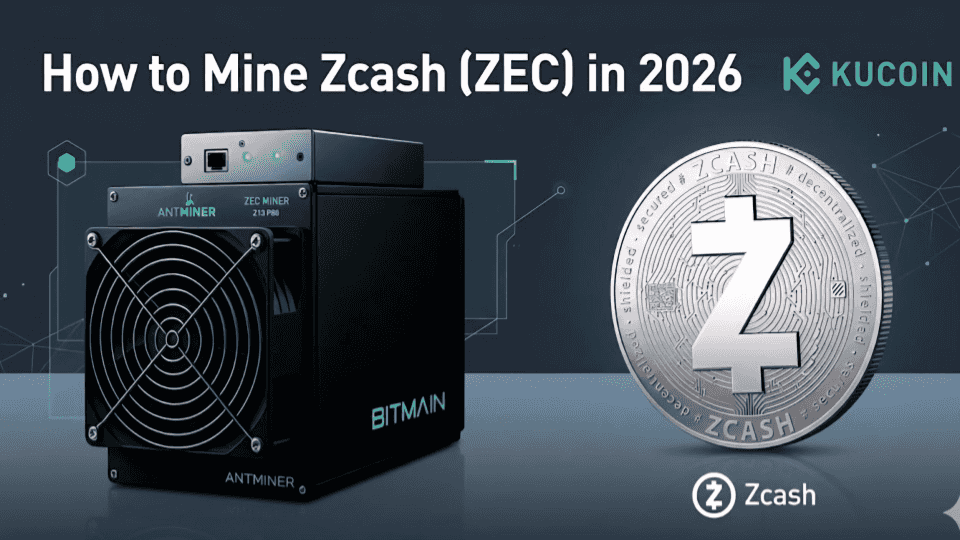
Bitmain Antminer Z15 Pro
The Antminer Z15 Pro is the benchmark machine for serious Zcash miners. It delivers approximately 860 kSol/s (kilosolutions per second), which represents the hashrate unit specific to Equihash mining. The Z15 Pro offers strong power efficiency relative to its output, meaning the cost per unit of hash is lower than older generation hardware. This matters more than raw hashrate when calculating long-term margins.
Bitmain also sells certified pre-owned Z15 Pro units through verified channels, which represent a lower upfront cost option for miners who want to enter the market without paying new hardware prices.
Innosilicon and Other Manufacturers
Innosilicon has produced competitive Equihash ASIC hardware and remains a relevant alternative to Bitmain. Comparing machines across manufacturers should focus on three figures: hashrate (kSol/s), power consumption (watts), and efficiency (joules per kilosolution). A machine with a slightly lower hashrate but meaningfully better efficiency may outperform a faster machine over a 12-month period when electricity costs are factored in.
When evaluating any ASIC purchase, verify that the machine is compatible with standard Equihash (200,9) parameters used by Zcash, not a variant parameter set used by a different chain.
A Note on Power Supply and Hosting
Zcash's own mining documentation flags the power supply as the single most important hardware component after the ASIC itself. Industrial-grade ASIC miners draw substantial power, and an undersized or unreliable power supply will cause hardware failures, downtime, and lost revenue. Spec your power supply with significant headroom above the miner's rated draw.
ASIC miners also run loud. Industrial fan systems are not suitable for residential environments. Many serious miners use hosted colocation facilities, which handle power, cooling, and physical maintenance for a monthly fee. This cost needs to be included in any profitability model.
Setting Up for ZEC Mining: Step-by-Step Overview
Getting started with Zcash ASIC mining involves five core steps.
-
Secure your hardware: Purchase an Equihash ASIC from a reputable manufacturer or verified reseller. Verify the hashrate specifications and warranty terms before buying.
-
Get a ZEC wallet address: Before the miner runs a single computation, you need a wallet to receive your rewards. Zcash supports both transparent addresses (similar to Bitcoin) and shielded addresses that use the network's privacy features. A hardware wallet is the most secure storage option and the one most commonly recommended by the mining community. You can also use software wallets for operational convenience, but hardware wallets should hold any significant balance.
-
Choose between solo mining and pool mining: Solo mining means competing against the entire network with only your own hardware. At current difficulty levels, solo mining is financially impractical for all but the largest operations. The variance is simply too high: you might mine several blocks in a week, or none for months. Pool mining solves this by combining your hashrate with other miners. The pool finds blocks more frequently, and rewards are distributed to participants based on the share of hashrate each contributed. For most miners in 2026, pool mining is the right default choice.
-
Configure your miner: Each ASIC has a firmware interface where you set the pool address, your wallet address, and worker credentials. The miner connects to the pool's stratum server and begins contributing hashrate.
-
Monitor performance: Most pools provide dashboards showing your hashrate, accepted shares, and estimated earnings. Professional monitoring software can track uptime, alert you to hardware issues, and help you identify efficiency losses before they become significant.
Zcash Mining Pools: Where to Direct Your Hashrate
Pool mining remains the dominant strategy for ZEC in 2026. Rather than competing individually, miners combine computational power to increase block discovery frequency, then share rewards proportionally. This approach smooths earnings and reduces the unpredictability associated with solo mining.
The pool landscape has also become more concentrated. ViaBTC currently leads the network with approximately 4.73 GSol/s out of 10.71 GSol/s, accounting for about 44.2% of total Zcash hashrate. It is followed by F2Pool with 2.02 GSol/s, and 2Miners with 1.07 GSol/s. This distribution highlights a clear dominance by top-tier pools, which typically offer more consistent payouts due to higher block discovery rates.
Beyond these leaders, established pools such as Flypool, Nanopool, and Slushpool continue to be referenced in Zcash documentation as reliable options, particularly for miners prioritizing stability and long-term uptime.
Choosing the right pool comes down to a few critical variables. Pool fees generally range between 0.5 and 2% of rewards, directly affecting net profitability over time. Server location matters as well, since lower latency reduces the likelihood of rejected shares. Pool size influences payout consistency, with larger pools offering steadier returns while smaller pools may introduce more variance. Finally, reward structures differ: PPS provides fixed payouts per share, PPLNS ties rewards to recent contribution windows, and PROP distributes earnings based on proportional work per round.
In practice, directing your hashrate is less about finding a single “best” pool and more about aligning these variables with your operational goals, whether that is maximizing consistency, reducing fees, or maintaining decentralization exposure.
Calculating ZEC Mining Profitability in 2026
Profitable ZEC mining in 2026 comes down to a clear set of inputs. Running these numbers before you buy any hardware is not optional.
-
Revenue inputs: Current ZEC price, your miner's hashrate in kSol/s, and the current network difficulty determine how much ZEC you earn per day. Online mining calculators can compute this quickly once you have your hardware specifications.
-
Cost inputs: Electricity is the largest ongoing cost. Your miner's power draw in watts multiplied by your electricity rate (cost per kilowatt-hour) and operating hours per day produces your daily power cost. Add pool fees as a percentage of revenue. If you use colocation hosting, add the monthly facility fee.
-
Capital costs: The purchase price of your ASIC amortized over its useful life determines your depreciation cost per day. More expensive hardware typically delivers better efficiency, so the tradeoff between upfront cost and ongoing efficiency is worth calculating carefully.
-
The halving adjustment: Because the next halving will cut block rewards in half, any profitability model should include a sensitivity analysis showing what happens to your margins if the ZEC price stays flat while rewards are cut. Miners who build in this scenario as a planning assumption are far better prepared than those who assume current conditions persist indefinitely.
The broader principle is that ZEC mining profitability is dynamic. It responds to the ZEC price, network difficulty (which rises as more hashrate joins the network), electricity costs, and the halving schedule. Monitoring all four variables and adjusting your operation accordingly is the discipline that separates sustained profitability from a single lucky quarter.
Why Mine Zcash? The Broader Case
Beyond the numbers, there is a substantive case for Zcash mining worth understanding.
ZEC has high liquidity and trades across major exchanges including KuCoin, making it straightforward to convert to Bitcoin, stablecoins, or fiat. Mining ZEC can serve as a cost-basis acquisition strategy for an asset you believe will appreciate, particularly if your electricity costs are below the global average.
Zcash mining also directly supports a network with a distinct purpose. Privacy in financial transactions is not a niche concern: it is relevant to journalists, activists, businesses protecting commercial relationships, and individuals who believe financial data is personal. Mining ZEC contributes hashrate to a blockchain that exists specifically to protect that interest.
The network's proof-of-work model means miners have real skin in the game. Unlike delegated or staked systems where validators are selected by token holdings, Zcash miners must continuously invest in hardware and electricity to participate. That ongoing commitment is what keeps the network genuinely decentralized and resistant to capture.
Key Takeaways for ZEC Miners
Zcash mining is an ASIC-driven activity. GPU mining is no longer competitive given the network's hashrate and difficulty. The Equihash algorithm is stable and well-understood, giving miners confidence that their hardware investment will not be invalidated by a sudden fork.
The halving schedule is the most important variable to build into any financial model. Every four years, block rewards are cut in half. Miners who plan for this and maintain efficient operations with low electricity costs are positioned to remain profitable through the cycle. Those who operate with thin margins and no buffer are exposed to serious risk when the next halving arrives.
Pool mining is the right choice for the vast majority of miners. Solo mining is statistically unworkable at current difficulty levels outside of very large operations. Choose a reputable pool with transparent fees and servers near your location.
Hardware selection should prioritize efficiency over raw hashrate. The machine that delivers the best joules-per-kilosolution ratio at your electricity rate is the machine that produces the best margin over a 12-month period.
If you are ready to get started, KuCoin offers ZEC trading with deep liquidity, making it straightforward to sell, trade, or hold your mined rewards in a single platform.
FAQs
What is the best way to mine Zcash in 2026?
The most effective way to mine Zcash in 2026 is by using Equihash ASIC miners. GPU mining is no longer competitive due to increased network difficulty and the efficiency advantage of ASIC hardware.
Can you still mine Zcash with a GPU in 2026?
Technically yes, but it is not profitable. ASIC miners dominate the network, making GPU mining inefficient and unlikely to generate consistent rewards.
What is the current Zcash block reward?
As of 2026, the Zcash block reward is 1.5625 ZEC per block. This reward is reduced by half approximately every four years through scheduled halvings.
When is the next Zcash halving?
The next Zcash halving is expected in 2028, when the block reward will decrease from 1.5625 ZEC to 0.78125 ZEC.
What is the best ASIC miner for Zcash?
Top-performing ASIC miners include models like the Bitmain Antminer Z15 Pro and competing hardware from Innosilicon. The best choice depends on efficiency (joules per solution), not just raw hashrate.