

Moscow Exchange to Launch Perpetual Futures on Cryptocurrency and US Stocks: Why the Exchange Needs Partner Depositories
2026/08/17 12:00:00
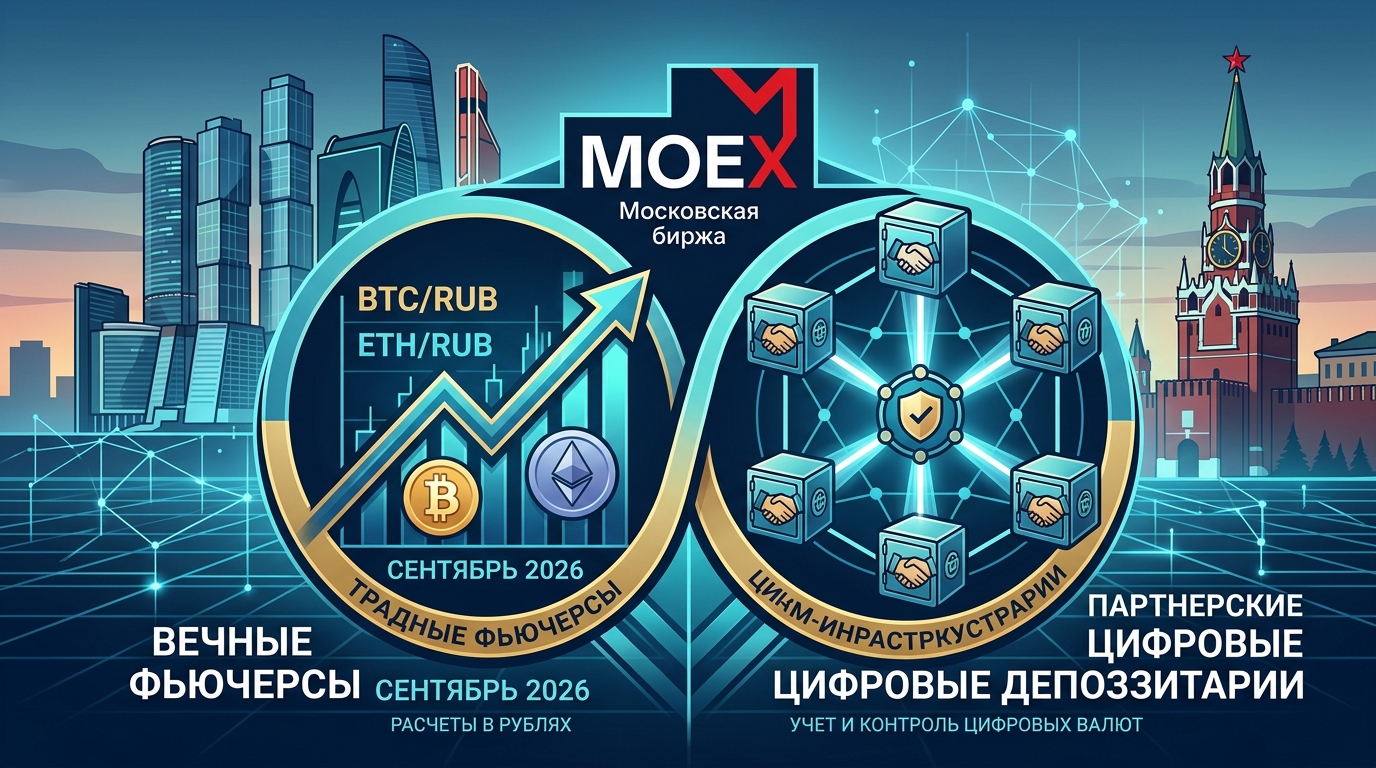
Moscow Exchange plans to launch its first perpetual futures on Bitcoin and Ethereum indices in September 2026, with settlements conducted in Russian rubles. At the same time, the exchange is building a partnership-based model for recording digital currencies: it does not plan to create its own crypto depository on the basis of the National Settlement Depository, and will therefore work with external digital depositories. This is more important than simply expanding the derivatives list. The trading venue is creating a regulated framework in which traditional investors can gain crypto exposure without opening an overseas account or taking the asset directly into a personal wallet.
The conclusion is that perpetual futures give the market a new trading instrument, while depository accounting creates infrastructure for the legal ownership, transfer, and verification of digital assets within the Russian legal system. Most of the changes provided for by Federal Law No. 282-FZ are expected to enter into force on September 1, 2026. The launch of derivatives and the connection of digital depositories should therefore be viewed as two parts of the same infrastructure transformation rather than as unrelated developments.
What exactly will Moscow Exchange launch in September 2026?
Moscow Exchange plans to start with two perpetual futures on Bitcoin and Ethereum indices. These contracts allow traders to trade changes in the settlement index without a fixed expiration date. According to RBC, the announcement was made by Maria Patrikeeva, Managing Director for the Derivatives Market, at the exchange’s annual seminar for journalists.
This product gives investors a derivative position based on the performance of the underlying indicator rather than direct ownership of the coin. A trader can open a long or short position, use the contract for hedging, and build arbitrage strategies. The final contract parameters—including the initial margin, price increment, funding calculation, limits, and trading schedule—must be determined by the exchange’s specifications and clearing rules.
The cryptocurrency lineup complements preparations already under way for futures on US instruments. At the end of July, the exchange reported 23 fixings required to launch derivatives on individual US securities and instruments. The list included Amazon, Netflix, Tesla, and SpaceX. On August 4, the first perpetual contracts on SPY and QQQ appeared—exchange-traded funds that reflect the performance of the S&P 500 and Nasdaq indices.
How does a perpetual future differ from buying Bitcoin or Ethereum?
A perpetual future is a cash-settled derivative, not a transaction to buy cryptocurrency and subsequently receive coins at a blockchain address. Under Moscow Exchange’s proposed model, the contract will be cash-settled: obligations will be closed in money at the settlement price, and no physical delivery of Bitcoin, Ethereum, a US stock, or an ETF will take place.
This distinction determines the entire user experience. A contract buyer does not become the owner of BTC on the blockchain and does not receive the right to sign transactions independently. Instead, the buyer receives a financial result based on changes in the settlement index. If the price moves in the expected direction, the result is credited according to clearing rules. If the movement is unfavorable, the participant incurs a loss and must maintain the required level of collateral.
The quotation may be expressed in a foreign currency or linked to an international indicator, but settlements remain in Russian rubles. As a result, the participant does not need to open an overseas brokerage account, purchase a foreign stock on an external venue, or arrange cross-border delivery of a digital asset. This does not eliminate market risk, liquidity risk, or exchange-rate risk, but it changes the transaction’s operational framework.
Why do ruble settlements matter for Russian investors?
Ruble settlement moves the trading and clearing side of the transaction into the Russian financial system. Monetary claims, margin, and final payments pass through domestic infrastructure rather than through a chain of foreign brokers, banks, and crypto platforms.
The practical effect is reduced dependence on foreign accounts and intermediaries. If the contract does not provide for delivery of a US stock or coin, the participant does not need to own the foreign underlying asset. In the case of a cash-settled future within a domestic ruble system, Western sanctions mechanisms, including OFAC, do not have a direct cross-border object to freeze at a foreign depository. This does not mean that sanctions, counterparty, or regulatory risks disappear: the exchange, broker, bank, and clearing organization continue to operate under Russian law and their own compliance procedures.
Ruble settlement also makes the product easier to understand for traditional investors who earn income in rubles and want to trade based on global market movements. However, the currency component does not disappear. If the index or quotation is denominated in dollars, a change in the ruble exchange rate can affect the final ruble result even if the price of the underlying indicator barely changes.
Why does Moscow Exchange need partner digital depositories?
Partner digital depositories are needed to record and control digital assets, not to turn the exchange into an ordinary crypto wallet. RBC reports that the National Settlement Depository does not plan to create its own crypto depository because traditional depository activity and a digital depository under the new regulatory model are considered different areas. At the same time, Moscow Exchange intends to cooperate with several partner accounting organizations.
Within this framework, a depository’s functions include maintaining records of rights to a digital asset, segregating client positions, confirming transfers of rights, participating in settlements, and preparing information for compliance and audit. In essence, the depository answers three questions: who owns the recorded asset, on what basis did it enter the system, and how can it be transferred, inherited, or reflected in legally significant records?
Russian Law No. 282-FZ places digital depositories, trading organizers, brokers, clearing organizations, and other regulated elements within the broader framework for the circulation of digital currencies. Therefore, depository accounting is not a decorative entry in an application. It is part of the mechanism for accessing regulated operations. The more procedures are fixed in rules and contracts, the easier it becomes to prove an asset’s origin, separate client assets from intermediary assets, and resolve a dispute.
Will it be possible to withdraw cryptocurrency to a cold wallet?
Most likely, Moscow Exchange’s partnership model will not provide direct withdrawals of digital currency to a personal cold wallet in the manner of a conventional crypto exchange. Its purpose is to service transactions and records within a closed regulated ecosystem rather than give users independent control over private keys.
This limitation follows from the nature of the product. A perpetual future does not involve a deliverable coin at all: after the position is closed, the participant receives a cash settlement. For a digital asset recorded by a depository, the ownership right is confirmed by an entry in a digital account and governed by an agreement with an authorized organization. Moving the asset to an unidentified external address could violate requirements concerning traceability, owner control, and assessment of the asset’s source.
Clients must therefore distinguish between three concepts. A cryptocurrency wallet stores keys and allows blockchain transactions to be signed. An exchange account reflects a position in a derivative. A digital depository account confirms the right to an asset within a regulated accounting system. These structures can interact only in the manner established by law, platform rules, and regulations issued by the Bank of Russia.
Who will be able to trade these instruments?
At launch, access to digital-currency operations within the regulated framework will most likely be primarily aimed at qualified investors. The law preserves the distinction between qualified and non-qualified investors. For non-qualified investors, it provides for testing, risk notifications, possible annual investment limits, and restrictions on the list of permitted assets.
A qualified investor also does not receive an automatic right to conduct every type of transaction. The investor will still have to complete identification procedures, accept the terms of the broker or depository, and review the risks of the specific instrument. The status merely expands the range of available operations; it does not turn a volatile derivative into a risk-free product.
For a mass-market client, the barrier will not consist solely of confirming investor status. The client will need to understand margin mechanics, be able to cover variation margin, and be prepared for rapid capital losses during a sharp market move. A perpetual future may be more convenient than a spot purchase for hedging, but leverage can increase losses faster than an investor expects.
Why is depository accounting strategically more important than launching futures?
Launching a future creates a specific trading product, while depository accounting changes the market’s architecture. A derivative can be added to a trading system relatively quickly. Depository infrastructure, by contrast, determines how digital assets will be recognized, transferred, and serviced for years.
It is accounting that makes a crypto asset comparable to traditional financial property. If a right can be recorded unambiguously in a digital account, its transfer history can be verified, it can be separated from an intermediary’s assets, passed on by inheritance, and presented in court, then it becomes suitable for institutional infrastructure. This does not turn Bitcoin into a stock or eliminate its volatility, but it reduces the main barrier for conservative capital: uncertainty surrounding legally significant ownership and operational control.
The strategic meaning of the partnership model lies in standardization. When several digital depositories operate under compatible rules, the exchange can connect brokers, banks, clearing organizations, and large clients to a single market without building every component from scratch. RBC notes that Sberbank, VTB, T-Bank, and Alfa-Bank had previously announced plans to create digital depositories. This shows that infrastructure competition is already extending beyond a single trading venue.
How are digital depositories connected to DFAs and bank capital?
The development of digital financial assets and digital currencies in Russia is creating a legal environment in which traditional financial institutions can gradually connect to the crypto market. An overview of the law published on August 10, 2026, states that digital currency is expressly recognized as property and that the regulated framework includes digital depositories and professional intermediaries.
This matters to Sberbank, VTB, and other banking groups because their institutional clients assess not only potential returns but also the quality of accounting, reporting, risk controls, and disclosure. A bank needs to know who owns the asset, how its origin is verified, how a client’s instruction is executed, and what happens if an intermediary becomes insolvent or a dispute over ownership arises.
Accordingly, connecting depositories represents the gradual “securitization” and standardization of digital assets in an operational sense. It does not legally transform every cryptocurrency into a security. Rather, it brings asset-recording procedures closer to familiar financial-market standards. Over time, this could open the way for large pools of capital and affluent bank clients seeking crypto returns through familiar Russian infrastructure.
What risks remain under the new model?
A regulated framework reduces some operational risks but does not eliminate investment risks. The price of Bitcoin and Ethereum can change sharply, while a perpetual future adds leverage, collateral requirements, the risk of forced liquidation, and possible payments under the funding mechanism.
The second risk concerns liquidity. A Moscow Exchange representative expects to create a liquid market with representative prices, but at the time of RBC’s publication, market participants allowed for liquidity to be distributed across several pools rather than concentrated in one centralized pool. In practice, this could mean wider spreads, differences between price sources, and difficulty executing a large order.
The third risk is regulatory. Most of the new framework is expected to take effect on September 1, 2026. However, specific access rules, asset lists, limits, requirements for digital depositories, and procedures for interaction with brokers may be clarified through subordinate regulations. Until the final specifications are published, it is not possible to promise that all clients will receive the same range of services.
Finally, the partnership model distributes responsibility among several participants. An error by a broker, depository, clearing organization, or external information system could affect access to the asset and the settlement process. Investors will therefore have to assess not only the Moscow Exchange brand but also the specific intermediary, the contract, client-asset protection rules, and the procedure for handling claims.
How do perpetual futures on US stocks complement the cryptocurrency lineup?
Futures on US instruments extend the same idea: giving Russian participants ruble-based exposure to international markets without direct ownership of a foreign asset. A contract on SPY or QQQ does not require physical delivery of the ETF; settlement takes place under the rules of the Russian derivatives market.
For an investor, this may serve as a tool for tactical hedging or a speculative position on the S&P 500 and Nasdaq. For Moscow Exchange, it may help recapture part of the demand that previously flowed to foreign platforms. However, this exposure remains synthetic: the investor does not automatically receive ETF dividends, does not become a shareholder in a US company, and does not acquire corporate rights.
The simultaneous launch of crypto futures and contracts on US instruments shows that the exchange is developing not merely individual products but a universal ruble-based venue for trading global price benchmarks. This increases the importance of reliable clearing, transparent fixing methodologies, and clear disclosure of how the settlement price is formed.
KuCoin Offers A More Stable Option in A Volatile Market
If you worry about the frequent ups and downs in the market, and pursue a more stable option to earn money passively, KuCoin is the right place to come:
Simple Earn: Deposit and withdraw tokens anytime, earning stable returns.
Kucoin Earn: Earn stable profits with professional asset management.
Hold to Earn: Earn rewards by holding assets in Funding, Trading, Margin, Futures, Mining, and Unified Accounts.
Staking: Unlock the earning potential of on-chain assets.
Advanced Investments: Advanced Investments offer a variety of structured products to help your money grow in any market.
Shark Fin: Principal Protection and Guaranteed Gains
Dual Investment: Buy low and sell high with transparent return calculations.
Snowball: High yields, with price protection.
Discount Buy: Buy crypto at discount prices.
KCS Loyalty: Level up to enjoy exclusive perks by staking ≥ 1 KCS.
KuCoin Wealth: Discover future value and begin your smart investing journey.
KCS Benefits: Hold and stake KCS to access benefits across the platform.
KCS Staking 2.0: Participate in KCS on-chain governance to earn yield.
Conclusion
Moscow Exchange is preparing to launch perpetual futures on Bitcoin and Ethereum indices in September 2026 and is also developing contracts on US instruments. Their key feature is cash settlement without physical delivery of coins, stocks, or ETFs. Quotations may track international prices, but monetary obligations will be closed in rubles within the Russian clearing system.
At the same time, the exchange is choosing a partnership model for digital-depository accounting. The National Settlement Depository does not plan to create its own crypto depository, while Moscow Exchange intends to work with several specialized accounting organizations. Their role will be to record rights to digital assets, ensure traceability, segregate positions, and maintain legally significant documentation.
Depository infrastructure may prove to be the more durable step. It creates a foundation for connecting banks, brokers, large investors, and affluent clients to a regulated crypto market. Direct withdrawals to a cold wallet are unlikely to become a standard service, while access to transactions will depend on qualified-investor status, testing, and Bank of Russia rules. The new model reduces cross-border operational barriers but does not eliminate volatility, liquidity, regulatory, or counterparty risks.
Frequently Asked Questions
1. Will the future be backed by real Bitcoin or Ethereum?
No. The proposed model is cash-settled. The contract does not provide for physical delivery of Bitcoin or Ethereum; the financial result is determined by the settlement price and credited in rubles under clearing rules.
2. Will it be possible to buy actual Bitcoin on Moscow Exchange?
The launch of a perpetual future does not itself mean that coins will be sold. If access to digital currency becomes available within the regulated framework, it will depend on a separate product, the broker, the digital depository, and applicable legal requirements.
3. Is qualified-investor status required to trade crypto futures?
Access is expected to be linked to qualified-investor status and special access requirements. For non-qualified investors, the law provides for testing, risk notifications, limits, and restrictions on permitted assets. Final conditions will be determined by market rules and regulatory acts.
4. Does ruble settlement protect against a decline in Bitcoin?
No. Ruble settlement reduces dependence on foreign accounts and physical delivery, but it does not protect against a decline in the underlying index. When leverage is used, losses may exceed the initially expected amount and lead to forced liquidation.
5. Why is depository accounting important for banks?
It creates a verifiable record of ownership and asset movements, helps segregate client positions, supports audits, and facilitates succession. This makes digital assets operationally more understandable for banks and large investors, although it does not turn cryptocurrency into an ordinary stock.
Disclaimer : This material is provided for informational purposes only and does not constitute financial, investment, legal, or tax advice. Transactions involving cryptocurrencies and tokenized assets carry substantial risks — including price volatility, limited liquidity, counterparty exposure, and the potential for total loss of invested capital. Readers should conduct their own research and, where appropriate, consult a qualified professional before making any financial decisions.