

Moscow Exchange Adds Commercial Bonds to the OTC with CCP Regime: What Will Change for Issuers and Investors
Introduction
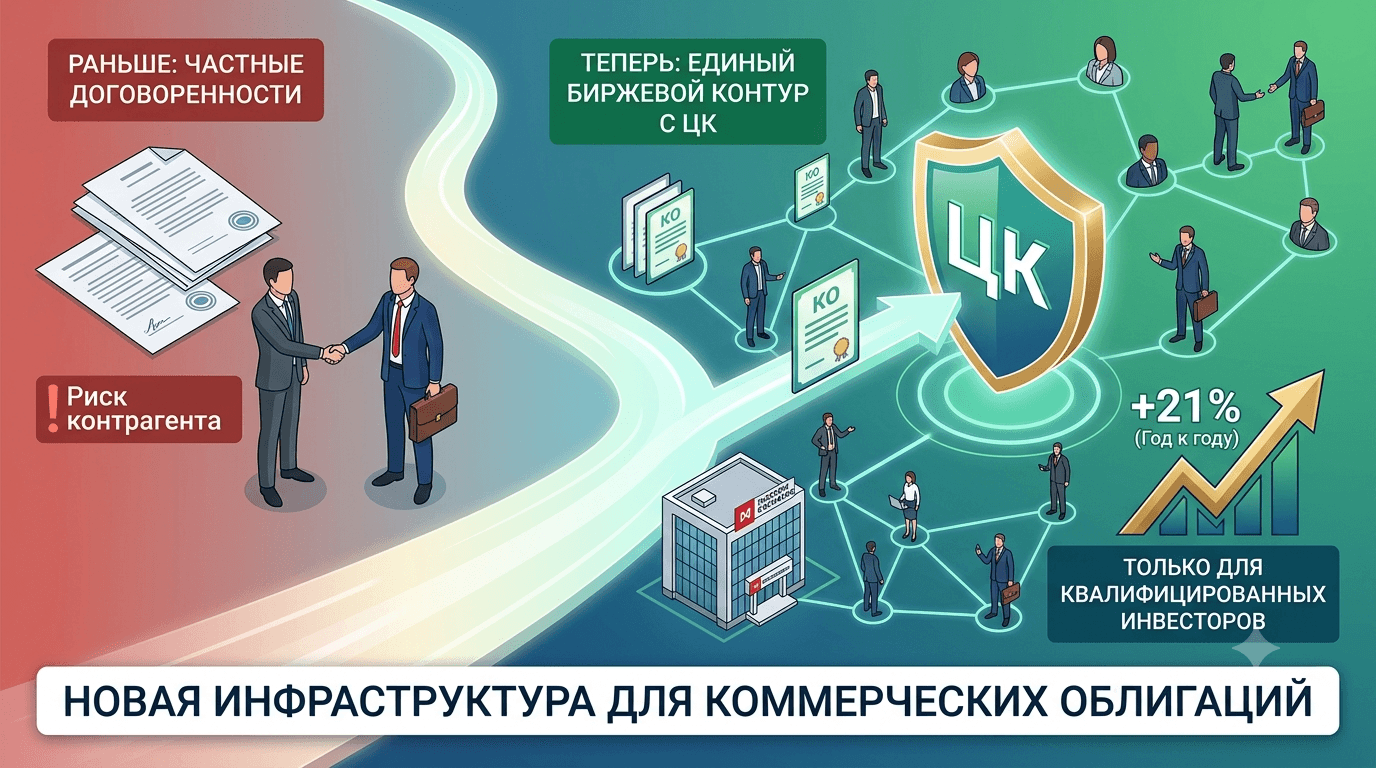
Can an instrument that previously traded mainly through private arrangements gain full-fledged secondary-market infrastructure? Since September 14, 2026, Moscow Exchange has allowed commercial bonds to be included in the over-the-counter trading regime with a central counterparty — OTC with CCP. This means that primary placements and secondary transactions can take place within a unified exchange infrastructure. According to Moscow Exchange's official announcement of September 14, the National Settlement Depository, or NSD, registered six commercial bond programs worth RUB 757 billion for 14 issuers during the first eight months of 2026, including 31 issues totaling RUB 178 billion.
Access to placements and trading remains limited to qualified investors. Commercial bonds give companies a fast channel for short-term financing, while OTC with CCP adds unified settlement and clearing. A qualified investor receives more predictable infrastructure, but not a guarantee of returns or capital repayment.
What exactly did Moscow Exchange launch?
Moscow Exchange allowed commercial bonds to be included in the over-the-counter trading regime with a central counterparty starting September 14, 2026. Under the new format, both primary placements and secondary trading in these securities can take place through unified trading infrastructure.
This does not mean that a separate class of securities has been created. A commercial bond remains a flexible debt instrument that an issuer uses to raise funds for periods and on terms suited to its business cycle. What changes primarily is how transactions, recordkeeping, settlements, and servicing are organized.
The National Settlement Depository registers commercial bonds. Market participants receive a common infrastructure framework in which a trading transaction is connected to centralized clearing and settlement. According to Moscow Exchange, this should improve execution protection and transaction predictability.
It is important to distinguish OTC with CCP from ordinary exchange trading. OTC refers to an over-the-counter regime in which transaction parameters may be agreed while taking into account the characteristics of a particular issue and participant. A CCP, or central counterparty, becomes a party to the obligations owed to the buyer and seller. This reduces the need to assess the counterparty's execution risk directly, but it does not eliminate the issuer's credit risk.
Why is the commercial bond market growing rapidly?
The main reason for the growth is that commercial bonds allow Russian companies to raise short-term financing more quickly when the cost of money is high. Such an issue can match a company's working-capital needs more precisely than a standard long-term bond program.
According to data published by Moscow Exchange on September 14, 2026, the volume of commercial bond issuance in 2026 increased by 21% compared with 2025. From January through August 2026, NSD registered six programs with a total placement volume of RUB 757 billion. These programs included 14 issuers and 31 issues that were actually placed, totaling RUB 178 billion.
These figures must be interpreted correctly. The registered program volume represents authorized or planned placement potential, while the actual issue volume reflects transactions that have already taken place. Therefore, RUB 757 billion and RUB 178 billion describe different stages of the market and should not be added together.
Growth also reflects the practical value of a private placement. An issuer can offer securities to a limited group of investors without registering a public prospectus with the Bank of Russia, provided that the issue meets the applicable legal requirements. This shortens preparation time and allows the company to adjust the volume, maturity, and rate more quickly to its needs.
However, speed has a downside. The less public information is available to the broader market, the more important it becomes to conduct professional due diligence on the issuer's financial condition, issue terms, and covenants. New infrastructure makes settlement more standardized, but it does not turn a commercial bond into a risk-free instrument.
How did commercial bond trading work before?
Before commercial bonds were connected to OTC with CCP, secondary-market circulation often relied on private agreements between participants, followed by separate coordination of securities delivery and cash settlement. This approach could be convenient for familiar counterparties, but it created additional operational and credit risks.
The buyer had to assess whether the seller could deliver the securities within the agreed period. The seller, in turn, assessed the risk of receiving payment. Participants also had to coordinate documents, recordkeeping, trade confirmation, and possible changes to the terms. When the number of participants was small, these processes could be handled manually, but as the market expanded, they became costly and slow.
Liquidity was a major problem. An investor could buy a commercial bond in a primary placement but might not have a clear and fast exit route before maturity. If there are few buyers and sellers, the difference between the purchase and sale price — the spread — can remain wide. This increases the cost of an early exit and reduces the instrument's usefulness for portfolio management.
OTC with CCP does not promise a continuously active two-sided market, but it creates a clearer foundation for one. Unified recordkeeping and settlement procedures reduce friction between participants. Actual liquidity, however, will depend on the number of issues, broker activity, the quality of information disclosure, and investors' willingness to quote the securities.
What advantages does a central counterparty provide?
The central counterparty's key advantage is greater certainty of transaction execution. After a trade is concluded, the buyer and seller interact with clearing infrastructure under established rules rather than relying solely on each other.
How are transaction risks reduced?
The central counterparty assumes the role of an intermediary party to the obligations. As a result, participants do not have to base their entire settlement model on trust in a specific counterparty. Clearing, collateral requirements, and execution procedures establish a uniform operating framework.
This reduces the risk of failed settlement caused by uncoordinated actions, but it does not eliminate every risk. Technology failures, insufficient collateral, participant delays, or problems with the issue itself remain possible. The central counterparty provides an execution mechanism for trades; it does not guarantee the issuer's ability to repay principal.
Why could secondary-market liquidity increase?
The secondary market receives a unified route for concluding and settling transactions. According to representatives of Moscow Exchange and NSD, this may expand the pool of potential participants, improve position-building efficiency, and make it easier to exit a trade.
If brokers can offer qualified clients more issues through familiar infrastructure, the number of potential orders may increase. Competition among orders can narrow spreads and make prices more informative. This effect does not arise automatically on the launch date, however. It requires regular quotations, sufficient issue volumes, and comparable data standards.
How will operating costs change?
Unified standards for recordkeeping, settlement, and servicing may reduce the number of manual operations. Anna Volodina, NSD's Managing Director for Corporate Client Product Development, said that the new regime should improve participant efficiency and reduce operating costs.
Savings may arise for brokers, depositaries, issuers, and investors. It is easier for participants to scale operations when settlement and servicing rules do not have to be renegotiated for every private transaction. The final cost, however, will depend on the fees charged by the trading, clearing, and depository infrastructure.
|
Market element
|
Before connection to OTC with CCP
|
After connection to OTC with CCP
|
|
Trade organization
|
Private agreements and individual coordination
|
Unified procedures within Moscow Exchange infrastructure
|
|
Settlement
|
Agreed by the parties and servicing organizations
|
Conducted through a clearing framework with a CCP
|
|
Secondary exit
|
May depend on finding a specific buyer
|
A standardized channel for secondary transactions becomes available
|
|
Access
|
Private placement and a limited group of participants
|
Qualified investors only under the new regime
|
|
Credit risk
|
Includes counterparty and issuer risk
|
Counterparty risk is reduced; issuer risk remains
|
What will change for issuers?
For issuers, the main effect is a direct distribution channel through brokers using exchange infrastructure. A company will be able to offer short-term securities to a defined group of qualified investors more quickly without building a completely individualized settlement chain each time.
Commercial bonds suit businesses that need to align borrowing with their working-capital cycle. For example, a company may raise funds for a period covering raw-material purchases, the execution of a major contract, or a temporary cash-flow gap. Flexible maturity and terms can help the company avoid overpaying for financing designed for a longer period.
The new regime may expand the potential investor base. Unified infrastructure makes the instrument easier to understand for brokers and professional participants that already use the services of Moscow Exchange, the National Clearing Centre, and NSD. This may increase competition for high-quality issues.
Issuers, however, will face higher expectations regarding operational discipline. Investors will compare rates, maturities, collateral, financial indicators, and early-redemption terms. Access to OTC with CCP does not replace credit analysis. A company with high leverage may remain a difficult borrower even when modern infrastructure is available.
What does a qualified investor gain?
A qualified investor receives a more convenient way to participate in primary placements and may be able to sell commercial bonds more quickly in the secondary market. Transactions can be conducted through a broker within a unified infrastructure framework, while settlement and recordkeeping become more standardized.
The new regime does not guarantee a positive result, however. A commercial bond's return is linked to default risk, maturity, the issuer's financial condition, and the availability of buyers. Even with a central counterparty, the security's price may decline if market rates rise or the market's assessment of the company deteriorates.
Before buying, an investor should review several groups of parameters. These include the purpose of the borrowing, maturity, rate and income-payment schedule, collateral, restrictions on early redemption, financial statements, repayment history, and default provisions. It is also important to confirm that the broker has verified the investor's qualified status and that the specific issue is available for the selected account type.
Commercial bonds should not be confused with bank deposits. A bond is a claim against the issuer, not an insured deposit. If the company's financial condition worsens, the investor may face delayed payments, restructuring, or a partial loss of capital.
Will the market become fully exchange-traded?
No. Commercial bonds do not become ordinary publicly traded exchange bonds merely because they are admitted to OTC with CCP. Their placement remains a private placement, while participation in primary and secondary trading under the new regime is limited to qualified investors.
Nor should inclusion in the infrastructure be viewed as a guarantee of high turnover. Liquidity results from continuous interaction between buyers and sellers. If an issue is small, its terms are complex, and information is updated infrequently, the presence of a central counterparty alone will not create an active market.
Another misconception is that NSD or Moscow Exchange is responsible for returning the principal. NSD registers commercial bonds and participates in the recordkeeping infrastructure, while the exchange and clearing system organize the trading and settlement process. The obligation to pay coupons or principal rests with the issuer under the terms of the issue.
Finally, a high rate does not automatically mean high attractiveness. It may compensate investors for elevated credit risk or a short financing period. An issue should be compared not only with the yields of alternative bonds, but also with the probability of delayed payment, the cost of exiting, and the concentration of risk in the portfolio.
What risks remain after the launch of OTC with CCP?
The primary risk remains the issuer's credit quality. If a company cannot service its debt, settlement infrastructure will not remove the underlying cause of nonpayment. Therefore, an analysis of the balance sheet, cash flows, leverage, and collateral structure should precede any purchase.
The second risk is liquidity. An investor may have the technical ability to place an order but still fail to find a buyer at the desired price. A wide spread can reduce the effective return when the security is sold before maturity.
The third risk is interest-rate risk. When the key rate and market expectations change, the price of already-issued securities may also change. This effect is often limited by the maturity of short-term issues, but it does not disappear completely.
The fourth risk is concentration. Buying several issues from the same sector or group of related companies creates dependence on a single economic scenario. Diversification across issuers, maturities, and industries reduces, but does not eliminate, overall risk.
The fifth risk is regulatory and operational. Investors need to monitor access rules, fees, changes to issue documents, and the capabilities of their specific broker. Access to the regime may differ by product and service channel.
How should an investor evaluate a commercial bond?
The first step is to determine the role the issue will play in the portfolio: preserving short-term liquidity, earning fixed income, or making a tactical investment in a particular issuer. The investor should then compare the security's maturity with the time when the funds may be needed.
Next, the investor should calculate not only the nominal yield but also the net result after commissions, taxes, purchase expenses, and a potential discount on sale. If the investor plans to hold the security to maturity, the issuer's solvency is more important. If an early exit is expected, secondary-market liquidity becomes the priority.
The next step is to review the documents. The investor should study the issue terms, settlement procedure, events of default, restrictions on holders, and information-disclosure process. The absence of a public prospectus does not mean that analysis is unnecessary.
The practical conclusion is straightforward: new infrastructure improves the transaction process, but the quality of an investment decision still depends on assessing the borrower and the price of risk. More reliable delivery of the security does not compensate for an excessive price or weak company financials.
How can investors buy commercial bonds through a broker?
Only qualified investors can buy a commercial bond under the OTC with CCP regime, and they must use a broker that supports the relevant transactions. First, the client must confirm their status, review the list of available issues, and check the terms of the specific trade.
The investor then selects an issue, determines the order size, and confirms the parameters: price or rate, maturity, number of securities, settlement date, and fees. Before submitting an order, the investor must ensure that the account contains sufficient funds and that the issue matches the investment strategy.
Because the market is new, the availability of issues and quotations may vary among brokers. Investors should clarify whether orders and current prices are displayed in the trading terminal, whether instructions can be submitted remotely, and how participation in a primary placement is arranged.
Beyond the Headlines: What KuCoin 5.0 Means for You
Market news moves fast — but where you act on it matters just as much. This October, KuCoin launches KuCoin 5.0, transforming KuCoin into a rebuilt platform. Here's what actually changes for you:
-
One account for everything. Older platforms split your money across separate "spot," "margin," and "futures" accounts and expected you to understand why. KuCoin 5.0's unified account removes that entirely — deposit once, and everything is simply there.
-
Stocks, indices, and commodities. KuCoin 5.0 expands beyond crypto into global markets. When crypto chops sideways and equities rally (or the reverse), you rotate in minutes instead of opening a brokerage account and waiting days for fiat rails.
-
Real-world assets (RWA). Tokenized exposure to traditional assets like commodities, right inside your crypto account. One of the fastest-growing segments in global finance is no longer reserved for institutions — you access it from the same balance you trade with.
-
Earn while you learn. Not ready to trade? KCUSD lets your stablecoins earn daily, auto-compounding interest. The lowest-stress way to put your idle deposit to work for 4% yield.
-
An AI assistant in plain language. Ask questions, get market context, understand what you're looking at — built into the platform, no jargon required.
-
An app that doesn't overwhelm. Faster, cleaner, and consistent — intuitive from the first tap, not after a tutorial.
-
Safety you can check, not just trust. A MiCAR-licensed EU entity, Proof of Reserves you can verify yourself, and internationally certified security (SOC 2 Type II, ISO 27001:2022).
Create your account in minutes — and start on the platform built for where crypto is going, not where it's been.
Conclusion
The inclusion of commercial bonds in the OTC with CCP regime from September 14, 2026, is an important infrastructure step for Russia's debt market. Moscow Exchange has combined primary placement and secondary trading within a more standardized framework, while NSD continues to register the securities. According to exchange data, during the first eight months of 2026, six programs worth RUB 757 billion were registered for 14 issuers, while the actual volume of 31 issues reached RUB 178 billion. Issuance volume also increased by 21% year over year.
For issuers, the new regime may reduce operational friction and accelerate the distribution of short-term financing through brokers. For qualified investors, it creates a clearer path to execution and may improve secondary-market liquidity. However, the central counterparty primarily reduces transaction-execution risk, not the issuer's default risk. Yield, liquidity, interest-rate sensitivity, and borrower quality remain the key factors.
Commercial bonds do not become deposits and do not automatically turn into a mass-market public product. Investors must therefore study the issue terms, the company's financial condition, and the actual possibility of exiting the position. KuCoin does not provide access to this market: such transactions require a Russian broker and qualified-investor status.
Frequently Asked Questions
1. Can an ordinary retail investor buy commercial bonds?
Under the OTC with CCP regime, only qualified investors may participate in primary placements and secondary trading. An ordinary retail investor does not gain access merely by having a brokerage account.
2. Is a prospectus required for commercial bond issuance?
Commercial bonds are placed through a private placement and, in the format described here, do not require registration of a prospectus with the Bank of Russia. Specific requirements depend on the structure of the issue and the applicable legislation.
3. Who registers commercial bonds?
The National Settlement Depository registers commercial bonds. This is a recordkeeping and registration function, not a guarantee of the issuer's solvency.
4. Can a commercial bond be sold before maturity?
A security can be sold before maturity if a buyer is available and a secondary market exists. The sale price may differ from the purchase price, while a wide spread or low demand can reduce the final return.
5. Does the central counterparty protect investors against issuer default?
No. The central counterparty improves the predictability of trade execution and organizes clearing, but it does not guarantee that the issuer will pay the coupon or principal. The borrower's credit risk remains.
Disclaimer : This material is provided for informational purposes only and does not constitute financial, investment, legal, or tax advice. Transactions involving cryptocurrencies and tokenized assets carry substantial risks — including price volatility, limited liquidity, counterparty exposure, and the potential for total loss of invested capital. Readers should conduct their own research and, where appropriate, consult a qualified professional before making any financial decisions.