

Michael Burry AI Bubble Bet: Puts on Micron, Palantir, and SOXX Explained
Introduction
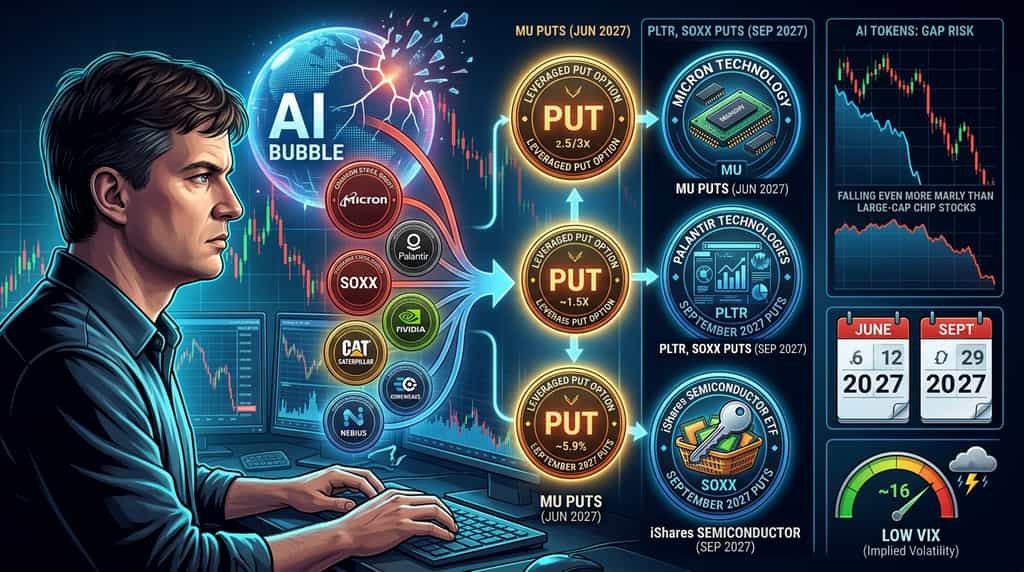
Can a single investor move a multi-trillion-dollar AI trade by swapping stock shorts for cheaper puts? Michael Burry is testing that question. In a late-September 2026 investment newsletter, the investor known for The Big Short said put options had fully replaced his short stock positions, and that he is pulling forward his timeline because he believes the AI bubble may burst sooner than later.
The new structure concentrates leverage on Micron Technology, Palantir Technologies, and the iShares Semiconductor ETF (SOXX), with additional replacements across Nvidia, Nebius, CoreWeave, and Caterpillar. For crypto traders, the shift matters because AI-linked equities and AI tokens often move on the same narrative: unbounded capex, scarce chips, and software that is supposed to monetize that spending.
This article explains what Burry changed, why options replace shorts, what the Micron, Palantir, and SOXX legs imply, and how an equity repricing could transmit into digital assets.
What Did Michael Burry Change in His Latest AI Bubble Trade?
Burry covered his common-stock shorts and replaced them with put options so he could raise leverage on a shorter timeline. According to his late-September 2026 newsletter, puts now stand in for prior short stock positions in Micron, Nebius, Caterpillar, SOXX, CoreWeave, Nvidia, and Palantir.
The replacement is not a quiet hedge. It is a timing call. Burry wrote that he is moving timelines up and that better timing makes leverage more acceptable. Options, in his framing, are the cleanest way to express that view while volatility remains relatively cheap.
The new map of expiries is the most important detail. Micron and Nebius puts are concentrated around a June 2027 expiry. Palantir and SOXX puts are concentrated around September 2027. Caterpillar was shifted into December 2027 puts. That calendar tells readers Burry is no longer waiting for a distant 2028–2029 accounting unwind as his only path to profit. He wants a market that can break earlier.
Some of the repositioning was tax-loss harvesting. Burry said that was not the main driver. The majority, he wrote, followed weekend research that convinced him the AI bubble may burst sooner than later.
That research, as he described it, leans on an Ares Management observation that the current boom assumes sustained AI capital spending and still-unproven revenue conversion. If revenue supporting that capex disappoints for even one quarter, boards can redirect cash. Existing contracts often allow that flexibility.
The trade therefore has two clocks. One is the memory-chip cycle, where supply can catch demand faster than bulls expect. The other is the AI software and infrastructure cycle, where valuations assume years of uninterrupted spending.
Why Did Burry Replace Stock Shorts With Put Options?
Puts give Burry more downside exposure per dollar of capital than a short stock position, and he argues they are inexpensive while the Cboe Volatility Index remains subdued. According to Cboe data, the VIX last sale stood at 16.07 on September 28, 2026, after closing the prior session at 14.87. That is below the index's long-term average near 18.6 and far from crisis readings.
A short stock position requires borrow, pays borrow fees, and has theoretically unlimited loss if the share price rises. A purchased put has a defined premium at risk. If the stock or ETF never falls through the strike by expiry, the put can expire worthless. If it does fall, the put can rise by a multiple of the premium.
Burry made that trade-off explicit. He said nothing expresses leverage like options, and that current volatility measures make puts relatively cheap. Low implied volatility reduces option premiums. That is attractive for a buyer of protection or directional downside.
The strikes also reveal how aggressive the bet is. Micron puts in the $500 range sit far below the share price shown on Micron's investor site around $1,053.98. Palantir puts clustered in the low-to-mid $100s are a multi-year claim that a high-multiple software name can de-rate even if revenue is still growing. SOXX puts in the low $400s target the entire semiconductor complex rather than one ticker.
Leverage cuts both ways. If Micron, Palantir, or SOXX grind higher into those expiries, the premium decays. Time decay accelerates as expiry approaches. That is why Burry's comment about a clearer timeline matters. He is not buying cheap lottery tickets with no view on when the break arrives. He is saying the break may arrive soon enough that paying for options is rational.
For crypto markets, the same volatility backdrop is relevant. When equity implied volatility is low, risk assets often trade as if shocks are distant. AI tokens have historically been more volatile than large-cap chip stocks. A sudden jump in equity volatility can reprice those tokens faster than the underlying companies' fundamentals change.
What Do Micron Puts Reveal About the Memory Cycle?
Burry's Micron puts are a bet that AI-driven memory tightness is cyclical, not permanent, and that prices can fall hard when supply catches up. Micron is not a struggling firm on current reported numbers. It is a company printing record results while a prominent skeptic buys crash insurance against those results.
According to Micron's fiscal third-quarter 2026 release, revenue reached $41.46 billion, compared with $23.86 billion in the prior quarter and $9.30 billion in the same period a year earlier. GAAP net income was $28.24 billion, or $24.67 per diluted share. Operating cash flow was $25.39 billion. Chairman, President, and CEO Sanjay Mehrotra tied the record quarter and a stronger fourth-quarter outlook to the strategic value of memory in the AI era.
The company's own fourth-quarter fiscal 2026 guidance is equally strong on the surface. Micron guided revenue to $50.0 billion, plus or minus $1.0 billion, with non-GAAP diluted earnings per share of $31.00, plus or minus $1.00, and gross margin near 86%. Those figures explain why bulls treat Micron as a core AI infrastructure winner rather than a fading cycle stock.
Burry is not arguing that last quarter's sales were fake. He is arguing that the market is capitalizing a shortage as if it cannot end. Memory has a long history of boom-bust pricing. High prices pull in capacity. Chinese suppliers adding output can compress that cycle. Burry has pointed to comments from Acer CEO Jason Chen that inventories are building and that a continuous shortage is not realistic across the full product stack.
That is why June 2027 expiry on Micron puts is a statement about the next three quarters of supply, pricing, and guidance — not about whether AI servers need HBM forever. If one guidance cut, one inventory digest, or one price war appears, a stock that discounted years of shortage can re-rate quickly.
Micron also signed a strategic agreement with Anthropic covering memory and storage architecture, supply, enterprise adoption, and an investment in Anthropic's Series H round. That deal supports the bull case that frontier labs will keep locking in supply. It also raises the bear case that a handful of large counterparties now dominate demand, so any pause at those counterparties hits Micron with force.
Crypto traders should treat Micron as a proxy for the physical layer of AI. When memory pricing is tight, narratives around compute scarcity lift tokens tied to decentralized GPU markets and AI infrastructure. When memory pricing breaks, those same narratives often deflate, even if on-chain activity has not changed.
What Does a SOXX Put Position Imply for Semiconductors?
A SOXX put is a sector short: it does not require Burry to pick the single chip name that breaks first. SOXX holds a concentrated basket of semiconductor designers, foundry-adjacent names, memory producers, and equipment makers. Recent holdings snapshots show Micron, Nvidia, AMD, Broadcom, and Intel among the largest weights, with Micron often near the top of the book.
That concentration is the point. If AI capex slows, the damage is rarely isolated to one ticker. GPU vendors, HBM suppliers, networking chips, and wafer-fab equipment can fall together. Buying September 2027 SOXX puts in the low $400s is a way to express that cluster risk with one instrument.
Burry also replaced shorts in Nvidia and CoreWeave. Those names sit on the compute and cloud-GPU side of the same chain. The SOXX put then becomes the index overlay. Single-name puts express specific stories. The ETF put expresses the idea that the whole semiconductor complex is priced for an AI cycle that cannot miss.
Nasdaq's own tape shows why that overlay is controversial. According to Nasdaq market activity, the Nasdaq Composite stood at 26,820.38 on September 28, 2026. The index has spent 2026 absorbing repeated bubble warnings while remaining near cycle highs. A short against that backdrop is a statement that leadership has become too narrow, not that every listed company is failing.
Ares Management's public commentary adds a second layer. Ares CEO Michael Arougheti has described hyperscaler capex near $300 billion annualized, still less than 1% of GDP, while arguing that raw compute demand is growing several hundred percent a year and that infrastructure is not keeping up. That is a bullish physical-demand case. Burry is using similar capex facts to reach the opposite market conclusion: spending this large can only persist if revenue shows up, and boards can cut if it does not.
Crypto traders should watch SOXX for correlation, not for copy-trading. When the semiconductor ETF drops on growth-scare headlines, Bitcoin beta to Nasdaq often rises in the short run, and high-beta AI tokens usually gap more than BTC. When SOXX rallies on capex confirmation, those same tokens can squeeze regardless of on-chain usage.
Beyond the Headlines: What KuCoin 5.0 Means for You
Market news moves fast — but where you act on it matters just as much. This October, KuCoin launches KuCoin 5.0, transforming KuCoin into a rebuilt platform. Here's what actually changes for you:
-
One account for everything. Older platforms split your money across separate "spot," "margin," and "futures" accounts and expected you to understand why. KuCoin 5.0's unified account removes that entirely — deposit once, and everything is simply there (only available to VIPs for now).
-
Stocks, indices, and commodities. KuCoin 5.0 expands beyond crypto into global markets. When crypto chops sideways and equities rally (or the reverse), you rotate in minutes instead of opening a brokerage account and waiting days for fiat rails.
-
Real-world assets (RWA). Tokenized exposure to traditional assets like commodities, right inside your crypto account. One of the fastest-growing segments in global finance is no longer reserved for institutions — you access it from the same balance you trade with.
-
Earn while you learn. Not ready to trade? KCUSD lets your stablecoins earn daily, auto-compounding interest. The lowest-stress way to put your idle deposit to work for 4% yield.
-
An AI assistant in plain language. Ask questions, get market context, understand what you're looking at — built into the platform, no jargon required.
-
An app that doesn't overwhelm. Faster, cleaner, and consistent — intuitive from the first tap, not after a tutorial.
-
Safety you can check, not just trust. A MiCAR-licensed EU entity, Proof of Reserves you can verify yourself, and internationally certified security (SOC 2 Type II, ISO 27001:2022).
Create your account in minutes — and start on the platform built for where crypto is going, not where it's been.
Conclusion
Michael Burry has converted a broad AI short book into put options because he now believes the bubble can break sooner, and because low equity volatility makes that leverage cheaper. The Micron June 2027 $500-area puts target a memory cycle that official results still show as historically strong. The enlarged Palantir September 2027 puts target a software multiple that official growth has not yet broken. The SOXX September 2027 puts target the semiconductor complex as a whole.
Those three legs are one thesis with three clocks. Memory can crack first if supply arrives. Software can crack later if multiples compress. The ETF can crack if leadership narrows further and then fails. Official company filings do not currently confirm the bust. They confirm why the bust, if it comes, would shock a market that has been paid to ignore skeptics.
Crypto markets sit downstream of that shock. According to CoinGecko, AI tokens are a few tens of billions of dollars against a nearly $3 trillion digital-asset market and a much larger listed-tech complex. They will not decide whether Burry is right. They will price the story quickly if he is.
Treat the newsletter as a research input, not an instruction. Check expiries, strikes, and official earnings. Then decide whether your book is built for a continued AI bid — or for the first quarter where capex stays high and revenue does not.
FAQs
What is a put option in this trade?
A put option gives the buyer the right to sell a stock or ETF at a set strike before expiry. Burry is using puts so he can profit if Micron, Palantir, or SOXX fall, while limiting his loss to the premium paid.
Does Burry's move mean AI technology is a fraud?
No. His stated issue is timing, valuation, and whether capex will keep being funded if AI revenue disappoints. Strong official results at Micron and Palantir can coexist with a view that prices already discount too much future spending.
Why do June 2027 and September 2027 expiries matter?
Those dates are the market's deadline for his leverage. June 2027 Micron puts need a nearer memory-cycle break. September 2027 Palantir and SOXX puts give more time for a broader de-rating.
How should crypto traders read AI-token market cap during an equity debate?
Use it as a sentiment gauge. According to CoinGecko, the AI category recently clustered near $25 billion. If that basket falls while BTC dominance holds, the market is cutting theme risk rather than abandoning crypto.
Can someone follow this thesis without shorting U.S. stocks?
Yes. Traders can reduce AI-token beta, rotate into Bitcoin or stablecoins, or wait for confirmed earnings misses before adding risk. Copying strikes and expiries is not required to manage exposure to the same narrative.
Disclaimer: This article is for informational purposes only and does not constitute financial, legal, or investment advice. Always conduct your own research before interacting with digital assets.