

Marathon Fusion's Mercury-to-Gold Technology: Could Nuclear Fusion Reshape the Global Gold Supply?
Introduction
What if a future fusion power plant could produce electricity and manufacture gold at the same time? Marathon Fusion is developing a concept that could turn mercury into gold using high-energy neutrons generated by nuclear fusion. The idea could create a valuable byproduct for future fusion facilities, potentially changing their economics and adding a new source of gold to the market. However, the technology remains a proposed process rather than a commercially proven source of precious metals.
According to Marathon Fusion's current technology overview, the process uses mercury-198 in a fusion reactor's neutron-producing environment to generate gold-197, the stable isotope of gold. The company argues that gold production could add substantial revenue to future fusion plants. Whether it could materially affect gold supply depends on engineering feasibility, production costs, regulatory requirements, and the scale at which commercial fusion becomes available.
How Does Marathon Fusion's Mercury-to-Gold Technology Work?
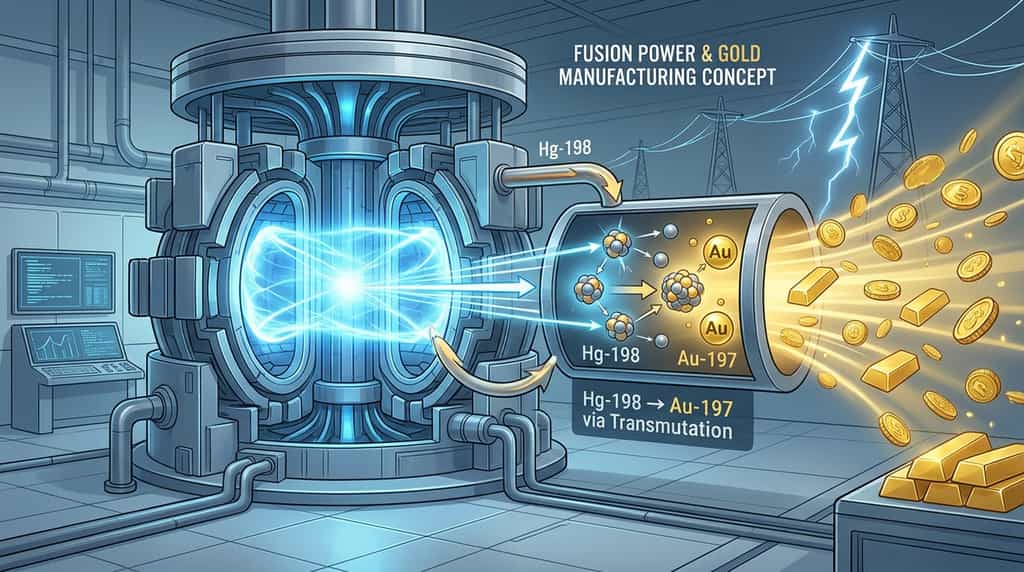
Marathon Fusion's concept uses nuclear transmutation to turn a specific isotope of mercury into gold, using neutrons produced by a deuterium-tritium fusion reaction. Unlike chemical processes, which rearrange atoms without changing their nuclei, nuclear transmutation changes an atom's nuclear composition to create a different element.
In a deuterium-tritium fusion reaction, two hydrogen isotopes combine and release energy, including a high-energy neutron. Marathon Fusion proposes using these neutrons to irradiate mercury-198, a stable isotope of mercury. Through a nuclear reaction known as an (n, 2n) reaction, mercury-198 can become mercury-197. Mercury-197 is unstable and subsequently decays into gold-197.
The proposed process is described in the American Physical Society's conference abstract on scalable gold production, which identifies fast neutrons from a deuterium-tritium fusion plasma as the energy source for the reaction pathway. The research outlines a reactor-blanket configuration intended to produce gold while also contributing to neutron multiplication, an important function in fusion fuel-cycle design.
How Much Gold Could Marathon Fusion Produce?
Marathon Fusion's modeling suggests that a future fusion plant could generate thousands of kilograms of gold annually, but these figures are projections rather than verified commercial production results. The company's gold-production overview describes the potential for large-scale gold production and estimates that the additional product could substantially increase a plant's annual revenue.
The scientific concept presented by Marathon Fusion's researchers at the American Physical Society's 2025 Division of Plasma Physics meeting estimated production of approximately two metric tons of gold-197 per gigawatt of thermal fusion power per year for a modeled reactor configuration. This is a simulation-based result, not a record of gold produced by an operating commercial fusion plant. Thermal power also differs from electrical output, so production estimates must be compared using consistent reactor-capacity assumptions.
The distinction matters because commercial gold supply depends on actual output, not theoretical reactor performance. A model may demonstrate that a nuclear pathway is physically plausible while leaving substantial engineering and economic questions unresolved. Reactor availability, operating conditions, isotope enrichment, material extraction, and purification could all affect the amount of saleable gold produced.
Could Artificial Gold Disrupt the Global Gold Supply?
Marathon Fusion's technology could eventually add a new source of gold, but a meaningful disruption to global supply would require multiple commercial facilities producing large quantities of saleable metal. A promising laboratory concept or computer simulation alone would not be enough to transform the precious-metals market.
Gold supply currently comes primarily from mining and recycling. A fusion-based source would introduce a different production pathway, with output tied to the deployment and operation of fusion power plants rather than the discovery and development of mineral deposits. If the technology became commercially viable, it could diversify the sources of gold available to manufacturers, investors, and other buyers.
However, market impact would depend on the quantity actually delivered to buyers. Even a technically successful process might initially contribute only a limited amount if few commercial fusion plants operate or if gold recovery is expensive. Conversely, if many plants eventually adopted the process and achieved high output, the additional supply could become more significant over time.
Would More Gold Production Automatically Push Prices Lower?
No. An increase in potential supply does not automatically translate into a lasting decline in gold prices. Market prices reflect demand as well as supply, including purchases by investors, central banks, jewelry manufacturers, and industrial users. Changes in interest-rate expectations, currency movements, economic uncertainty, and investment demand can also affect the market.
The timing and scale of new production would be crucial. If fusion-derived gold entered the market gradually while demand remained strong, the effect on prices might be limited. If output expanded rapidly and materially exceeded additional demand, the added supply could place downward pressure on prices, all else being equal.
Product characteristics would also matter. Buyers would need confidence that the gold meets relevant purity, safety, traceability, and regulatory standards. A new production route would need to establish reliable quality and a transparent chain of custody before becoming a mainstream source for jewelry, investment products, or industrial applications.
For now, it is more accurate to describe Marathon Fusion's concept as a potential future supply source than as an imminent threat to mined gold. Commercial adoption, rather than the theoretical ability to produce gold, will determine whether the technology meaningfully changes market supply.
How Could Mercury-to-Gold Technology Affect Gold Investors?
For gold investors, Marathon Fusion's concept is a long-term technological development to monitor, not a standalone signal for buying or selling gold. Its eventual market impact will depend on verified production, commercial deployment, and the amount of additional supply that reaches the market relative to global demand.
Investors following the story should distinguish between three milestones: technical feasibility, commercial viability, and meaningful market penetration. Technical feasibility means the proposed nuclear reaction can be achieved under relevant conditions. Commercial viability means it can be operated safely and economically. Market penetration means enough facilities produce and sell gold for the new source to influence supply dynamics.
Each milestone requires different evidence. Research results can support technical plausibility, but pilot-scale testing and independent engineering assessments would provide stronger evidence of practical performance. Commercial contracts, operating facilities, and disclosed production figures would be more relevant to estimating future market supply than theoretical production capacity alone.
Gold prices are also affected by factors unrelated to production technology, including investment demand, monetary policy, and broader economic conditions. Even if fusion-derived gold becomes viable, its price impact could take years to emerge and may vary as demand and other sources of supply change. Investors should therefore assess the technology in the context of the wider gold market rather than assuming that the prospect of manufactured gold determines future prices.
Join KuCoin's Futures Trading Competition
Looking to put your market analysis and trading skills to the test? Join the KuCoin Futures Trading Competition and explore an opportunity to compete with other traders.

Whether you are tracking AI-related stocks like Micron or following broader market trends, disciplined risk management remains essential when trading volatile assets. Before participating, review the competition rules, eligibility requirements, reward details, and trading conditions on the official event page. Futures trading involves substantial risk and may not be suitable for every trader.
Conclusion
Marathon Fusion's mercury-to-gold concept offers a compelling example of how future nuclear fusion systems could potentially generate valuable materials alongside electricity. By using high-energy neutrons to convert mercury-198 through a nuclear reaction pathway into gold-197, the proposed process aims to create an additional revenue stream while contributing to the neutron-multiplication requirements of fusion fuel systems.
The concept could eventually diversify gold supply and improve the economics of fusion power plants. However, the production estimates currently available are based on modeled reactor configurations, not verified output from commercial facilities. Reactor integration, isotope processing, radiation management, operating costs, and regulatory approval all remain important considerations in determining whether the approach can become commercially viable.
For the global gold market, the decisive question is not whether nuclear reactions can produce gold, but whether the process can deliver substantial quantities of safe, saleable metal at competitive costs. Even if commercial production becomes feasible, its effect on gold prices will depend on the pace of deployment, the amount of additional supply, and the strength of global demand. Until these factors are demonstrated, Marathon Fusion's technology is best viewed as a potentially important long-term development rather than an immediate disruption to the precious-metals market.
FAQs
1. What is Marathon Fusion's mercury-to-gold technology?
It is a proposed nuclear-transmutation process that uses high-energy neutrons from a fusion reaction to convert mercury-198 through an unstable intermediate into gold-197. The concept is intended to produce gold as a byproduct of future fusion power generation.
2. Is Marathon Fusion already producing commercial gold?
The company's public materials describe a proposed production method and modeled output. These estimates do not establish that commercial fusion facilities are already manufacturing and selling gold at the projected scale.
3. Is fusion-produced gold chemically different from mined gold?
Gold-197 is the stable isotope of gold, so properly purified gold-197 has the same elemental identity regardless of how it was produced. However, material from a nuclear process must be assessed for isotopic impurities, radioactive contaminants, and purity before it can be considered suitable for commercial use.
4. Could mercury-to-gold technology make gold much cheaper?
It could add supply if commercial production becomes economically viable and expands substantially. Whether prices decline would depend on actual output, production costs, market demand, and other factors affecting the global gold market.
5. What is the biggest obstacle to commercial fusion-derived gold?
The central challenge is proving that the process can be integrated into a practical fusion facility and deliver safe, saleable gold at a competitive cost. Reactor performance, isotope processing, material handling, and regulatory requirements will all affect commercial feasibility.
Disclaimer: This article is for informational purposes only and does not constitute financial, legal, or investment advice. Always conduct your own research before interacting with digital assets.