

LME Copper Inventories Fall for 42 Straight Sessions, Longest Streak Since 2014
2026/08/18 11:13:00
Copper Market Tightens Sharply as U.S. Tariff Fears and China Demand Drain Global Stocks
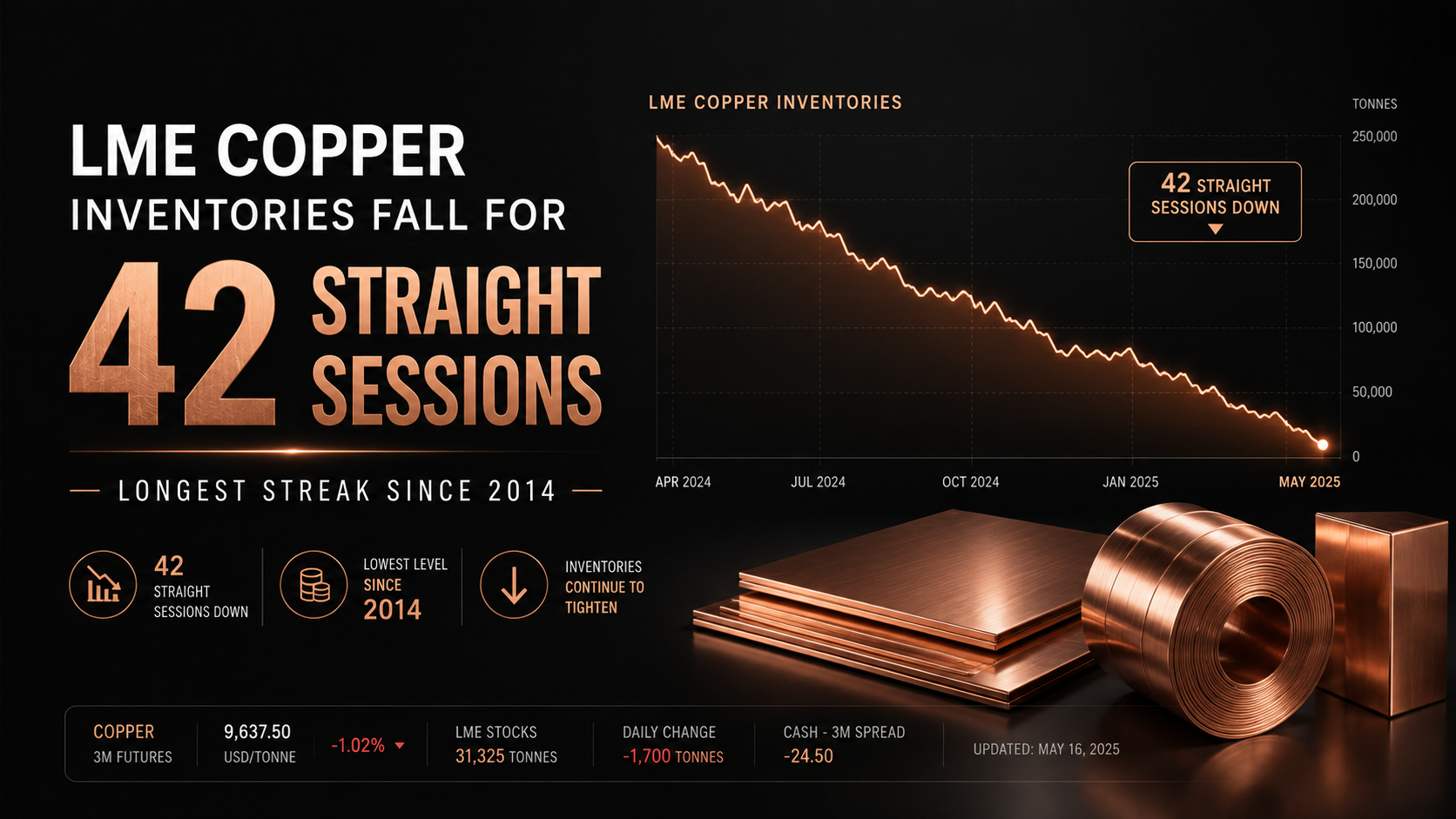
Copper markets are registering one of their sharpest inventory contractions in more than a decade. London Metal Exchange warehouse stocks of the red metal have declined for 42 consecutive trading sessions, the longest uninterrupted streak since early 2014, falling to approximately 204,975 tonnes. Nearly half of the remaining metal has already been earmarked for withdrawal. This sustained drain has produced the widest cash-to-three-month backwardation since the 2021 squeeze, with prompt premiums reaching $434 a tonne and cash prices trading near record levels around $14,500 a tonne.
The move reflects heavy shipments into the United States ahead of potential refined-copper tariffs and continued flows into China, where prices have commanded premiums over LME levels. The current inventory collapse is reshaping near-term price discovery, amplifying physical tightness signals, and forcing traders holding short positions into increasingly competitive bidding for scarce prompt metal, with clear implications for industrial consumers and speculative positioning across major exchanges.
Record US Imports Drain LME Stocks Toward Five-Year Lows
United States importers took in more than 200,000 tonnes of refined copper in July 2026, the largest monthly volume in at least 12 years. Combined with metal already held in Comex warehouses, LME-registered stock, and private port storage, total US copper inventories have pushed past one million tonnes. This accumulation has been driven almost entirely by positioning ahead of a proposed 15 percent tariff on refined copper imports scheduled to begin in January 2027 and rise to 30 percent in 2028. The Commerce Department recommendation process remains unresolved, yet the anticipatory flow of metal into American warehouses has steadily emptied LME sheds elsewhere.
LME stocks have fallen from levels above 400,000 tonnes in mid-May to just 204,975 tonnes, with cancelled warrants representing nearly 50 percent of the residual inventory. Cash copper has responded by trading at a $434-a-tonne premium to the three-month contract, the widest gap since the 2021 squeeze that required exchange intervention. Prompt prices have approached $14,500 per tonne as buyers scramble for immediate delivery. The scale of the US stockpile build effectively locks a large volume of metal out of the global float available to the rest of the world, tightening conditions on the LME and reinforcing the backwardation structure that signals acute near-term scarcity.
Uncertain Tariffs Accelerate Copper Stock Relocation and Physical Market Tightness
Market participants note that the tariff timeline itself remains uncertain, with some assessments placing the probability of the proposed 15 percent duty landing on the original schedule at well below 20 percent. Even so, the physical relocation of copper has already occurred. Traders and producers have redirected shipments westward, reducing the buffer that LME warehouses traditionally provide as a last-resort source of supply. This redistribution has left available on-warrant stocks at critically low levels relative to open interest and physical demand.
The result is a market in which holders of short futures positions face mounting pressure to secure metal before contracts expire, elevating the risk of further price spikes in the cash market. Industrial users in Europe and Asia are already encountering higher premiums for prompt delivery, while the overall price curve reflects the structural shift in inventory location rather than any sudden change in global mine supply.
Cash Premiums Reach Five-Year Extremes Amid Prompt Scarcity
The cash-to-three-month copper spread on the LME has widened to $434 a tonne, matching levels last seen during the 2021 squeeze. Front-month premiums over September contracts have also climbed above $370 a tonne on peak days, underscoring the intensity of demand for immediate metal. These spreads function as a real-time indicator of physical tightness: when nearby contracts trade at substantial premiums to deferred ones, the market is signaling that available inventory is insufficient relative to near-term consumption and contractual obligations. With nearly half of the remaining 204,975 tonnes already cancelled for withdrawal, the effective free float is considerably smaller.
Short position holders must therefore compete aggressively to obtain warrants or physical delivery, creating the conditions for a self-reinforcing bidding process. Cash prices have traded near $14,500 a tonne, and, on some sessions, cash settlements have approached or exceeded previous records. The three-month contract itself has remained elevated, trading above $14,100 a tonne and posting year-to-date gains of roughly 14 percent.
Shrinking LME Inventories Intensify Physical Copper Tightness
This configuration differs from a simple speculative rally because the price structure is being driven by verifiable inventory movements rather than purely financial flows. Warehouse metal serves as the ultimate delivery mechanism for expiring futures; when that pool shrinks quickly, the cost of securing physical settlement rises. Analysts tracking the market observe that the current backwardation has already forced some participants to adjust positions earlier than planned. The combination of cancelled warrants and continued outflows has reduced the buffer that previously absorbed short-covering demand.
As a result, each successive session of inventory decline has amplified the premium for prompt metal. Consumers reliant on LME pricing for procurement contracts face higher effective costs, while producers and traders able to deliver into the cash market capture elevated returns. The persistence of these spreads over multiple weeks indicates that the tightness is structural rather than transitory, rooted in the ongoing redirection of metal toward higher-priced regions.
Global Exchange Stocks Show Sharp Regional Divergence
While LME inventories have collapsed, Comex-registered copper stocks have surged to approximately 667,000 metric tonnes, representing an increase of nearly 700 percent since tariff proposals first gained traction. Shanghai Futures Exchange stocks have also trended lower, contributing to a combined LME and SHFE total that now accounts for less than 30 percent of the three-exchange aggregate. Overall monitored stocks across LME, SHFE, and Comex have declined for multiple consecutive weeks, yet the composition has shifted dramatically toward the United States. This regional imbalance means the apparent global inventory figure overstates the metal available for delivery outside North America. Traders monitoring the three exchanges note that the metal “locked” in US warehouses is effectively removed from the international float, leaving European and Asian markets to compete for a much smaller pool.
The divergence has practical consequences for arbitrage and logistics. Copper that moves into Comex warehouses or private US storage is no longer readily available to settle LME contracts or meet Chinese physical demand without additional transportation costs and time delays. Premiums in China have remained elevated relative to LME, encouraging further eastward shipments even as the US absorbs record volumes. The net effect is a simultaneous drawdown on both sides of the Atlantic and Pacific while North American stocks accumulate. This pattern has accelerated the LME decline and sustained the longest continuous inventory reduction streak since 2014. Market participants tracking cancelled warrants on the LME report that the high cancellation rate implies further outflows in coming sessions unless new metal is delivered into the system at a sufficient pace. So far, deliveries have been modest relative to the rate of withdrawals, leaving the available balance under continued pressure.
Chilean Production Outlook Adds Supply-Side Pressure
Chile’s copper commission has projected a 2.6 percent year-on-year decline in national output to 5.3 million tonnes for 2026, citing weaker performance at Codelco and certain BHP operations. As the world’s largest copper producer, any sustained reduction in Chilean supply removes a meaningful volume from the global market at a time when inventories are already contracting rapidly. The forecast compounds the effect of inventory relocation by limiting the rate at which new refined metal can replenish warehouse stocks. Mine-level disruptions and lower grades have constrained output growth in recent years, and the latest guidance suggests the constraint will persist through the current calendar year. Traders factoring production data into price models note that the combination of reduced Chilean supply and accelerated warehouse withdrawals leaves little margin for unexpected demand strength or further logistical bottlenecks.
The production shortfall is particularly relevant because refined copper is the form that enters LME and Comex warehouses. Concentrate shipments and smelting capacity further downstream can also influence refined availability, yet the immediate impact on exchange stocks depends on refined output. When a major producer signals lower volumes, the market anticipates tighter refined balances later in the year. This expectation supports the current premium structure and encourages inventory holders to retain metal rather than deliver it into the exchange system. Industrial consumers in construction, power transmission, and electric-vehicle supply chains must therefore secure longer-term contracts at elevated prices or risk exposure to further cash-market spikes. The Chilean outlook reinforces the view that the current inventory draw is occurring against a backdrop of constrained primary supply rather than pure demand destruction.
Chinese Demand Continues to Absorb Metal Despite Domestic Inventory Trends
China remains a key destination for copper flows even as local exchange stocks have declined. Smelters have faced tighter concentrate feedstock after export restrictions in the Democratic Republic of Congo, supporting demand for refined imports. Physical premiums in Chinese markets have stayed elevated relative to LME prices for extended periods, creating a consistent arbitrage incentive for traders to ship metal eastward. The combination of industrial consumption in power infrastructure and manufacturing, together with the need to replace constrained concentrate supplies, has sustained import interest. Although official Chinese bonded-warehouse data can lag, market reports indicate that the draw on LME stocks has been partly directed toward meeting this demand.
The Chinese contribution to the LME drawdown is distinct from the US tariff-driven accumulation. Metal moving to China typically enters the physical manufacturing chain rather than remaining in speculative storage. This distinction means the metal is less likely to return quickly to LME warehouses if conditions change. As a result, the inventory reduction is more durable than a pure repositioning trade. Analysts following Asian physical markets observe that the sustained premium structure has encouraged consistent deliveries out of LME Asian warehouses, accelerating the overall decline. With LME Asian stocks accounting for a substantial portion of earlier reductions, the Chinese demand channel has played a measurable role in extending the 42-session streak. The interaction between Chinese physical requirements and US tariff positioning has therefore created a dual drain that has proven difficult for the exchange system to replenish in the short term.
Speculative Positioning Supports Elevated Price Levels
Money managers have increased net long positions in Comex copper to levels not seen since early 2021, adding more than 3,000 lots in recent reporting periods to reach approximately 80,880 lots. This positioning reflects confidence that the inventory tightness and tariff uncertainty will continue to support prices. Speculative flows have amplified the price response to the physical drawdown, helping push three-month LME copper above $14,100 a tonne and supporting cash prices near record territory. The alignment of financial positioning with genuine physical scarcity has produced a more durable rally than pure speculative episodes. Year-to-date gains of roughly 14 to 16 percent place copper among the stronger performers in the base-metals complex.
The risk embedded in this positioning is that any unexpected resolution of tariff uncertainty or sudden large deliveries into LME warehouses could trigger rapid unwinding. For the moment, however, the inventory data and cancelled-warrant ratios provide fundamental justification for the long bias. Traders monitoring commitments-of-traders reports note that the increase in net longs has occurred alongside the inventory decline rather than in isolation, reducing the likelihood that the rally is purely technical. The interaction between speculative demand and physical scarcity has therefore reinforced the backwardation and elevated the cost of maintaining short positions. Industrial hedgers and producers must now navigate a market in which both physical and financial participants are competing for limited near-term supply.
Historical Context Highlights the Rarity of a 42-Session Streak
Continuous inventory declines lasting 42 sessions are rare in LME copper history. The last comparable streak occurred in early 2014. Most drawdowns reverse within a few weeks once price incentives attract new metal into the warehouse network. The current episode has persisted because the price signals that normally pull metal back into LME sheds are competing against stronger incentives in the United States and China. The mid-May peak above 400,000 tonnes has been roughly halved in under three months, a pace that ranks among the faster multi-week reductions on record. Cancelled warrants remaining near 50 percent of total stocks indicate that the process is not yet exhausted.
Comparisons with the 2021 squeeze are instructive. That episode also featured extreme backwardation and required exchange intervention to manage delivery pressures. The present situation shares the same inventory-driven character, yet the underlying cause is a deliberate geographic reallocation rather than a sudden production shock or speculative corner. The absence of a comparable intervention so far suggests the LME views the move as orderly, albeit extreme. Market participants tracking historical warehouse data note that stocks at current levels still sit well above the absolute lows recorded in prior cycles, yet the speed of the decline and the high cancellation ratio create conditions that can escalate quickly if outflows continue. The rarity of a 42-session streak therefore serves as a caution that mean-reversion assumptions based on shorter historical episodes may not apply until the tariff and Chinese demand drivers moderate.
Industrial Consumers Face Rising Procurement Costs
Power utilities, construction firms, and manufacturers of electrical equipment are encountering higher effective prices for prompt copper. The cash premium of more than $400 a tonne adds a meaningful increment to the already elevated three-month benchmark. Contracts priced against LME cash or nearby futures now embed this tightness premium, raising input costs for projects that cannot easily substitute alternative materials. Electric-vehicle and renewable-energy supply chains, which rely heavily on copper for wiring and components, are particularly exposed. Procurement managers report that securing physical metal for near-term delivery requires either paying the full cash premium or accepting longer lead times from non-exchange sources.
The cost impact extends beyond spot purchases. Many industrial users hedge with futures; when the curve is steeply backwardated, rolling short-dated hedges becomes more expensive. The combination of higher outright prices and steeper near-term premiums has therefore increased both the absolute and the relative cost of copper exposure. Some consumers have responded by accelerating purchases to lock in supply before further inventory declines, which itself contributes to the demand pressure on remaining stocks. Others have sought longer-term fixed-price contracts with producers, shifting risk onto the supply side. The net result is a market in which physical tightness is transmitted directly into industrial cost structures rather than remaining confined to speculative trading accounts.
Potential Catalysts for Inventory Stabilization Remain Limited
Several factors could eventually slow or reverse the drawdown: a clear decision against the proposed US tariffs, a sudden surge in deliveries into LME warehouses, or a meaningful softening of Chinese physical premiums. At present, none of these appears imminent. Tariff uncertainty continues to favor accumulation in the United States, Chinese premiums remain supportive of eastward flows, and new deliveries into the LME system have been insufficient to offset cancellations. Analysts note that the high ratio of cancelled warrants implies further outflows are already scheduled. Until the volume of metal earmarked for withdrawal declines and fresh warrants are created at a higher rate, the inventory trajectory is likely to remain downward.
The absence of an immediate stabilizing catalyst keeps the risk of further price spikes elevated. Short-covering demand could intensify if open interest in nearby contracts remains large relative to available warrants. Conversely, any large unexpected delivery could ease the cash premium and allow the curve to flatten. Market participants are therefore monitoring daily LME stock reports and cancellation data with heightened attention. The current configuration leaves limited room for complacency; each additional session of decline extends the historical streak and further reduces the free float available for delivery.
Price Forecasts Reflect Upside Risks from Continued Tightness
Research houses have raised average-price forecasts for 2026 in response to the inventory developments. One recent revision lifted the full-year average toward $13,500 a tonne from a previous $12,700, citing strong upside risks if the drawdown persists. Spot prices trading near $14,500 already exceed many earlier full-year averages, illustrating how rapidly the physical tightness has altered the price outlook. The combination of constrained Chilean production, dual regional demand drains, and elevated speculative positioning supports the case for further upside if stocks continue to fall.
These forecast adjustments are grounded in observable warehouse data rather than speculative narratives. The 42-session decline and the 50 percent cancellation rate provide concrete evidence of scarcity that models can incorporate. At the same time, the elevated US stockpile creates a potential overhang should tariff policy shift. Forecast ranges therefore embed both the near-term tightness and the medium-term uncertainty surrounding policy. Traders and industrial users must weigh these competing forces when setting procurement and hedging strategies. The current price environment rewards those who can secure physical metal promptly while penalizing those reliant on deferred delivery at lower levels.
Patterns for Base-Metal Complex and Broader Commodity Markets
The copper inventory collapse is occurring alongside inventory declines in other LME metals, though copper’s 42-session streak stands out for its duration. Aluminum and zinc have also experienced notable drawdowns, contributing to a broader sense of tightness across the base-metals complex. Copper’s status as a leading indicator of industrial activity means its price and inventory signals receive particular attention from macro investors. The current episode reinforces the view that physical markets can tighten quickly even when global production appears adequate, simply because metal is relocated rather than consumed.
Broader commodity markets are watching the copper situation for clues about trade-policy effects on inventory distribution. The US accumulation of copper mirrors patterns seen in other strategic materials when tariff or quota risks emerge. The copper experience demonstrates how quickly exchange stocks can migrate and how those migrations can reshape price curves on the originating exchange. For investors in diversified commodity portfolios, the lesson is that regional policy uncertainty can create localized scarcity even in the presence of ample global stocks. Copper’s current configuration offers a live case study of that dynamic.
Market Structure Risks Intensify for Short Positions
Holders of short futures positions face an increasingly difficult environment. With available LME metal declining and nearly half already cancelled, the volume that can be delivered against expiring contracts is constrained. This raises the probability that shorts will be forced to bid aggressively in the cash market or roll positions at unfavorable spreads. The 2021 squeeze demonstrated how quickly such conditions can escalate into disorderly price moves. Although the LME has not yet intervened, the combination of low free float and high cancellation rates keeps that risk elevated.
Risk-management practices are adapting accordingly. Some participants are reducing short exposure in nearby contracts or securing physical inventory in advance. Others are monitoring daily stock and warrant data more closely than usual. The market structure itself has shifted: warehouse metal is no longer a reliable buffer that can absorb large short-covering flows without significant price impact. Until inventories stabilize or the cancellation ratio falls, and the asymmetry between long and short positions will favor those holding or able to deliver physical metal.
FAQs
What exactly does a 42-session inventory decline mean for copper availability?
A continuous 42-session decline means that every trading day for more than eight weeks LME copper stocks have registered a net reduction. The total has fallen from above 400,000 tonnes in mid-May to roughly 205,000 tonnes, with nearly half of the residual already cancelled for withdrawal. This leaves a much smaller free float available for prompt delivery against futures contracts or physical offtake. The duration is the longest since 2014 and indicates that the rate of metal leaving the warehouse system has consistently exceeded the rate of new deliveries.
Why are US copper imports at 12-year highs while LME stocks fall?
US importers brought in more than 200,000 tonnes of refined copper in July, the largest monthly volume in at least 12 years, because market participants are positioning ahead of possible tariffs on refined imports. The proposed duties would begin at 15 percent in 2027 and rise later. Metal is therefore being stockpiled inside the United States, pushing total US inventories past one million tonnes. That metal is no longer available to LME warehouses, producing the observed drawdown on the London exchange.
How wide is the current copper backwardation, and why does it matter?
Cash copper has traded at a premium of approximately $434 a tonne over the three-month contract, the widest since the 2021 squeeze. Front-month premiums have also exceeded $370 a tonne. Backwardation signals that immediate physical supply is scarce relative to demand. It raises the cost of securing prompt metal for industrial users and forces short futures holders to compete for limited warrants, increasing the risk of further price spikes in the cash market.
What portion of remaining LME copper is already earmarked for withdrawal?
Nearly 50 percent of the approximately 205,000 tonnes still in LME warehouses has been cancelled, meaning it is scheduled to leave the system. Cancelled warrants are a leading indicator of further inventory declines. High cancellation ratios reduce the free float available for delivery and intensify competition among buyers needing prompt metal.
How does Chilean production guidance affect the inventory situation?
Chile’s copper commission expects national output to fall 2.6 percent year-on-year to 5.3 million tonnes in 2026 because of weaker performance at major operations. Lower primary production limits the volume of new refined metal that can replenish warehouse stocks at a time when existing inventories are already declining rapidly, reinforcing the tightness already visible in the price structure.
Are Chinese demand and US tariff positioning both contributing to the LME draw?
Yes. Metal is flowing both to the United States for tariff-related stockpiling and to China, where physical premiums have remained elevated, and concentrate feedstock has been constrained. The dual destinations have accelerated the reduction in LME stocks beyond what either factor alone would have produced.
🔥 KuCoin Offers A More Stable Option in A Volatile Market
If you worry about the frequent ups and downs in the market, and pursue a more stable option to earn money passively, KuCoin is the right place to come:

Simple Earn: Deposit and withdraw tokens anytime, earning stable returns.
Kucoin Earn: Earn stable profits with professional asset management.
Hold to Earn: Earn rewards by holding assets in Funding, Trading, Margin, Futures, Mining, and Unified Accounts.
Staking: Unlock the earning potential of on-chain assets.
Advanced Investments: Advanced Investments offer a variety of structured products to help your money grow in any market.
Shark Fin: Principal Protection and Guaranteed Gains
Dual Investment: Buy low and sell high with transparent return calculations.
Snowball: High yields, with price protection.
Discount Buy: Buy crypto at discount prices.
KCS Loyalty: Level up to enjoy exclusive perks by staking ≥ 1 KCS.
KuCoin Wealth: Discover future value and begin your smart investing journey.
KCS Benefits: Hold and stake KCS to access benefits across the platform.
KCS Staking 2.0: Participate in KCS on-chain governance to earn yield.
Disclaimer: This content is for informational purposes only and does not constitute investment advice. Cryptocurrency investments carry risk. Please do your own research (DYOR).