

Lighter Could Be the Top Beneficiary If the CLARITY Act Passes: Here’s Why
Introduction
The CLARITY Act, formally the Digital Asset Market Clarity Act, stands on the verge of reshaping U.S. crypto regulation as of July 2026. Senate negotiators released updated text on July 22, 2026, incorporating ethics provisions with a 2029 sunset while preserving core market-structure reforms.
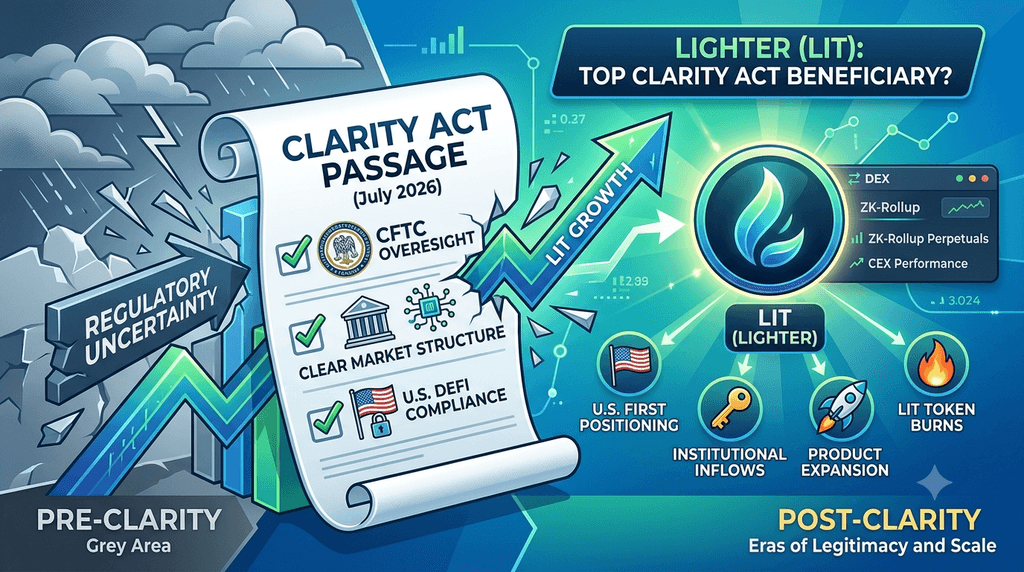
Lighter, a U.S.-registered perpetuals DEX built as a custom ZK-rollup on Ethereum, positions itself uniquely to capitalize on this legislation. Eric Conner, former Ethereum core developer and angel investor, stated on July 22, 2026, that Lighter could become the biggest winner if the bill passes, citing its domestic incorporation, ongoing CFTC license application, and founder’s role on the CFTC Innovation Advisory Committee.
Lighter benefits directly from regulatory clarity that favors compliant U.S. entities pursuing derivatives oversight. Most competing perpetuals platforms operate offshore with limited U.S. exposure, while Lighter has built its strategy around domestic compliance and institutional-grade infrastructure.
What Is the CLARITY Act and Why Does It Matter in 2026?
The CLARITY Act establishes clear jurisdictional lines between the SEC and CFTC for digital assets. It assigns most digital commodities, including many tokens and derivatives, primarily to the CFTC while maintaining SEC authority over investment contracts.
Key provisions as of the July 22, 2026 draft include:
-
CFTC oversight for spot markets in digital commodities.
-
Protections for non-custodial developers and self-custody rights.
-
Customer asset bankruptcy safeguards, addressing issues seen in prior platform failures.
-
Registration requirements for digital commodity exchanges, brokers, and dealers.
-
Ethics rules barring officials from issuing or sponsoring digital assets (with a 2029 sunset).
Passage would reduce regulatory uncertainty that has driven innovation offshore. According to recent analyses, the bill could unlock institutional capital and provide legal certainty for U.S.-based platforms. Senate momentum has strengthened, with negotiators describing it as “almost there” and on the “1-yard line” ahead of the August recess.
For derivatives-focused platforms like Lighter, CFTC clarity is particularly transformative. Perpetual futures fall squarely under CFTC purview, and the bill streamlines compliance pathways while closing loopholes that previously favored unregulated offshore entities.
Lighter’s Unique U.S.-First Positioning
Lighter operates as a decentralized perpetuals exchange with verifiable order matching and liquidations via custom ZK circuits settled on Ethereum. It delivers zero fees for retail traders while charging competitive rates to market makers and high-frequency participants.
Lighter’s strategic decisions align precisely with CLARITY Act incentives. Unlike many DeFi projects incorporated offshore, Lighter registered as a U.S. C-corp. It is actively pursuing a CFTC license for on-chain derivatives trading, and founder Vladimir Novakovski joined the CFTC Innovation Advisory Committee in July 2026.
This positioning provides multiple advantages:
-
Direct engagement with regulators through advisory roles.
-
Ability to list and offer U.S.-compliant products post-CLARITY.
-
Credibility with institutions seeking regulated on-chain derivatives exposure.
Lighter’s infrastructure supports high performance — processing hundreds of millions of orders daily — while maintaining provable correctness on Ethereum. This hybrid approach appeals to both retail and institutional users once regulatory barriers ease.
How CLARITY Act Passage Unlocks Lighter’s Growth Potential
CFTC clarity would accelerate Lighter’s licensing and product expansion. The bill clarifies rules for digital commodity exchanges and derivatives, reducing enforcement risks that currently deter U.S. users and capital. Lighter’s preemptive compliance efforts position it to capture market share quickly.
Key benefits include:
-
Institutional inflows: Clear CFTC jurisdiction enables asset managers and TradFi participants to engage with on-chain perps more confidently.
-
Developer and ecosystem protections: Safe harbors for non-custodial protocols support Lighter’s ZK-rollup model and future expansions like spot trading and tokenized assets.
-
Customer protections: Bankruptcy rules ensuring user assets remain segregated strengthen trust in platforms like Lighter.
-
Competitive moat: Offshore competitors face higher barriers to U.S. market entry, while Lighter’s domestic status and regulatory relationships provide an edge.
Lighter already integrates with Robinhood Wallet (launched July 2026), offering perps trading and tokenized assets with USDG collateral. This retail distribution channel, combined with regulatory clarity, could drive significant volume growth.
Recent tokenomics updates reinforce sustainability: revenue-funded buybacks now result in permanent burns, with the first burn removing over 15.6 million LIT (about 6.3% of supply) in July 2026. Staking provides access to liquidity pools and yields.
Addressing Common Misconceptions About Lighter and Regulation
Some observers assume all DeFi perpetuals platforms operate similarly in a regulatory gray area. However, Lighter’s deliberate U.S. focus and CFTC engagement differentiate it substantially.
Lighter does not rely on regulatory arbitrage. Its architecture supports compliance features like verifiable matching, which aligns well with potential CFTC position limits, risk controls, and reporting requirements once formalized.
Another misconception is that CLARITY primarily benefits centralized exchanges. In reality, the bill includes DeFi carve-outs and developer protections, favoring sophisticated, compliant decentralized platforms like Lighter that can demonstrate robust risk management and transparency.
Risks and Challenges Even If CLARITY Passes
Regulatory implementation timelines matter. Even with passage, full rulemaking could take 360+ days, creating a transitional period where early movers like Lighter gain advantages but must navigate details.
Market competition remains intense from both DeFi rivals and potential TradFi entrants. Lighter’s success depends on continued execution, liquidity growth, and maintaining its performance edge.
Token unlocks beginning in late 2026 (team and investor portions) could introduce selling pressure, though burns and utility mechanisms aim to counterbalance this.
Broader crypto market conditions and geopolitical factors also influence outcomes, as seen in recent volatility.
Conclusion
The CLARITY Act represents a pivotal shift toward coherent U.S. crypto regulation, with CFTC oversight for commodities and derivatives creating clear winners among compliant domestic platforms. Lighter stands out due to its U.S. incorporation, active CFTC engagement, founder’s advisory role, and advanced ZK infrastructure tailored for high-performance, verifiable trading.
As of July 22, 2026, with updated bill text circulating and momentum building toward a potential Senate vote, Lighter’s strategic positioning could translate into substantial growth in volume, institutional adoption, and token value if the legislation advances. Its Robinhood integration further amplifies retail reach, while token burns enhance supply dynamics.
While risks around implementation timelines, competition, and unlocks exist, Lighter’s proactive compliance approach provides a structural advantage in a post-CLARITY environment. For traders and investors seeking exposure to the intersection of DeFi innovation and regulatory clarity, Lighter emerges as one of the best-positioned beneficiaries in the perpetuals and broader derivatives space.
The coming weeks will prove decisive as lawmakers race toward the August recess. Platforms that prepared for clarity — like Lighter — are poised to thrive as the U.S. crypto market enters a new era of legitimacy and scale.
FAQs
What exactly is Lighter?
Lighter is a zero-fee (for retail) perpetuals DEX built as a custom ZK-rollup on Ethereum, offering verifiable order matching, liquidations, and CEX-level performance.
Does the CLARITY Act directly mention Lighter?
No, but its provisions on CFTC jurisdiction, exchange registration, and developer protections align strongly with Lighter’s U.S.-compliance strategy, as noted by industry observers.
When might the CLARITY Act pass?
Senate action is targeted before the August 2026 recess, though exact timing depends on final negotiations and vote thresholds.
How does Lighter’s token (LIT) benefit from burns?
Revenue from trading fees funds buybacks that are now permanently burned, reducing supply; the first major burn removed over 15 million LIT in July 2026.